
Next-Generation Surgical Tools in the Body
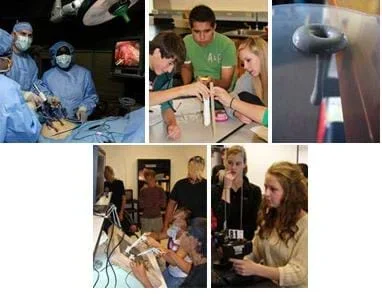 Students learn about human anatomy and physiology, and the mechanics of biomaterials before designing their own laparoscopic surgical robots and testing them in a synthetic abdominal cavity simulator.
At the beginning of the unit, as part of lesson 1, introduce the culminating engineering design challenge of the unit, which is the design project described in the Designing a Robotic Surgical Device activity. After lesson 1, have student teams conduct its associated Challenges of Laparascopic Surgery activity as a hook to engage them in the subsequent lessons. Then present the mechanics of biomaterials lessons and activities (lessons 2, 3, 4 and 5, and their associated activities). After lesson 5 is presented, conduct the concluding design activity to complete the design challenge.
Biomechanical engineers work closely with laparoscopic surgeons to develop surgical procedures and tools. Biomechanical engineers must have an understanding of anatomy, physiology and surgery in order to communicate well with surgeons and other medical professionals. They also must have an understanding of materials properties so as to study pathologies and design implants and devices that function reliably and safely in the human body. Engineers partner with surgeons to create, design, test and manufacture new tools, devices and prosthetics—a partnership that helps to advance life-saving and life-enhancing technologies.
- HS-PS2-6 Communicate scientific and technical information about why the molecular-level structure is important in the functioning of designed materials.
Grades 9-12
This resource focuses on the following Three Dimensional Learning aspects of NGSS:
Science & Engineering Practices- Communicate scientific and technical information (e.g. about the process of development and the design and performance of a proposed process or system) in multiple formats (including orally, graphically, textually, and mathematically).Do you agree with this alignment?
Disciplinary Core Ideas- Attraction and repulsion between electric charges at the atomic scale explain the structure, properties, and transformations of matter, as well as the contact forces between material objects.Do you agree with this alignment?
Crosscutting Concepts- Investigating or designing new systems or structures requires a detailed examination of the properties of different materials, the structures of different components, and connections of components to reveal its function and/or solve a problem.Do you agree with this alignment?
Do you agree with this alignment? - Communicate scientific and technical information (e.g. about the process of development and the design and performance of a proposed process or system) in multiple formats (including orally, graphically, textually, and mathematically).
The following schedule provides the recommended sequence to conduct the lessons and activities, which have been designed to be taught as a cohesive unit.
Lesson 1: Abdominal Cavity and Laparoscopic Surgery (100 minutes)
Activity: Challenges of Laparoscopic Surgery (55 minutes)
Activity: Using Hooke's Law to Understand Materials (50 minutes)
Lesson 2: Mechanics of Elastic Solids (75 minutes)
Lesson 3: Viscous Fluids (50 minutes)
Activity: Measuring Viscosity (80 minutes)
Activity: Creepy Silly Putty (first half of 60 minutes)
Lesson 4: Viscoelasticity (50 minutes)
Activity: Creepy Silly Putty (last half of 60 minutes)
Activity: Preconditioning Balloons: Viscoelastic Biomedical Experiments (30 minutes)
Lesson 5: Tissue Mechanics (25 minutes)
Activity: Designing a Robotic Surgical Device (two versions: 47 or 38 hours)
- Next-Generation Surgical Tools in the Body
Learn more about the creation of this curricular unit, which was based on engineering graduate student work:
Brandi N. Briggs, Benjamin S. Terry, Janet L. Yowell and Stephanie Rivale. (2011) Incorporating Biomechanical Research Topics into K-12 Classroom Design Projects to Broaden Participation and Increase Engineering Interest. Proceedings, ASME 2011 International Mechanical Engineering Congress and Exposition, November 11-17, 2011, Volume 5, Denver, CO. Paper #IMECE2011-64530. http://proceedings.asmedigitalcollection.asme.org/proceeding.aspx?articleid=1643683
Pre-Engineering Biomedical Curriculum Highlights Value of Engineering for High Schoolers. Published November 10, 2011. eNotes, College of Engineering and Applied Science, University of Colorado Boulder. Accessed November 10, 2011. http://ecadw.colorado.edu/enotes/current/
Contributors
Benjamin S. Terry; Brandi Briggs; Stephanie Rivale
Supporting Program
Integrated Teaching and Learning Program, College of Engineering and Applied Science, University of Colorado Boulder
Acknowledgements
This digital library content was developed by the Integrated Teaching and Learning Program under National Science Foundation GK-12 grant no. DGE 0338326. However, these contents do not necessarily represent the policies of the National Science Foundation, and you should not assume endorsement by the federal government.
Copyright
2011 by Regents of the University of Colorado