
Activity (Hands-On)Grades 4 - 8
Soil Contamination in Rivers
Materials List
This activity was designed for classrooms with access to an erosion table. However, if unavailable, instructions are provided below for alternate materials.
Each group needs:
- LEGO EV3 Intelligent Brick (such as part #45500 for $197.99, available at https://shop.lego.com/en-US/EV3-Intelligent-Brick-45500)
- LEGO MINDSTORMS EV3 Color Sensor, available at https://shop.lego.com/en-US/EV3-Color-Sensor-45506 for $41.99
- 8 clear plastic cups, 8-ounce size or larger; 1 empty, 1 for water, 1 for sand and 5 for different contaminated sand samples that are labeled and prepared with drops of dye
- 6 plastic spoons; 1 for each of the 5 contaminated sand samples plus 1 for adding sand and water
- Soil Contamination Pre-Evaluation (PDF), one per student
- Soil Contamination Post-Evaluation (PDF), one per student
- Soil Contamination Worksheet (PDF), one per student
To share with the entire class:
- simulation of river flow, via an erosion table with hydraulic bench OR a stream table OR a homemade erosion table; see below for details about these options
- 10 pounds fine sand (~$5)
- roll of aluminum wire mesh, 7 feet in length such as this New York Wire 24-in (61 cm) wide aluminum screening at https://www.zoro.com/phifer-screen-bright-aluminum-24in-w-x-100ft-l-3000727/i/G9554736/?q=New+York+Wire+24-in+wide+aluminum+screening
- heavy-duty scissors or tin snips, to cut wire mesh
- permanent marker, to write on plastic cups
- box of liquid food color dye ($9), such as https://www.amazon.com/MCCORMICK-FOOD-AND-COLORING-Colors/dp/B004G7PLJI/ref=sr_1_2?ie=UTF8&qid=1401487149&sr=8-2&keywords=food+coloring+mccormick%20OR%20http://www.amazon.com/McCormick-486204917497-Mccormick-Color-1-Ounce/dp/B006K3RKEU/ref=pd_sim_gro_3?ie=UTF8&refRID=1GPATVZ1NK8VJCQM4ATX
- access to water and sink
River Simulation Options
- Erosion table with hydraulic bench for academic purposes, such as the Hydro-Geology Stream Table - Hubbard (#Z06394M) for $1,330 from Nasco at https://www.enasco.com/p/Z06394M; the recommended table dimensions are 26-in wide X 66-in long X 6-in deep; the author used the erosion table shown in Figure 1.
- Alternatively, use a stream table, such as, such as the Stream Table Kit (#SB01704M) for $80 from Nasco at https://www.enasco.com/p/SB01704M; its heavy plastic tray is 14-in wide X 48-in long X 3-in deep with a drain hole.
- Alternatively, create a homemade erosion table, such as the one shown in Figure 4. Although a bit more work, it is an efficient low-cost alternative that can be created for ~$34 using the following supplies:
- a large plastic box of similar dimensions to the erosion and stream tables; manually create a drain (hole) on one end, such as this 16.25-in wide X 23-in long X 6-in deep 28-quart storage bin for ~$7 at http://www.homedepot.com/p/Sterilite-28-Qt-Latch-Box-16551010/100671079
- a second pan or bucket to collect the water, such as a five-gallon bucket for ~$3
- a filter, such as a piece of cheesecloth, to keep soil from escaping the pan, ~$4
- a pump, with velocity or flow meter if possible, so students can observe differences in erosion effects due to flow rate changes, ~ $20
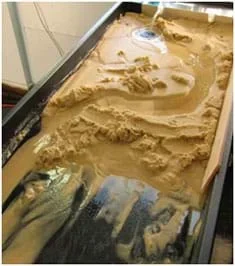 Figure 1. The erosion table used in this activity, filled with fine sand.Copyright 2012 Ryan Cain, Polytechnic Institute of NYU