
Boat Design Challenge: Journey to the Egyptian Afterlife
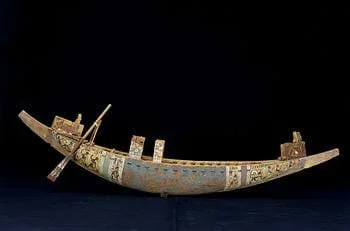 A painted wooden boat from the tomb of Amenhotep II, c. 1400 BC. The Egyptian Museum, Cairo.Copyright 2011 National Gallery of Art, Washington DC http://www.nga.gov/exhibitions/2002/egypt/imagelist/31-1.htm
Student teams are challenged to design models of Egyptian funerary barges for the purpose of transporting mummies through the underworld to the afterlife. Planning the boat designs requires an understanding of ancient culture and beliefs so the mummies are transported safely through the perils of the underworld. Students design and build prototypes using materials and tools like the ancient Egyptians had at their disposal. Then they do the same with modern materials and techniques, forming an awareness of the similarities and differences of the barge designs between the ancient materials and tools (technologies) and today's technologies, which are evolved from the earlier ways.
Engineers work within constraints such as available materials and what would work for a certain culture. While this may seem like a limitation, it usually results in more successful designs. For example, whether designing consumer products, shelter or clean water delivery systems, the best engineering designs take into consideration the local community's culture, climate, materials, resources, and labor.
- Students compare and contrast the ancient with the modern tools and technology used in constructing prototype barges.
- Students come to see that the engineering design process has remained the same since ancient times and that it is the technology that has evolved.
- Students realize that technology is not something totally new, but that it is as old as human civilization.
- Students see how modern builders copied and improved on the techniques developed by the ancient world.
- Students will develop an understanding of the attributes of design.
Grades K-12
Do you agree with this alignment? - Students will develop an understanding of engineering design.
Grades K-12
Do you agree with this alignment? - Students will develop abilities to apply the design process.
Grades K-12
Do you agree with this alignment? - Meeting societal expectations is the driving force behind the acceptance and use of products and systems.
Grades 6-8
Do you agree with this alignment? - Modeling, testing, evaluating, and modifying are used to transform ideas into practical solutions.
Grades 6-8
Do you agree with this alignment? - Make two-dimensional and three-dimensional representations of the designed solution.
Grades 6-8
Do you agree with this alignment? - STEL-1J Develop innovative products and systems that solve problems and extend capabilities based on individual or collective needs and wants.
Grades 6-8
Do you agree with this alignment? - STEL-3E Analyze how different technological systems often interact with economic, environmental, and social systems.
Grades 6-8
Do you agree with this alignment? - STEL-5F Analyze how an invention or innovation was influenced by its historical context.
Grades 6-8
Do you agree with this alignment? - STEL-7J Evaluate designs based on criteria, constraints, and standards.
Grades 3-5
Do you agree with this alignment? - STEL-7Q Apply the technology and engineering design process.
Grades 6-8
Do you agree with this alignment? - STEL-7R Refine design solutions to address criteria and constraints.
Grades 6-8
Do you agree with this alignment?
- 6.MS-ETS1-6(MA) Communicate a design solution to an intended user, including design features and limitations of the solution.
Grade 6
Do you agree with this alignment? - 7.MS-ETS1-4 Generate and analyze data from iterative testing and modification of a proposed object, tool, or process to optimize the object, tool, or process for its intended purpose.
Grade 7
Do you agree with this alignment? - 7.MS-ETS1-7(MA) Construct a prototype of a solution to a given design problem.
Grade 7
Do you agree with this alignment? - Identify and explain the steps of the engineering design process, i.e., identify the need or problem, research the problem, develop possible solutions, select the best possible solution(s), construct a prototype, test and evaluate, communicate the solution(s), and redesign.
Grades 6-8
Do you agree with this alignment? - Describe and explain the purpose of a given prototype.
Grades 6-8
Do you agree with this alignment? - Identify appropriate materials, tools, and machines needed to construct a prototype of a given engineering design.
Grades 6-8
Do you agree with this alignment? - Describe and explain parts of a structure, e.g., foundation, flooring, decking, wall, roofing systems.
Grades 6-8
Do you agree with this alignment?
- MS-ETS1-2 Evaluate competing design solutions using a systematic process to determine how well they meet the criteria and constraints of the problem.
Grades 6-8
This resource focuses on the following Three Dimensional Learning aspects of NGSS:
Science & Engineering Practices- Evaluate competing design solutions based on jointly developed and agreed-upon design criteria.Do you agree with this alignment?
Disciplinary Core Ideas- There are systematic processes for evaluating solutions with respect to how well they meet the criteria and constraints of a problem.Do you agree with this alignment?
Do you agree with this alignment? - Evaluate competing design solutions based on jointly developed and agreed-upon design criteria.
- MS-ETS1-3 Analyze data from tests to determine similarities and differences among several design solutions to identify the best characteristics of each that can be combined into a new solution to better meet the criteria for success.
Grades 6-8
This resource focuses on the following Three Dimensional Learning aspects of NGSS:
Science & Engineering Practices- Analyze and interpret data to determine similarities and differences in findings.Do you agree with this alignment?
Disciplinary Core Ideas- There are systematic processes for evaluating solutions with respect to how well they meet the criteria and constraints of a problem.Do you agree with this alignment?
- Sometimes parts of different solutions can be combined to create a solution that is better than any of its predecessors.Do you agree with this alignment?
- Although one design may not perform the best across all tests, identifying the characteristics of the design that performed the best in each test can provide useful information for the redesign process—that is, some of the characteristics may be incorporated into the new design.Do you agree with this alignment?
Do you agree with this alignment? - Analyze and interpret data to determine similarities and differences in findings.
- MS-ETS1-4 Develop a model to generate data for iterative testing and modification of a proposed object, tool, or process such that an optimal design can be achieved.
Grades 6-8
This resource focuses on the following Three Dimensional Learning aspects of NGSS:
Science & Engineering Practices- Develop a model to generate data to test ideas about designed systems, including those representing inputs and outputs.Do you agree with this alignment?
Disciplinary Core Ideas- Models of all kinds are important for testing solutions.Do you agree with this alignment?
- The iterative process of testing the most promising solutions and modifying what is proposed on the basis of the test results leads to greater refinement and ultimately to an optimal solution.Do you agree with this alignment?
Do you agree with this alignment? - Develop a model to generate data to test ideas about designed systems, including those representing inputs and outputs.
- books on Egypt, for research
- computers with internet access
- pencils and paper for note-taking and drawing
- (optional) CAD software
- a variety of ancient and modern building materials and tools (to be determined by teams with request lists given to the teacher)
- a water table, for testing the prototype barges
- a flat object to create waves
- electric cooling fan
Culture of Egyptian funerals and beliefs. Alternately, assign investigation of this topic as part of the research step.
Ancient Egyptians believed in an underworld known as the Duat. They believed the underworld was filled with perils such as executioners, poisonous snakes, and lakes of fires.
In the underworld, the deceased had to use the Book of the Dead, which contained spells to counteract the dangers and a map to navigate their way. Both the Book of the Dead and the map of the underworld were placed in the coffin or transcribed in hieroglyphics on the coffin.
The mummy was placed on a funerary barge while it traversed through the underworld. The ultimate danger in the underworld was the weighing of the heart; the dead person's heart was weighed against his past deeds. The goddesses interrogated the dead person, accusing them of crimes, and if they told the truth, they would survive in the afterlife; however, if they lied, the goddesses would call upon the Devourer of the Dead to eat up their heart.
Overview
In groups of four, students design models of Egyptian funerary barges to transport mummies through the underworld to the afterlife. According to ancient traditions, the boat design is extremely critical in order for the mummy to have a chance to reach and enter the afterlife, so in planning the boat designs, students must be aware of the perils of the underworld.
To design and construct the boats, student are given the materials and tools the ancient Egyptians had at their disposal. Once the students have determined their boat designs, ask them to create prototypes using the materials the ancient Egyptians used. Next, students are given the opportunity to use new materials and techniques, which are in fact based on Egyptian construction technologies.
Throughout the design challenge, as students work through the seven steps of the engineering design process, guide them to keep in mind the similarities and differences of the boat designs made with ancient Egyptian materials and tools (technologies) compared to today's technologies.
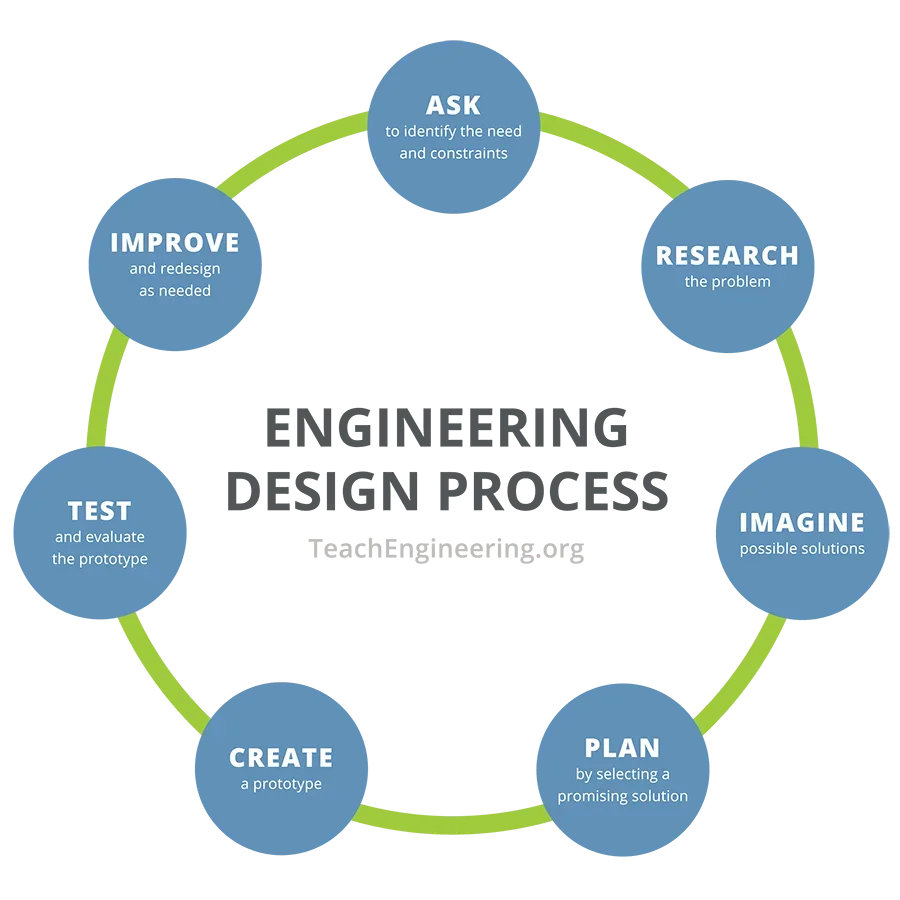 The steps of the engineering design process.Copyright TeachEngineering.org. All rights reserved.
Design Process Step 1 – Ask to Identify the Needs and Constraints:
The Challenge: Design an Egyptian funerary barge to transport a mummy safely through the underworld to the afterlife. Two designs: One using ancient materials and tools and one using modern materials and tools/technologies.
Design Process Step 2 – Research the Problem:
Provide students with computers that have Internet access to research the different materials and construction technologies ancient Egyptians used. Have students take notes on a few tool and construction technologies. Then, have students research and take notes on the different modern technologies that would be useful in creating a barge for a successful voyage through the underworld to the afterlife.
Design Process Step 3 - Imagine Possible Solutions:
Create several sketches/drawings (by hand or using a simple CAD program) of the design ideas for boats that would have been created in ancient Egypt using the materials and techniques of the times, as well as boats with modifications as a result of today's technologies.
Design Process Step 4 - Plan by Selecting a Promising Solution:
Once finished creating multiple design possibilities, select the best design for both the ancient boat and the modern boat. This requires some team discussion as to which boats they perceive will be most successful in traveling through the treacherous underworld.
Design Process Step 5 - Create a Prototype:
Divide and conquer: Within the groups of four students, have two construct ancient Egyptian boat prototypes and the other two construct modern boat prototypes. Both boats will go on the same journey through the underworld, with an ultimate destination to the afterlife. Materials for both ancient and modern designs are at the students' discretion. Have students make lists of materials and tools needed for each boat design. Construct the prototypes.
Design Process Step 6 - Test and Evaluate the Prototype:
Using a water table, test the boats and determine which would be successful in traveling through the underworld. Simulate conditions of the underworld and its dangers, such as as applying pressure, wind currents, and rough seas using fans and slapping the surface of the water with a flat object.
Design Process Step 7 - Improve and Redesign as Needed:
As time permits, give students time to re-design and improve their prototype barges based on testing results. Ask students to identify the best characteristics of each that can be combined into a new solution to better meet the criteria for success.
Once students have completed the design/build/test portion of the activity, it is very important that they have the opportunity to present their designs to the other teams. After viewing all presentations, lead a class discussion in which students discuss and decide which team had the strongest boats and why.
By comparing the different materials and techniques developed by ancient Egyptians with modern materials and techniques, students see how modern builders have evolved the earlier techniques. Evaluate students using criteria such as their ability to differentiate between the ancient and modern technologies, ability to recognize why prototype designs were strong or weak, presentation style and content, and creativity.
Contributors
Heather Blackwell; Bryan Licciadri; Anthony Trinh
Supporting Program
Center for Engineering Educational Outreach, Tufts University
Copyright
2013 by Regents of the University of Colorado; original © 2005 Worcester Polytechnic Institute