
Reverse Engineering: Ball Bounce Experiment
Many of today's popular sports, like soccer, basketball, and tennis, involve using balls, but each ball is unique in its own way. These balls are carefully created with special features to make playing each sport a fun and exciting experience. Students explore the concept of reverse engineering to understand how and why engineers use it. Then, students investigate how different balls bounce by dropping them from various heights and create graphs to show their findings. Through their investigation and analysis, they are able to reverse-engineer different characteristics of several types of balls.
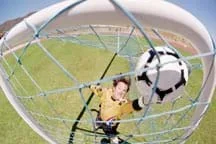 Students investigate balls and their bounceCopyright Microsoft Corporation, 1983-2001
Reverse engineering is the process of analyzing a product, system, or piece of technology to understand how it works, its design principles, and its components. This is done by dissecting, deconstructing, and examining the object of interest in order to gain insights into its inner workings, structure, and functionality. Materials scientists and engineers identify the properties of many different materials and recommend their best uses. This activity demonstrates reverse engineering, in which the properties of finished products are determined by performing tests on the products.
After this activity, students should know:
- How to run an experiment.
- How to collect data.
- How to present data.
- How to interpret graphs.
- How to graph results.
- Teamwork.
- What reverse engineering is.
- CCSS.Math.Content.3.MD.B.3 Draw a scaled picture graph and a scaled bar graph to represent a data set with several categories. Solve one- and two-step "how many more" and "how many less" problems using information presented in scaled bar graphs.
Grade 3
Do you agree with this alignment? - CCSS.Math.Content.5.G.A.1 Use a pair of perpendicular number lines, called axes, to define a coordinate system, with the intersection of the lines (the origin) arranged to coincide with the 0 on each line and a given point in the plane located by using an ordered pair of numbers, called its coordinates. Understand that the first number indicates how far to travel from the origin in the direction of one axis, and the second number indicates how far to travel in the direction of the second axis, with the convention that the names of the two axes and the coordinates correspond (e.g., x-axis and x-coordinate, y-axis and y-coordinate).
Grade 5
Do you agree with this alignment? - CCSS.Math.Content.5.NBT.B.7 Add, subtract, multiply, and divide decimals to hundredths, using concrete models or drawings and strategies based on place value, properties of operations, and/or the relationship between addition and subtraction; relate the strategy to a written method and explain the reasoning used.
Grade 5
Do you agree with this alignment?
- Compare, contrast, and classify collected information in order to identify patterns.
Grades 3-5
Do you agree with this alignment? - STEL-1H Design solutions by safely using tools, materials, and skills.
Grades 3-5
Do you agree with this alignment? - STEL-2I Describe the properties of different materials.
Grades 3-5
Do you agree with this alignment? - STEL-2K Describe requirements of designing or making a product or system.
Grades 3-5
Do you agree with this alignment? - STEL-7J Evaluate designs based on criteria, constraints, and standards.
Grades 3-5
Do you agree with this alignment? - STEL-8G Examine information to assess the trade-offs of using product or system.
Grades 3-5
Do you agree with this alignment?
- 2.MD.9 Generate measurement data by measuring lengths of several objects to the nearest whole unit, or by making repeated measurements of the same object. Show the measurements by making a line plot, where the horizontal scale is marked off in whole-number units.
Grade 2
Do you agree with this alignment? - 3.MD.3 Draw a scaled picture graph and a scaled bar graph to represent a data set with several categories. Solve one- and two-step "how many more" and "how many less" problems using information presented in scaled bar graphs.
Grade 3
Do you agree with this alignment? - 3.MD.4 Generate measurement data by measuring lengths using rulers marked with halves and fourths of an inch. Show the data by making a line plot, where the horizontal scale is marked off in appropriate units— whole numbers, halves, or quarters.
Grade 3
Do you agree with this alignment? - 4.MD.B Represent and interpret data.
Grade 4
Do you agree with this alignment? - 5.G.A Graph points on the coordinate plane to solve real-world and mathematical problems.
Grade 5
Do you agree with this alignment? - 5.MD.B Represent and interpret data.
Grade 5
Do you agree with this alignment?
- Identify materials used to accomplish a design task based on a specific property, e.g., strength, hardness, and flexibility.
Grades 3-5
Do you agree with this alignment? - Identify a problem that reflects the need for shelter, storage, or convenience.
Grades 3-5
Do you agree with this alignment?
- 4 different balls to test, such as a super ball, tennis ball, basketball, kickball, baseball, etc.
- 1 stopwatch per group
- 1 yardstick per group
- worksheets (see attachments)
- Ball Characteristics Worksheet (doc)
- Ball Characteristics Worksheet (pdf)
- Ball Bounce Experiment 1 Worksheet (doc)
- Ball Bounce Experiment 1 Worksheet (pdf)
- Ball Bounce Experiment 1 Bar Graph (doc)
- Ball Bounce Experiment 1 Bar Graph (pdf)
- Ball Bounce Experiment 2 Bar Graph (doc)
- Ball Bounce Experiment 2 Bar Graph (pdf)
- Test Worksheet (doc)
- Test Worksheet (pdf)
Could you play tennis with a baseball or soccer with a basketball? (Listen to student responses.) What are all the different sports that are played with balls? (Possible answers: Volleyball, soccer, football, softball, baseball, ping pong, whiffle ball, bowling, dodge ball, golf, jacks, tennis, croquet, racquetball, squash, tetherball, etc.) What are some differences and similarities among the balls used for different sports?
How do the materials and design of a ball affect its characteristics? A soccer ball is designed to be bouncy, flexible and full of air, making it great to be kicked down a soccer field without injuring players. A bowling ball is dense, heavy and hard so that it can be rolled down a bowling alley to hopefully get a strike rather than a gutter ball. Each ball is designed with specific materials, making it appropriate for a particular sport.
 Copyright Microsoft Corporation, 1983-2001
When engineers are given a design task, whether it is designing a new volleyball that can bounce twice as high or a new airplane or skyscraper, they must study and analyze the properties of the materials they would like to use. They often analyze an existing product, system, or piece of technology to understand how it works, its design principles, and its components.
What might be some material properties that you should consider? (Elicit student responses.) (Possible answers: Weight, strength, hardness and flexibility.)
Do you think it is important to understand materials and their properties, especially in the design of a ball used in a game? Well, imagine being the goalie in a soccer game that uses a bowling ball instead of a soccer ball. OUCH!!!
You and your engineering firm have been hired to use reverse engineering to determine and compare the characteristics of several different balls to see how they affect the bouncing behaviors.
Background Information
This activity coincides well with math graphing practice.
Recommended Resources:
Description of different graph types (line, scatter, bar, pie). Nice example pictures. https://www.keynotesupport.com/excel-basics/excel-chart-types.shtml
This is a link to an online game that teaches mean, median, and mode. http://www.kidsmathgamesonline.com/numbers/meanmedianmode.html
Allows children to create graphs and experiments with probability. https://nces.ed.gov/nceskids/createagraph/
Instructions
- Walk students through the information in the Introduction/Motivation content.
- Gather materials and make copies of the worksheets.
- Explain the two tests that will be done to reverse engineer and determine the bouncing properties of different balls.
- Divide the class into groups of three students each. One student serves as the recorder, one drops the ball, and one is the timekeeper.
- Assign each group a ball. After running both tests on that ball, have the groups switch balls (rotate) and test a new ball until all balls have been tested by each group.
- Conduct tests and record data.
Test 1: Ball Bounce Height Comparison
The first time you drop the ball do not take a measurement, just watch where the ball goes so the next time the observer knows where to look. This help to greatly increase the accuracy of the experiment. Drop a ball from 1 foot off of the floor, slightly in front of a yardstick. Measure the height the ball reaches after the first bounce and record. Repeat this test from 2 ft, 3 ft, and 1/2 ft. Do this test for each ball and record data. To increase accuracy, you may repeat each test three times and divide by 3 to find an average.
Test 2: Ball Bounce Time Comparison
Drop a ball from a height of 3 ft, timing from when the ball is released until the ball stops bouncing. Record the time. Repeat this test for each ball. Talk with the students about coming up with a system for releasing the ball and starting the stop watch. Possible suggestions are to have the same student drop the ball and start the watch, or have the two students count down from five.
- Graph group results. (If this activity is not able to be accompanied by a math lesson on graphing, introduce the topic before the activity starts or perhaps after the class has recorded its data and worked through it as a group.)
- Compare results as a class.
- reverse engineering
- the process of analyzing a product, system, or piece of technology to understand how it works, its design principles, and its components.
Supporting Program
Center for Engineering Educational Outreach, Tufts University
Copyright
2013 by Regents of the University of Colorado; original © 2004 Worcester Polytechnic Institute