
Balancing Liquid on a Coin: How Intermolecular Forces Work
What can the act of balancing liquid on the surface of a coin tell us about the water molecules and molecular formulas? In this activity, students observe different types of intermolecular forces of water through two simple experiments. During this introductory activity students have hands-on experience visualizing the effects of hydrogen bonding through surface tension and evaporation.
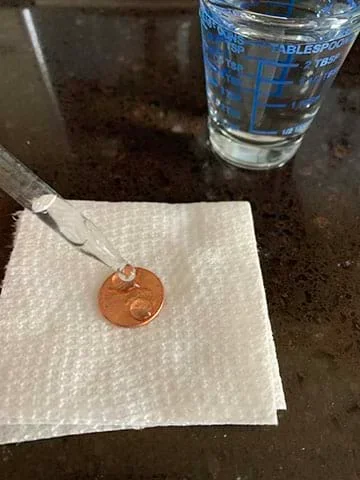 Experiment #1 Set-UpCopyright 2020 Victoria Bartow, Boston University RET
Wastewater engineers work to ensure that all water systems at a water treatment plant are working correctly. Their responsibilities revolve around producing clean, safe drinking water for the community. Their duties include the design and operation of the machines, systems, and equipment that receive, clean, and distribute water. Knowing the basic properties of water is an important first step in developing water treatment methods.
After this activity, students should be able to:
- Explain why water is important to life.
- Explain how the properties of water and isopropyl alcohol differ due to their molecular structures.
- Consider how the properties of water make it unique and why it has a higher evaporation point than alcohol.
- Have a cursory knowledge of water’s structure to consider its properties for future engineering.
- Students will develop an understanding of the relationships among technologies and the connections between technology and other fields of study.
Grades K-12
Do you agree with this alignment?
- HS-PS1-3 Plan and conduct an investigation to gather evidence to compare the structure of substances at the bulk scale to infer the strength of electrical forces between particles.
Grades 9-12
This resource focuses on the following Three Dimensional Learning aspects of NGSS:
Science & Engineering Practices- Construct and revise an explanation based on valid and reliable evidence obtained from a variety of sources (including students' own investigations, models, theories, simulations, peer review) and the assumption that theories and laws that describe the natural world operate today as they did in the past and will continue to do so in the future.Do you agree with this alignment?
- Construct an explanation based on valid and reliable evidence obtained from a variety of sources (including students' own investigations, models, theories, simulations, peer review) and the assumption that theories and laws that describe the natural world operate today as they did in the past and will continue to do so in the future.Do you agree with this alignment?
Disciplinary Core Ideas- The structure and interactions of matter at the bulk scale are determined by electrical forces within and between atoms.Do you agree with this alignment?
Crosscutting Concepts- Different patterns may be observed at each of the scales at which a system is studied and can provide evidence for causality in explanations of phenomena.Do you agree with this alignment?
Do you agree with this alignment? - Construct and revise an explanation based on valid and reliable evidence obtained from a variety of sources (including students' own investigations, models, theories, simulations, peer review) and the assumption that theories and laws that describe the natural world operate today as they did in the past and will continue to do so in the future.
Each group needs:
- science notebook for each student
- Intermolecular Forces Lab Worksheet (PDF) for each student
- 2 pennies
- dropper bottle with water
- dropper bottle with isopropyl alcohol
- paper towels
- 4-5 Q-tips
- safety gloves for each student
- stopwatch, smartphone timer or watch timer
The teacher needs:
- projector and whiteboard/blackboard/chart paper for recording student ideas
Students should know how to read molecular formulas and draw atom structures. They should have learned about atomic and molecular structures as well as chemical bonding. They should understand polarity and dipole moments.
In many ways, water is a miracle liquid. It is essential for all living things on earth and it is often referred to as a universal solvent because many substances dissolve in it. Water displays unusual properties due to the ways in which individual water molecules interact with each other.
As a refresher, let’s review the properties of water. Who can name a property of water? (Answers include polarity, cohesion, adhesion, surface tension, high specific heat, and evaporative cooling.)
Today you will complete two experiments that compare the properties of water to the properties of isopropanol (a type of rubbing alcohol). Before conducting each experiment, you will make a prediction about what you think will happen. You will then read about and do the experiment. Afterwards, you will write an explanation of what was happening at the atomic level that let us observe these properties.
Background
In many ways, water is a miracle liquid. It is essential for all living things on earth as it is one of the more abundant molecules in living cells. Approximately 60% – 70% of the human body is made up of water. Without it, life simply would not exist.
Because water is essential to life, it is important to know the basic properties of water. As it turns out, water displays some unusual properties due to the way individual water molecules interact with each other.
Polarity
A single water molecule is composed of one oxygen atom and two hydrogen atoms. Together these atoms form polar covalent bonds. (A covalent bond is a chemical bond when electrons are shared between two atoms.) A polar covalent bond forms when atoms with different electronegativities share electrons in a covalent bond. In water, the result is that each hydrogen atom shares electrons with the oxygen atom; however, the shared electrons spend more time associated with the oxygen atom than they do with hydrogen atoms. The result is that there is a slight positive charge on each hydrogen atom and a slight negative charge on the oxygen atom.
Cohesion
Since the hydrogen and oxygen atoms in a water molecule carry opposite (partial) charges, nearby water molecules will be attracted to each other. The attraction between the δ+ hydrogen and the δ- oxygen in adjacent molecules is called hydrogen bonding. Hydrogen bonding is an intermolecular force, which are forces between molecules in a substance. Hydrogen bonding is one of the strongest intermolecular forces. This means that neighboring water molecules are strongly attracted to one another. This is called cohesion. The property of cohesion describes the ability of water molecules to be attracted to other water molecules.
Surface Tension
Water has surface tension. Because the water molecules at the surface of liquid water have fewer neighbors, they will have an even stronger attraction to the few water molecules that are nearby. This enhanced (or greater) attraction is called surface tension. It makes the surface of the liquid water slightly more difficult to break through than the interior of the water. Cohesion gives rise to surface tension, the capacity of a substance to withstand rupture when placed under tension or stress.
Solvent
Water is often referred to as a universal solvent because many substances dissolve in it. Because of water’s polarity and structure, ionic compounds and polar molecules can readily dissolve in it. Water is, therefore, what is referred to as a solvent—a substance capable of dissolving another substance. The charged particles in water molecules will form hydrogen bonds with a surrounding layer of water molecules. When a substance readily forms hydrogen bonds with water, it can dissolve in water. Since water can dissolve so many it is important in its many roles in living systems.
Evaporation
The hydrogen bonds in water allow it to absorb and release heat energy more slowly than many other substances. Water can absorb a great deal of energy before its temperature rises. Since the hydrogen and oxygen atoms in the molecule carry opposite partial charges, nearby water molecules are attracted to each other. The attraction between the δ+ hydrogen and the δ- oxygen in adjacent molecules is a special type of intermolecular force called hydrogen bonding that causes water molecules to “stick” together in liquid form. This force must be overcome for liquid water to become a gas. It takes a lot of energy to overcome the force of hydrogen bonding.
When enough energy has been added to water it boils and turns from liquid to gas. This happens at a temperature of 100˚C. In comparison, isopropanol turns from liquid to gas at 82.5˚C. Since the vaporization of isopropanol occurs at a lower temperature than water, this means it takes less energy to turn isopropanol into a gas, and therefore it will evaporate faster than water. Isopropanol has weaker intermolecular forces holding its molecules together, so it takes less energy (a lower temperature) to separate the molecules to enter the gas phase.
Before the Activity
- Arrange students into groups of two or let them work individually if enough materials are available.
- Develop a system for having students get rid of lab waste and return materials to the instructor.
With Students
Part 1: Introduction (10 minutes)
- Students can work independently or with a partner through the Introduction section.
- Have students answer questions 1 and 2 of the Intermolecular Forces Lab Worksheet (PDF).
- While they work on the Introduction section, select a student or group to present their structural formulas of water and isopropyl alcohol to the class. This may be done using a document camera, or any other way you can present student work to the class.
- Answer any questions or help correct misconceptions before having students work on Experiment #1.
Experiment #1: Penny (30 minutes)
- Hand out materials to students.
- Students work though Experiment #1
Experiment #1 Set-UpCopyright 2020 Victoria Bartow, Boston University RET
- Place one penny on a paper towel.
- Drop water onto the surface of the penny, slowly, one drop at a time.
- Count how many drops it takes until the water spills off the penny.
- Record the number of drops to the right.
- Repeat steps A through D for isopropanol.
- Compare the number of drops of isopropanol to the number of drops of water.
- (Optional) If time, have students repeat the experiment for consistency.
- [Optional] Pause students after collecting data about number of drops of water on the penny and discuss everyone’s findings. This can be an opportunity to calculate averages and analyze the group data.
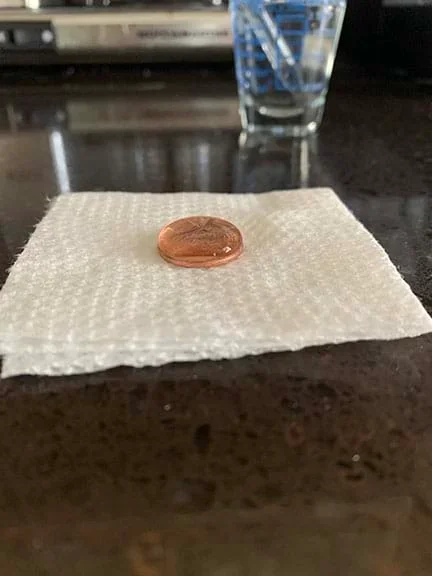 Surface tension of water on a pennyCopyright 2020 Victoria Bartow, Boston University RET
- Have students read and mark up the “Reading” section about intermolecular forces and then develop an explanation about what happened during the experiment.
- [Optional] Have students share out their explanations and clear up misconceptions about surface tension before moving on. Another option here is to have students define the tier three academic vocabulary (bolded) in their notes: surface tension, hydrogen bonding and intermolecular forces.
Experiment #2: Evaporation Rates (30 minutes)
- Hand out materials to students.
- Students work though Experiment #2
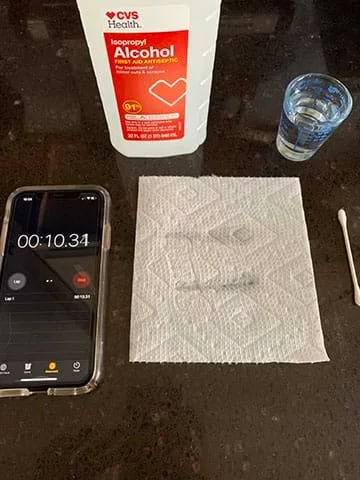 Experiment #2 Set-UpCopyright 2020 Victoria Bartow, Boston University RET
- Dip one end of a Q-tip in water. Shake off excess water.
- Dip one end of a different Q-tip in isopropanol. Shake off excess isopropanol.
- At the same time, draw (streak) the tips of each Q-tip across a paper towel in two parallel lines.
- Time how long it takes for each streak to evaporate.
- (This may take a few minutes.) Record your observations.
- (Optional) If time, have students repeat the experiment for consistency.
- [Optional] Pause students after collecting data about time taken for each liquid to evaporate and discuss findings. This can be an opportunity to calculate averages and analyze the group’s data.
- Students read and mark up the “Reading” section about hydrogen bonding and then develop an explanation about what happened during the experiment.
- [Optional] Have students share out their explanations and clear up misconceptions about hydrogen bonding. Another option here is to have students define in their notes: surface tension, hydrogen bonding and intermolecular forces.
- cohesion
- Describes the ability of molecules (such as water) to be attracted to other molecules of the same makeup.
- evaporation
- Process by which water changes from a liquid to a gas or vapor.
- hydrogen bonding
- Attraction between the δ+ hydrogen and the δ- oxygen in adjacent molecules.
- intermolecular force
- Force between molecules in a substance.
- polarity
- Separation of electric charge leading to a molecule or its chemical groups having an electric dipole moment, with a negatively charged end and a positively charged end.
- solvent
- The liquid in which a solute is dissolved to form a solution, or the ability to dissolve other substances.
- surface tension
- Attractive force exerted on the surface molecules of a liquid caused by the attraction of the particles in the surface layer by the bulk of the liquid, which tends to minimize surface area.
Pre-Activity Assessment
During the Introduction activity while the students are drawing their structural models, in the teacher should walk around and see who is doing their models accurately and who needs more support. By going over the models BEFORE completing the activity, students who are struggling to understand are given a chance to revise their thinking.
Activity Embedded (Formative) Assessment
During the introductory assignment where students learn discuss the importance of water, there is an opportunity for formative assessment by walking around and listening to partnerships share out ideas about what will happen in each of the experimental trials.
Post-Activity (Summative) Assessment
During the activity, students evaluate their predictions as accurate or inaccurate and then explain what they observed after reading the section. This helps to see students’ abilities to explain the observed phenomena.
There are no safety issues, but students should wear gloves as a best practice for maintaining a safe lab space as well as follow other lab safety protocols.
This lab is a great introductory lab to the properties of water and can be used as any pre-teaching lesson before students work with the mechanics of water or other polar substances.
Contributors
Amanda Dillingham MEd.; Brad Lepak MEd.; Victoria Bartow MEd.
Supporting Program
Boston University Photonics Center RET, Boston University
Acknowledgements
This material is based upon work supported by the National Science Foundation under grant no. EEC 1407165— Boston University Photonics Center Research Experience for Teachers. However, these contents do not necessarily represent the policies of the National Science Foundation, and you should not assume endorsement by the federal government.
Copyright
2021 by Regents of the University of Colorado; original © 2018 Boston University