
Thinking Small – Measuring Small Things
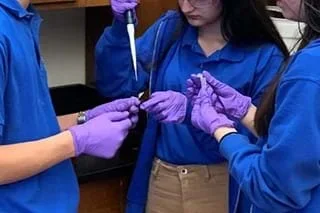 Students practice using the micropipette in a group by measuring water into microcentrifuge tubes.Copyright 2018 Amanda Dillingham, Boston University RET
Explore unseen phenomena in the microscopic world through measurements and observations. In this activity, students are introduced to the concepts of size and scale and make sense of sizes at the nanoscale through a card sort activity, in which specific objects must be ordered by size. Students then explore the concepts of measuring small volumes and masses by using graduated cylinders and micropipettes. Finally, they think about how scientists and engineers might use a compound microscope to observe microscopic objects.
Engineering occurs at many different scales and sizes, and nanoengineering is the practice of engineering at the microscopic level such as at nanoscale. The nanoscale refers to structures with a length scale applicable to nanotechnology, 1–100 nanometers. The focus of this activity is to allow students to gain access to the microscopic world around them as an introduction to microengineering and nanoengineering.
After this activity, students should be able to:
- Measure mass and volume using a digital scale, graduated cylinders, and micropipettes.
- Use a conversion table to convert between metric units.
- Set up a wet slide and use a compound microscope.
- Identify which sizes of objects they cannot see with the unaided eye.
- Identify the best tool for measuring different objects based on the measurement needing to be taken (for example, using the correct size micropipettes or using the correct microscope).
- CCSS.Math.Content.HSN-Q.A Reason quantitatively and use units to solve problems.
Grades 9-12
Do you agree with this alignment? - CCSS.Math.Content.HSN-Q.A.1 Use units as a way to understand problems and to guide the solution of multi-step problems; choose and interpret units consistently in formulas; choose and interpret the scale and the origin in graphs and data displays.
Grades 9-12
Do you agree with this alignment? - CCSS.Math.Practice.MP2 Reason abstractly and quantitatively.
Grades K-12
Do you agree with this alignment? - CCSS.Math.Practice.MP6 Attend to precision.
Grades K-12
Do you agree with this alignment?
- AI.N-Q.A Reason quantitatively and use units to solve problems.
Grades 9-12
Do you agree with this alignment? - MP.2 Reason abstractly and quantitatively.
Grades -1-12
Do you agree with this alignment? - MP.6 Attend to precision.
Grades -1-12
Do you agree with this alignment? - N-Q.A.1 Use units as a way to understand problems and to guide the solution of multi-step problems; choose and interpret units consistently in formulas; choose and interpret the scale and the origin in graphs and data displays.
Grades 9-12
Do you agree with this alignment?
- SEP.12.9-12.2 Use mathematical representations of phenomena to describe explanations.
Grades 9-12
Do you agree with this alignment? - SEP.3.9-12.6 Construct an explanation based on valid and reliable evidence obtained from a variety of sources (including students' own investigations, models, theories, simulations, peer review) and the assumption that theories and laws that describe the natural world operate today as they did in the past and will continue to do so in the future.
Grades 9-12
Do you agree with this alignment?
Each student needs:
- pen/pencil
- Thinking Small Worksheet (PDF)
Each group needs:
- set of cut out Card Sort (PDF) cards
- laptop with access to the Internet
- digital scale
- scoopula
- 25 g salt
- weigh paper or small weigh dish ( a piece of paper towel can also be used)
- 3 graduated cylinders (10 mL, 50 mL, 100 mL)
- 2 micropipettes (different sizes)
- 4 micropipette tips (at a minimum)
- 2 beakers (one for sharps waste, one for measured liquid from micropipette)
- compound light microscope
- fixed slide with a microscopic organism
- plastic pipette or dropper
- clean slide + coverslip
- paper towels
- safety gloves
- safety glasses
To share with the class:
- laptop/tablet/computer with access to Internet and a projector
- red food coloring
- blue food coloring
- beaker with pond water
- paper towels
While this activity is meant to be an introductory activity to smaller scales, it is beneficial if students have some experience with the one or more of the following:
- Basic understanding of the units of measurement.
- Familiarity of common lab measurement materials.
- Experience using a micropipette.
- Familiarity with a compound microscope.
Note: If this is used as an introductory activity, supplementary measurement and instrument practice are strongly recommended.
True or False: we can see everything in the world that affects our daily lives. (Let students provide answers. Give students time for debate.)
As engineers and scientists, we not only explore our world that we can see with the naked eye, but we also explore the microscopic world. There are billions of things that are too small for us to see with our naked eye, and even more things we can’t even see with the strongest microscopes in the world.
Today we are going to focus on deepening our understanding of and ability to measure tiny things.
Background
Overview
This is an introductory activity to many engineering themes that occur in biology, chemistry, physics, and biotechnology classrooms. There are five parts of this activity that can be done in one long lab period or taught over the course of three 50-minute periods.
Part 1: Introduces the concept of size and scale to students by doing a card sort to put objects in order from largest to smallest and then checking a web platform called “Scale of the Universe” against their answers to determine the actual size of these objects.
Part 2: Introduces the concept of measuring small objects and how to do unit conversions with small sizes.
Part 3: Includes three measurement activities where students measure mass with a digital scale, volume with graduated cylinders, and microvolumes with micropipettes.
Part 4: Introduces different types of microscopy by focusing on how to measure objects that we cannot see with our bare eyes.
Part 5: Introduces students to using a compound microscope and looking at microscopic objects. This whole activity is centered around gaining access to the unseen world.
Microscopy is the field of study that uses microscopes to view objects that cannot be seen by the naked eye.
Light microscopy uses focused light and lenses to magnify small (microscopic) objects we would otherwise not be able to see. In light microscopy there are different types of microscopes, however the four most popular types are: compound, stereo, digital and pocket or handheld microscopes. These different types of microscopes are used for everything from personal use to biological applications.
The Compound Light Microscope typically has two eye pieces (binocular) and allows for magnification of 10X-15X. More lenses can be combined in the Compound light microscope, typically rotated into the field of view, and magnification of up to 1000x can be reached. Uses for this type of microscope include studying plant cells, viewing bacteria and parasites and other human/animal cells. These microscopes are commonly found in science classrooms.
The stereo microscope has two optical paths at slightly different angles which allows the image to be viewed three dimensionally. Stereo microscopes magnify typically between 10x and 200x, although generally below 100x. Uses for this type of microscope include looking at surfaces, microsurgery, and watchmaking, plus building and inspecting circuit boards in an engineering setting.
The digital microscope uses the power of the computer to view objects not visible to the naked eye. To magnify the specimen, special computer software displays the magnified object on a monitor. Digital microscopes can also record and save moving images in addition to single images.
Finally, pocket microscopes are small but are very useful for magnification ranging from 25x to 100x. This microscope may be small but it can be utilized by hobbyists, students, scientists, and engineers in the field.
Before the Activity
- Set up classroom tables for groups of 3-4 students.
- Gather and distribute all materials to each group’s table. (If you are doing this activity over the course of multiple days you can hand out only the materials necessary for that day’s activities).
- Set up a teacher’s station to model parts of the activity or prepare to use a student station to model parts of the activity.
- Make copies of the Thinking Small Worksheet (PDF) and cutting out the Card Sort (PDF) (You can make this into a packet or just print pages as you need them each day.)
- Set up your laptop/computer/tablet and projector for video viewings.
With the Students
Part 1: How small is small?
- (5 minutes) Give introduction (as stated in the motivation section above.)
- (25 minutes) Instruct students to work on and answer Part 1 of the worksheet, “How small is small?” (Note: Per the instructions, the students should answer the first questions independently and the last two questions with their groupmates.)
- (15 minutes) Have students move on to working on the “Can you put the items in order by size?” section.
- Students complete the Card Sort (PDF) by arranging the objects on the cards in order or largest to smallest.
- Students record their answers in the Thinking Small Worksheet (PDF).
- Students open the interactive site “Scale of the Universe” (https://htwins.net/scale2/) on their laptop/tablet/computer and check the order of their card sort. After finding the relevant objects they should record object sizes on the chart.
Circulate while students are working on the “Can you put the items in order by size?” section and answer any student questions. (Be prepared to provide support them when they access the “Scale of the Universe” web program.)
- (5 minutes) Facilitate a short share out where students share what they were surprised by or what stuck out to them about size during Part 1.
Stop here if doing Part 1 as one 50-minute activity.
Part 2: How do we measure small things?
- Introduce Part 2: “How do we measure small things?”
- (10 minutes) Have students read the Part 2 Reading Segment and then work on the unit conversions independently. Instruct them to check their answers within their groups before moving on to Part 3.
- Optional: Select students while circulating to show the class how to do each of the six conversions either up on the board or with a document camera.
Part 3: Practicing Taking Measurements
- (15 minutes) Once students have completed Part 2, instruct them to move on to Part 3 (Challenge 1: Measuring Mass and Challenge 2: Measuring Volume ONLY). Have the materials already set up on their group’s table or sectioned/measured out in an easy to access area for the students to grab the necessary materials. Circulate while students work on Part 3 Challenges 1 and 2.
- (3 minutes) Pause students at the end of Challenges 1 and 2 to clean their workspace of materials.
- (7 minutes) Show the video Lab Skills: Micropipetting Basics (https://www.youtube.com/watch?v=22Y34316nZs) to model correct hand placement and usage.
- (15 minutes) Have students complete Part 3 Challenge 3: Measuring Volume Using Micropipettes, answer the reflection questions in their Thinking Small Worksheet (PDF), and clean up their workspaces. See images below for reference.
Students practice using the micropipette in a group by measuring water into microcentrifuge tubes.Copyright 2018 Amanda Dillingham, Boston University RET
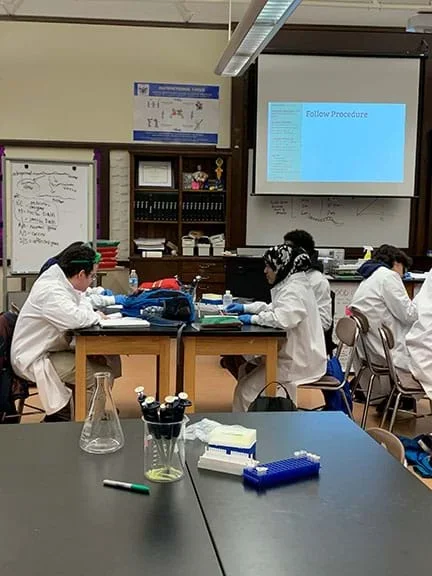 The material set up for Part 3 Challenge 3 in the foreground and students preparing for the activity in the background.Copyright 2018 Amanda Dillingham, Boston University RET
Note: Stop here if doing Parts 2+3 as a second 50-minute activity.
Part 4: Measuring things unseen
- Introduce students to Part 4.
- (15 minutes) Show students the video Mysteries of the Unseen World (from 21:38 - 35:00) https://www.youtube.com/watch?v=OzFvGx6DZOs (optional) Have students watch the video in their groups, or have students watch the video individually (if each student has their own device).
- Have students answer questions about the video on their Thinking Small Worksheet (PDF).
Part 5: Focusing on the small things!
- (10 minutes) Read through Part 5 as a group and answer questions 1 and 2 as a group (or have students answer these questions with their group and then facilitate a share out.)
- (optional) The teacher may choose to model how to use the microscope if this is the first time that students are encountering microscopes. However, if students have done microscopy before, they made not need a demonstration.
- Instruct students to gather materials necessary for Part 5 (if they are not set out on their tables already).
- (25 minutes) Instruct students to work with their groups to complete the remaining parts of Part 5.
- Students select one of the organisms on the slides and practice visualizing them at different powers.
- Students draw what they see on their Thinking Small Worksheet (PDF) at three different powers (4x, 10x and 40x)
- Students create a pond water slide to view with the microscope, using the wet mount technique:
- Place a drop of pond water in the center of the slide.
- At an angle, place one side of the coverslip against the slide making contact with outer edge of the liquid drop.
- Lower the cover slowly, avoiding air bubbles.
- Remove excess water with the paper towel.
- Circulate while students are working, assisting students, if needed, to mount their pond water slides if they have not done that technique before. See image below.
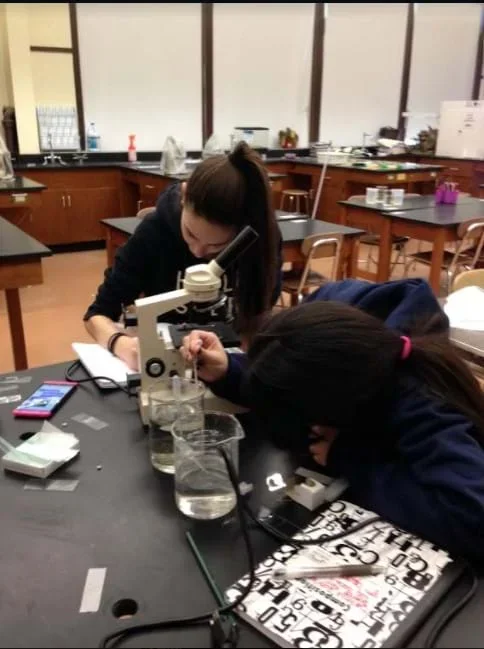 Students work on Part 5 of the worksheet: Focusing on the Small Things but creating a wet slide to look at pond water.Copyright 2018 Amanda Dillingham, Boston University RET
End here for third 50-minute activity.
- micron
- A unit of length equal to one millionth of a meter, used in many technological and scientific fields.
- microscopy
- A technique of using microscopes.
- nanometer
- A unit of measurement for length equal to one billionth of a meter, 0.000000001 or 10-9 meters.
- nanoscale
- Of a size measurable in nanometers or microns, 1-100 nanometers (nm).
- nanotechnology and nanoengineering
- Technology and engineering that occur at the nanoscale.
Pre-Activity Assessment
Student Reported “Pulse Check”: Before beginning the activity, the teacher should ask students about:
- their experience with taking measurements in a lab setting.
- their comfort in using the techniques that will be used in the hands-on activities. (Note: This can be an informal raise of hands or a formal survey.)
Activity Embedded (Formative) Assessment
Student Worksheet: Students fill out the Thinking Small Worksheet (PDF) during the activity.
Spontaneous teacher questions: Teacher circulates during the activities and uses check-for understanding techniques. The teacher should circulate to groups and individuals and have them report out on their findings for the part that require answering questions.
(optional) Group share: For the unit conversions, the teacher can have each group share out one of their unit conversions and a description of how they did their conversion.
(optional) Daily Exit Tickets: If the teacher implements this activity across multiple days, they can give exit tickets with questions about the work students did during class at the end of each day.
(optional) Daily homework assignments: Teachers can also choose to give homework assignments that goes into deeper investigations into the connection between the activity and engineering.
Post-Activity (Summative) Assessment
Student Worksheet: Student answers on the Thinking Small Worksheet (PDF) after the activity is complete.
(optional) Practical Quiz: The teacher may choose to give a practical quiz where students demonstrate the lab techniques they learned. (However, given that this activity focuses on introducing a concept and practicing the concept, the teacher may wait to do a project or test until the end of the unit that this introduces.)
(optional) Written Quiz: The teacher may choose to give a written quiz about the tools used during the course of this activity. (However, given that this activity focuses on introducing a concept and practicing the concept, the teacher may wait to do a project or test until the end of the unit that this introduces.)
- Use eye protection when using the micropipettes.
- Use gloves when handling the glass microscope slides.
- Have glass waste available if students break slides when making their wet mounts with pond water.
- No eating or drinking during the lab activities.
Common challenges may include:
- Using the computer platform to identify sizes of objects – they might struggle to identify the exact size of object based on the reading in the bottom right corner, you can advise them to approximate.
- Taring (or zeroing) their scales when measuring the salt - this may lead to incorrect readings.
- Using the micropipettes – be prepared to troubleshoot with students how to measure using the first stop on the plunger and release liquid using the second stop. Students may also need help releasing the micropipette tip from their micropipette. Remind them not to use their hands, but to use the release button.
- Finding the object in their microscope field of view – remind students to move the stage slowly and to start on the lowest lens setting.
- Making their wet pond mount – remind students to only use one drop of pond water. It may be helpful for you to have a couple of premade slides for students to use if they are unable to find an organism in their field of view.
This activity can be extended to support any engineering investigation that occurs on a small scale or that requires precise mass or volume measurements. Part 3, specifically, can be extended to include more measurement techniques or to include more practice with the micropipettes. Part 5 can also be extended to include teaching students how to measure size of an object using the microscope’s field of view.
- For lower grades with younger students,
- Give students fewer cards in the card sort activity.
- Make some of the card sort cards more relatable.
- Model how to do unit conversions before setting students to do the measurement conversions.
- Demonstrate how to take mass and volume measurements.
- Demonstrate how to make pond water slides.
- For upper grades with older students,
- Have students who have already done these skills work with students who are less familiar with the measurement techniques.
- Have students learn more about the electromagnetic spectrum.
- Have students explore how each kind of microscope works with the EM spectrum to visualize microscopic objects.
- Provide more challenging unit conversion problems.
- Have more and deeper discussions about how the microscopic world affects our daily life.
Additional multimedia support may include:
- Another size and scale web program: https://learn.genetics.utah.edu/content/cells/scale/ (Utah genetics cell size and scale)
- Visuals of the parts of a micropipette to accompany the introductory video
- Other micropipette activities using well plates and food coloring to make designs
- Videos or news articles of microscopy in action
- Cell phone clip-on microscopes to bring microscopy into everyday life.
BU Photonics Center. (2018). NSF RET in Integrated Nanomanufacturing. 2021 Boston University. https://www.bu.edu/photonics-ret/research-projects/2019-summer-projects/
Nanometres and nanoscale. (2014, April 10). Science Learning Hub. https://www.sciencelearn.org.nz/resources/1651-nanometres-and-nanoscale
NNI. (2018). Educational Resources | National Nanotechnology Initiative. National Nanotechnology Initiative. https://www.nano.gov/
Scale of the Universe 2. (n.d.). Scale of the Universe 2. Retrieved July 12, 2021, from https://htwins.net/scale2/
SRI International. (2007, November 15). NanoSense: Activities. Nanosense Activities. https://nanosense.sri.com/activities/sizematters/
Contributors
Amanda Dillingham MEd.; Brad Lepak; Victoria Bartow MEd.
Supporting Program
NSF Research Experience for Teachers (RET) in Integrated Nanomanufacturing at the Photonics Center, Boston University
Acknowledgements
This activity was developed under National Science Foundation grant no. EEC-1407165—Boston University Photonics Center Research Experience for Teachers under the supervision of Helen Fawcett, PhD. However, these contents do not necessarily represent the policies of the National Science Foundation, and you should not assume endorsement by the federal government.
Copyright
2021 by Regents of the University of Colorado; original © 2018 Boston University