
Using Nature as the Solution: Biomimicry in Engineering
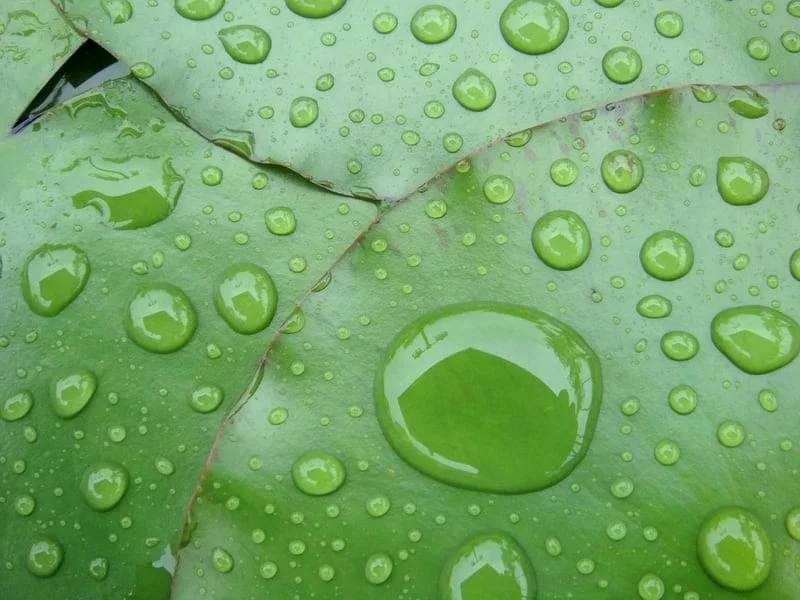 The lotus effect in action on a leafCopyright 2021 The Biomimicry Institute, AskNature Team, https://asknature.org/strategy/surface-allows-self-cleaning/
In this exploration of the natural world, students make sense of biomimicry through examples and think about situations where they could develop something using biomimicry. The first part of the activity has students think about the importance of water and introduces biomimicry. Students then learn about biomimicry from a TED Talk, explore examples of biomimicry through a station activity, and then visualize the lotus effect while thinking about the implications of the lotus effect on access to clean drinking water. This activity is the third in a sequence that introduces nanotechnology, bioengineering, and the importance of access to clean drinking water. This activity could be used to prepare students to begin designing their own water filter in a subsequent activity.
This activity could be used as a precursor to discussions on how to engineer a water filter. The activity introduces the use of biomimicry in development of technologies that can help provide access to clean drinking water. This activity also encourages student thinking about nanoengineering and how engineers use influences from nature to solve human problems.
After this activity, students should be able to:
- Identify and discuss ways in which water is important to our existence.
- Define and explain biomimicry.
- Provide and analyze examples of how engineers use biomimicry to solve problems.
- Explain how “superhydrophobia” contributes to the ability for materials to self-clean, repel microbes, prevent corrosion, and prevent wetness.
- Have cursory ideas about how people with water insecurity may have better access to water using biomimicry or nanotechnology.
- STEL-3G Explain how knowledge gained from other content areas affects the development of technological products and systems.
Grades 6-8
Do you agree with this alignment?
- CCC.12.6-8.3 Advances in technology influence the progress of science and science has influenced advances in technology.
Grades 6-8
Do you agree with this alignment? - SEP.3.6-8.5 Apply scientific ideas to construct an explanation for real-world phenomena, examples, or events.
Grades 6-8
Do you agree with this alignment?
Teacher needs:
- Laptop and projector (or another ability) to project two videos to the class
- Optional: drytek, a nanocoating spray to demo during the “Very Dry Demo” video (available online as a fabric swatch)
Each student needs:
- Nature as a Solution Worksheet (PDF)
- writing utensil
Each group needs:
- One station page from the Image Sets (PPTX) (There are four stations. If you have a large class, you may consider making to sets of the image set making eight stations and students rotate only to four of them.)
- paper towel
- small pieces of mature kale leaf (not baby kale)
- plastic pipette
- cup or beaker of water
To be successful in this activity, students should already have a basic understanding of nanotechnology and engineering. An understanding of the properties of water could also be helpful as well as a background understanding of inequities in global water access.
Today we are going to learn about biomimicry and how we can apply biomimicry to engineering solutions to complex problems. To start us off, please read the two paragraphs on your worksheet (or below). [Students will be sitting in groups so you can have them read aloud in groups, read independently, or read it as a class.]
Biomimetics, also known as biomimicry (bio=life, mimic=copy), is a newly developed field that uses concepts and structures developed in nature to solve complex human problems. Biomimicry empowers engineers to create eco-friendly and sustainable solutions inspired by nature. Many of the problems humans face have been solved already in nature. It is by researching nature’s engineers that we can mimic and solve our own problems.
One very important problem engineers try to solve is how to help more people have abundant, clean water. Water affects your life in many ways. With your group, write down as many ideas as you can think of for the prompt below.
Now, as a group, I’d like you to discuss and list the ways water affects your life. [Give students 5-10 minutes to respond to the prompt.]
Let’s hear what you came up with. [Let students share out their responses to the prompt.]
Background
Biomimicry, uses concepts and structures developed in nature to solve complex human problems. Biomimicry empowers engineers to create eco-friendly and sustainable solutions to modern problems. One problem engineers try to solve is how to provide access to abundant, clean water. This activity is an introduction to biomimicry, providing real-world examples.
The motivation for this assignment is to have students start thinking about the significance of access to clean water, in what ways that water might need to be purified, and ways in which biomimicry can help.
Before the Activity
- Gather materials for the kale mini-lab and distribute to student group tables.
- Make copies of the Nature as a Solution Worksheet (PDF) and as many copies of the Image Sets (PPTX) as you would like. (There are four stations to rotate through, so teachers with larger classes may want to make more copies of the stations).
- Arrange the classroom in groups (3-5) and establish how you want students to rotate through the four stations.
- Prepare a computer to present two videos.
With the Students
Introduction to Biomimicry (10 min)
- Have students read the two introductory paragraphs on the first page of the Nature as a Solution Worksheet (PDF).
- In their groups, have students brainstorm and respond to the prompt: in what ways does water affect your life? Have students record their ideas on their worksheets.
- Ask students to share their lists with the full group. (See introduction/motivation section above for detailed instructions.)
Part 1- Biomimicry in Action (35 min)
- Play the Ted Talk by Janine Benyus: Biomimicry in Action https://www.ted.com/talks/janine_benyus_biomimicry_in_action/transcript?language=en
- Have students answer questions on the Nature as a Solution Worksheet (PDF). (5 minutes)
- Students will share out and ask questions in a discussion after the video. (10 minutes)
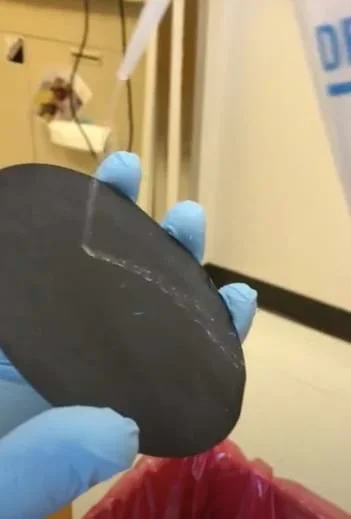 Water stream bouncing off a wafer coated in drytekCopyright 2018 Amanda Dillingham, Boston University RET
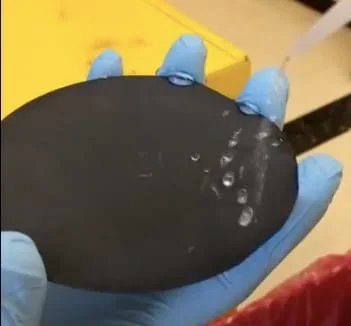 Water beading off a wafer coated in drytekCopyright 2018 Amanda Dillingham, Boston University RET
Stop here if doing part 1 as one 45-minute class period
Part II – Examples of Biomimicry (20 min)
- Have students complete a rotating station activity with four stations. At each station, students will discuss with their group how the images are related, what the structure of the organisms is, and what innovation the organisms inspired. (Allow 5 minutes per station.)
Part III – The Lotus Effect (25 min)
- In their groups, have students read the introductory paragraph to the lotus effect.
- Have student groups carry out the kale leaf exploration and answer the two questions that follow. (The teacher can also demonstrate the kale leaf experiment.)
- Once students finish exploring, have them read the next paragraph on their worksheet.
- Play the Ted Talk by Mark Shaw: One Very Dry Demo. https://www.ted.com/talks/mark_shaw_one_very_dry_demo?language=bo. While students are watching the video, have them answer the last two questions on the worksheet. (5 min)
- At this point, the instructor chooses to facilitate a group share out here or do a demonstration with drytek spray (optional).
- biomimicry
- The emulation of the models, systems, and elements of nature for the purpose of solving complex human problems
- corrosion
- The process of corroding metal, stone, or other materials. It is a gradual destruction of materials by chemical and/or electrochemical reaction with their environment.
- desalination
- Desalination is a process that takes away mineral components from saline water. More generally, desalination refers to the removal of salts and minerals from a target substance.
- drag
- The longitudinal slowing force exerted by air or other fluid surrounding a moving object. Ex: "the coating reduces aerodynamic drag".
- superhydrophobic
- Any object or natural phenomena with a coating or a thin surface layer designed to repel water.
Pre-Activity Assessment
Use the Nature as a Solution Worksheet (PDF) and discuss the first two paragraphs as a class. Develop investigating questions as to the nature of biomimicry before continuing.
Activity Embedded (Formative) Assessment
Teacher circulates as students discuss the structure and function of organisms in the station activity or during the kale leaf mini-lab.
Post-Activity (Summative) Assessment
If this activity is used independently, there can be an extension question to have students think up an idea for how nature can be mimicked to help humans based on what they learned in class. Additionally, they could be asked to think of practical applications for the lotus effect.
Worksheet: Students fill out the Using Nature as the Solution Worksheet (PDF). Additionally, there can be an extension question to have students think up an idea for how nature can be mimicked to help humans based on what they learned in class or students could be asked to think of practical applications for the lotus effect.
No safety measures need to be considered.
For the station activity and the videos, students may need more time based on the pace at which they write or how much time they spend discussing. Additionally, if the instructor plans to use drytek spray, they should test it out and follow all directions for use before using it in a demonstration.
If this activity is used independently and not in conjunction with a practical bioengineering project afterwards, there can be an extension question to have students think up an idea for how nature can be mimicked to help humans based on what they learned in class. Additionally, they could be asked to think of practical applications for the lotus effect or uses for the drytek material.
- For lower grades, use more grade level appropriate language, or definitions might be provided for some WIDA Tier 2 vocabulary. Additionally, you may provide lower grade students with an example of one of the images from the station and talk through with students how to fill in the station activity. Additionally, the lotus effect/kale mini-lab might need more detailed instructions for lower grades.
- For higher grades, the lotus effect mini-lab might be elaborated on and students could be asked to determine water absorption or they might compare absorption between different plants to determine which exhibits the greatest hydrophobia. Older students may also be asked to conduct research into examples of biomimicry that they then present to their peers or that are used as the station activity where they explain the form and function.
- (optional) Introduction to Biomimicry: https://toolbox.biomimicry.org/introduction/
- (optional) Youth Design Challenge: https://www.youthchallenge.biomimicry.org/
Contributors
Amanda Dillingham MEd.; Brad Lepak; Victoria Bartow MEd.
Supporting Program
NSF Research Experience for Teachers (RET) in Integrated Nanomanufacturing at the Photonics Center, Boston University
Acknowledgements
This activity was developed under National Science Foundation grant no. EEC-1407165—Boston University Photonics Center Research Experience for Teachers under the supervision of Helen Fawcett, PhD. However, these contents do not necessarily represent the policies of the National Science Foundation, and you should not assume endorsement by the federal government.
Copyright
2021 by Regents of the University of Colorado; original © 2018 Boston University