
Exploring Heat Transfer: Engineering Energy-Efficient Cooking Systems
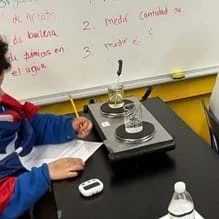 Students explore heat transferCopyright Marla Rhuma, Boston Public Schools, 2024
Students explore the concept of specific heat capacity by comparing how water and oil respond to heating. Through hands-on experimentation, students measure the temperature changes of both substances over time, graphing their results to determine which has the higher specific heat capacity. Building on this knowledge, students then engage in an engineering design challenge, where they work in teams to design and test a more energy-efficient cooking system. By considering factors such as material type, insulation, and surface area, students create prototypes that minimize heat loss and optimize energy use when heating liquids. After testing and analyzing their designs, students reflect on how different materials and designs affect thermal efficiency and propose improvements to their systems.
Specific heat is essential for materials engineers because it determines how materials behave under thermal conditions, which directly impacts their performance, safety, and efficiency in real-world applications. When selecting materials for specific environments—whether in construction, manufacturing, or aerospace—engineers must consider how much heat the material can absorb or dissipate without experiencing thermal degradation or failure. For instance, materials with high specific heat are often chosen for thermal insulation or environments requiring heat resistance, while materials with lower specific heat may be selected for applications where rapid temperature change is beneficial. This property is crucial in designing products that must withstand temperature fluctuations, ensuring longevity and reliability in various engineering systems. Understanding specific heat enables materials engineers to optimize processes such as heat treatment, cooling, and thermal management, improving energy efficiency and performance in industries ranging from automotive to electronics.
After this activity, students should be able to:
- Create a table and graph showing the change in temperature for water and oil.
- Explain why water and oil do not increase by the same amount of temperature using specific heat capacity.
- Solve for the heat energy added when given the specific heat capacity of water and oil, and then compare values.
- CCSS.Math.Content.HSS-ID.B.6 Represent data on two quantitative variables on a scatter plot, and describe how the variables are related.
Grades 9-12
Do you agree with this alignment? - CCSS.Math.Practice.MP2 Reason abstractly and quantitatively.
Grades K-12
Do you agree with this alignment? - CCSS.Math.Practice.MP4 Model with mathematics.
Grades K-12
Do you agree with this alignment?
- MP.2 Reason abstractly and quantitatively.
Grades K-12
Do you agree with this alignment? - MP.4 Model with mathematics.
Grades K-12
Do you agree with this alignment? - S.ID.6 Represent data on two quantitative variables on a scatter plot, and describe how the variables are related.
Grades 9-12
Do you agree with this alignment?
- HS-ETS1-2 Break a complex real-world problem into smaller, more manageable problems that each can be solved using scientific and engineering principles.
Grades 9-10
Do you agree with this alignment? - HS-ETS1-3 Evaluate a solution to a complex real-world problem based on prioritized criteria and trade-offs that account for a range of constraints, including cost, safety, reliability, aesthetics, and maintenance, as well as social, cultural, and environmental impacts.
Grades 9-10
Do you agree with this alignment?
- HS-ETS1-2 Design a solution to a complex real-world problem by breaking it down into smaller, more manageable problems that can be solved through engineering.
Grades 9-12
This resource focuses on the following Three Dimensional Learning aspects of NGSS:
Science & Engineering Practices- Design a solution to a complex real-world problem, based on scientific knowledge, student-generated sources of evidence, prioritized criteria, and tradeoff considerations.Do you agree with this alignment?
Disciplinary Core Ideas- Criteria may need to be broken down into simpler ones that can be approached systematically, and decisions about the priority of certain criteria over others (trade-offs) may be needed.Do you agree with this alignment?
Do you agree with this alignment? - Design a solution to a complex real-world problem, based on scientific knowledge, student-generated sources of evidence, prioritized criteria, and tradeoff considerations.
- HS-ETS1-3 Evaluate a solution to a complex real-world problem based on prioritized criteria and trade-offs that account for a range of constraints, including cost, safety, reliability, and aesthetics, as well as possible social, cultural, and environmental impacts.
Grades 9-12
This resource focuses on the following Three Dimensional Learning aspects of NGSS:
Science & Engineering Practices- Evaluate a solution to a complex real-world problem, based on scientific knowledge, student-generated sources of evidence, prioritized criteria, and tradeoff considerations.Do you agree with this alignment?
Disciplinary Core Ideas- When evaluating solutions it is important to take into account a range of constraints including cost, safety, reliability and aesthetics and to consider social, cultural and environmental impacts.Do you agree with this alignment?
Crosscutting Concepts- New technologies can have deep impacts on society and the environment, including some that were not anticipated. Analysis of costs and benefits is a critical aspect of decisions about technology.Do you agree with this alignment?
Do you agree with this alignment? - Evaluate a solution to a complex real-world problem, based on scientific knowledge, student-generated sources of evidence, prioritized criteria, and tradeoff considerations.
- HS-PS3-1 Create a computational model to calculate the change in the energy of one component in a system when the change in energy of the other component(s) and energy flows in and out of the system are known.
Grades 9-12
This resource focuses on the following Three Dimensional Learning aspects of NGSS:
Science & Engineering Practices- Create a computational model or simulation of a phenomenon, designed device, process, or system.Do you agree with this alignment?
Disciplinary Core Ideas- Energy is a quantitative property of a system that depends on the motion and interactions of matter and radiation within that system. That there is a single quantity called energy is due to the fact that a system's total energy is conserved, even as, within the system, energy is continually transferred from one object to another and between its various possible forms.Do you agree with this alignment?
- Conservation of energy means that the total change of energy in any system is always equal to the total energy transferred into or out of the system.Do you agree with this alignment?
- Energy cannot be created or destroyed, but it can be transported from one place to another and transferred between systems.Do you agree with this alignment?
- Mathematical expressions, which quantify how the stored energy in a system depends on its configuration (e.g. relative positions of charged particles, compression of a spring) and how kinetic energy depends on mass and speed, allow the concept of conservation of energy to be used to predict and describe system behavior.Do you agree with this alignment?
- The availability of energy limits what can occur in any system.Do you agree with this alignment?
Crosscutting Concepts- Science assumes the universe is a vast single system in which basic laws are consistent.Do you agree with this alignment?
- Models can be used to predict the behavior of a system, but these predictions have limited precision and reliability due to the assumptions and approximations inherent in models.Do you agree with this alignment?
Do you agree with this alignment? - Create a computational model or simulation of a phenomenon, designed device, process, or system.
Each group needs:
- Student Worksheet (PDF) (1 per student)
- Engineering Design Challenge Worksheet (PDF) (1 per student)
- 2 200 mL beakers
- 2 cups of vegetable oil
- 1 hot plate
- 1 pair of oven mitts
- eye protection for each student
- 2 cups of water
- 1 timer or stopwatch (students can also use their phone timers)
- 1 thermometer
For the class to share:
Suggestions for construction materials to make available for the engineering design challenge:
- aluminum and steel cans or small metal pots
- insulation materials (e.g., cotton, foam, aluminum foil, cardboard)
- materials for creating lids or custom pot designs (e.g., plastic wrap, foil, modeling clay)
- Students should know how to graph data from a table and also be able to describe the meaning of that data.
- Students should already know how to do basic arithmetic calculations such as subtraction, multiplication, and division.
Have you ever noticed how the crust of a warm apple pie gets hot, but the filling stays cool? That’s because the crust and the filling have different specific heat capacities!
But what exactly does that mean? Specific heat capacity is the amount of heat energy needed to raise the temperature of one gram of a substance by one degree Celsius.
As engineers, understanding specific heat is crucial. Materials with a high specific heat require more time and energy to heat up, while those with a low specific heat are faster to heat up.
Today, you’ll become materials engineers, investigating the specific heat of water and oil. You’ll heat both substances and track their temperatures every 30 seconds for 5 minutes to determine which one has the greater specific heat capacity.
Afterward, you’ll apply what you've learned in an engineering design challenge, where you'll design a more energy-efficient cooking system to reduce energy waste when heating liquids. Are you ready to dive into the science of heat and engineering? Let’s get started!
Background
Materials with high specific heat capacity take longer to heat up and require more energy to do so, while materials with low specific heat capacity heat up more quickly. This concept is expressed through the heat formula Q=mc∆T, where Q is the heat energy added, m is the mass, c is the specific heat capacity, and ΔT is the change in temperature (final temperature minus initial temperature). Specific heat capacity is defined as the amount of heat required to raise the temperature of one gram of a substance by one degree Celsius (or Kelvin), and is typically measured in joules per gram per degree Celsius (J/g°C). Materials that have a high specific heat, such as water, absorb more heat without experiencing large temperature changes, while substances with low specific heat, such as oil, heat up more quickly. Understanding this property is crucial for applications ranging from cooking to designing energy-efficient systems.
The specific heat capacity of a material is influenced by several factors, the most significant of which is the type of substance. For example, water's high specific heat is due to its molecular structure and strong hydrogen bonds, which require more energy to break and raise the temperature. By contrast, materials such as metals have lower specific heat capacities because their molecular bonds are weaker and heat up faster. Additionally, the phase of a material—whether it is solid, liquid, or gas—affects its specific heat. Water, for example, has a much higher specific heat in its liquid form than in its gaseous form. Other factors, such as temperature and pressure, can also alter specific heat, with different materials behaving differently under varying conditions. These factors determine how efficiently a substance can absorb and release thermal energy.
Heat transfer occurs through three primary mechanisms: conduction, convection, and radiation. Conduction is the transfer of heat between objects in direct contact, such as when heat moves from the hot plate to the beaker and from the beaker to the substance inside. Convection involves the movement of warmer molecules rising and cooler molecules sinking within fluids such as liquids and gases, facilitating heat transfer in those materials. Although radiation, the transfer of heat through electromagnetic waves, plays a smaller role in this experiment, it is still a key heat transfer mechanism. Each of these processes contributes to how heat moves and affects materials during heating.
Day 1 (70 minutes)
Before the Activity
- Make copies of the Student Worksheet (PDF), one per student.
- Gather each groups’ activity materials for measuring the specific heat capacity of water and oil.
Pre-Activity (10 minutes)
- Hand out one Student Worksheet (PDF)to each student.
- Read the Pre-Activity question: “Why do you think it feels colder stepping on the tiles of a bathroom floor than on a mat?” Give students 5 minutes to answer the question in their worksheet. Students working to complete the worksheet.Copyright Marla Rhuma, Boston Public Schools, 2024
 Students working to complete the worksheet.Copyright Marla Rhuma, Boston Public Schools, 2024
 - While students are working, walk around the classroom to look for answers that stand out.
- After 5 minutes, bring the class back together and call on a few students to share their responses.
Measuring Specific Heat Capacity of Oil and Water (60 minutes)
- Review the activity as a class (10 minutes)
- Ask for one student to volunteer to read the description of Specific Heat Capacity Experiment Part 1 in the Student Worksheet (PDF).
“Materials science involves investigating the unique properties of substances, such as boiling point, freezing point, and elasticity. In this activity, you will act as materials engineers conducting research on heat transfer. Your task is to heat two materials—water and oil—and record their temperatures every 30 seconds for 5 minutes. By analyzing the data, you will determine which substance has the greater specific heat capacity. Best of luck with your experiment!”
- Ask a different student to explain the task to be completed in Part 1. Note: This ensures the class understands what they will be doing. It also reinforces the Ask step of the engineering design process.
- Remind students that they will be working with hot materials, so they must be careful!
- Inform students that they MUST use oven mitts and wear eye protection (e.g., goggles).
- Walk through the activity procedure with the class to ensure they understand:
- Add 1 cup of water to beaker #1.
- Put beaker on hot plate and heat water to a boil.
- As the water heats, take the appropriate measurements outlined in the worksheet.
- Add 1 cup of oil to beaker #2.
- Put beaker on hot plate and heat oil to a boil.
- As the oil heats, take the appropriate measurements outlined in the worksheet.
- Collect data (15 minutes)
- Give students 12 minutes to collect their data for both the oil and water. As they complete the experiment, they should fill out their tables with their data.
- After 15 minutes, have students finish collecting their data and move on to graphing each of the graphs with different colors.
- Graph data (10 minutes)
- Remind students to include each part of the graph to receive full credit (e.g., label axes, add title, etc.).
- Conduct analysis (10 minutes)
- After completing their graphs, have students move on to the analysis portion of the lab.
- Remind students to answer each question using full sentences.
- Give students 10 minutes to answer the analysis questions with their group members.
- Reflection Writing Prompt (15 minutes)
- Allow 15 minutes for students to complete the writing prompt questions.
- Remind students to meet the minimum sentence requirement for each question.
- (optional or potential homework) Extension: Solving for the heat energy added to water and oil
- Have students complete the extension problems in the Student Worksheet, where they solve for the heat energy added to both water and oil.
Day 2 (70 minutes)
Before the Activity
- Make copies of the Engineering Design Challenge Worksheet (PDF), one per student.
- Review the engineering design process.
- Gather each groups’ activity materials for measuring the specific heat capacity of water and oil.
- Hand out one Engineering Design Challenge Worksheet (PDF)to each student.
- Ask: Introduce the design challenge by explaining that students will act as materials engineers tasked with designing a more energy-efficient cooking system to reduce energy waste when heating liquids.
- Research: Lead a discussion to review what was learned in the previous class about the specific heat capacity of water and oil. Have students take notes in the Research section of their Engineering Design Challenge Worksheet (PDF)as you review the key points:
- Water has a higher specific heat capacity than oil.
- Water absorbs more heat for each degree of temperature increase than oil.
- The temperature of water rises more slowly than that of oil.
- Water retains heat longer than oil.
- Water cools down more slowly than oil.
- Put students in groups of 2 to 3 students.
- Imagine: Give students 10 minutes to individually brainstorm prototypes that could create a more energy-efficient cooking system when heating liquids, factoring in what influences heat transfer, such as material type, insulation, and surface area. If students get stuck, have them think about:
- Material Type: Ask questions about why metal heats up faster than wood or why thermoses use certain materials to introduce the idea that different substances respond differently to heat. This leads to understanding that water (with a high specific heat capacity) heats up and cools down more slowly than oil (with a lower specific heat capacity).
- Insulation: Discuss how jackets, mittens, or polar bear fur work. This introduces the concept of retaining or slowing heat transfer. This relates to why water, with its high specific heat, can "hold" heat longer compared to oil, making it a better thermal stabilizer.
- Surface Area: Ask questions about how surface area affects heating or cooling. This helps students understand that the rate of heat transfer can depend on how exposed a material is. When combined with specific heat, this explains why water might take longer to heat up overall, even if both water and oil are exposed to the same surface area.
- Show students what materials are available for their prototypes.
- Plan: Have each group sketch one design they want to build for their cooking system, deciding:
- Which material to use for their prototype.
- How to insulate the prototype.
- Whether to include a lid or other design features to reduce heat loss.
- Build: Give groups time to construct their designs.
- Test: Let students test their designs using the provided materials and following their sketch.
- Have students test their designs by heating 1 cup of water or oil for a set time (e.g., 5 minutes).
- Have students record the starting and ending temperatures and calculate the change in temperature in the Test section of their Engineering Design Challenge Worksheet (PDF).
- Have students use the heat formula to calculate the energy used and evaluate efficiency.
- Give students time to analyze their data and their classmates’ data.
- Have each group share their results with the class.
- Have a class discussion comparing the results across the groups to identify which design(s) was most energy efficient.
- Discuss factors contributing to efficiency, such as material choice and insulation effectiveness.
- Improve: Have students write down what they would change to improve their design in the Improve section of the Engineering Design Challenge Worksheet (PDF).
- (optional) Iterate: Allow groups to modify their designs based on initial results and test again.
- specific heat capacity
- The quantity of heat required to raise the temperature of one gram of a substance by one degree Celsius.
- heat
- The energy that is transferred from one body to another as the result of a difference in temperature.
- temperature
- The measure of hotness or coldness expressed in terms of any of several arbitrary scales and indicating the direction in which heat energy will spontaneously flow.
- mass
- The resistance that a body of matter offers to a change in its speed or position upon the application of a force.
Pre-Activity Assessment
Worksheet Pre-Activity section: Before the activity starts, students complete the Pre-Activity question in the Student Worksheet (PDF)about why it feels colder to step on tiles of a bathroom floor than on a mat. This question introduces students to the concept of heat transfer and material properties, specifically how different materials (e.g., tile vs. mat) absorb and release heat. This provides insight into their prior knowledge about heat transfer, thermal conductivity, and the concept of specific heat.
Activity Embedded (Formative) Assessment
Specific Heat Capacity of Oil and Water Activity: When students are collecting data on the temperature changes of water and oil, you can review their recorded measurements. If students have missed key observations or made errors in their data, you can intervene and correct them. You should also check the graphs students create to ensure that they are accurately plotting their data, labeling axes correctly, and drawing meaningful conclusions.
Probing questions during the engineering design challenge: While students work in small groups to brainstorm and design energy-efficient systems, walk around and listen to their conversations. You can ask probing questions such as:
- Why do you think a certain material would be better for insulating your design?
- How does the specific heat capacity of the materials you're using affect your design?
This will help you assess whether students are applying the concepts of specific heat and heat transfer effectively as they design their prototypes.
Post-Activity (Summative) Assessment
Reflection Writing Prompt Questions: Students complete a writing prompt connecting specific heat to real-life phenomena and engineering in the Student Worksheet (PDF). They will be answering questions about why touching one object feels colder than touching another object.
Extension problem: Students will complete the extension activity in the Student Worksheet (PDF), where they solve for the heat energy added to both water and oil to make claims about the scientific process and how this relates to materials science.
Reflection Writing Prompt: Students will complete a reflection writing prompt discussing their design process, what worked well, what could be improved, and what they learned about specific heat and heat transfer through the experiment.
Students should wear mittens when touching the beakers on the hot plate.
Students can pick two different liquid materials of their choice and conduct a similar experiment to determine which has a higher specific heat.
Britannica, T. Editors of Encyclopedia (2024, April 26). specific heat. Encyclopedia Britannica. https://www.britannica.com/science
Contributors
Marla Rhuma (Boston Public Schools, East Boston High School); Shereen Mejia (Boston Public Schools, East Boston High School)
Supporting Program
NSF Research Experience for Teachers (RET) in Integrated Nanomanufacturing at the Photonics Center of Boston University
Acknowledgements
This activity was developed under National Science Foundation grant no. EEC-1407165—Boston University Photonics Center Research Experience for Teachers under the supervision of Helen Fawcett, PhD. However, these contents do not necessarily represent the policies of the National Science Foundation, and you should not assume endorsement by the federal government.
Copyright
2024 by Regents of the University of Colorado; original © 2024 Boston University