
Human Power
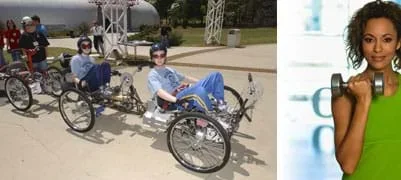 How much of your own "person power" does it take to equal a horse?Copyright (left) NASA http://mix.msfc.nasa.gov/abstracts.php?p=2631 (right) US National Library of Medicine http://dietarysupplements.nlm.nih.gov/dietary/women.jsp
Students do work by lifting a known mass over a period of time. The mass and measured distance and time is used to calculate force, work, energy and power in metric units. The students' power is then compared to horse power and the power required to light 60-watt light bulbs.
The basic concepts of work, force, energy and power are fundamental physics concepts utilized in many engineering calculations and design. Every engineered device that moves, lifts or pushes requires energy. Engineers must know how to calculate the power and energy needed to do the necessary work or provide the required heat. Most of the world uses metric units to quantify engineering terms. But the US is still one of the few countries that performs some of its engineering work in the old British system units. Metric units are all based on fundamental physics quantities, which makes the metric joule, newton and watt much easier to use and calculate than the British BTU (British thermal unit), horse power, pound force and slug.
After the activity, students should be able to:
- Define and contrast energy, work and power.
- Given mass, distance, and time, calculate work, force and power using appropriate units.
- Given the conversion equations, convert between horsepower and kilowatts.
- Use measurement tools to apply the concepts of work, power and energy to a real life example.
- CCSS.Math.Content.6.NS.B.2 Fluently divide multi-digit numbers using the standard algorithm.
Grade 6
Do you agree with this alignment? - CCSS.Math.Content.6.NS.B.3 Fluently add, subtract, multiply, and divide multi-digit decimals using the standard algorithm for each operation.
Grade 6
Do you agree with this alignment? - CCSS.Math.Practice.MP2 Reason abstractly and quantitatively.
Grades K-12
Do you agree with this alignment? - CCSS.Math.Practice.MP4 Model with mathematics.
Grades K-12
Do you agree with this alignment?
- Energy is the capacity to do work.
Grades 6-8
Do you agree with this alignment? - Power is the rate at which energy is converted from one form to another or transferred from one place to another, or the rate at which work is done.
Grades 6-8
Do you agree with this alignment?
- recognize and apply mathematics in contexts outside of mathematics
Grades -1-12
Do you agree with this alignment? - relate and compare different forms of representation for a relationship
Grades 6-8
Do you agree with this alignment? - develop an initial conceptual understanding of different uses of variables
Grades 6-8
Do you agree with this alignment? - model and solve contextual problems using various representations, such as graphs, tables, and equations
Grades 6-8
Do you agree with this alignment? - solve problems that arise in mathematics and in other contexts
Grades -1-12
Do you agree with this alignment? - understand relationships among units and convert from one unit to another within the same system
Grades 6-8
Do you agree with this alignment?
- Mathematics is important in all aspects of scientific inquiry.
Grades 5-8
Do you agree with this alignment? - Think critically and logically to make the relationships between evidence and explanations. Thinking critically about evidence includes deciding what evidence should be used and accounting for anomalous data. Specifically, students should be able to review data from a simple experiment, summarize the data, and form a logical argument about the cause-and-effect relationships in the experiment. Students should begin to state some explanations in terms of the relationship between two or more variables.
Grades 5-8
Do you agree with this alignment? - Use mathematics in all aspects of scientific inquiry. Mathematics is essential to asking and answering questions about the natural world. Mathematics can be used to ask questions; to gather, organize, and present data; and to structure convincing explanations.
Grades 5-8
Do you agree with this alignment? - Use appropriate tools and techniques to gather, analyze, and interpret data. The use of tools and techniques, including mathematics, will be guided by the question asked and the investigations students design. The use of computers for the collection, summary, and display of evidence is part of this standard. Students should be able to access, gather, store, retrieve, and organize data, using hardware and software designed for these purposes.
Grades 5-8
Do you agree with this alignment?
- 6.NS.2 Fluently divide multi-digit numbers using the standard algorithm.
Grade 6
Do you agree with this alignment? - 6.NS.3 Fluently add, subtract, multiply, and divide multi-digit decimals using the standard algorithm for each operation.
Grade 6
Do you agree with this alignment? - MP.2 Reason abstractly and quantitatively.
Grades -1-12
Do you agree with this alignment? - MP.4 Model with mathematics.
Grades -1-12
Do you agree with this alignment?
- MS-PS3-2 Develop a model to describe that when the arrangement of objects interacting at a distance changes, different amounts of potential energy are stored in the system.
Grades 6-8
Do you agree with this alignment?
- MS-PS3-2 Develop a model to describe that when the arrangement of objects interacting at a distance changes, different amounts of potential energy are stored in the system.
Grades 6-8
This resource focuses on the following Three Dimensional Learning aspects of NGSS:
Science & Engineering Practices- Develop a model to describe unobservable mechanisms.Do you agree with this alignment?
- Analyze and interpret data to provide evidence for phenomena.Do you agree with this alignment?
- Use mathematical representations to describe and/or support scientific conclusions and design solutions.Do you agree with this alignment?
Disciplinary Core Ideas- A system of objects may also contain stored (potential) energy, depending on their relative positions.Do you agree with this alignment?
- When two objects interact, each one exerts a force on the other that can cause energy to be transferred to or from the object.Do you agree with this alignment?
Crosscutting Concepts- Models can be used to represent systems and their interactions—such as inputs, processes and outputs—and energy and matter flows within systems.Do you agree with this alignment?
Do you agree with this alignment? - Develop a model to describe unobservable mechanisms.
To share with the entire class:
- scale (~500-1000 g)
Each group needs:
- stopwatch
- large bottle filled with water (500 ml – 1 L water or soda bottle)
- meter stick
- pole (2-3 cm dowel, ~ ½ m long)
- rope/string to tie bottle to dowel with ½ - 1 m length between
- activity sheet and data table (one per student)
 Human power experiment.Copyright 2008 Clarkson University, Potsdam NY
Work is force applied over a distance, and is measured in units of joules (J). That means that work is a measure of energy! Power, the rate at which work is done, is measured in joules per seconds. One J/s is also known as a watt. The watt is named after James Watt, who invented the first steam engine. When he was selling it, he advertised to farmers and miners that it could give more power than a horse. He said that it had 1.5 horsepower. Although the unit of horsepower is still used today, it does not accurately describe how many horses it replaces because not every horse is the same.
Not every person is the same either. How many of your own person power does it take to equal a horse? How about to light up a 60 W light bulb? Do you think you have enough power to do that?
Before class:
- Prepare the bottle/dowel apparatuses. Fill water bottle full and cap tightly. Tie ~1 m long string to the top of the bottle, and the other end to the middle of the dowel.
- Make copies of the Human Powered Student Worksheet.
With the students:
1. Have a student demonstrate the basic concept of the human power experiment (no measurement).
- Hold the dowel horizontally with a hand on either side of the string and with the string and bottle hanging down. The student might need to stand on a chair to hold the dowel high enough to lift the bottle off the floor.
- The student holds the dowel out in front of his/her body and rotates the dowel in his/her hands to raise the bottle as the string wraps around the dowel.
2. Discuss what happened – use discussion to review energy, work, and power – go over equations and units for force, work, power.
- Want to determine POWER
- Power = work/time
- Work = force x distance
- Force = mass x acceleration (know acceleration of gravity, need to measure mass)
3. Ask students: if you have two objects at different heights, which one has greater potential energy? (The higher one). When we do work on the bottle by pulling it up with the string, what is happening to the potential energy of the bottle? Discuss how doing work on an object means transferring energy to that object. Make sure students realize that work can also change the kinetic energy of an object, which would be observable as a change of motion or temperature of the object.
4. Ask students: If we wanted to determine how much work the student just did (and therefore how much energy was transferred to the object), what could we measure? (mass, time, distance – cannot measure force directly in this case)
5. Introduce the Human Power Activity. This activity requires students to collect data for mass, distance and time. The activity sheet lists equipment needed, but you may want to substitute heavier bottles so students can "feel" the work they do (filled 2-liter or half-gallon milk jugs work well).
6. Using the data collected in the activity, calculate average time and apply the appropriate formulas to calculate work and power. Calculate a few of the trials in class; have students finish the calculations for homework.
7. Hold up a 60 watt light bulb and ask if anyone produced enough power to light the bulb (hopefully no one actually does). Ask if they could produce more power possibly with their legs. (Give an example of human-powered bicycle headlights.)
8. Ask and/or lead a student (at the board) through a calculation of how many of themselves it would take to light the bulb, based on their power output from the activity. # of people to light 60 watt bulb = 60 watts/power from the activity. (For example, if the student's name was Nate and it took 300 of them to light the bulb, it is therefore a 300 Nate-power bulb)
9. Convert watts to horsepower in the activity.
Have students complete the activity worksheet and discussion questions and turn in for review and grading.
This activity was originally published by the Clarkson University K-12 Project Based Learning Partnership Program and may be accessed at http://internal.clarkson.edu/highschool/k12/project/energysystems.html.
Contributors
Susan Powers; Jan DeWaters; Clarkson and St. Lawrence University Students (K-12 Project Based Learning Partnership Program)
Supporting Program
Office of Educational Partnerships, Clarkson University, Potsdam, NY
Acknowledgements
This activity was developed under National Science Foundation grant nos. DUE 0428127 and DGE 0338216. However, these contents do not necessarily represent the policies of the National Science Foundation, and you should not assume endorsement by the federal government.
Copyright
2013 by Regents of the University of Colorado; original © 2008 Clarkson University