
Investigations With Nitinol: The Metal With Shape Memory!
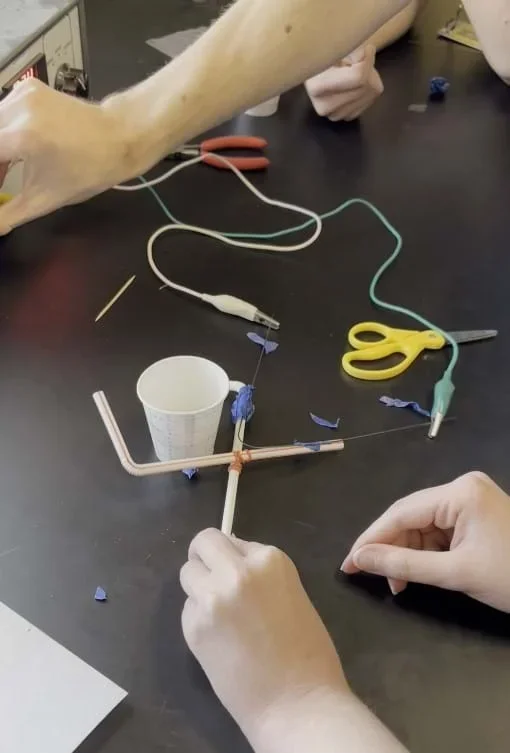 What uses can we come up with for a shape memory alloy?Copyright Josh Carroll
Students investigate nitinol (nickel-titanium alloy), a shape memory alloy known for its ability to return to a pre-set shape when heated and its super elastic properties. Through hands-on exploration, they examine how phase transformations between martensite and austenite influence nitinol’s behavior and discuss its applications in fields such as biomedicine, robotics, and aerospace. By connecting microscopic atomic structures to macroscopic material properties, students develop a deeper understanding of how engineers design advanced materials to solve real-world problems.
Materials engineers study nitinol because of its unique properties and wide range of applications. Its shape memory effect allows it to return to a pre-set shape when heated, making it valuable for self-expanding medical devices and actuators. Additionally, its superelasticity enables it to undergo large deformations and return to its original shape without permanent damage, which is useful in medical, aerospace, and robotic applications. Understanding the phase transformations between martensite and austenite helps engineers design materials that respond predictably to temperature changes or stress.
After this activity, students should be able to:
- Design an original demonstration of a material property using the engineering design process.
- Explain how the martensite/austinite phases of the nitinol alloy affect observed material properties.
- HS-ETS1-2 Design a solution to a complex real-world problem by breaking it down into smaller, more manageable problems that can be solved through engineering.
Grades 9-12
This resource focuses on the following Three Dimensional Learning aspects of NGSS:
Science & Engineering Practices- Design a solution to a complex real-world problem, based on scientific knowledge, student-generated sources of evidence, prioritized criteria, and tradeoff considerations.Do you agree with this alignment?
Disciplinary Core Ideas- Criteria may need to be broken down into simpler ones that can be approached systematically, and decisions about the priority of certain criteria over others (trade-offs) may be needed.Do you agree with this alignment?
Do you agree with this alignment? - Design a solution to a complex real-world problem, based on scientific knowledge, student-generated sources of evidence, prioritized criteria, and tradeoff considerations.
- HS-PS2-6 Communicate scientific and technical information about why the molecular-level structure is important in the functioning of designed materials.
Grades 9-12
This resource focuses on the following Three Dimensional Learning aspects of NGSS:
Science & Engineering Practices- Communicate scientific and technical information (e.g. about the process of development and the design and performance of a proposed process or system) in multiple formats (including orally, graphically, textually, and mathematically).Do you agree with this alignment?
Disciplinary Core Ideas- Attraction and repulsion between electric charges at the atomic scale explain the structure, properties, and transformations of matter, as well as the contact forces between material objects.Do you agree with this alignment?
Crosscutting Concepts- Investigating or designing new systems or structures requires a detailed examination of the properties of different materials, the structures of different components, and connections of components to reveal its function and/or solve a problem.Do you agree with this alignment?
Do you agree with this alignment? - Communicate scientific and technical information (e.g. about the process of development and the design and performance of a proposed process or system) in multiple formats (including orally, graphically, textually, and mathematically).
Teacher needs (for class demonstrations):
- 10-30 cm length of nitinol wire with activation above room temperature (available on Amazon)
- (optional) nitinol paperclip (available on Amazon)
- 2 500 ml beakers
- 500 ml water (warm)
- 500 ml water (cool)
- tongs
- Bunsen burner or hot plate (to warm water to around 35°C or 95°F)
- safety glasses or goggles
- (optional) thermometer
Each group needs:
- 1 student whiteboard or large sheet of paper
- colored whiteboard markers and eraser or markers for paper
- 10-30 cm length of nitinol wire with activation above room temperature (available on Amazon)
- 1 pair of needle nose pliers
- 1 pair of heat-resistant gloves
- safety glasses or goggles for every student
- 1 Student Guide (PDF) for each student
For the entire class to share:
- power supplies or three 6V batteries with alligator clips
- assorted construction paper, scissors, glue, rubber bands, straws, tape and other supplies at teacher’s discretion
- laptop with projector (to display the Nitinol Slides (PPTX))
Students should:
- Be familiar with the types of elements in the periodic table.
- Be familiar with metal alloys.
- Have background knowledge of the atomic structures of various types of compounds and molecules.
- Optional: Be familiar with phases of matter (solid/liquid/gas) and phase diagrams for compounds such as water.
What if I told you there’s a metal that can remember its shape—like it has a mind of its own? Today, you're going to witness something that seems like science fiction but is 100% real. We’re going to kick off with a live demo where a bent piece of wire will magically return to its original shape just by being dipped in warm water. Sounds wild, right? Your job is to observe, ask questions, and figure out what might be going on. You’ll start to uncover the mystery behind this strange behavior and begin thinking like real scientists and engineers.
But that’s just the beginning. You’re not just students today—you’re materials engineers, diving into the world of smart metals. You’ll learn about a unique alloy called nitinol, which has incredible shape-changing powers. These kinds of metals are used in everything from space shuttles to medical devices to high-tech glasses. Then it’s your turn to take what you’ve learned and create something brand new. Using the engineering design process, you’ll invent, sketch, prototype, and test your own smart metal device. Think: self-fixing jewelry, transforming robots, or gadgets that work without motors. Your imagination is the limit!
By the end of this challenge, you’ll have a deeper understanding of how materials work at the atomic level—and you’ll have designed your own futuristic tech using nitinol. This is your chance to turn science into innovation, and maybe even create the next big thing. Ready to explore the magic of metal memory and show off your engineering skills? Let’s do this!
Background
Metals are shiny, malleable, and good conductors of heat and electricity. Comparatively, nonmetals are dull, brittle, and poor conductors of heat and electricity. Nitinol is made up of two or more metals, and we observe these properties in the opening demonstration in the lesson. Because nitinol is not made of a single metal element, it is considered an alloy, a solid mixture of metallic elements.
A metal is a type of material that typically has high electrical and thermal conductivity, luster, and the ability to be shaped or molded (malleability and ductility). Metals are composed of atoms that readily lose electrons to form positive ions and are held together by strong metallic bonds, which allow electrons to move freely throughout the material. This free movement of electrons is what gives metals their conductivity and other characteristic properties, such as their ability to conduct heat and electricity. Common examples of metals include iron, copper, aluminum, and gold. Metals are widely used in construction, manufacturing, electronics, and many other industries because of their strength, durability, and versatility.
An alloy is a material made by combining two or more elements, at least one of which is a metal, to enhance certain properties such as strength, durability, corrosion resistance, or workability. Alloys are often created to improve on the characteristics of pure metals, which may be too soft, brittle, or reactive for practical use. For example, steel is an alloy of iron and carbon, where carbon improves the strength and hardness of iron. Alloys can also be designed to have specific properties, such as lightweight aluminum alloys for aircraft or corrosion-resistant stainless steel for cookware.
Nitinol is a metal alloy made of nickel and titanium, known for its unique properties of shape memory and super elasticity. It can "remember" its original shape, returning to that shape when heated after being deformed, and it can also withstand significant deformation without permanent damage, recovering its form when a load is removed. These properties result from a phase transition between two crystal structures, austenite and martensite, depending on temperature and stress. Nitinol is commonly used in medical devices such as stents and orthodontic wires, as well as in various engineering applications.
Before the Activity
- Gather all the materials needed for the teacher demonstrations (e.g., nitinol wire, hot plate or Bunsen burner, beaker, tongs, thermometer, water, etc.).
- Prepare and organize all tools and materials needed for each group’s design and prototype work.
- Make copies of the Student Guide (PDF) (one per student).
- Make a copy of the Group Checklist (PDF)(for your use).
- Review the Nitinol Slides (PPTX) and be ready to present them to the class.
During the Activity
Part 1: Demonstration and Discussion (10 min)
- Hand out one Student Guide (PDF) to each student.
- Begin the activity by showing the demonstration of the nitinol wire. (Note: A nitinol paper clip can also be used for the demonstration.)
- Set up a Bunsen burner or hotplate in a place in the classroom where all students can view the demonstration.
- Add enough water into a 300 mL to 500 mL beaker that is deep enough for the nitinol wire to be submerged.
- Heat the water to the activation temperature of your nitinol sample (typically between 50–60°C or 120–140°F).
- Pre-bend the nitinol wire or paper clip out of shape.
- Using tongs, dip the pre-bent nitinol wire into the heated water until it is fully submerged.
- Remove the nitinol wire or paperclip from water when it finishes changing shape.
- Instruct students to record two observations they made during the demonstration in their Student Guide (PDF).
- Give students 2 minutes to make inferences or statements about what is behind their observations in their Student Guide (PDF). Prompt the students with these questions:
- What do you think is causing the changes you see in the situation?
- What inferences can you make about the situation?
- What might be some of the causes of the observations you are making about the situation?
- As a class, discuss what students observed and what they think is going on. Ask the following questions:
- How is the metal changing shape? (Potential answers: Somehow energy is making the wire move or the heat energy is being transferred).
- What do you know about metals? (Potential answers: They conduct heat and electricity well).
- What do you know about the structure of metals? (Potential answers: Most metals are alloys, they are a mixture, they are solids at room temperature).
- What could be causing this change in shape? (Answer: The heat).
- How is this possible? (Answer: Somehow the metal is doing something like expanding and contracting).
- And how and why THIS shape? (Answer: This metal has a “memory,” which we will explore).
- How could this be useful? (Potential answers: Could be used to move things, make designs, replace hydraulics or motors).
- Ask students what kinds of questions they have about this material and have students record their questions in their Student Guide (PDF).
- Ask students to share some of their questions with the class.
Part 2: Introduction, Ask, and Research (20 min)
- Display the Nitinol Slides (PPTX).
- Read through Slide 2: This material is called nitinol, and you can probably understand why it is considered a shape memory alloy. Shape memory alloys are metals that exhibit shape-changing properties when heated. These shape memory alloys are sometimes called smart metals.
- Read through Slides 3 and 4: Smart metals are useful in all kinds of applications, such as space exploration, aerospace, biomedical devices, art, jewelry, glasses, braces, and more!
- Present the design challenge on Slide 5: Today, you’re not just students—you’re materials science engineers. You’re going to dive into the mysterious world of nitinol. We’re going to uncover what’s happening deep inside at the atomic level that makes this possible. And then… it’s your turn. Your challenge? Use the engineering design process to invent your own use for this amazing metal. That’s right—you’ll design it, prototype it, and test it. Think: eyeglasses that repair themselves, or robots that move without motors. Let’s see if you can turn this strange wire into the next big thing in technology.
- Introduce or review the steps of the engineering design process on Slide 6.
- Ask: Reiterate the design challenge. Ask students to think about the problem they want to solve. What do they want to design? Who is it for? What do we want to accomplish? What are the project requirements? What are the limitations? What is their goal?
- Research:
- Present Slides 7-12. Have students follow along in their Student Guide (PDF) to fill in blanks and complete prompts for discussions and diagrams.
- For Slides 13 – 14, have students recall the demonstration you performed at the beginning of class. Have students work through their Student Guide (PDF) as they are prompted to think about the macroscopic and macroscopic changes in the wire during the demonstration.
- Perform a second nitinol demonstration of the wire in a “super elastic” state (transition temperature below room temperature).
- Submerge the wire in cool water.
- Show students that the wire can be stretched or deformed and return to its original shape without heating.
- Show Slides 16-17 and have students complete their Student Guide (PDF)during this time as they are prompted to think about the macroscopic and macroscopic changes in the wire during the second demonstration.
- Emphasize or reiterate the following key ideas:
- The behavior of the nitinol wire differs significantly between hot and cold water because of its shape memory and super elasticity properties:
- Hot water: When the nitinol wire is submerged in hot water, it changes back to its original, pre-programmed shape. This is because heat causes the material's atomic structure to return to its "remembered" configuration (this is the shape memory effect).
- Cold water: When the nitinol wire is cooled (submerged in cold water), it becomes super-elastic. This means it can be stretched or deformed and, once released, will return to its original shape without needing heat. The super-elasticity comes from the material's ability to undergo a reversible phase transformation at a temperature below room temperature.
- Atomic structure: Nitinol has a special atomic arrangement that allows it to "remember" its original shape when heated. This is due to the phase transition between the austenite phase (high temperature) and the martensite phase (low temperature), which allows the wire to "snap back" to its pre-formed shape when heated.
- Memory effect: When heated, the atoms in nitinol shift from one arrangement to another (from martensite to austenite), causing the wire to regain its original shape. Cooling allows it to return to a more flexible state, where it can be deformed and then recover its shape.
- Perform a quick embedded assessment to reveal who might need more guidance or instruction. Ask students to give a “fist to five” check for understanding (five fingers being “I fully understand” to 1 finger “I have no idea”) for the following topics:
- Metals, nonmetals, alloys
- Structure of metals and alloys
- Structure of nitinol
- Representing changes in the microscopic structure of nitinol
Part 3: Imagine, Plan, Create, and Test (30 min)
- Show Slide 18 and reiterate the design challenge.
- Show Slide 19 and present the example.
- Display the materials available for their device prototypes.
- Give students 5 minutes to sketch all ideas they individually have for a NiTi device in their Student Guide (PDF).
- Divide the class into groups of 3-4 students.
- Give students 5-10 minutes to share their brainstormed ideas and then as a team select ONE solution they want to try. This can be one specific solution or a mixture of ideas. Have everyone draw their team’s solution in the “Plan” section of their Student Guide (PDF). Remind students to label parts of their device and identify the materials they want to use.
- Give students time to create and test their prototype devices.
- While students work on the creating and testing steps, walk around the classroom and ask questions about each team’s design and assess student involvement using the Group Checklist (PDF).
- Have students answer the questions in the “Test” section of their Student Guide (PDF).
What uses can we come up with for a shape memory alloy?Copyright Josh Carroll
Part 4: Whiteboards and Presentation (30 min)
- After each group creates and tests their prototype, distribute whiteboards or paper, markers, and erasers.
- Show Slide 20 with the Board Meeting requirements.
- Give students 10 minutes to draw representations of the microscopic and macroscopic explanations of their group’s prototype devices on their whiteboards.
- Give each group 2 minutes to present their whiteboard.
- Have students ask each group 2-3 questions after the group presents.
- Have students answer the questions and take notes in the “Whiteboard Meeting Notes” section of their Student Guide (PDF).
- Take photos of each group whiteboard as summative assessment.
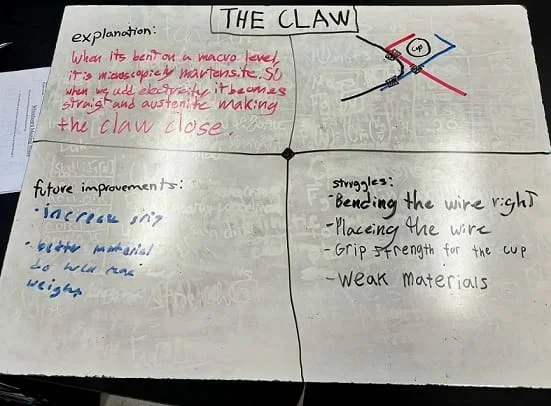 Student whiteboarding is used for informal presentation of ideas.Copyright Josh Carroll
- metal
- An element that is shiny, malleable, and a good conductor of heat and electricity. Has a positive ionic charge.
- nonmetal
- An element that is dull, brittle, and a poor conductor of heat and electricity.
- alloy
- A solid mixture of a metallic elements.
- crystalline solid
- A solid in which particles are arranged in repeating patterns.
- amorphous
- A solid in which particles are randomly arranged throughout; also known as non-crystalline solids or glasses.
- unit cell
- The simplest repeating unit of the structure of a crystalline solid.
- lattice points
- Locations where atoms or ions can be placed in a unit cell.
- simple cubic structure
- A crystalline structure with a cubic unit cell and lattice points at the corners.
- martensite
- A crystalline structure that looks like a squished cube or parallelogram cube.
- austenite
- A crystalline arrangement that looks like a simple cubit structure.
Pre-Activity Assessment
“Fist to Five:” After going through the background information slides of the Nitinol Slides (PPTX) (Slides 7-17), perform a quick embedded assessment to reveal who might need more guidance/questions/instruction. Ask students to give a “fist to five” check for understanding (five fingers being “I fully understand” to 1 finger “I have no idea”) for the following topics:
- Metals, nonmetals, alloys
- Structure of metals and alloys
- Structure of nitinol
- Representing changes in the microscopic structure of nitinol
Activity Embedded (Formative) Assessment
Background Chemistry Information: Students complete the questions in their Student Guide (PDF) as you go through the background information slides.
Engineering Design Process: Students sketch, plan, and answer questions after testing their prototype devices in their Student Guide (PDF), which demonstrates that they are following the engineering design process steps.
Group Checklist: During the group work and whiteboard time, observe each group and complete the Group Checklist (PDF). Ask students questions related to their performance of the checklist items.
Post-Activity (Summative) Assessment
Team whiteboard presentations: The summative assessment for this activity is the student whiteboard. After the presentation, students or you should take pictures of the whiteboards and assess them for the key items given at the beginning of the whiteboard session.
Students will need to wear protective gloves when handling the nitinol because some of the wire is very thin. Also, some students may not know how to safely use a power supply, so you may want to have one power supply at the front of the room for guidance and supervision during testing.
A common problem with the activity could entail:
- The wire does not go back to its “remembered” shape when attached to power supply. Solution: Turn the voltage down and wait longer for the length of the wire to heat. Alternatively, if it is safe with the design, use a lighter to heat the wire.
- For the introductory demonstration, the nitinol paperclip can be used as an alternative to the form pre-made by the teacher (available at Sci-Supply).
- Modifications for lower grade levels or for classes with time constraints:
- Make it a whole-class project (no stations) with the nitinol paperclip demo as the mystery to contemplate.
- Follow the engineering design process as a group.
- Focus on key concepts of metals vs nonmetals and properties at different temperatures.
- Adjust student sheets and PowerPoint accordingly.
- Modifications for higher grade levels or advanced students:
- Use a problem-based learning approach by beginning with the demo, then dividing into teams for each to experiment and investigate on their own without any other investigative structure or introduction except the engineering design process.
- At first, do not allow teams to use online resources.
- Have them present best ideas and questions. Then, allow teams to use online resources to upgrade their presentation with additional information.
- Have teams present again and link to real-world applications for nitinol.
Aurora Design. “Nitinol - FAQ - Smart Wires.” Smartwires.eu, 2020, http://smartwires.eu/index.php?id_cms=9&controller=cms&id_lang=1. Accessed 29 Nov. 2023.
Eduqas. “Design and Technology.” Resource.download.wjec.co.uk.s3.Amazonaws.com, 29 Nov. 2023, http://resource.download.wjec.co.uk.s3.amazonaws.com/vtc/2016-17/16-17_1-4/website/category/2/shape-memory-alloys-sma/index.html. Accessed 29 Nov. 2023.
Engineerguy. “Nitinol: The Shape Memory Effect and Superelasticity.” Www.youtube.com, 25 Oct. 2015, http://www.youtube.com/watch?v=wI-qAxKJoSU. Accessed 29 Nov. 2023.
Flowers, Paul. “OpenStax.” Openstax.org, 2019, http://openstax.org/details/books/chemistry-2e. Accessed 29 Nov. 2023.
Mmm-jun. “This Is a Picture Illustrating Shape Memory Effect of NiTi Alloys.” Wikimedia Commons, 10 Dec. 2012, http://commons.wikimedia.org/wiki/File:NiTi_structure_transformation.jpg#/media/File:NiTi_structure_transformation.jpg. Accessed 29 Nov. 2023.
Nasa Technology Transfer Program. “NASA’s Shape Memory Materials Open Doors for Smart Tech | T2 Portal.” Nasa.gov, 2022, http://technology.nasa.gov/Shape%20Memory%20Materials%20Open%20Doors%20for%20Smart%20Tech. Accessed 29 Nov. 2023.
Science, MEL. “Nitinol Paper Clip.” MEL Science, 29 Nov. 2023, http://melscience.com/US-en/physics/experiments/physics-nitinol_1-paper-clip. Accessed 29 Nov. 2023.
Science, Verge. “How a Metal with a Memory Will Shape Our Future on Mars.” Www.youtube.com, 17 Mar. 2021, http://www.youtube.com/watch?v=Pn-6bGORy0U. Accessed 29 Nov. 2023.
Shimoga, Ganesh, et al. “An Intermetallic NiTi-Based Shape Memory Coil Spring for Actuator Technologies.” Metals, vol. 11, no. 8, 29 July 2021, p. 1212, https://doi.org/10.3390/met11081212. Accessed 29 Nov. 2023.
Veritasium. “How NASA Reinvented the Wheel.” Www.youtube.com, 29 Apr. 2023, http://www.youtube.com/watch?v=vSNtifE0Z2Q&t=2s. Accessed 29 Nov. 2023.
Wang, Liqiang. “Niti Structure: (A) Austenite B2 Structure; (b) Martensite B19 ...” Research Gate, Apr. 2018, http://www.researchgate.net/figure/Fig-2-NiTi-structure-a-austenite-B2-structure-b-martensite-B19-structure_fig45_324355411. Accessed 29 Nov. 2023.
Wikipedia Contributors. “Shape-Memory Alloy.” Wikipedia, Wikimedia Foundation, 11 Sept. 2019, http://en.wikipedia.org/wiki/Shape-memory_alloy. Accessed 29 Nov. 2023.
Contributors
Josh Carroll
Supporting Program
Engaging and Enabling Teachers through Advanced Manufacturing Research RET Site, Clemson University
Acknowledgements
This digital library content was developed by the Engaging and Enabling Teachers through Advanced Manufacturing Research RET Site at Clemson University under National Science Foundation grant number 2206962. However, these contents do not necessarily represent the policies of the NSF and you should not assume endorsement by the federal government.
Copyright
2025 by Regents of the University of Colorado; original © 2023 Clemson University