
Astro Cup: Designing Quieter Spaceships and Habitats
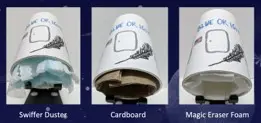 Examples of decorated cups.Copyright Photo by Kristen Yip 2022
Students take on the role of acoustic engineers to investigate how different materials affect sound inside a spacecraft crew capsule. Using two cups, one as a control and one as a "capsule-cup," students test everyday household materials such as cotton, foam, bubble wrap, aluminum foil, and paper to determine which materials are most effective at reducing perceived noise. Students decorate their capsule-cup to resemble Blue Origin's New Shepard crew capsule and test two different space-related sounds, such as a Saturn V launch recording or sounds recorded aboard the International Space Station (ISS). Students hold each cup over an ear, listen to the sounds at a moderate volume, and compare the results. They record whether each material makes the sound seem louder, quieter, or unchanged compared to the control cup. After testing, students analyze their findings, reflect on how different sounds affect people, and consider engineering tradeoffs such as incorporating windows into a spacecraft. Finally, students apply their findings to design a quieter rocket or space habitat, identifying areas for scientific equipment, exercise, and sleeping quarters.
The acoustic principles in this activity apply to many engineering fields. Aerospace engineers use sound-dampening materials in spacecraft to protect astronauts during launch and long missions. Automotive engineers reduce road and engine noise inside vehicles for passenger comfort. Architects and architectural engineers select insulation and building materials to control sound in schools, hospitals, and concert halls. Consumer electronics engineers apply acoustic principles when designing headphones and speakers. Industrial engineers use sound barriers to protect workers from excessive noise exposure in factories and airports. By investigating and comparing the effectiveness of different materials, students explore how engineers use acoustic principles to improve safety and comfort in real-world environments.
After this activity, students should be able to:
- Investigate how different materials absorb, reflect, or transmit sound by conducting a controlled experiment and comparing results across multiple everyday materials.
- Apply the engineering design process to identify a real-world problem (noise in spacecraft) and evaluate potential solutions based on their effectiveness in reducing sound.
- Collect, record, and analyze data to draw evidence-based conclusions about which materials perform best for acoustic insulation in a crew capsule.
- STEL-7T Assess design quality based upon established principles and elements of design.
Grades 6-8
Do you agree with this alignment? - STEL-7U Evaluate the strengths and weaknesses of different design solutions.
Grades 6-8
Do you agree with this alignment?
- MS-ETS1-1 Define the criteria and constraints of a design problem with sufficient precision to ensure a successful solution, taking into account relevant scientific principles and potential impacts on people and the natural environment that may limit possible solutions.
Grades 6-8
This resource focuses on the following Three Dimensional Learning aspects of NGSS:
Science & Engineering Practices- Define a design problem that can be solved through the development of an object, tool, process or system and includes multiple criteria and constraints, including scientific knowledge that may limit possible solutions.Do you agree with this alignment?
Disciplinary Core Ideas- The more precisely a design task's criteria and constraints can be defined, the more likely it is that the designed solution will be successful. Specification of constraints includes consideration of scientific principles and other relevant knowledge that is likely to limit possible solutions.Do you agree with this alignment?
Crosscutting Concepts- The uses of technologies and any limitations on their use are driven by individual or societal needs, desires, and values; by the findings of scientific research; and by differences in such factors as climate, natural resources, and economic conditions.Do you agree with this alignment?
- All human activity draws on natural resources and has both short and long-term consequences, positive as well as negative, for the health of people and the natural environment.Do you agree with this alignment?
Do you agree with this alignment? - Define a design problem that can be solved through the development of an object, tool, process or system and includes multiple criteria and constraints, including scientific knowledge that may limit possible solutions.
- MS-ETS1-2 Evaluate competing design solutions using a systematic process to determine how well they meet the criteria and constraints of the problem.
Grades 6-8
This resource focuses on the following Three Dimensional Learning aspects of NGSS:
Science & Engineering Practices- Evaluate competing design solutions based on jointly developed and agreed-upon design criteria.Do you agree with this alignment?
Disciplinary Core Ideas- There are systematic processes for evaluating solutions with respect to how well they meet the criteria and constraints of a problem.Do you agree with this alignment?
Do you agree with this alignment? - Evaluate competing design solutions based on jointly developed and agreed-upon design criteria.
- MS-ETS1-3 Analyze data from tests to determine similarities and differences among several design solutions to identify the best characteristics of each that can be combined into a new solution to better meet the criteria for success.
Grades 6-8
This resource focuses on the following Three Dimensional Learning aspects of NGSS:
Science & Engineering Practices- Analyze and interpret data to determine similarities and differences in findings.Do you agree with this alignment?
Disciplinary Core Ideas- There are systematic processes for evaluating solutions with respect to how well they meet the criteria and constraints of a problem.Do you agree with this alignment?
- Sometimes parts of different solutions can be combined to create a solution that is better than any of its predecessors.Do you agree with this alignment?
- Although one design may not perform the best across all tests, identifying the characteristics of the design that performed the best in each test can provide useful information for the redesign process—that is, some of the characteristics may be incorporated into the new design.Do you agree with this alignment?
Do you agree with this alignment? - Analyze and interpret data to determine similarities and differences in findings.
Each group needs:
- 1 laptop or computer with internet access
- 2 plastic or paper cups (12–16 oz; one control cup and one capsule-cup)
- 3-6 different everyday household materials (see options below)
- markers or crayons for decoration
- tape
- scissors
- 1 device per group (phone, tablet, or laptop) with preloaded space sounds, or access to a central speaker (see below)
- Astro Cup Handout (1 per student)
- (optional) pre-portioned bags of testing materials
For the class to share:
- 1 small bag of cotton balls
- 1 small roll of aluminum foil
- 1 small roll or sheet of bubble wrap
- 2–3 sheets of craft foam or packing foam
- small assortment of recycled cloth or fabric scraps
- small stack of scrap or construction paper
- 1 roll of masking or transparent tape
- 1 central speaker and audio playback device (optional, if not using individual group devices)
- space sound recordings (for either playback method):
Welcome, everyone! Before we get started today, I want you to close your eyes for just a moment and imagine you're strapped into a rocket seat. The countdown begins... 3... 2... 1... liftoff! (Pause for a few seconds. Optional: Play a 15-20 second clip of the Saturn V launch sound or a New Shepard launch video. Turn the volume up so students can feel the intensity.)
Okay, open your eyes. What did you notice? What did you wonder? (Call on 2-3 students. Possible answers: "It was really loud!" "It sounded like thunder." "How do astronauts hear each other?" "Does it hurt their ears?" Write responses on the board.)
Those are amazing observations. Here's something to think about: Astronauts spend hours, sometimes months, inside spacecraft surrounded by loud engines, humming equipment, fans, pumps, and life support systems. Imagine trying to sleep, eat, do a science experiment, or even just talk to a crewmate with all that noise around you.
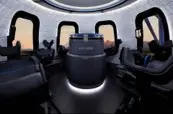 Inside a New Shepard crew Capsule.Copyright Interior of New Shepard’s Crew Capsule, Blue Origin, https://www.blueorigin.com/_next/image?url=https%3A%2F%2Fd1o72l87sylvqg.cloudfront.net%2Fblue-origin%2FNewShepard_capsule-details.jpg&w=1920&q=75
What problem do you think engineers at companies like Blue Origin and NASA have to solve? (Possible answers: "Make it quieter." "Protect astronauts' ears." "Help them sleep." Affirm all responses.)
Exactly! This is a real job. It's called acoustic engineering—designing spaces and materials to control sound. And it's not just about space. Think about it: Where else in your life do you experience noise that bothers you? (Possible answers: "Traffic outside my window." "Loud classrooms." "Airplanes overhead." "Construction." "My little brother!" Encourage laughter and connection.)
That's the beauty of this problem—it affects everyone. Acoustic engineers design quieter cars, hospitals where patients can rest, headphones that block out noise, and yes, spacecraft that keep astronauts comfortable and safe.
Today, you are the acoustic engineers. Your mission is to figure out which everyday materials work best to quiet down the noise inside a crew capsule.
(Hold up a plastic or paper cup.) This is your crew capsule. It's small, just like a real one. You'll test different materials such as cotton, foil, bubble wrap, fabric, and foam to see which ones make sounds quieter, louder, or the same. You'll play space sounds through the cup and compare what you hear.
Here's the exciting part: There is no single right answer. Engineers try many solutions, collect data, and use what they learn to make better designs. You might discover something surprising—maybe a material you thought would work great actually doesn't, or maybe something ordinary turns out to be amazing.
As you work, I want you to think like a real engineer. That means:
- Ask questions. If you're curious, that's a sign you're on the right track.
- Test carefully. Try to play the sound the same way every time so your results are fair.
- Record what you observe. Even “surprising” or “weird” results are valuable data.
- Talk with your group. Some of the best engineering happens when people share ideas.
You can work with your group however works best for you. Some of you might want to sketch designs first. Others might want to jump right into testing. Some might want to research materials online before starting. All of those are valid ways to approach this problem. (Optional: Briefly show the data table on the board or handout so students know how they'll record findings.)
Here's something cool to remember: The work you're doing today mirrors what real engineers do every single day—at Blue Origin, at NASA, in car companies, in hospitals, in recording studios. Engineering isn't just about rockets; it's about solving problems that make life better for people.
And who are those people? They might be astronauts on the Moon someday. But they might also be people in your neighborhood who live near a noisy highway, or a baby in a hospital who needs a quiet environment to grow strong, or a student trying to focus in a busy classroom. Engineers design for people. Today, you get to design for the future.
Before we begin, take 30 seconds with your group. Talk about this: What's one material you think will work really well, and why? What's one you think won't work at all? Make a prediction, and we'll come back to it at the end and see if you were right. (Give groups 30 seconds to discuss. Then distribute materials and data sheets.)
Alright, acoustic engineers, let's get to work. Liftoff in 3... 2... 1..." (Begin the activity.)
Background (Educator's Guide)
Sound is a form of energy that travels in waves created by vibrating objects. When something vibrates—a rocket engine, a fan, a human voice—it causes the air molecules around it to compress and expand, creating sound waves that travel outward until they reach our ears. Our eardrums vibrate in response, allowing us to perceive sound. Sound waves are described by two key properties: amplitude, which determines loudness and is measured in decibels, and frequency, which determines pitch and is measured in hertz.
When sound waves encounter a material, three things can happen: The sound can be reflected (bounced back), absorbed (converted into a small amount of heat energy within the material), or transmitted (passing through the material to the other side). Materials that are soft, porous, and fibrous, such as cotton, foam, and fabric, tend to absorb sound waves effectively because the tiny air pockets inside them trap and dissipate sound energy. In contrast, hard, dense, smooth materials such as metal, glass, and plastic tend to reflect sound waves, which can actually make sounds seem louder or create echoes. This is the fundamental principle behind acoustic engineering: selecting and arranging materials to control how sound behaves in a given environment.
In the context of space travel, acoustic engineering is critical. Rocket engines produce noise levels above 140 decibels during launch, which is loud enough to cause permanent hearing damage in seconds. Even once in orbit, spacecraft interiors are filled with continuous noise from ventilation fans, water pumps, computer cooling systems, and life-support equipment. NASA has documented that International Space Station noise levels often exceed 65 decibels, comparable to a loud restaurant, and astronauts have reported sleep disruption, fatigue, and hearing loss on long-duration missions. Engineers at Blue Origin, NASA, and other aerospace companies solve this by lining crew capsules with sound-absorbing materials, isolating noisy equipment with vibration dampeners, and designing quiet ventilation systems.
This activity introduces students to these concepts through a hands-on, controlled experiment. By comparing a “control cup” (empty) to a “capsule-cup” (filled with a test material), students isolate one variable at a time—the type of material—and observe its effect on perceived sound. This mirrors the engineering design process used by professionals: identifying a problem, researching solutions, testing designs, collecting data, and iterating based on results. The activity connects to broader real-world applications including automotive design, architecture, consumer electronics, and workplace safety, demonstrating that acoustic engineering is not just a "space problem" but rather a universal challenge affecting people's health, comfort, and quality of life.
Before the Activity (Preparation)
- Gather materials for each group of 3-4 students (see Equipment and Materials section).
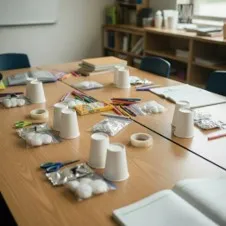 Materials for students.Copyright Photo by Kristen Yip 2026
- Make copies of the Astro Cup Handout (1 per student).
- Pre-load space sounds on each group's device, or prepare a central speaker for audio playback, depending on the testing setup:
- NASA's Saturn V launch audio
- Real ISS ambient sound recordings
- Confirm links work and set volume to a safe, moderate level.
- Optional: Pre-portion testing materials into bags to facilitate quick distribution.
- Set up a materials station with materials available for testing.
- Prepare the control cup and capsule-cup testing setup for demonstration.
- Optional: Bookmark or display an image of Blue Origin's New Shepard crew capsule for design inspiration.
- Post key vocabulary on the board: acoustic, absorb, reflect, dampen.
- Consider accommodations: Prepare visual aids for multilingual learners and alternative participation methods for students with hearing sensitivities or hearing impairments.
During the Activity
Hook and Introduction (5 minutes)
- Introduce the activity as outlined in the Introduction and Motivation section.
- Divide the students into groups of 3 or 4.
- Distribute one Astro Cup Handout to each student.
Research, Imagine, and Plan (20 minutes)
- Research
- Give students 10 minutes to research different types of materials scientists and engineers use to reduce or control sound.
- Have students record their findings in the "Research Data" section of their Astro Cup Handout.
- Prompt students with the following questions:
- What materials do aerospace engineers use to reduce noise inside spacecraft?
- What properties make certain materials effective at reducing sound?
- How do engineers test and compare the effectiveness of sound-dampening materials?
- Imagine and Plan
- Distribute two cups, markers or crayons, scissors, and tape to each group.
- Instruct students to designate one cup as the "control cup" (empty) and one as the "capsule-cup."
- Have students briefly label or decorate their capsule-cup using markers or crayons (2–3 minutes maximum).
- Display the materials available for testing.
- Give students 2 minutes to individually identify three materials they predict will be most effective at reducing sound.
- Have students discuss their predictions within their groups and select three materials to test. Ask students to explain the reasoning behind their selections.
- Optional: Have groups plan how they will position their selected materials in the capsule-cup during testing.
Examples of decorated cups.Copyright Photo by Kristen Yip 2022- Create, Test & Collect Data (20 minutes)
- Model the testing procedure for the class.
- Demonstrate placing the empty control cup over the ear, playing Space Sound 1 at medium volume, and listening.
- Repeat the procedure with the capsule-cup containing the first testing material.
- Emphasize safe listening practices throughout testing.
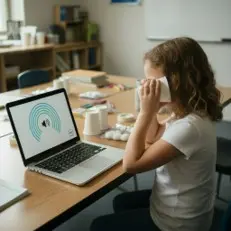 A student listening to sound with a cup.Copyright Photo by Kristen Yip 2026
- Round 1: Space Sound 1
- Have groups test their three materials with Space Sound 1, one material at a time.
- After testing each material, have students compare the perceived sound level with the control cup.
- Instruct students to record whether the sound was louder, quieter, or the same compared to the control cup in their Astro Cup Handout.
- Round 2: Space Sound 2
- Have groups repeat the testing procedure using Space Sound 2.
- Instruct students to record whether the sound was louder, quieter, or the same compared to the control cup in the second section of their data table.
- As groups work, circulate and ask:
- Why do you think one material worked better than another?
- Did any of your results surprise you?
Analyze and Reflect (10 minutes)
- Have groups analyze their recorded observations and identify which materials were most and least effective at reducing perceived sound levels. Ask students to support their conclusions using evidence from their data and note any differences between the two sounds.
- Lead a whole-class discussion using the following questions:
- Which material made your capsule quieter? Was there a material that made it louder? If so, which one?
- How did each sound make you feel? Do you think different sounds can affect people differently? Explain your answer.
- What might happen if you added a window to your capsule? Are there any tradeoffs to having a view? Does the sound change?
Wrap-Up and Real-World Connection (5 minutes)
- Invite each group to share one key finding from their investigation.
- Connect the activity to real-world engineering applications. Explain how acoustic engineers use material testing and data to design quieter spacecraft, cars, hospitals, and homes.
- Optional: Have students draw their visions for a rocket or space habitat that keep sounds quiet. labeling where they would put scientific equipment, the gym, and sleeping areas.
- acoustic
- Relating to sound or the sense of hearing.
- acoustic engineering
- The branch of engineering focused on designing materials, spaces, and technologies that control how sound behaves.
- volume
- How loud or soft a sound is.
- dampen
- To reduce or lessen the intensity of sound or vibration.
Pre-Activity Assessment
Motivating Questions/Quick Discussion: Before introducing the activity, pose the following questions to the class and record student responses on the board. This helps you gauge prior knowledge, surface misconceptions, and spark curiosity.
- Ask: "What do you think it sounds like inside a spacecraft?" (Possible answers: "Loud." "Quiet because space is a vacuum." "Beeping computers." "Roaring engines." Use this to clarify that while space itself is silent, spacecraft interiors are actually very noisy due to equipment.)
- Ask: "Have you ever tried to block out a loud sound? What did you use?" (Possible answers: "Pillow over my ears." "Headphones." "Closed the door." "Cotton in my ears." Use this to build a connection between everyday experience and acoustic engineering.)
- Quick Poll: "Which material do you think will block sound best: cotton, aluminum foil, or bubble wrap?" Tally responses on the board and revisit at the end of the activity to compare predictions to results.
Activity-Embedded (Formative) Assessment
Data Sheet/Research Notes: Students complete the Astro Cup Research Data and data table throughout the activity, recording whether each material made the sound louder, the same, or quieter. Circulate during testing to review data entries and check for careful observation and accurate recording.
Circulating Probing Questions: As groups test their materials, ask targeted questions to check understanding in real time. Sample questions and answers:
- Ask: "Why do you think the cotton made the sound quieter?" (Possible answer: "Because it's soft and fluffy. The sound gets stuck inside the fibers instead of bouncing through.")
- Ask: “What surprised you about your results?" (Possible answer: "The foil actually made the sound louder. I thought it would block it because it's solid.")
- Ask: "How do you know your test is fair?" (Possible answer: "We played the sound at the same volume every time and used the same cup." This checks understanding of controlled variables.)
Thumbs Up/Thumbs Down Check-In: Between Sound 1 and Sound 2 testing, quickly poll the class: "Thumbs up if you think your best material will work equally well for the second sound. Thumbs down if you think results will change." This gauges predictive reasoning and engagement.
Post-Activity (Summative) Assessment
Wrap-Up Engineering Discussion Questions: Facilitate a whole-class discussion using the questions below. Solicit, integrate, and summarize student responses to reinforce key concepts.
- Ask: "Which material was the best sound dampener? Why do you think it worked so well?" (Possible answers: Cotton, foam, or fabric worked best because they are soft and porous. The tiny air pockets inside these materials trap sound energy and prevent it from passing through.)
- Ask: "Which material made the sound louder or didn't help at all? Why?" (Possible answers: Aluminum foil often made sound louder because it's hard and smooth, which causes sound waves to reflect and even amplify inside the cup.)
- Ask: "Why is it important to reduce noise inside a spacecraft?" (Possible answers: Loud noise can damage astronauts' hearing, disrupt sleep, cause stress and fatigue, and make it hard to communicate with crewmates or mission control.)
- Ask: "Where else in the world do engineers use these same ideas to solve noise problems?" (Possible answers: Cars, headphones, hospitals, recording studios, apartment buildings, airports, factories, movie theaters, schools.)
- Ask: "If you were designing a real crew capsule, what tradeoffs might you need to think about?" (Possible answers: Sound-dampening materials add weight to the spacecraft, which costs more fuel. Windows let astronauts see out but let sound in. Adding thick padding takes up space inside the capsule. Engineers have to balance safety, comfort, cost, and function.)
Optional: Design Sketch as Summative Artifact: Collect students' quiet rocket or space habitat design sketches. Assess for:
- Inclusion of labeled quiet zones (sleeping area, science lab, gym).
- Evidence that students applied their test results (e.g., using cotton or foam around noisy areas).
- Justification of design choices, either written or verbal.
- Audio volume: Keep audio recordings at safe, moderate volume levels. Avoid sudden loud sounds, and do not increase the volume to simulate the intensity of a rocket launch.
- Hearing sensitivities: Inform students before playing sounds and provide alternative participation options for students with hearing sensitivities or hearing impairments, such as observing tests, recording data, or analyzing group results.
- Safe listening: Do not place speakers or audio devices directly against students' ears. Allow students to stop listening if they experience discomfort.
For Lower Grades (K-2)
- Simplify the data table to just two options: "louder" or "quieter" (remove "same"). Use pictures or emojis (🔊 / 🔇) instead of words.
- Reduce the number of test materials to two instead of three to keep the activity focused and manageable.
- Use only one space sound instead of two to shorten testing time.
- Skip written predictions and instead have students point to a picture of the material they think will work best.
- Pre-assemble the capsule-cups with materials already inside so students can focus on listening and comparing rather than construction.
- Emphasize sensory language, such as "soft," "hard," "fluffy," "smooth," instead of scientific vocabulary such as "porous" or "dense."
- Add a movement component: Have students act out sound waves bouncing (reflecting) or getting trapped (absorbing) with their bodies.
For Middle Grades (3-5)
- Follow the standard activity as designed with three materials and two sounds.
- Add a written reflection at the end where students explain their results in two or three sentences using evidence.
- Introduce basic graphing: Have students create a simple bar graph comparing how well each material worked.
- Encourage one redesign cycle where students combine two materials to try to improve their capsule.
For Upper Grades (6-8)
- Increase the number of test materials to five or six for more robust data comparison.
- Add multiple trials per material (e.g., three trials each) and have students calculate averages to introduce statistical thinking.
- Introduce decibel measurement using a free smartphone decibel-meter app to collect quantitative data instead of qualitative descriptions.
- Require the creation of bar graphs comparing decibel levels across materials in Excel or Google Sheets.
- Add multiple redesign iterations where students combine materials, layer them, or test different thicknesses.
- Introduce constraints such as a "weight budget" or "cost per material" to simulate real engineering tradeoffs. For example: cotton costs $1/unit, foam costs $3/unit, and students must stay under a budget while maximizing sound reduction.
- Require a written engineering brief with problem statement, hypothesis, methods, results, and conclusion.
For High School / Advanced Learners
- Introduce sound wave physics: Have students research and explain absorption coefficients, wavelength, and frequency response of different materials.
- Explore material science: Investigate why porous materials absorb sound better and connect to real-world acoustic panels used in studios and spacecraft.
- Design a controlled experiment from scratch: Rather than using the provided procedure, challenge students to design their own testing methodology and defend it.
- Analyze frequency-specific performance: Test how each material performs against high-pitched vs. low-pitched sounds and discuss why.
- Introduce CAD or engineering software: Have students digitally design an optimized crew capsule interior with labeled acoustic zones.
- Connect to careers: Research and present on real acoustic engineering careers, materials used in spacecraft (e.g., melamine foam, Kevlar felt), or the acoustic challenges of the Artemis program.
Contributors
Club for the Future
Supporting Program
Club for the Future
Acknowledgements
This activity was developed by Club for the Future. Founded by Blue Origin, Club for the Future is a non-profit with the mission to inspire and mobilize future generations to pursue careers in STEAM (science, technology, engineering, arts, and math) for the benefit of Earth. Club and its partners are doing this through the Postcards to Space program, providing space-focused lessons and events, and activating ambassadors around the world.