
Leaf Etchings to Model Leaf Structure
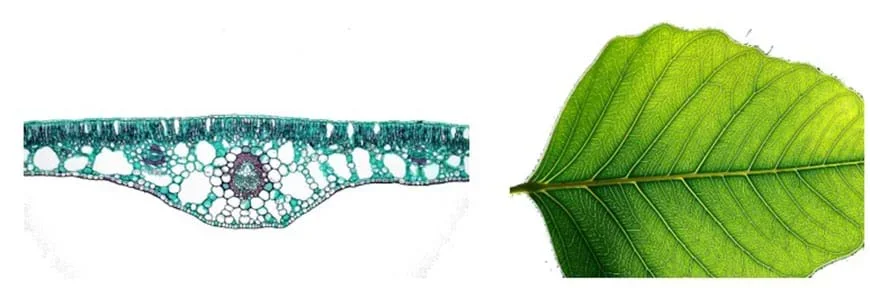 Copyright 2014 (left) Berkshire Community College, Public Domain, Flickr:
https://www.flickr.com/photos/146824358@N03/36716447811; 2003 (right) Jon Sullivan, Public Domain, Wikimedia Commons:
https://en.wikipedia.org/wiki/Evolutionary_history_of_plants#/media/File:Leaf_1_web.jpg
Copyright 2014 (left) Berkshire Community College, Public Domain, Flickr:
https://www.flickr.com/photos/146824358@N03/36716447811; 2003 (right) Jon Sullivan, Public Domain, Wikimedia Commons:
https://en.wikipedia.org/wiki/Evolutionary_history_of_plants#/media/File:Leaf_1_web.jpg
In this design analysis activity, students create their own personal model of a leaf by etching a leaf onto a blank piece of paper. Using this model, they can explain and demonstrate the dynamic interaction that occurs between systems to ensure the carbon dioxide gas, water and visible light are delivered to every chloroplast within every cell for photosynthesis, as well as the systems needed to remove the oxygen gas and glucose.
Engineers need to create systems that seamlessly work together that will introduce new resources as needed and systems to remove the waste as quick as it is produced. For example, electrical and civil engineers are mindful of resources and waste when wiring a building with electricity or creating a water distribution system, respectively.
After this activity, students should be able to:
- Model the activities found with a leaf focusing on the physical structures and their uses within a leaf that are present to deliver the reactants of photosynthesis.
- Explain and demonstrate the dynamic interaction between systems to ensure the carbon dioxide gas (CO2), water (H2O) and visible light are delivered to every chloroplast within every cell for photosynthesis, as well as the systems needed to remove the oxygen gas (O2) and glucose (C6H12O6).
- CCSS.ELA-Literacy.W.9-10.7 Conduct short as well as more sustained research projects to answer a question (including a self-generated question) or solve a problem; narrow or broaden the inquiry when appropriate; synthesize multiple sources on the subject, demonstrating understanding of the subject under investigation.
Grades 9-10
Do you agree with this alignment?
- HS-LS1-2 Develop and use a model to illustrate the hierarchical organization of interacting systems that provide specific functions within multicellular organisms.
Grades 9-12
Do you agree with this alignment? - HS-LS2-5 Develop a model to illustrate the role of photosynthesis and cellular respiration in the cycling of carbon among the biosphere, atmosphere, hydrosphere, and geosphere.
Grades 9-12
Do you agree with this alignment?
- HS-LS1-2 Develop and use a model to illustrate the hierarchical organization of interacting systems that provide specific functions within multicellular organisms.
Grades 9-12
This resource focuses on the following Three Dimensional Learning aspects of NGSS:
Science & Engineering Practices- Develop and use a model based on evidence to illustrate the relationships between systems or between components of a system.Do you agree with this alignment?
Disciplinary Core Ideas- Multicellular organisms have a hierarchical structural organization, in which any one system is made up of numerous parts and is itself a component of the next level.Do you agree with this alignment?
Crosscutting Concepts- Models (e.g., physical, mathematical, computer models) can be used to simulate systems and interactions—including energy, matter, and information flows—within and between systems at different scales.Do you agree with this alignment?
Do you agree with this alignment? - Develop and use a model based on evidence to illustrate the relationships between systems or between components of a system.
- HS-LS2-5 Develop a model to illustrate the role of photosynthesis and cellular respiration in the cycling of carbon among the biosphere, atmosphere, hydrosphere, and geosphere.
Grades 9-12
This resource focuses on the following Three Dimensional Learning aspects of NGSS:
Science & Engineering Practices- Use a model based on evidence to illustrate the relationships between systems or between components of a system.Do you agree with this alignment?
Disciplinary Core Ideas- Photosynthesis and cellular respiration are important components of the carbon cycle, in which carbon is exchanged among the biosphere, atmosphere, oceans, and geosphere through chemical, physical, geological, and biological processes.Do you agree with this alignment?
- The main way that solar energy is captured and stored on Earth is through the complex chemical process known as photosynthesis.Do you agree with this alignment?
Crosscutting Concepts- Models (e.g., physical, mathematical, computer models) can be used to simulate systems and interactions—including energy, matter, and information flows—within and between systems at different scales.Do you agree with this alignment?
Do you agree with this alignment? - Use a model based on evidence to illustrate the relationships between systems or between components of a system.
- One large flat leaf (a large maple, oak, and beech leaves are best although any leaf with high veins on the underside will work)
- Sheet of plain white paper large enough to cover the entirety of the leaf with additional room available to write in the margins (photocopy or printer paper)
- Multicolored colored pencils with large graphite cores (mechanical pencils don’t work well)
Students should be familiar with the Law of conservation of Energy, Law of Conservation of Mass, and the inputs (reactants) and outputs (products) in a chemical equation. They should be familiar with the balanced chemical equation of photosynthesis and have the knowledge that photosynthesis takes place within all leaves, more specially in the chloroplast.
When photosynthesis is mentioned, many of our first thoughts are, “what plants do to grow”. This is true, but like many topics in science there is far more to it. For example, photosynthesis most likely provided ALL of the energy that you have used today. Photosynthesis is the unsung hero that not only provides our food, but moves our cars, allows our lights to turn on, keeps us cool in the summer, and warm in the winter, along with so much more.
Photosynthesis is as much of a miracle as it is common. The apparently simple act of a green leaf absorbing sunlight in the presence of carbon dioxide (CO2) and Water (H2O) and then changing them into an energy-rich carbon-based fuel (food or fossil fuels) and pure oxygen is anything but simple. In fact, the best scientists in the world today cannot replicate this process in a laboratory setting. If it were possible, all of the world’s energy problems would be solved! Science can use solar panels to transform sunlight into electricity, but it cannot transform sunlight into a powerful fuel that can be used in a variety of settings.
Our modern society is full of appliances that use energy for all kinds of things. We have machines that can do just about anything for us. All of these machines and appliances take energy out of a fuel or an energy source. The Law of Conservation of energy requires that energy comes for energy; therefore, there must be energy in a substance before energy can be taken out of it. When “energy is removed from or taken out of a fuel” it is called an exothermic reaction. The opposite of exothermic is endothermic. An endothermic reaction is when “energy is put into a reaction”. The only appliance or machine that puts energy into a fuel is a plant and the reaction is called photosynthesis.
You can think of photosynthesis as your generous, hard-working relatives that make a steady amount of money, but spend very little; all of their extra money gets put into a savings account for future generations to spend. Plants are our lost generous relatives. For thousands of years, plants have been working away, changing CO2 and sunlight into energy-rich, carbon-based fuels (coal, gasoline, natural gas, all fossil fuels) that we are consuming at an incredible rate.
As good as this analogy is for later generations, there are down-sides. For example, our relatives did work steady, but they did not work fast; and although they always put the extra money into the savings, the savings grew at a very slow rate. Although plants do store the energy from sunlight into food and fuels, it can only store small amounts of energy during a single growing season. Dimes are going into savings and dollars are coming out. The rate that energy is being spent nowhere near the rate that energy was being stored.
An even more sinister down-side of relying on our previous generation’s hard work may be the money itself. The physical accumulation of the money spent is changing the world as we know it. All of the carbon in the CO2 that was changed into an energy-rich, carbon-based fuel (food and fossil fuels) during photosynthesis will return into CO2, as the fuels are burned to power our modern society. This is the exact CO2 that is accumulating in our atmosphere, causing the climate to change.
In the field of science, there are many astonishing events. Photosynthesis must be noted as one of the greatest ones; the miraculous events that have and will continue to occur within a plant where water, carbon dioxide, and sunlight spontaneously combine to form the organic material and the energy that supports all life on this planet. This is an astonishing event.
[Hold up a leaf for the class.] What do you see when I show you this leaf? (Let students offer answers. Potential observations include leaf color, leaf shape, stem, texture, etc.) When we look at a leaf, it appears that the leaf is stagnant, still, and not moving; the leaf does not seem to be dynamic at all. However, this could not be farther from the truth! Each leaf is more like a bustling factory than a frozen piece of art.
To get a sense of the highly coordinated, purposeful movement within the cells of a leaf, let’s look at these videos. The first video shows a time lapse of a 30-story building built in 15 days. As we watch the video, keep an eye out for any specialize machinery, movement of parts to make larger pieces and the work done in the planning and preparation of resources. (Show the video: “30-Story Building Built In 15 Days (Time Lapse)” - https://www.youtube.com/watch?v=rwvmru5JmXk.) What did you notice? [Let students offer their observations.]
Next, we will watch this incredible time lapse video of Boeing 737 construction. Again, watch for any specialize machinery, movement of parts to make larger pieces and the work done in the planning and preparation of resources. (Show the video: “Incredible time lapse video of Boeing 737 construction” - https://www.youtube.com/watch?v=Axfo1Gixj40.) What did you notice? [Let students offer their observations.]
Finally, let’s watch this time lapse video of a home being constructed from start to finish. (Show the video: “Time lapse of home constructed start to finish” -https://www.youtube.com/watch?v=C3iI6S7TuCA.) What did you notice? [Let students offer their observations.]
Did anyone notice the clean-up crews that needed to keep the processes moving smoothly? What other jobs were needed to support building the house? [Let students offer their observations.]
Today we are going to model all the processes that go on within a leaf by etching a leaf. Let’s get started!
Background:
Energy + 6CO2 + 6H2O —> C6H12O6 + 6O2
Students should be familiar with the chemical equation of photosynthesis. They should also be aware that this reaction takes place in the chloroplast organelle. This activity is meant to instill the enormity of the micro-world within a leaf. If each leaf has millions of cells and each leaf cell has several of chloroplasts, there are billions of locations within a tree where photosynthesis is occurring.
How does sunlight, carbon dioxide and water physically get from where they are found in nature into each one of those billions of locations, in chloroplasts? In addition, what happens to the glucose and how does the oxygen get back into the atmosphere? [Answers to these questions are given in the With the Students section under “Modeling photosynthesis onto the leaf etching.”]
There are three reactants for photosynthesis:
- Sunlight, electromagnetic energy from the sun shines onto the leaf.
- Carbon dioxide, CO2 from the air floats into the leaf through the stomata.
- Water, H2O within the ground is transpired up to the leaves from the roots.
There are two products of photosynthesis:
- Oxygen, O2, floats out of the leaf into the atmosphere.
- Glucose, C6H12O6, simple sugars can be used or converted into complex sugars or cellulose.
With the Students
Note: This activity will be broken up into three parts:
- Leaf examination of both top and bottom side
- Etching of the bottom side for the leaf
- Modeling photosynthesis onto the leaf etching
- Have each student lay their leaf down on their desk with the waxy side up (top side up.)
- Each student closely examines the top side of the leaf and answers the associated questions on the Leaf Etching Activity Sheet (PDF).
- Teacher brings the class back together and goes over the following points:
- The function the top of a leaf is to be waterproof, to avoid the inner leaf from getting saturated. Water does NOT enter a leaf by soaking into the top of a leaf.
- It must provide protective coating avoid damage to the inner structures.
- It must be transparent to allow the sunlight to enter the top side of the leaf.
- The cuticle is the waxy protein, the covers the top of the leaf and provides these requirements.
- Have each student turn their leaf over on their desk with the non-waxy side up (bottom side up.)
- Each student closely examines the bottom side of the leaf and answer the associated questions on the Leaf Etching Activity Sheet (PDF).
- Teacher brings the class back together and goes over the following points:
- The bottom of the leaf must provide several intertwining functions.
- The rough and spongy texture is due in part to the guard cells creating the stomata.
- This spongy texture to allows the absorption carbon dioxide and the release of oxygen gas and water vapor.
- The veins or branches within the leaf forms ridges that travel throughout the leaf. These provide the leaf with its structure, strength and resource distribution.
- Teacher asks the question: Why are the top and bottom sides of the leaf physically different? (Answer: This is due their functions have different purposes and objectives.)
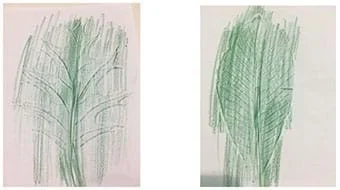 Figure 1. Modeling photosynthesis onto the leaf etchingCopyright 2020 Andy Frisch, Central Michigan University RET
- Students now etch the bottom side of their leaf. (See Figure 1.) Either side of the leaf would work but since the bottom side is rough with its protruding structures it works better. Give students time to scribble away. Ensure they are etching the entire leaf, including all the way out to the tips of the leaf and as much of the stem as possible. If they develop better methods, as they etch, encourage them to share their techniques. Allow the students to start over as long as time permits. Allow the students to do more than one leaf if time permits.
- Once each student has one complete leaf etching that is centered on a sheet of blank paper, they will begin to model the previously discussed structures and processes of photosynthesis onto the etching. The students should still have access to their original leaf, to examine it even closer, as the model is being created.
- Each student should write, “Energy + 6CO2 + 6H2O —> C6H12O6 + 6O2” across the top of their model.
- Have students circle the reactants and underline the products. (See Figure 2.)
- Ask them “Where does photosynthesis happen?” Have them put an “X” on the model in one place they think photosynthesis happens. Then ask them to place an “X” on two, three, four and five other places that photosynthesis happens. (Of course, an “X” anywhere on the model is an acceptable answer, because photosynthesis happens (chloroplasts) in innumerous locations within a leaf.)
- Pose this question to the students as an introduction to the next part: “What are the systems involved in getting the reactant to the site of photosynthesis and the systems involved in getting the products away?” (Cuticle, Stomata, Xylem, Phloem and Transpiration)
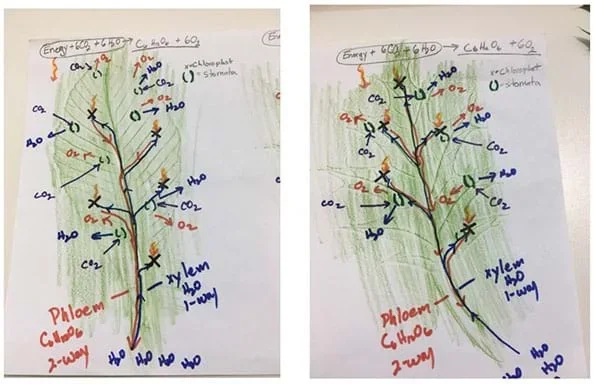 Figure 2. A student example of a leaf etching, labeled with the appropriate reactants.Copyright 2020 Andy Frisch, Central Michigan University RET
- Starting with the Reactants, the teacher reads the following:
- Sunlight energy shines on the entirety of the top of the leaf, the leaf can be held outstretched to maximize surface area for the energy absorption. And the protective coating is transparent to allow for the electromagnetic energy from the sun to enter the chloroplasts. (Although the students will not label the transparent cuticle onto their model, they can visibly see it on the original leaf and they can model this by drawing a squiggly line going into the leaf from the top, the sun.)
- In addition, the strength required to hold the leaf outstretched can be modeled, by holding the tip of the stem of the leaf with two fingers and then gently waving the leaf up and down, much like a fan.
- Carbon Dioxide (CO2) floats into the bottom of the leaf through the stomata. Students can feel the roughness of bottom of the leaf and imagine the bumps to be stomata. Students are then encouraged to draw several stomata onto their model. Stomata should be drawn as two guard cells or two parentheses, draw them as “()”, they look like parenthesis.
- This can then be modeled by writing “CO2” in the margins of the paper and then draw an arrow from each “CO2” leading it into the leaf through the stomata.
- Water (H2O) is drawn up from the ground through the roots by the process of transpiration. This process has two demanding requirements. There must be a route for the water to travel from under ground level to several feet above the ground. Much like homes in rural areas, they pull the water from underground into their first and second story houses, there must be pipes and a pump.
- The pump that pulls the water up, against gravity, is the act of transpiration. However, transpiration relies on evaporation, which then causes a suction. But for evaporation to happen, there must be an exit for the water vapor to leave from the inner part of the leaf. Again, the stomata provide the opening for the water vapor to leave.
- This can be modeled, by drawing arrows out from each stoma and labeling them as, “H2O”. Reinforce that the stomata are huge when compared to CO2 and H2O. Molecules can easily pass each other within these openings, much like two students walking past each other in a large gymnasium.
- The pipes are the veins or the branches that are visible throughout the leaf. These veins not only provide the leaf with its structure and strength to remain outstretched, but they also allow the pipes that connect the chloroplast to roots below.
- Have the students “snap” the stem of their leaf. It probably will not break clean, but rather peel down toward the leaf before it pulls away. This is because they are long, extensive pipes that literally run from each cell, through the stem of the leaf, and within the bark of the trunk, and up from the roots. This complete one-way path that carries H2O up from the ground into the leaves is called the xylem.
- This can be modeled, by writing “H2O” several time at the tip of the stem, as if it came from the ground. A zig zag looking line should be drawn as the path of water is pulled from the stem to each chloroplast and staying on the dark edges of the etching, only. This zig zag pattern in not random it is cause be repeating geometric patterns on larger and smaller scales. Remind the students the water must say on the dark lines because they the etching of the xylem and phloem.
- Moving on to the Products, the teacher reads the following:
- Oxygen (O2) is the by product that is released out of the leaf through the stomata. This can easily be added to the model, by drawing arrows out of each stoma and then labeling it “O2”. Much like the water vapor it is exiting the leaf through the stomata, and again there is more than enough room for the molecules to freely move in out of the leaf through these common openings.
- Glucose (C6H12O6) is also a product of photosynthesis. This the magic molecule, this is the molecule that has all the energy, this is the molecule that can be a simple sugar or a complex carbohydrate or even the cellulose, the tree fiber itself. Part of this activity is to look at the systems required to move the freshly produced glucose from the chloroplast to all part of tree or plant. This is done by using a separate two-way pipe called the phloem. Phloem run alongside of the xylem to make up the veins. (Veins are actually bundling of xylem and phloem.)
- Although xylem and phloem are parallel and blend together within the etching, in reality, they have very different structures and functions. This can be modeled by drawing a second arrow parallel to the dark zig zag line (the xylem and phloem) in the etching of only this time in the opposite direction, from the chloroplast to the stem and then label it “C6H12O6”. But once this arrow reaches the stem it will become a two-way arrow. Glucose can enter and exit a leaf as needed.
- Once everyone finishes their models, talk about the engineering connection to this activity. Just like there are systems built into the leaf to provide a constant and continuous flow of reactants to the chloroplast and separate systems designed to remove the products and either store them for later use or dispose of them out into the environment, engineers and city planners must do the same within several different venues. Three of which are:
- Electrical engineers must get power to every appliance within a household or building. Then every household and building must be connected to the power station.
- Civil engineers must ensure clean water is provided to each house and pipefitter must then ensure each faucet and toilet has access. And then must be a separate sewage system available to remove the wastewater.
- City planners and designers must develop a system of roads and transportation that allows each household access to every other household, business, hospital, and so on.
- There is great practicality in designing and improving systems of distribution and removal of resources.
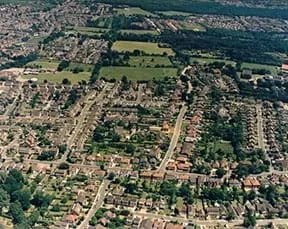 Roads leading from homes to the city.Copyright 1987 Edward Clack, (CC BY-SA 2.0) Geograph https://www.geograph.org.uk/photo/1636724
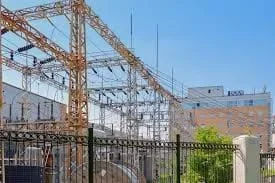 Powering a city with electricity.Copyright 2021 Max Pixel, Public Domain, https://www.maxpixel.net/Power-Plant-Electricity-Electric-Power-1727363
- capillary action
- Adhesion of water to the walls of a vessel will cause an upward force on the liquid at the edges and result in a meniscus which turns upward.
- chloroplast
- The organelle in which photosynthesis takes place.
- cuticle
- A protective and waxy or hard layer covering the epidermis of a plant.
- phloem
- The vascular tissue in plants that conducts sugars and other metabolic products downward from the leaves.
- photosynthesis
- The process in which the energy of light to convert carbon dioxide and water into glucose and oxygen.
- stomata
- Tiny openings or pores in plant tissue that allow for gas exchange.
- transpiration
- The process by which moisture is carried through plants from roots to small pores on the underside of leaves, where it changes to vapor and is released to the atmosphere.
- xylem
- The vascular tissue in plants that conducts water and dissolved nutrients upward from the root and helps to form the woody element in the stem.
Pre-Activity Assessment
Brainstorming: In small groups have students predict where the materials that “build a tree” come from. Trees grow from a small seed into a mighty, massive lumber, where do all of those atoms come from? And how do they get into the tree?
Activity Embedded Assessment
Photosynthesis Equation: There is continual reinforcement of the balanced chemical equation of photosynthesis. Students will refer to the structure of the leaf to better understand the chemical equation.
Post-Activity Assessment
3-2-1: Have students complete an exit ticket asking them to write down three things they learned from the activity, two difficulties they had to overcome, and one moment they felt successful.
Push the paper down hard onto the leaf. Make sure there is good contact between the two.
Use wide lead pencils. The thin brittle lead of mechanical pencils do not work well.
Once students can follow pathway of the reactant into the chloroplast, have them follow the path of the products: Glucose, specifically, how it can either go to the mitochondria for respiration, the roots of storage, or undergo polymerization into cellulose.
- For lower grades, provide students with colored pencils and label all the parts to be noted.
- For higher grades, have students include mineral absorption into transpiration.
Contributors
Andy Frisch
Supporting Program
Research Experience for Teachers, Central Michigan University
Acknowledgements
This activity was developed under National Science Foundation grant no. EEC 1542368. However, these contents do not necessarily represent the policies of the National Science Foundation, and you should not assume endorsement by the federal government.
Copyright
2021 by Regents of the University of Colorado; original © 2019 Central Michigan University