
Create a Safe Pathway for Turtles
The students must solve a real-world phenomenon with constraints. Students follow steps of the engineering design process to design and construct a bridge or some form of crossover to provide a pathway for a turtle to safely cross the road. Students pick a specific turtle species native to their state or region. They research their chosen species to identify its niche and habitat, with a special emphasis on the difference between the turtle’s “normal” location and behaviors and its “nesting grounds”. Often, it is the movement between these two locations that can be lethal to the turtles. The goal of the students is to try and lessen the impact of the highway on turtle populations. Civil engineers and environmental engineers must keep ecosystems stable, while allowing infrastructure to be built and all within a reasonable budget.
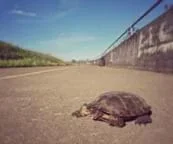 It is estimated that turtles only have ~2% chance of successfully crossing busy roads, how can we modify roads to reduce turtle mortality?Copyright 2020 Jonathan Lidbeck, Central Michigan University
Road construction must consider human conveniences and average traffic flow, but also must be mindful to wildlife populations. Roads are being built into more remote locations, as humans want to live within nature. Civil engineers need to build the roads that can safely get them there, while keeping nature itself safe. Engineers must find a balance between efficiency and ethics.
After this activity, students should be able to:
- Define problems in wildlife management due to human actions.
- Analyze a conservation problem based on its human and animal considerations.
- Develop solutions to problems based on relevant data and constraints on the problem.
- Build a model of their design.
- Understand the different steps of the engineering design process.
- Students will develop an understanding of the effects of technology on the environment.
Grades K-12
Do you agree with this alignment? - Students will develop an understanding of the attributes of design.
Grades K-12
Do you agree with this alignment? - Students will develop an understanding of engineering design.
Grades K-12
Do you agree with this alignment?
- 3-5-ETS1-1 Define a simple design problem reflecting a need or a want that includes specified criteria for success and constraints on materials, time, or cost.
Grades 3-5
Do you agree with this alignment? - 3-5-ETS1-2 Generate and compare multiple possible solutions to a problem based on how well each is likely to meet the criteria and constraints of the problem.
Grades 3-5
Do you agree with this alignment? - 5-ESS3-1 Obtain and combine information about ways individual communities use science ideas to protect the Earth's resources and environment.
Grade 5
Do you agree with this alignment?
- 3-5-ETS1-1 Define a simple design problem reflecting a need or a want that includes specified criteria for success and constraints on materials, time, or cost.
Grades 3-5
This resource focuses on the following Three Dimensional Learning aspects of NGSS:
Science & Engineering Practices- Define a simple design problem that can be solved through the development of an object, tool, process, or system and includes several criteria for success and constraints on materials, time, or cost.Do you agree with this alignment?
Disciplinary Core Ideas- Possible solutions to a problem are limited by available materials and resources (constraints). The success of a designed solution is determined by considering the desired features of a solution (criteria). Different proposals for solutions can be compared on the basis of how well each one meets the specified criteria for success or how well each takes the constraints into account.Do you agree with this alignment?
Crosscutting Concepts- People's needs and wants change over time, as do their demands for new and improved technologies.Do you agree with this alignment?
Do you agree with this alignment? - Define a simple design problem that can be solved through the development of an object, tool, process, or system and includes several criteria for success and constraints on materials, time, or cost.
- 3-5-ETS1-2 Generate and compare multiple possible solutions to a problem based on how well each is likely to meet the criteria and constraints of the problem.
Grades 3-5
This resource focuses on the following Three Dimensional Learning aspects of NGSS:
Science & Engineering Practices- Generate and compare multiple solutions to a problem based on how well they meet the criteria and constraints of the design problem.Do you agree with this alignment?
Disciplinary Core Ideas- Research on a problem should be carried out before beginning to design a solution. Testing a solution involves investigating how well it performs under a range of likely conditions.Do you agree with this alignment?
- At whatever stage, communicating with peers about proposed solutions is an important part of the design process, and shared ideas can lead to improved designs.Do you agree with this alignment?
Crosscutting Concepts- Engineers improve existing technologies or develop new ones to increase their benefits, to decrease known risks, and to meet societal demands.Do you agree with this alignment?
Do you agree with this alignment? - Generate and compare multiple solutions to a problem based on how well they meet the criteria and constraints of the design problem.
- 5-ESS3-1 Obtain and combine information about ways individual communities use science ideas to protect the Earth's resources and environment.
Grade 5
This resource focuses on the following Three Dimensional Learning aspects of NGSS:
Science & Engineering Practices- Obtain and combine information from books and/or other reliable media to explain phenomena or solutions to a design problem.Do you agree with this alignment?
- Support an argument with evidence, data, or a model.Do you agree with this alignment?
Disciplinary Core Ideas- Human activities in agriculture, industry, and everyday life have had major effects on the land, vegetation, streams, ocean, air, and even outer space. But individuals and communities are doing things to help protect Earth's resources and environments.Do you agree with this alignment?
Crosscutting Concepts- A system can be described in terms of its components and their interactions.Do you agree with this alignment?
Do you agree with this alignment? - Obtain and combine information from books and/or other reliable media to explain phenomena or solutions to a design problem.
This is hands-on activity uses basic classroom art supplies and recycled materials from around the school and home. The “picnic” section within a grocery store has many good items to use.
Each group needs:
- device connected to the Internet for research
- 2 sheets of plain white printer paper for drawing turtle models
- 30.5 cm x 13 cm (12’’ x 5’’) road cut from black construction paper
- Create a Safe Pathway for Turtles Design Sheet (PDF)
For the class to share:
- colored pencils, crayons, markers
- tape, glue
- rulers, protractors
- bridge building’ materials:
- recycled materials
- cardboard (cereal boxes, paper towel rolls, small boxes, etc.)
- glass jars
- plastic bowls, containers
- clothes hangers
- classroom art supplies
- colored pencils, crayons, markers
- tape, glue
- rulers, protractors
- plastic cups
- paper plates
Many of us have a special place in our hearts for turtles. They are a reptile that many of us find cute, which may explain why many of us will stop the car when we see a turtle crossing the road to ensure its safe passage. Unfortunately, thousands of turtles are killed each year on roadways. To make the problem worse, it is often the pregnant females on their way to their nesting grounds that are killed along the roadway. To ensure a stable, long-term turtle population, we must find ways for turtles to safely cross the road.
To focus our efforts on the most crucial population, we will look at breeding turtles and the pathways they use to go between their “normal” living habitat and their “nesting” egg-laying habitat.
We can think of it as family living in their home going through their normal daily routine. Suddenly, one of the family members needs to go to the doctor. We need to ensure a safe and easy way for them to get there. We live in houses and apartments and go to hospitals when we need medical help. Where do turtles live? Where do they go to lay their eggs? Not all people live in the same homes, eat the same food, or have the same jobs. Nor do all turtles live in the same habitat or perform the same niche.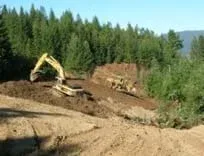 Roads are essential towards transportation and as new areas are being developed new roads must be built. As civil engineers we must be mindful of the damage and destruction to the existing ecosystems.Copyright 2019 Redwood National and State Parks, Public Domain, Creative Commons.com https://ccsearch.creativecommons.org/photos/bf296720-38f9-4e16-9ba7-2061908f6b72
The students are encouraged to think of a “turtle memory” or take some time researching various turtles from their state or region. Once they have chosen a turtle species and have modeled the two locations, normal and nesting, they will be using the engineering design process to engineer a safe way across the road.
Before the Activity
- Gather materials and make copies of the worksheet
- Prepare the “roads” for each group – cut a 30.5 cm x 13 cm (12’’ x 5’’) road out of black construction paper
- Prepare two location drawings
- Base research done on a specific turtle (if applicable)
- Gather materials need to create the drawings (this could be skipped and the teacher could simply provide a pre-made habitat)
- Gather materials for building the crossover
Note: This activity can be broken into two parts the model or drawing of the two locations and the building of the crossover.
With the Students
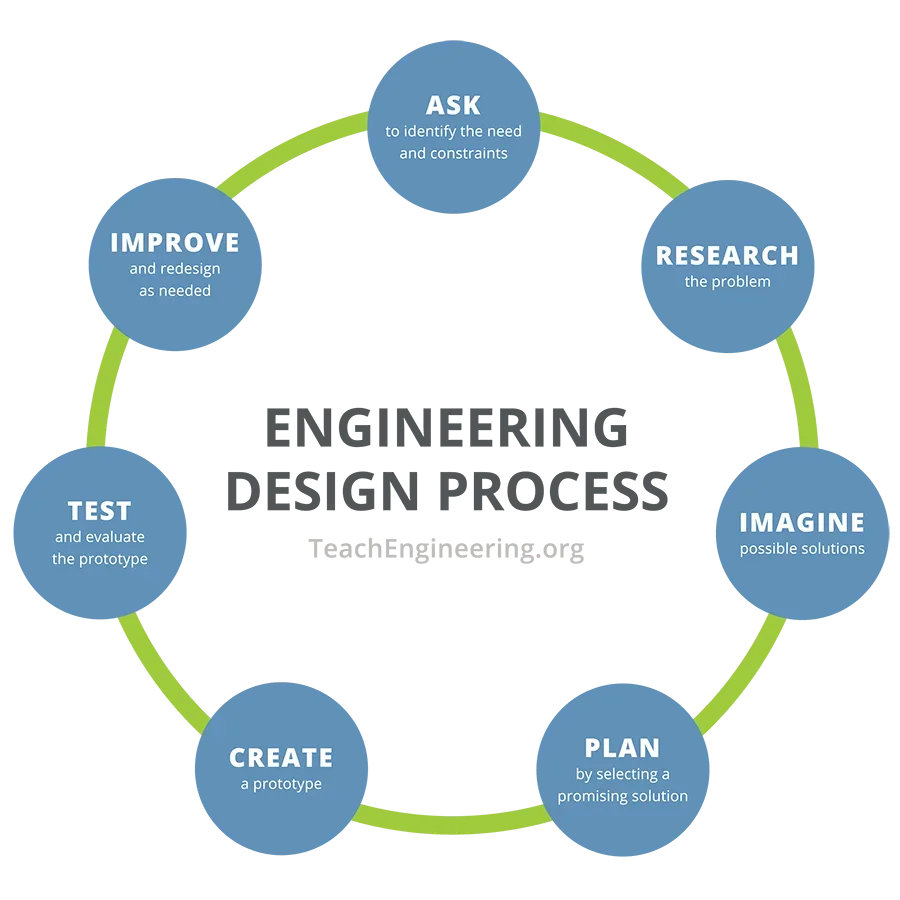
- Break the students up into groups of two students and define the criteria and constraints of this design challenge. Explain to them that this is the first step of the engineering design process and how engineers have to ask to determine their criteria and constraints in order to design the best solution.
- Have students pick from one of the ten known turtle species. (Optional, students may research a turtle species from their own state or region.)
- Common snapping turtle
- Common musk turtle
- Spotted turtle
- Wood turtle
- Eastern box turtle
- Blanding’s turtle.
- Common map turtle
- Midland painted turtle
- Western painted turtle
- Red-eared slider
- Instruct students to begin the second step of the engineering design process as they research their chosen turtle species’ ideal living and birthing biotic and abiotic conditions with the expectation that they will be able to draw or model the information into a drawing. Encourage students to use the internet, textbooks, and personal experiences when creating their models.
- Have students draw or model their chosen turtle species’ normal habitat and nesting grounds on two separate sheets of standard printer paper. The students should be sure to include details and use colored pencils or crayons to bring their models and drawings to life. If needed, students may express habitat conditions to increase clarity.
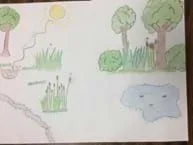 Example of student work. Left side is the nesting habitat and the right side is the normal habitat. If a road went between the two of them, how could the turtles get between them?Copyright 2020 Andrew J. Frisch, Central Michigan University
- Consider the following conditions during student research:
- Living conditions of their turtle species:
- Physical features (for example, land, water, swamp, wetland)
- Food preferences (worms, berries, fish, plants)
- Predators and defense
- Birthing conditions:
- Age turtles lay eggs
- Physical features of the nest (soil type, elevation, proximity to water)
- How long does the egg-laying process take? What time of year does it take place?
- Incubation time (How long it takes for the eggs to hatch?)
- Ideal temperature and moisture
c. Post egg-laying conditions:
- Do female turtles return to the same habitat is came from or does it have a separate behavior?
- After the student’s drawings sufficiently model both the nesting ground and the normal habitat, hand them a 30.5 cm x 13 cm (12’’ x 5’’) strip of black construction paper meant to look like a road. Tell students to tape their two pieces of paper together with the black strip, road, between their drawings. This black strip is meant to model the road separating the two locations.
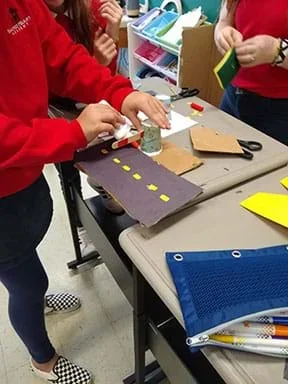 Students building their version of a turtle crossing gate. To ensure turtles safe passage across the road.Copyright 2020 Brad Parsons, Central Michigan University
- The engineering activity will require the students to ensure safe passage of the turtle from one location to another.
- Allow students to imagine and brainstorm ideas and materials. They should be given freedom to create. Explain to the students that engineers create several designs and then plan by selecting the most promising solution.
- Have groups collect the necessary materials that are needed to build their crossover.
- The students will now go into step five of the engineering design process: creating and building their prototype. Ensure they have enough time to build their crossover.
- Students “test” their crossover by defining the strengths and weaknesses of their solutions.
- Optional: Students could get feedback on their design from other student teams.
- Explain to the students that the seventh step is to improve and redesign as necessary. Engineers are constantly working to create a better end product. Students modify and rebuild their crosswalk based on their identified weaknesses and (optional) peer feedback.
- Students create an argument from evidence in efforts to convince the road construction engineers to use their idea. Note: Students need to appreciate that as more people want to build homes farther into the woods, more roads will need to be built. Unfortunately, the exact things that we find so beautiful and pristine can be affected by us. But if we are smart about it, we can do both.
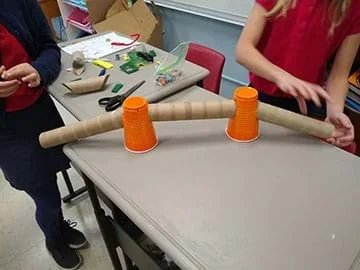 Students building an elevated tunnel for a turtle to safely get across the road.Copyright 2020 Brad Parsons, Central Michigan University
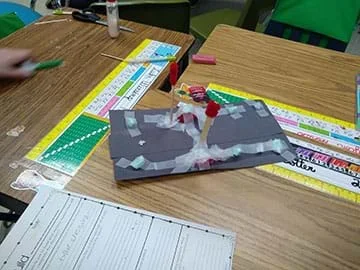 Students building their version for a turtle to safely get across the road.Copyright 2020 Brad Parsons, Central Michigan University
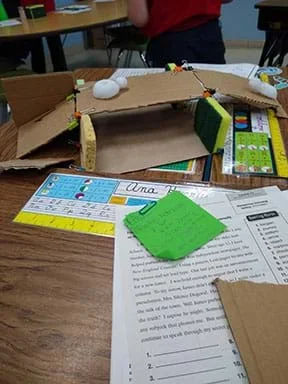 Students building their version for a turtle to safely get across the road.Copyright 2020 Brad Parsons, Central Michigan University
- abiotic
- Something physical, rather than biological that doesn’t come from living things.
- anthropogenic change
- Change caused by human activity.
- biodiversity
- The number of different species of organisms in a given ecosystem
- biotic
- Something that comes from a living thing.
- ecological degradation
- The reduction in the overall health of an ecosystem, primarily caused by human activity.
- ecosystem
- A system that includes all living organisms (biotic factors) in an area as well as its physical environment (abiotic factors) functioning together as a unit.
- habitat
- The physical space where an organism or population inhabit.
- keystone species
- A species that is essential to maintain ecosystem stability. If this species goes extinct, it might endanger other species in the ecosystem.
- nesting grounds
- A preferred location and behaviors for egg laying.
- niche
- The role or function of an organism or species in an ecosystem.
- population
- A group of organisms from the same species in the same habitat.
Pre-Activity Assessment
Research: By having the students research the turtle’s specific habitat and niches, they will become familiar with the topography and landscape. This is important for determining what type of crossover will be most effective. As they are learning about the turtles, they will also be learning about the road conditions.
Activity Embedded (Formative) Assessment
Worksheet: Have students begin to fill out the Create a Safe Pathway for Turtles Design Sheet (PDF).
Drawings: As the activity begins, be sure the students’ drawings are complete. The drawings are done for the biological importance and species identification, but it is also important to learn these physical characteristics for the sake of building the crossover. Ask the students about constraints within the landscape. How does their cross walk deal with region specific issues?
Post-Activity (Summative) Assessment
Worksheet: Have students fill out the Create a Safe Pathway for Turtles Design Sheet (PDF). This focuses more on the engineering design process than the product. If the teacher chooses, a rubric could be added to grade the quality of the crossover itself.
Making Sense: Have students reflect on the science concepts they explored and/or the science and engineering skills they used by completing the Making Sense Assessment (PDF).
Material collection can be an issue if you do not have easy access to an art classroom, so make sure you have plenty of material and a way to distribute them. The students will need space to work and build. Include clean-up procedures into the activity.
Contributors
Andrew Frisch; Wil Falkner; Brad Parsons
Supporting Program
Research Experience for Teachers, Central Michigan University
Acknowledgements
This curriculum was based upon work supported by the National Science Foundation under RET grant no. EEC 1542368— Research Experience for Teachers through Central Michigan University. Any opinions, findings, and conclusions or recommendations expressed in this material are those of the authors and do not necessarily reflect the views of the National Science Foundation.
Copyright
2020 by Regents of the University of Colorado; original © 2020 Central Michigan University