
Do Different Colors Absorb Heat Better?
Students test whether the color of a material affects how much heat it absorbs. They leave ice cubes placed in boxes made of colored paper (one box per color; white, yellow, red and black) in the sun, and predict in which colored box ice cubes melt first. They record the order and time required for the ice cubes to melt.
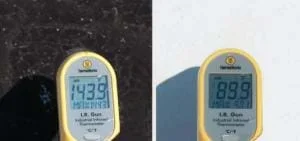 On a summer afternoon, the black roof at left was measured to be 54ºF (30ºC) warmer than the white roof at right.Copyright Lawrence Berkeley National Laboratory, U.S. Department of Energy http://heatisland.lbl.gov/coolscience/cool-science-cool-roofs
The study of light and its behavior is an important component in the design of many items, everything from optical instruments to roofing materials to solar cells. The performance and characteristics of light guide engineers to come up with different forms of light detection for lenses in cameras, microscopes, CD players and medical devices. Different sources of light carry different quantities of energy. For example, powerful lasers can cut through stone or even metal.
- Certain colors absorb light better than others.
- The sun produces heat and light.
- Why ice cubes melt.
- (optional) The purpose of solar panels.
- CCSS.Math.Content.1.MD.C.4 Organize, represent, and interpret data with up to three categories; ask and answer questions about the total number of data points, how many in each category, and how many more or less are in one category than in another.
Grade 1
Do you agree with this alignment? - CCSS.Math.Content.2.MD.D.10 Draw a picture graph and a bar graph (with single-unit scale) to represent a data set with up to four categories. Solve simple put-together, take-apart, and compare problems using information presented in a bar graph.
Grade 2
Do you agree with this alignment? - CCSS.Math.Content.K.MD.A.2 Directly compare two objects with a measurable attribute in common, to see which object has "more of"/"less of" the attribute, and describe the difference.
Grade 0
Do you agree with this alignment?
- Asking questions and making observations helps a person to figure out how things work.
Grades K-2
Do you agree with this alignment? - Compare, contrast, and classify collected information in order to identify patterns.
Grades 3-5
Do you agree with this alignment? - Energy comes in many forms.
Grades K-2
Do you agree with this alignment? - STEL-2C Explain that materials are selected for use because they possess desirable properties and characteristics.
Grades -1-2
Do you agree with this alignment?
- 1.MD.C.4 Organize, represent, and interpret data with up to three categories; ask and answer questions about the total number of data points, how many in each category, and how many more or less are in one category than in another.
Grade 1
Do you agree with this alignment? - 2.MD.D.10 Draw a picture graph and a bar graph (with single-unit scale) to represent a data set with up to four categories. Solve simple put-together, take-apart, and compare problems,11 using information presented in a bar graph.
Grade 2
Do you agree with this alignment? - K.MD.A.2 Directly compare two objects with a measurable attribute in common, to see which object has "more of"/"less of" the attribute, and describe the difference.
Grade 0
Do you agree with this alignment?
- Recognize that the sun supplies heat and light to the earth and is necessary for life.
Grades -1-2
Do you agree with this alignment?
- K-2-ETS1-3 Analyze data from tests of two objects designed to solve the same problem to compare the strengths and weaknesses of how each performs.
Grades K-2
This resource focuses on the following Three Dimensional Learning aspects of NGSS:
Science & Engineering Practices- Analyze data from tests of an object or tool to determine if it works as intended.Do you agree with this alignment?
Disciplinary Core Ideas- Because there is always more than one possible solution to a problem, it is useful to compare and test designs.Do you agree with this alignment?
Do you agree with this alignment? - Analyze data from tests of an object or tool to determine if it works as intended.
- colored paper 4 sheets per group (white, yellow, red, black)
- newspaper
- scissors (one per student if you want the them to cut out the boxes [cube templates] from the colored paper)
- clear tape, to make the cube boxes from colored paper
- 4 ice cubes per group
- sunny day or a heat lamp
- Activity Worksheet (PDF), one per group
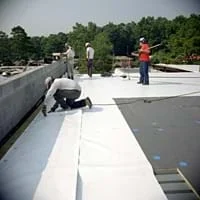 Workers install a white roof in Atlanta, Georgia, to reduce the amount of energy required to keep the inside building temperature cool.Copyright Federal Energy Management Guide, US Department of Energy http://www1.eere.energy.gov/femp/features/cool_roof_resources.html
Imagine that it is 100 degrees outside. How do you stay cool? What kinds of clothing do you wear? Any thought to color? (Listen to student ideas.)
What might be the influence of color and its relationship to heat? Can you think of any instances in which the color of something makes a difference in how hot it gets in the sun? (Listen to student ideas. Possibilities: Wearing white vs. black clothing on super hot days. Flat rooftops sealed in black tar vs. white polymer material. Walking barefoot across a black asphalt roadway vs. lighter concrete roadway. Choosing a white car instead of a black car if you live where it is sunny and hot all the time.)
The sun emits energy in the form of electromagnetic waves. We see part of the electromagnetic wave as light and we feel part of it as warmth. Darker colors absorb more sunlight than lighter colors, which is why darker colors get warmer more quickly in the sunlight than lighter colors. The lighter colors reflect more of the sun's radiant energy, so they remain cooler to touch in the sunlight.
Let's do our own testing to find out.
Before the Activity
- Make enough ice cubes so that each group can have four. Try to make them the same size for experiment consistency.
- To save time, pre-cut and assemble (using tape) the colored paper into five-sided boxes each big enough to fit an ice cube. Otherwise, have students cut, fold and tape together their own boxes. See the Additional Multimedia Support section for Internet resources on how to make a cube from a piece of paper.
- Gather the rest of the materials.
- Make copies of the Activity Worksheet (PDF), one per group.
With the Students
- With the class, talk through the Introduction/Motivation section.
- Once the class is thinking about the influence of color and its relationship to heat, divide the class into small groups.
- Give each group four sheets of colored paper (white, yellow, red, black) and have them cut and fold their sheets into boxes.
- Hand out newspaper and have each group spread the newspaper in an exposed, sunny place outside, or under a heat lamp.
- On the newspaper, place the boxes side by side with the opening facing away from the sun/light so students can see inside.
- Give each group four ice cubes and instruct them to place one ice cube in the center of each colored box.
- Let the ice cubes sit in the sun until they have melted. Have students check them every few minutes and record which ice cubes melted first, second, third, and fourth.
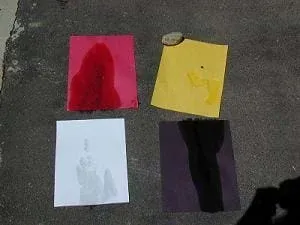 Copyright 2004 Center for Engineering Educational Outreach, Tufts University
 - Direct groups to record their data in the worksheet chart.
- Have students create a bar graph representing the time it took the ice to melt for each color of paper.
- Discuss with the class their observations, touching on the different colors and their ability to reflect light and heat. Also, talk about how these color characteristics help to melt the ice.
- Ask students the Investigating Questions. Discuss some real-world examples in which engineers use their understanding of how different colors reflect light and heat to design products and find solutions. (Example: Asphalt roads and tar roofs are dark surfaces that absorb heat from the sun. Measurements show that white roofs reflect some of the sun's heat back into space and cool temperatures, much as wearing a white shirt on a sunny day can be cooler than wearing a dark shirt. So, designing white roofing materials or paint for roofs has the effect of cooling temperatures within buildings.)
- heat
- A form of energy that causes substances to rise in temperature or to go through associated phase changes (as melting, evaporation, or expansion).
- solar energy
- Energy derived from sunlight.
- solar cell
- A photo-electric cell that converts sunlight directly into electrical energy and can be used as a power source.
- solar panel
- A group of solar cells forming a flat surface (as on a spacecraft).
- energy
- The capacity for doing work; raising weight, for example.
- absorb
- To take in; to transform (radiant energy) into a different form usually with a resulting rise in temperature.
- reflect
- To bounce waves of light, sound, or heat off a surface.
- radiant energy
- Energy (as heat waves, light waves, radio waves, x-rays) transmitted in the form of electromagnetic waves.
Rubric: Use the Rubric for Performance Assessment (PDF).
Making Sense: Have students reflect about the science phenomena they explored and/or the science and engineering skills they used by completing the Making Sense Assessment (PDF).
For a more challenging activity, add a discussion of heat as a form of energy, including the solar panels and solar energy.
Refer to WikiHow's instructions on How to Make a Paper Cube at http://www.wikihow.com/Make-a-Paper-Cube (includes a printable cube template) and How to Make a 3D Cube at http://www.wikihow.com/Make-a-3D-Cube.
Cool Roof Resources for Federal Agencies. Federal Energy Management Guide, U.S. Department of Energy. http://www1.eere.energy.gov/femp/features/cool_roof_resources.html
Do Different Colors Absorb Heat Better? Grades PreK-2. Education Resources Information Center. Office for Technology and Industry Collaboration, Tufts University and Department of Education. (alternate online location for activity) http://www.eric.ed.gov/ERICWebPortal/search/detailmini.jsp?_nfpb=true&_&ERICExtSearch_SearchValue_0=ED480661&ERICExtSearch_SearchType_0=no&accno=ED480661
Richards, Roy. An Early Start to Technology from Science. London, UK: Simon & Schuster, 1990, page 64.
White Roofs May Successfully Cool Cities: Computer Model Simulates Impact of White Roofs on Urban Areas. Posted January 28, 2010. Press release 10-016, National Science Foundation News. http://www.nsf.gov/news/news_summ.jsp?cntn_id=116283
Supporting Program
Center for Engineering Educational Outreach, Tufts University
Copyright
2013 by Regents of the University of Colorado; original © 2004 Worcester Polytechnic Institute