
Renewable Energy Living Lab: Energy Priorities
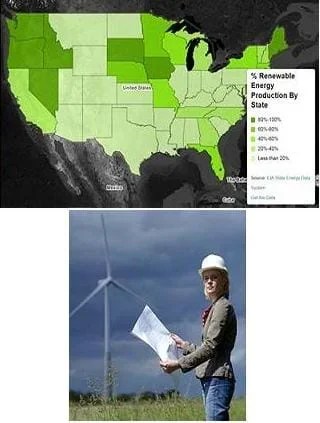 The feasibility in harnessing the various types of renewable energy varies by location. Map shows the percent renewable energy production by state in the U.S.Copyright (woman and wind turbine) US Bureau of Labor Statistics, US Department of Labor; (map) Energy.gov http://www.bls.gov/green/wind_energy/
http://energy.gov/maps/renewable-energy-production-state
The feasibility in harnessing the various types of renewable energy varies by location. Map shows the percent renewable energy production by state in the U.S.Copyright (woman and wind turbine) US Bureau of Labor Statistics, US Department of Labor; (map) Energy.gov http://www.bls.gov/green/wind_energy/
http://energy.gov/maps/renewable-energy-production-state
Students analyze real-world data for five types of renewable energy, as found on the online Renewable Energy Living Lab. They identify the best and worst locations for production of each form of renewable energy, and then make recommendations for which type that state should pursue.
Engineers are continually designing and inventing new technologies to harness energy. All of these technologies must be adapted, however, for local conditions. For example, in Iceland, an island with many active volcanoes, about two-thirds of the country's primary energy comes from geothermal sources. However, in New York, attempting to harness geothermal energy may not make as much sense. Part of an engineer's job is determining what sources of energy are feasible for a given area.
Scientists and engineers around the world gather data through observation and experimentation and use it to describe and understand how the world works. The Renewable Energy Living Lab gives students a chance to evaluate U.S. renewable energy sources. Using the real-world data in the living lab enables students and teachers to practice analyzing data to solve problems or answer questions, in much the same way that scientists and engineers do every day.
After this activity, students should be able to:
- Explain the underlying ideas behind the five renewable energy sources.
- Use maps to analyze and evaluate the potential for various energy sources.
- Explain the factors contributing to renewable energy feasibility and make recommendations for best energy sources.
- Earth's natural resources provide the foundation for human society's physical needs. Many natural resources are nonrenewable on human timescales, while others can be renewed or recycled
Grade 6
Do you agree with this alignment?
- Resources are the things needed to get a job done, such as tools and machines, materials, information, energy, people, capital, and time.
Grades 3-5
Do you agree with this alignment? - The management of waste produced by technological systems is an important societal issue.
Grades 6-8
Do you agree with this alignment? - Energy can be grouped into major forms: thermal, radiant, electrical, mechanical, chemical, nuclear, and others.
Grades 9-12
Do you agree with this alignment? - Energy resources can be renewable or nonrenewable.
Grades 9-12
Do you agree with this alignment? - STEL-3E Analyze how different technological systems often interact with economic, environmental, and social systems.
Grades 6-8
Do you agree with this alignment? - STEL-5F Analyze how an invention or innovation was influenced by its historical context.
Grades 6-8
Do you agree with this alignment? - STEL-7I Apply the technology and engineering design process.
Grades 3-5
Do you agree with this alignment? - STEL-7R Refine design solutions to address criteria and constraints.
Grades 6-8
Do you agree with this alignment?
- MS-ETS1-1 Define the criteria and constraints of a design problem with sufficient precision to ensure a successful solution, taking into account relevant scientific principles and potential impacts on people and the natural environment that may limit possible solutions.
Grades 6-8
This resource focuses on the following Three Dimensional Learning aspects of NGSS:
Science & Engineering Practices- Define a design problem that can be solved through the development of an object, tool, process or system and includes multiple criteria and constraints, including scientific knowledge that may limit possible solutions.Do you agree with this alignment?
Disciplinary Core Ideas- The more precisely a design task's criteria and constraints can be defined, the more likely it is that the designed solution will be successful. Specification of constraints includes consideration of scientific principles and other relevant knowledge that is likely to limit possible solutions.Do you agree with this alignment?
Crosscutting Concepts- The uses of technologies and any limitations on their use are driven by individual or societal needs, desires, and values; by the findings of scientific research; and by differences in such factors as climate, natural resources, and economic conditions.Do you agree with this alignment?
- All human activity draws on natural resources and has both short and long-term consequences, positive as well as negative, for the health of people and the natural environment.Do you agree with this alignment?
Do you agree with this alignment? - Define a design problem that can be solved through the development of an object, tool, process or system and includes multiple criteria and constraints, including scientific knowledge that may limit possible solutions.
- MS-ETS1-2 Evaluate competing design solutions using a systematic process to determine how well they meet the criteria and constraints of the problem.
Grades 6-8
This resource focuses on the following Three Dimensional Learning aspects of NGSS:
Science & Engineering Practices- Evaluate competing design solutions based on jointly developed and agreed-upon design criteria.Do you agree with this alignment?
Disciplinary Core Ideas- There are systematic processes for evaluating solutions with respect to how well they meet the criteria and constraints of a problem.Do you agree with this alignment?
Do you agree with this alignment? - Evaluate competing design solutions based on jointly developed and agreed-upon design criteria.
Each group needs:
- computer with internet access (or printed or projected renewable energy potential maps as found on the Renewable Energy Living Lab website)
- Energy Priorities Worksheet (PDF), one per student
What is renewable energy? (Listen to student ideas.) Renewable energy is generated by resources that will never dwindle because of use or overuse. Are all renewable energy resources equally feasible solutions to generate electrical energy across the US? (Listen to student ideas.) This is the question that we will investigate today.
We will learn more about renewable energy potential sources using the online Renewable Energy Living Lab during the next couple of class periods. We will look at data acquired and presented by the Department of Energy National Laboratories.
Today, we will investigate five key forms of renewable energy: wind, solar, geothermal, hydropower and biomass. What makes an area suitable for a particular type of renewable energy? Well, it varies, depending upon the type of renewable energy. Let's take Iceland for example. You may be aware that this island country is home to many active volcanoes. In fact, approximately two thirds of the country's primary energy comes from geothermal sources. On the other hand, geothermal energy might not make as much sense in other locations, say in New York. As another example, harnessing solar energy makes sense in the state of Colorado, which receives more than 300 days of sunlight every year, but is not as feasible in much of the Pacific Northwest where skies are more often overcast. Part of an engineer's job is to determine what sources of energy are feasible for a given area.
Before the Activity
- Prepare the computers and make copies of the Energy Priorities Worksheet (PDF).
- Divide the class into groups of two or three students each. Small groups work best so each student has a chance to explore the living lab data.
With the Students
- Provide students with the background and story for the activity and the challenge: Engineers are often called upon by decision- and policy-makers to provide information as the basis for community decisions about how to allocate resources. For this activity, you are acting as environmental engineers hired by the people on the state utilities commission to investigate which form of renewable energy they should focus their efforts on as they recruit new companies using a federal renewable energy grant. You have been tasked with analyzing potential energy data using the living lab data and then making a recommendation as to what form of energy the state should focus its recruitment efforts on. To solve this problem, we'll use real data hosted on a website called "a living lab."
- Hand out the worksheets as a guide for the activity. Review the worksheet with the class.
- Show students how to use the Renewable Energy Living Lab, as described in the next steps.
- Navigate students to http://www.teachengineering.org/livinglabs/index.php > click on Renewable Energy Living Lab.
- Review the five renewable energy icons; discuss why each icon is appropriate for the energy type it represents (wind, biomass, hydro, geothermal, solar).
- As an introduction to renewable energy, review the descriptive paragraphs about each energy source the page. Visit each "How It Works" link to explore the engineering.
 A brief description of wind energy, as found on the Renewable Energy Living Lab introduction page. Note the "How It Works" hot link.Copyright 2012 Renewable Energy Living Lab, Colorado School of Mines
 - Choose age group K-12.
- Zoom in on your state by double clicking on the map and/or using the mouse hand and the zoom and pan tool.
- Check the boxes under the Resources folder (located on the left under the Data Layers tab) to switch between the maps depicting the potential for the five different forms of renewable hydropower, biomass, geothermal, wind and solar. Use the icons in the lower left corner to read more information about each form of energy.
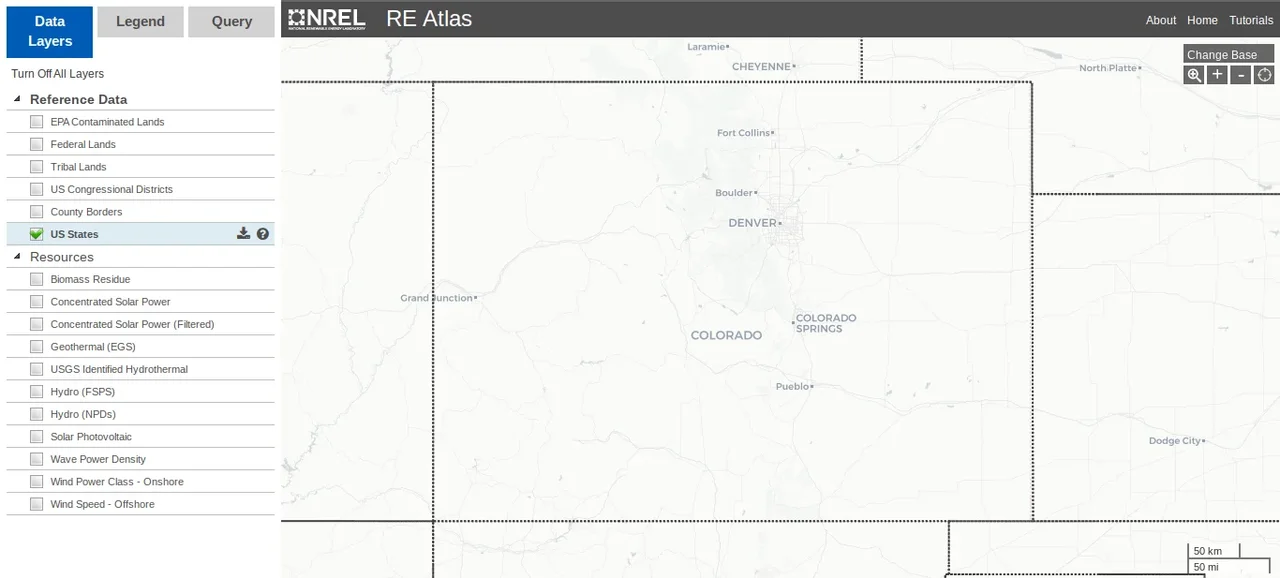 On the map, use the zoom and pan tool in the upper right-hand corner to find locationsCopyright 2016 Renewable Energy Living Lab, Colorado School of Mines
 - Give students time to explore the living lab before they begin to analyze data. Point out the legend under the Legend tab. Point out the various units and color keys. Point out hot links at the bottom of the legend box for additional resources about each energy type.
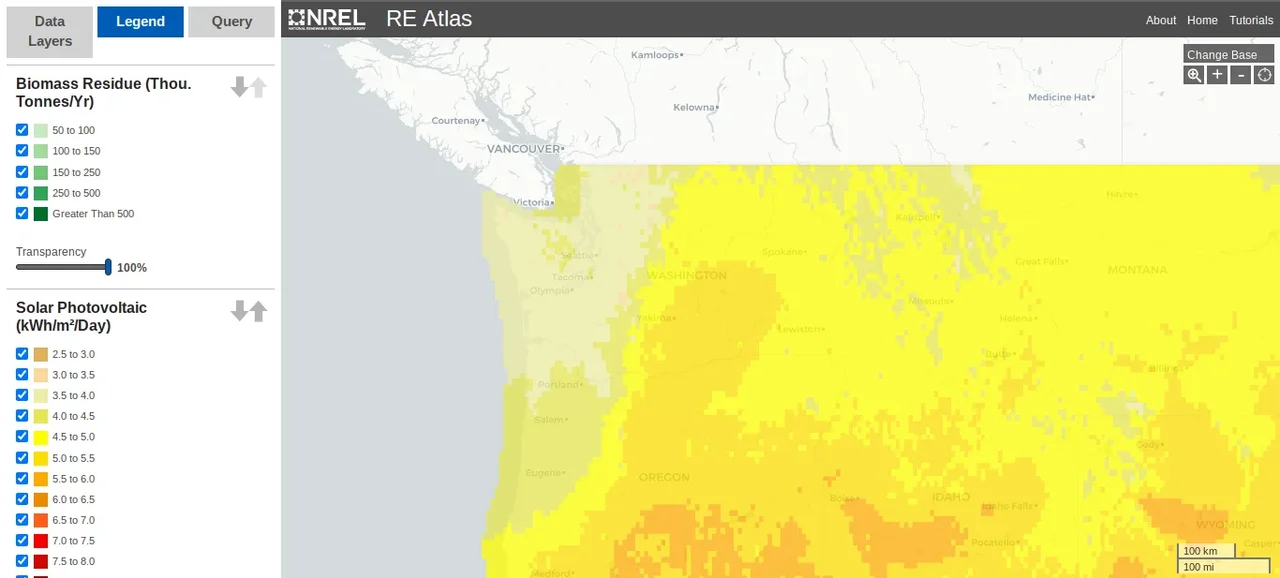 Example Renewable Energy Living Lab screen showing a map legend and additional links.Copyright 2016 Renewable Energy Living Lab, Colorado School of Mines
 - Guide students to complete the "Explain" and "Elaborate" sections of the worksheet. When estimating the average, an eyeball estimate suffices, but expect it to be within a reasonable range. For example, expect an estimate of the average solar output in Washington (see Figure 1) to be between 4.0 and 4.5 kWh/m2/day.
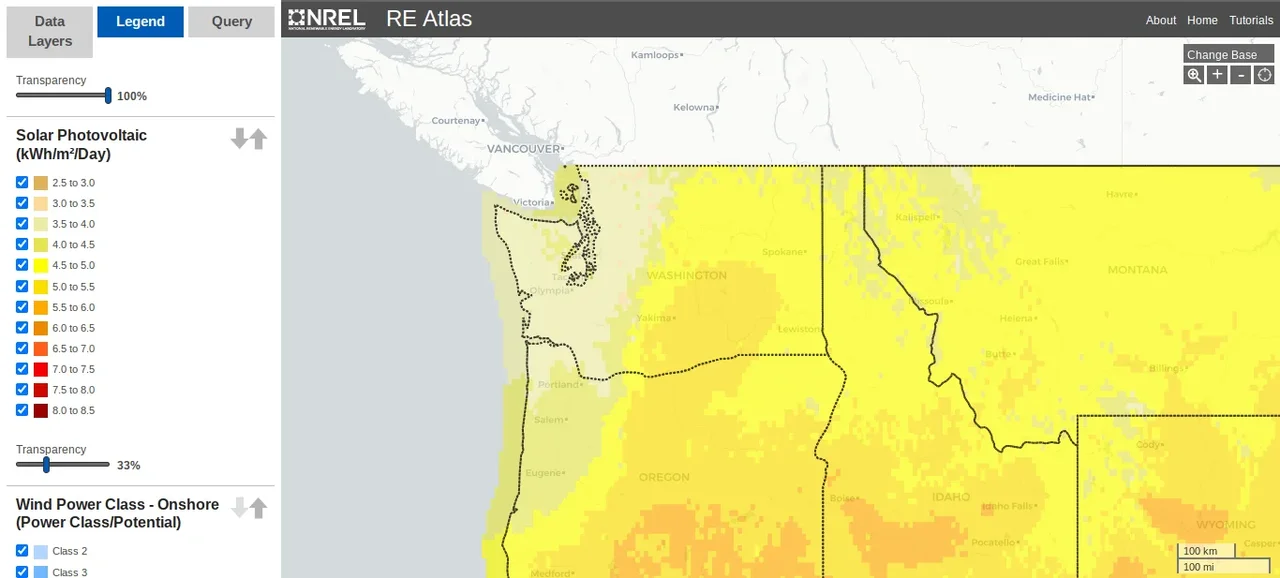 Figure 1: A solar energy potential map for the state of Washington.Copyright 2016 Renewable Energy Living Lab, Colorado School of Mines
 - Guide students to complete the "Evaluate" section of the worksheet. Expect answers to vary, which is acceptable since this is a qualitative rather than quantitative analysis, and only a limited amount of data is available. One answer for question 2 is the fact that all of the energy sources use different units, which means that they cannot be directly compared.
- Conclude by facilitating a class discussion to share results and conclusions, as described in the Assessment section. Have students turn in their worksheets for grading.
- biomass
- Biological (organic) material from living or dead organisms (especially plants) used as an energy source. Biomass used for electricity generation varies widely by region. Examples: Forest and wild plant growth (trees, branches, stumps), industrial wastes (such as from lumber and paper mills), urban waste (park trimmings, yard clippings, municipal solid waste, animal matter, sewage, food scraps), agricultural residues and fuel crops (corn, sugarcane, bamboo, hemp, wheat, straw, rice husks, grasses, algae, seaweed, animal fats, vegetable oils), etc.
- fossil fuel
- A type of fuel formed by the decay and decomposition process of dead organisms buried in the Earth for millions of years. Examples: Petroleum, natural gas, coal.
- geothermal energy
- Thermal (heat) energy from heat present under the Earth's surface.
- hydropower
- Power created from the movement (falling) of water. Dams are often used to create hydropower that can be converted to electricity.
- renewable energy
- Energy obtained from natural resources that are continually replenished, for example, regardless of how much of the Sun's heat energy is "used" today, more is received by the Earth tomorrow. Examples: Sunlight (solar energy), water (hydropower), geothermal, biomass.
- wind turbine
- A device similar to a windmill that moves with the wind to convert the kinetic energy created by the wind to mechanical energy. This mechanical energy can be converted to electrical energy as well.
Activity Embedded Assessment
Worksheet: As students navigate the website and complete their worksheets, walk around and notice their data and answers to gauge their understanding of the subject matter.
Post-Activity Assessment
Discussion & Worksheet: After students have completed the activity, have them share the results of their investigations, as documented on their worksheets, and discuss the differences as a class. Ask students to think of additional data that would be helpful in order to make better-informed decisions. Review their worksheet answers to gauge their comprehension.
- For lower grades, limit the analysis to only a few forms of energy (for example, just solar and wind).
- For upper grades, have students explore the other resources as well as utilize different reference data.
Teacher resources: http://www.teachengineering.org/livinglabs/renewable_energy/educators.php
This activity is designed around the Renewable Energy Living Lab, a resource of current and real-world scientific data, in this case a culmination of available renewable energy data from across the U.S. The data is available in a database with a graphical interface using a scaling map for viewing of regions as large as the continental U.S. and as small as a town. It is rare that students have access to query such as extensive body of scientific data to support their own inquiry-based questions. Additional background information is provided in the living lab interface including source information used to compile the data.
Contributors
Mike Mooney; Minal Parekh; Scott Schankweiler; Jessica Noffsinger; Karen Johnson; Jonathan Knudtsen
Supporting Program
Civil and Environmental Engineering Department, Colorado School of Mines
Acknowledgements
This curriculum was created with the support of National Science Foundation grant no. DUE 0532684. However, these contents do not necessarily represent the policies of the National Science Foundation, and you should not assume endorsement by the federal government.
Copyright
2013 by Regents of the University of Colorado; original © 2012 Colorado School of Mines