
Earthquakes Living Lab: Finding Epicenters & Measuring Magnitudes
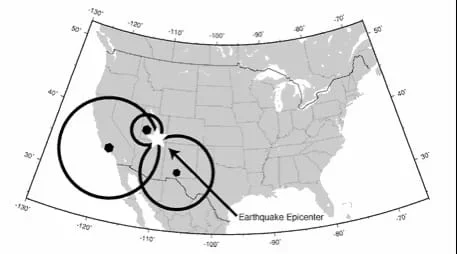 A process called triangulation uses seismic data from three locations to identify the epicenter of an earthquake.Copyright USGS http://earthquake.usgs.gov/learn/kids/eqscience.php
Students learn how engineers characterize earthquakes through seismic data. Then, acting as engineers, they use real-world seismograph data and a tutorial/simulation accessed through the Earthquakes Living Lab to locate earthquake epicenters via triangulation and determine earthquake magnitudes. Student pairs examine seismic waves, S waves and P waves recorded on seismograms, measuring the key S-P interval. Students then determine the maximum S wave amplitudes in order to determine earthquake magnitude, a measure of the amount of energy released. Students consider how engineers might use and implement seismic data in their design work. A worksheet serves as a student guide for the activity.
Every year, earthquakes cause death and destruction worldwide. These natural disasters may be mitigated, however, by insightful and creative engineering. Engineers first determine where earthquakes are likely to occur, and how severe they are likely to be. They use three seismographs in a process called triangulation to determine earthquake epicenters. Using historical seismographs, engineers forecast the strength or magnitude of earthquakes and make predictions and determine building codes and safety protocols.
Scientists and engineers around the globe gather data through observation and experimentation and use it to describe and understand how the world works. The Earthquakes Living Lab gives students the chance to track earthquakes across the planet and examine where, why and how they are occurring. Using the real-world data in the living lab enables students and teachers to practice analyzing data to solve problems and answer questions, in much the same way that scientists and engineers do every day.
After this activity, students should be able to:
- Use the process of triangulation to locate an earthquake's epicenter.
- Explain the difference between S and P waves, and how their time interval is used to determine the epicenter location.
- Describe the logarithmic nature of the earthquake magnitude scale.
- Analyze and interpret data about natural hazards using direct and indirect evidence
Grades 9-12
Do you agree with this alignment? - Seek, evaluate, and use a variety of specialized resources available from libraries, the Internet, and the community to find scientific information on Earth's history
Grades 9-12
Do you agree with this alignment?
- STEL-4P Evaluate ways that technology can impact individuals, society, and the environment.
Grades 9-12
Do you agree with this alignment? - STEL-4S Develop a solution to a technological problem that has the least negative environmental and social impact.
Grades 9-12
Do you agree with this alignment?
- HS-PS4-1 Use mathematical representations to support a claim regarding relationships among the frequency, wavelength, and speed of waves traveling in various media.
Grades 9-12
This resource focuses on the following Three Dimensional Learning aspects of NGSS:
Science & Engineering Practices- Use mathematical representations of phenomena or design solutions to describe and/or support claims and/or explanations.Do you agree with this alignment?
Disciplinary Core Ideas- The wavelength and frequency of a wave are related to one another by the speed of travel of the wave, which depends on the type of wave and the medium through which it is passing.Do you agree with this alignment?
Crosscutting Concepts- Empirical evidence is required to differentiate between cause and correlation and make claims about specific causes and effects.Do you agree with this alignment?
Do you agree with this alignment? - Use mathematical representations of phenomena or design solutions to describe and/or support claims and/or explanations.
- MS-ESS3-2 Analyze and interpret data on natural hazards to forecast future catastrophic events and inform the development of technologies to mitigate their effects.
Grades 6-8
This resource focuses on the following Three Dimensional Learning aspects of NGSS:
Science & Engineering Practices- Construct an oral and written argument supported by empirical evidence and scientific reasoning to support or refute an explanation or a model for a phenomenon or a solution to a problem.Do you agree with this alignment?
Disciplinary Core Ideas- Mapping the history of natural hazards in a region, combined with an understanding of related geologic forces can help forecast the locations and likelihoods of future events.Do you agree with this alignment?
Crosscutting Concepts- The uses of technologies and any limitations on their use are driven by individual or societal needs, desires, and values; by the findings of scientific research; and by differences in such factors as climate, natural resources, and economic conditions. Thus technology use varies from region to region and over time.Do you agree with this alignment?
- Graphs, charts, and images can be used to identify patterns in data.Do you agree with this alignment?
Do you agree with this alignment? - Construct an oral and written argument supported by empirical evidence and scientific reasoning to support or refute an explanation or a model for a phenomenon or a solution to a problem.
Each group needs:
- computer or other device with Internet access
- journal or writing paper for each student
- pen or pencil, one per student
- Finding Epicenters and Measuring Magnitudes Worksheet (PDF), one per group
Seismographs are measuring devices designed by engineers and used by researchers to determine the locations and magnitudes of earthquakes. Several thousand seismographs exist at locations around the planet, continuously measuring abnormalities in the Earth's movement. Specifically, seismographs make recordings (seismograms) of the seismic waves generated from earthquakes, providing engineers and other researchers with data that they use to make predictions about future earthquakes.
What types of engineers might use this data the most? How might they use this information? (Listen to student ideas.) Civil engineers, who design houses, apartment buildings, schools, skyscrapers, bridges, highways, tunnels, water treatment facilities, factories and other structures, may use this data to help them create safer structures that are less likely to sustain damage during earthquakes. While no one can predict earthquakes, knowing the intensities, frequencies and locations of past earthquakes and fault planes helps us to better anticipate the locations and forces to expect, so we can do our best to prepare our communities and infrastructure to withstand them safely.
Teacher Background
In this activity, students use an online simulation—Virtual Earthquake—that is accessible through the Earthquakes Living Lab interface, to locate the epicenter of an earthquake by making simple measurement on three seismograms, recordings of an earthquake's seismic waves detected by instruments (seismographs) far away from the earthquake. The process is called triangulation. Then from the same recordings they determine the earthquake's magnitude, an estimate of the amount of energy released during the earthquake. The point of origin of an earthquake is called its focus and the point on the Earth's surface directly above the focus is the epicenter.
Since the 1970s, the use of the Richter magnitude scale has largely been replaced in the scientific community by the moment magnitude scale (MMS). In the U.S., earthquake measurements under the MMS (those of magnitude 3.5 or higher) are still commonly erroneously referred to by the general public and media as being on the Richter scale, due to more familiarity with the Richter scale.
The Richter scale was created in the 1930s to assign a single number to quantify the energy released during earthquakes. It's a logarithmic scale from 1 to 10 with each succeeding level representing 10 times as much energy as the last. Today, most seismologists no longer follow Richter's original methodology because it does not give reliable results when applied to stronger earthquakes and it was not designed to use data from earthquakes recorded at epicentral distances greater than ~600 km.
The moment magnitude scale (MMS) was developed in the 1970s as a modification of the Richter scale and is better for measuring big earthquakes but less good for small ones. Even though the scale formulae are different, MMS retains the familiar continuum of magnitude values defined by the older scale. Thus, the Richter scale is used for measuring small earthquakes (3.5 M or less), while the moment magnitude scale is used for measuring stronger earthquakes (3.5 M or higher). The USGS now uses the MMS to estimate magnitudes for all modern large earthquakes.
For purposes of this activity, the least complicated and probably most accurate approach is to just use the term "magnitude," without needing to say "on the Richter scale" or "on the moment magnitude scale." To abbreviate, use the symbol M (a capital M, plain text, no sub/superscripts) expressed to the nearest 0.1. If less precision is desired, precede M with a tilde, such as "M ~7" or "magnitude ~6.8."
Before the Activity
- Make copies of the Finding Epicenters and Measuring Magnitudes Worksheet (PDF), one per group. The worksheet serves as a student guide for the activity.
- Make arrangements so that each student group has a computer with Internet access.
With the Students
- Divide the class into student pairs, and have them assemble at their computers with journals/paper and writing instruments.
- Hand out the worksheets to the groups and direct them to read through the instructions. Encourage them to explore all of the Earthquakes Living Lab as they complete the worksheet.
- Before looking at the Earthquakes Living Lab, have pairs complete the Engage section of the worksheet: What is the Richter scale? What is an epicenter?
- Then guide the teams to the Earthquakes Living Lab via the living lab website at http://www.teachengineering.org/livinglabs/index.php. Have them scroll down to the Earthquakes Living Lab section (see Figure 1). Tell students that this activity is designed around the Earthquakes Living Lab, a resource and online interface that uses real-time, real-world seismic data gathered from around the world.
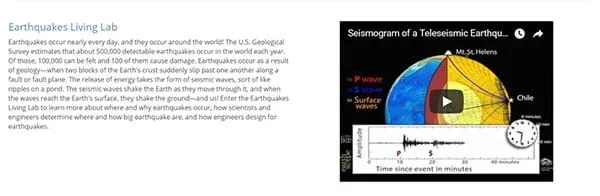 Figure 1. The entry web page for the Earthquakes Living Lab.
 - Have students click on the Earthquakes Living Lab hyperlink in the top left in the earthquakes section. Now on the main page of the Earthquakes Living Lab website (see Figure 2), note the featuring of four active seismic areas and the mapping of real-time and current data from earthquakes happening around the world.
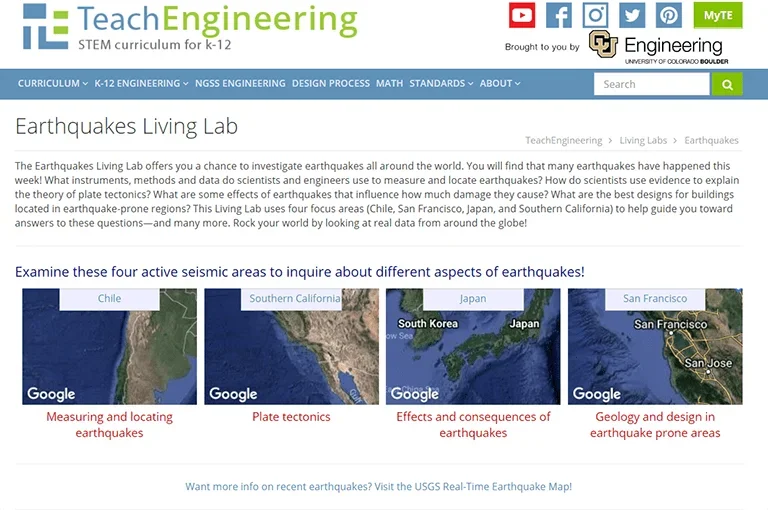 Figure 2. The main page of the Earthquakes Living Lab website.
 - Direct students to complete the Explore section of the worksheet.
 Figure 3: Select the "Chile" box to learn how earthquakes are measured and located.
- Of the four Earthquakes Living Lab seismic areas, choose the "Chile" box, as shown in Figure 3.
- Take a few minutes to read the information on the left side of this page for the 2010 earthquake off the coast of central Chile. Then locate and click the link in the center of the page under the question: "How is an earthquake epicenter located and how is magnitude determined"?
- This opens a new window to Michigan Tech’s UPSeis informational site about earthquakes and seismology. Read through the sections “What Is Seismology and What Are Seismic Waves?,” “Where Do Earthquakes Happen?,” and “Why Do Earthquakes Happen?” to answer the following questions:
What is an earthquake?
What is a seismic wave?
What is the difference between S and P waves?
- After reading about earthquakes, open a new window to an Earthquake Simulator at https://www.newpathonline.com/api_player/enus_54_6304/LXX/index.html. Select the location of Chile (the middle location).
- Follow the simulation instructions. As you read and complete the activity, take notes so you can complete the Explain questions next.
- Direct student pairs to independently complete the tutorial/simulation to find an epicenter location via the triangulation method and compute the earthquake magnitude:
- The simulation directs students to look at three simplified seismograms from seismic stations in Chile (Talca, Santiago, Osorno) and select the correct measurements of the S-P intervals.
- Doing this generates an S-P interval graph (time vs. distance, called the travel-time curve graph) from which they determine and select three epicentral distances.
- The simulation renders three circles on a map and directs students to find the epicenter. Success is figuring out that the epicenter is just off the coast of Chile, where the three circles intersect.
- To make a magnitude determination, two measurements are needed: the S-P interval (already determined earlier in the tutorial) and the maximum amplitude of the seismic waves. So next, students compute the magnitude of this same earthquake by looking at the three simplified seismograms again, but this time selecting each's maximum S wave amplitude (height). Tips: Make sure students are reading the S waves and not the P waves.
- Entering the three maximum amplitudes generates a nomogram, a graphical device that simplifies the process of estimating magnitude from distance (determined earlier in the tutorial from the S-P interval process) and amplitude. Looking at the nomogram, students click on each location data point to see where the three lines intersect to read the estimated magnitude. Success is figuring out that the estimated magnitude is 5.9.
- Next, have student groups answer the eight questions in the Explain section of the worksheet (also listed below). Allow students to return to Michigan Tech’s UPSeis website and read through the other informational sections. Allow students to return to Michigan Tech’s UPSeis website and read through the other informational sections.
- How is an earthquake located?
- What is an epicenter?
- How are S and P waves used to determine how far away epicenters are?
- How does distance from the epicenter affect the S-P time interval?
- Describe the process of triangulation to locate an epicenter.
- How is the magnitude of an earthquake determined?
- Describe what the "magnitude" of an earthquake is.
- What data is used to determine magnitude?
- Then have student pairs complete the Elaborate section of the worksheet.
- Why might the triangulation method not always produce an exact point (other than your measurement errors)?
- How does distance from the epicenter affect the magnitude (height) of the seismograph reading?
- Direct students to finish the activity by completing the Evaluate section. To answer the two questions, have students each write paragraphs to explain their opinions about the reliability of the science of seismology and ways that engineers use seismic data.
- Conclude the activity with a class discussion (and perhaps homework questions) to share ideas and answers, as described in the Assessment section.
- epicenter
- A point on the Earth's surface that is directly above the place where the underground forces of an earthquake originate.
- moment magnitude scale
- Similar to the Richter scale, but replacing its use starting in the 1970s for more accuracy in measuring big earthquakes (magnitudes > 3.5) from greater distances. (Source: USGS, Wikipedia)
- p wave
- The first seismic wave of an earthquake. Short for "primary wave" or "pressure wave." It travels faster than the same earthquake's S wave (almost double the speed) and is similar to sound waves.
- richter magnitude scale
- An earthquake measurement scale created in the 1930s to assign a single number to quantify the energy released during earthquakes. In this 1-to-10 logarithmic scale, each succeeding level representing 10 times as much energy as the last. The magnitude is the logarithm of the amplitude of the ground wave. Considered best for measuring small earthquakes (3.5 M or less). (Source: USGS, Wikipedia)
- s wave
- The second seismic wave of an earthquake. Short for "secondary wave" or "shear wave." It is slower than the same earthquake's P wave and cannot travel through liquids.
- s-p interval
- The time interval between the arrivals of P and S waves.
- seismograph
- An instrument that measures motions of the ground, including those of seismic waves generated by earthquakes. Also called seismometer. The instrument detects and documents the intensity, direction and duration of ground vibrations, which are used to determine the epicenters and strength/magnitudes of earthquakes or other seismic events.
- triangulation
- A method to determine exactly where an earthquake originates. It is called triangulation because a triangle has three sides, and it takes three seismographs to locate an earthquake. If you draw a circle on a map around three different seismographs where the radius of each is the distance from that station to the earthquake, the intersection of those three circles is the epicenter. (Source: USGS)
Pre-Activity Assessment
Introduction: Before student pairs look at the Earthquakes Living Lab, direct them to complete the Engage section of the Finding Epicenters and Measuring Magnitudes Worksheet (PDF), which asks them to apply any prior knowledge and/or speculate as to what the Richter magnitude scale is and what an epicenter is. Review their answers to assess their base knowledge of the subject matter.
Activity Embedded Assessment
Triangulation and Magnitude: Student pairs complete the worksheet (PDF), which includes following a tutorial/simulation accessed through the Earthquakes Living Lab. Students first triangulate the location of an earthquake's epicenter, then calculate its magnitude. Have students turn in their answers for the Explain portion of the worksheet. Assess their understanding based on the thoroughness of their answers.
Post-Activity Assessment
Sharing Information/Thinking Ahead: In the Evaluate section of the worksheet, student pairs are asked to compose answers to two questions—whether they think seismology is a reliable science and ways seismic data is useful for engineers. In a concluding class discussion, have groups share their ideas about engineering and one new thing they learned about earthquakes. Continue the discussion with the following questions (or assign these questions as homework):
- Do limits exist on what science can predict? What are those limits?
- Must engineers be content with mitigating disasters, instead of preventing them?
- Do you think we will someday be able to prevent earthquakes?
Have student groups explore one or more of the other two regions (Southern California and Japan) provided in the Virtual Earthquake simulation.
- For lower grades, just introduce the concepts of triangulation and the magnitude scale; a thorough understanding of P and S waves is not vital.
- For upper grades, have students work individually, do two of the three seismic area tutorials, and look up historical earthquakes to learn their magnitudes, and make data tables or graphs with this information.
Show students some of the numerous online animations comparing the movements of P and S waves.
Moment magnitude scale. Last updated November 26, 2013. Wikipedia, The Free Encyclopedia. Accessed December 11, 2013. http://en.wikipedia.org/wiki/Moment_magnitude_scale
Novak, Gary. Virtual Earthquake (tutorial/simulation) 1996. Geology Labs On-Line, Department of Geological Sciences, California State University, Los Angeles, CA. Accessed December 11, 2013. http://www.sciencecourseware.com/virtualearthquake/
USGS Earthquake Magnitude Policy (implemented on January 18, 2002). Last modified July 18, 2012. U.S. Geological Survey, U.S. Department of the Interior. Accessed December 11, 2013. http://earthquake.usgs.gov/aboutus/docs/020204mag_policy.php
This activity is designed around the Earthquakes Living Lab, a resource and online interface that uses real-time U.S. Geological Survey seismic data from around the world. The living lab presents earthquake information through a focus on four active seismic areas and historic earthquakes in those areas. The real-world earthquake data is viewable via a graphical interface using a scaling map.
Contributors
Mike Mooney; Minal Parekh; Scott Schankweiler; Jessica Noffsinger; Karen Johnson; Jonathan Knudtsen
Supporting Program
Civil and Environmental Engineering Department, Colorado School of Mines
Copyright
2013 by Regents of the University of Colorado; original 2013 Colorado School of Mines