
Earthquakes Living Lab: Geology and the 1906 San Francisco Quake
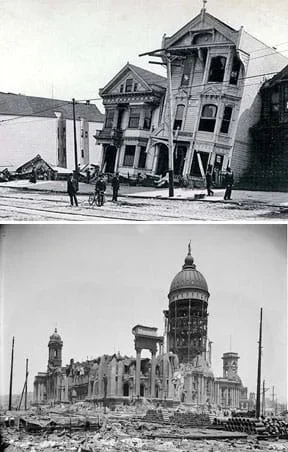 Damaged homes and the ruins of the San Francisco City Hall after the 1906 earthquake.Copyright (top) Wikimedia Commons, (bottom) U.S. Library of Congress
http://commons.wikimedia.org/wiki/File:SanFranHouses06.JPG
http://www.loc.gov/pictures/resource/det.4a25729/
Damaged homes and the ruins of the San Francisco City Hall after the 1906 earthquake.Copyright (top) Wikimedia Commons, (bottom) U.S. Library of Congress
http://commons.wikimedia.org/wiki/File:SanFranHouses06.JPG
http://www.loc.gov/pictures/resource/det.4a25729/
Students examine the effects of geology on earthquake magnitudes and how engineers anticipate and prepare for these effects. Using information provided through the Earthquakes Living Lab interface, students investigate how geology, specifically soil type, can amplify the magnitude of earthquakes and their consequences. Students look in-depth at the historical 1906 San Francisco earthquake and its destruction thorough photographs and data. They compare the 1906 California earthquake to another historical earthquake in Kobe, Japan, looking at the geological differences and impacts in the two regions, and learning how engineers, geologists and seismologists work to predict earthquakes and minimize calamity. A worksheet serves as a student guide for the activity.
Because San Francisco sits on the San Andreas Fault, it has experienced some devastating earthquakes during the past few centuries. One in particular, the 1906 earthquake, caused significant damage and killed ~3,000 people. In an attempt to avoid such catastrophes, engineers try to predict earthquakes and prepare accordingly. Predicting earthquakes exactly is difficult, if not impossible, but by working together to examine a region's geology, engineers, geologists and seismologists can determine the probability of a certain magnitude earthquake occurring in a given timeframe.
Scientists and engineers around the globe gather data through observation and experimentation and use it to describe and understand how the world works. The Earthquakes Living Lab gives students the chance to track earthquakes across the planet and examine where, why and how they are occurring. Using the real-world data in the living lab enables students and teachers to practice analyzing data to solve problems and answer questions, in much the same way that scientists and engineers do every day.
After this activity, students should be able to:
- Explain how engineers use soil and rock data to anticipate and design for earthquakes.
- Describe the basic subsurface geology in the San Francisco region.
- Describe factors that influenced the destruction resulting from two historical earthquakes.
- Gather, analyze, and communicate an evidence-based explanation for the complex interaction between Earth's constructive and destructive forces
Grade 6
Do you agree with this alignment? - Identify, interpret, and explain models of plates motions on Earth
Grade 7
Do you agree with this alignment? - Use maps to locate likely geologic "hot spots", using evidence of earthquakes and volcanic activity
Grade 7
Do you agree with this alignment?
- STEL-6D Engage in a research and development process to simulate how inventions and innovations have evolved through systematic tests and refinements.
Grades 6-8
Do you agree with this alignment? - STEL-6E Verify how specialization of function has been at the heart of many technological improvements.
Grades 6-8
Do you agree with this alignment?
- MS-ESS3-2 Analyze and interpret data on natural hazards to forecast future catastrophic events and inform the development of technologies to mitigate their effects.
Grades 6-8
This resource focuses on the following Three Dimensional Learning aspects of NGSS:
Science & Engineering Practices- Construct an oral and written argument supported by empirical evidence and scientific reasoning to support or refute an explanation or a model for a phenomenon or a solution to a problem.Do you agree with this alignment?
Disciplinary Core Ideas- Mapping the history of natural hazards in a region, combined with an understanding of related geologic forces can help forecast the locations and likelihoods of future events.Do you agree with this alignment?
Crosscutting Concepts- The uses of technologies and any limitations on their use are driven by individual or societal needs, desires, and values; by the findings of scientific research; and by differences in such factors as climate, natural resources, and economic conditions. Thus technology use varies from region to region and over time.Do you agree with this alignment?
- Graphs, charts, and images can be used to identify patterns in data.Do you agree with this alignment?
Do you agree with this alignment? - Construct an oral and written argument supported by empirical evidence and scientific reasoning to support or refute an explanation or a model for a phenomenon or a solution to a problem.
Each group needs:
- computer or other device with Internet access
- journal or writing paper for each student
- pen or pencil, one per student
- The Great 1906 San Francisco Earthquake Worksheet (PDF), one per group
Earthquakes can cause houses to crumble, bridges to fall and buildings to catch on fire. An historic 1906 earthquake shook for about a minute and resulted in San Francisco falling victim to all these consequences, causing widespread destruction, injuries and an estimated 3,000 deaths.
Following this earthquake, the U.S. saw a surge in scientific research surrounding earthquakes. With an increased understanding of earthquakes and their potential for disaster, scientists and engineers began working to try to predict earthquakes and take steps to mitigate their destruction in the future. This includes early warning systems and building codes that establish standards for earthquake-resistant structures.
Precisely predicting earthquakes is not possible, but by examining an area's seismic history and existing geology, engineers can determine the probability of a certain magnitude earthquake occurring in a given timeframe. For example, forecasters might say: "We see a 99% chance of a magnitude 6.7 quake within the next three decades, and 46% chance of a 7.5 or greater earthquake, with Southern California the likely center."
In this activity, we examine the San Francisco bay area in Northern California, where that magnitude ~7.8 earthquake took place more than 100 years ago, to find out how engineers, geologists and seismologists work to forecast future seismic events and prevent earthquake damage.
For this activity, have students follow the worksheet instructions, making sure they keep adequate notes in their journals of what they learn.
Before the Activity
- Make copies of the The Great 1906 San Francisco Earthquake Worksheet (PDF), one per group. The worksheet serves as a student guide for the activity.
- Make arrangements so that each student group has a computer with Internet access.
With the Students
- Divide the class into student pairs, and have them assemble at their computers with journals/paper and writing instruments.
- Hand out the worksheets to the groups and direct them to read through the instructions. Encourage them to explore all of the Earthquakes Living Lab, especially if they need more information to complete the worksheet.
- Before looking at the Earthquakes Living Lab, have pairs complete the Engage section of the worksheet, one question: What factors do they think contribute to the magnitude of earthquakes?
- Then guide the teams to the Earthquakes Living Lab via the living lab website at http://www.teachengineering.org/livinglabs/index.php. Have them scroll down to the Earthquakes Living Lab section (see Figure 1). Tell students that this activity is designed around the Earthquakes Living Lab, a resource and online interface that uses real-time, real-world seismic data gathered from around the world.
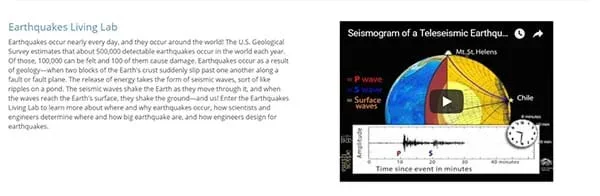 Figure 1. The entry web page for the Earthquakes Living Lab.
 - Have students select the Earthquakes Living Lab hyperlink in the top left in the earthquakes section. Now on the main page of the Earthquakes Living Lab website (see Figure 2), note the focus on four active seismic areas.
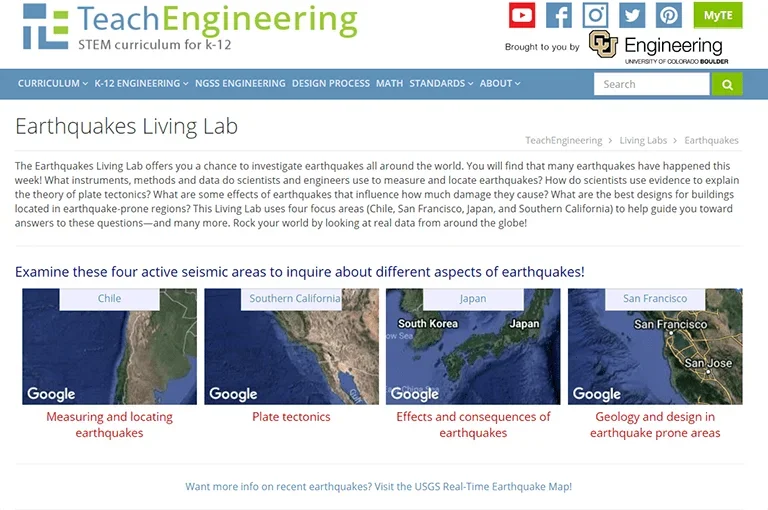 Figure 2. The main page of the Earthquakes Living Lab website.
 - Direct students to complete the Explore section of the worksheet.
- Of the four Earthquakes Living Lab seismic areas, select the "San Francisco" box.
- Once there, click the third link on the right side of the page about how scientists and engineers use geology to study earthquakes. This opens a new window at https://www1.wsrb.com/blog/the-effects-of-soil-type-on-earthquake-damage. Explore this page and answer the worksheet questions:
a. Was the soil type one of the factors you listed in the Engage section?
b. What makes this an important variable in the resulting magnitude of earthquakes?
c. Record a specific example of how geology has an effect on earthquakes.
d. Which soil type has the strongest amplification of shaking?
e. How might engineers use this data?
- Navigate to the USGS web page https://www.usgs.gov/natural-hazards/earthquake-hazards/earthquakes, select "Earthquakes." Find two earthquakes of the same magnitude or that are within .2 magnitude of each other. Then answer the worksheet questions:
a. Compare and contrast two earthquakes with the same magnitudes but different locations in the world. Use the links to view where on the map these earthquakes occurred.
b. Looking at the two earthquakes you chose, record information from the "Tectonic Summary" for both locations. The "Tectonic Summary' information is below the map for each location. Are any variables the same in both locations?
- Go to the link for the "1906 San Francisco Earthquake," at https://earthquake.usgs.gov/earthquakes/events/1906calif/18april/index.php.
a. Read about the 1906 San Francisco earthquake and explore the different links on the left side of the page.
b. Record at least five observations, including at least one from the 1906 earthquake photos.
- Return to the Earthquakes Living Lab main page at http://www.teachengineering.org/livinglabs/earthquakes/ and select Japan (the third seismic focus region). Read the paragraph on a 1995 earthquake located on the left side of the page, then click on the second picture on the right-hand side, which takes you to the Kobe earthquake of 1995 page, which opens a new window at https://www.britannica.com/event/Kobe-earthquake-of-1995.
a. Read through this information, paying special attention to the photographs, and record at least five observations about this earthquake
b. How are the effects of these two earthquakes the same? How are they different? What are some possible reasons for the differences between these earthquakes and the damage they caused?
- Have students move on to the Explain section of the worksheet:
- What patterns did you notice between geology and magnitude?
- How do you think engineers might use this information?
- Direct students to complete the Elaborate worksheet section. Remind them to explore other areas on the Earthquakes Living Lab page and USGS pages as needed.
- How do you think seismologists and geologists might work together to create maps of where earthquakes are most likely to occur (probability maps) of earthquake areas?
- Have students complete the Evaluate worksheet section. Suggest students use PowerPoint slides, videos, songs or skits to deliver their PSAs.
- Your engineering team is hired to create a public service announcement (PSA) about the soils found in the San Francisco area and the hazards related to earthquakes. Create a one-minute announcement that informs people about these hazards. Use any information found on the Earthquakes Living Lab and USGS pages.
- Conclude the activity with class presentations of the PSAs, as described in the Assessment section.
- geology
- The scientific study of the origin, history and structure of the Earth or a specific region of the Earth's crust.
- liquefaction
- A process by which water-saturated sediment temporarily loses strength and acts as a fluid. It occurs when vibrations or water pressure within a mass of soil causes the soil particles to lose contact with one another.
- magnitude
- A measurement to describe the relative amount of energy released in an earthquake. Based on the maximum seismic wave motion recorded by a seismograph. Typically measured on the Richter magnitude scale or moment magnitude scale.
Pre-Activity Assessment
Important Factors Intro: Before student pairs look at the Earthquakes Living Lab, have them complete the Engage section of The Great 1906 San Francisco Earthquake Worksheet (PDF), thinking about possible factors that might contribute to an earthquake's magnitude. Review their answers to assess their base knowledge of the subject matter.
Activity Embedded Assessment
Exploring Historic Earthquakes: Students follow the Earthquakes Living Lab and links in the worksheet (PDF) instructions to explore the effect of soil types on magnitude and amplification and answer the worksheet questions. Specifically, students examine the 1906 San Francisco and 1995 Kobe earthquakes, comparing geology and impacts in both regions. At class end, have students (or groups) turn in their journals. Review their Explore, Explain and Elaborate answers for comprehension and completeness.
Post-Activity Assessment
Sharing Information through PSAs: In the Evaluate worksheet section, students are asked to create public service announcements to warn citizens about soil types and potential earthquakes dangers. Have groups share their PSAs with the class using PowerPoint slides, videos, songs or skits.
Have students explore other historical earthquakes that happened in San Francisco or Japan. Or assign students to explore the geological issues for historic earthquakes that happened in the other two regions in the Earthquakes Living Lab (Southern California and Chile).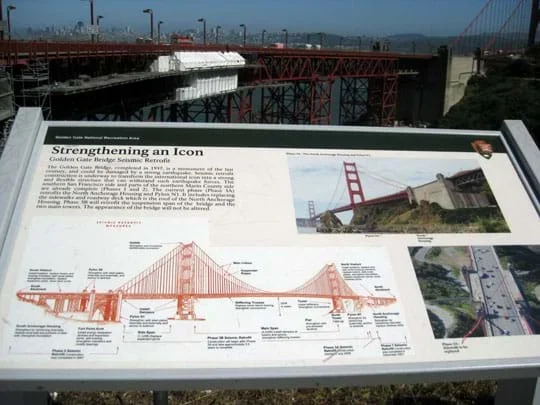 The more than 75-year-old Golden Gate Bridge has undergone years of seismic retrofit so that it is able to better resist seismic events.Copyright 2013 Denise W. Carlson. Used with permission.
Have students research and report back to the class about the engineering efforts that have been/are being made around the world to prepare for the inevitability of future big earthquakes. Start by researching "seismic retrofit" for bridges in San Francisco. Also search for seismic early warning systems, seismic building codes, and earthquake-resistant structures in known active seismic regions.
- For lower grades, eliminate the Elaborate and Explore sections of the worksheet.
- For upper grades, have students work individually, look at three or four earthquakes of similar magnitude or two different pairs in the Explore section, making data tables, and looking at other historical earthquakes to compare their geologies.
The Great 1906 San Francisco Earthquake (5:12AM, April 18, 1906). Last modified July 23, 2012. Earthquake Hazards Program, U.S. Geological Survey, U.S. Department of the Interior. Accessed August 7, 2012. https://earthquake.usgs.gov/earthquakes/events/1906calif/18april/
Henderson, Peter. "Special Report: Big California Quake Likely to Devastate State." Posted March 15, 2013. Thomson Reuters News Agency. Accessed August 7, 2012. http://www.reuters.com/article/2011/03/15/us-quake-california-idUSTRE72E06220110315
This activity is designed around the Earthquakes Living Lab, a resource and online interface that uses real-time U.S. Geological Survey seismic data from around the world. The living lab presents earthquake information through a focus on four active seismic areas and historic earthquakes in those areas. The real-world earthquake data is viewable via a graphical interface using a scaling map.
Contributors
Mike Mooney; Minal Parekh; Scott Schankweiler; Jessica Noffsinger; Karen Johnson; Jonathan Knudtsen
Supporting Program
Civil and Environmental Engineering Department, Colorado School of Mines
Acknowledgements
This curriculum was created with the support of National Science Foundation grant no. DUE 0532684. However, these contents do not necessarily represent the policies of the National Science Foundation, and you should not assume endorsement by the federal government.
Copyright
2013 by Regents of the University of Colorado; original 2013 Colorado School of Mines