
Renewable Energy Living Lab: Smart Solar
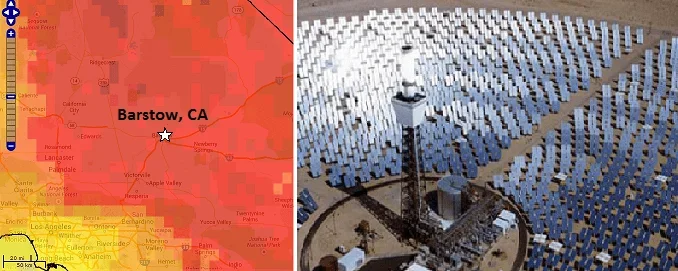 The color-coded map shows high solar power potential in southern California, such as the location of this field of solar panels in Barstow, CA.Copyright (left) 2012 Renewable Energy Living Lab, Colorado School of Mines; (right) 1996 Sandia National Laboratories via US Dept. of Energy https://www.eeremultimedia.energy.gov/solar/photographs/solar_two_tower_system
Students use real-world data to evaluate whether solar power is a viable energy alternative for several cities in different parts of the U.S. Working in small groups, they examine maps and make calculations using NREL/US DOE data from the online Renewable Energy Living Lab. In this exercise, students analyze cost and availability for solar power, and come to conclusions about whether solar power is a good solution for four different locations.
Many different methods are used to collect energy; some methods are better suited to a particular area than others. Engineers use data to understand the problem and evaluate viable solutions. When designing systems to produce or transmit sustainable energy, or power, engineers look at opportunities to harness renewable resources such as wind, sunlight, biofuels, geothermal heat and flowing water. Two important factors in analyzing the feasibility of a renewable energy source are cost and availability, which engineers routinely consider as they evaluate potential solutions.
Scientists and engineers around the world gather data through observation and experimentation and use it to describe and understand how the world works. The Renewable Energy Living Lab gives students a chance to evaluate U.S. renewable energy sources. Using the real-world data in the living lab enables students and teachers to practice analyzing data to solve problems or answer questions, in much the same way that scientists and engineers do every day.
After this activity, students should be able to:
- Use the Renewable Energy Living Lab to collect data.
- Describe the factors (cost, availability, others?) limiting renewable energy.
- Perform a basic economic analysis.
- Earth's natural resources provide the foundation for human society's physical needs. Many natural resources are nonrenewable on human timescales, while others can be renewed or recycled
Grade 6
Do you agree with this alignment?
- CCSS.Math.Content.6.NS.B.2 Fluently divide multi-digit numbers using the standard algorithm.
Grade 6
Do you agree with this alignment? - CCSS.Math.Content.6.NS.B.3 Fluently add, subtract, multiply, and divide multi-digit decimals using the standard algorithm for each operation.
Grade 6
Do you agree with this alignment? - CCSS.Math.Content.6.RP.A.3b Solve unit rate problems including those involving unit pricing and constant speed.
Grade 6
Do you agree with this alignment? - CCSS.Math.Content.6.RP.A.3d Use ratio reasoning to convert measurement units; manipulate and transform units appropriately when multiplying or dividing quantities.
Grade 6
Do you agree with this alignment?
- The management of waste produced by technological systems is an important societal issue.
Grades 6-8
Do you agree with this alignment? - Energy can be grouped into major forms: thermal, radiant, electrical, mechanical, chemical, nuclear, and others.
Grades 9-12
Do you agree with this alignment? - Energy resources can be renewable or nonrenewable.
Grades 9-12
Do you agree with this alignment? - STEL-3E Analyze how different technological systems often interact with economic, environmental, and social systems.
Grades 6-8
Do you agree with this alignment? - STEL-4L Analyze how the creation and use of technologies consumes renewable and non-renewable resources and creates waste.
Grades 6-8
Do you agree with this alignment? - STEL-5F Analyze how an invention or innovation was influenced by its historical context.
Grades 6-8
Do you agree with this alignment? - STEL-7I Apply the technology and engineering design process.
Grades 3-5
Do you agree with this alignment? - STEL-7R Refine design solutions to address criteria and constraints.
Grades 6-8
Do you agree with this alignment? - STEL-7S Create solutions to problems by identifying and applying human factors in design.
Grades 6-8
Do you agree with this alignment?
- MS-ETS1-2 Evaluate competing design solutions using a systematic process to determine how well they meet the criteria and constraints of the problem.
Grades 6-8
This resource focuses on the following Three Dimensional Learning aspects of NGSS:
Science & Engineering Practices- Evaluate competing design solutions based on jointly developed and agreed-upon design criteria.Do you agree with this alignment?
Disciplinary Core Ideas- There are systematic processes for evaluating solutions with respect to how well they meet the criteria and constraints of a problem.Do you agree with this alignment?
Do you agree with this alignment? - Evaluate competing design solutions based on jointly developed and agreed-upon design criteria.
Each group needs:
- computer with internet access (or printed or projected renewable energy potential maps as found on the Renewable Energy Living Lab website)
- Smart Solar Worksheet (PDF), one per student
(Lead a class discussion.) To understand how energy affects our lives, let's consider some questions.
- Why do we need to generate energy? (Listen to student ideas. Example answers: We need energy to power our industries, to move from place to place, to grow and cook our food, to warm or cool our homes.)
- From where do we get our power/electricity currently? (Example answers: Petroleum/oil, coal, solar, wind, hydropower.)
Let's consider different sources of energy.
- What does "renewable" mean? (Example answer: One definition is that renewable sources are those that will never dwindle or be used up because of use or overuse. Renewable energy comes from natural resources such as wind, plant material, water [rain or tides], geothermal and sunlight, and is naturally replenished.)
- How is "renewable" the same and how is it different from "green energy"? (Points to make: "Green energy" commonly means that no pollution or environmental hazards are created during the energy generation process. All energy sources require energy to generate and have some impact, so the definition of "green" is debatable. For example, solar energy can be collected passively, but energy and materials are required to produce the panels, and that production may generate waste products.)
Today, we will focus on determining whether solar energy is a feasible source of renewable energy for cities across the country.
- To consider whether solar energy is feasible, what questions would you ask? (Listen to student suggestions. Example questions: How does it work? How much power potential exists? How much does it cost? What is its environmental impact? Is the resource available in the area where we need it?)
We will learn more about renewable energy potential sources using the online Renewable Energy Living Lab. We will look at data acquired and presented by the Department of Energy National Laboratories.
Before the Activity
- Prepare the computers and make copies of the Smart Solar Worksheet (PDF).
- Divide the class into groups of two or three students each. Small groups work best so each student has a chance to explore the living lab data.
With the Students
- Provide students with background for the activity, and the challenge: Many people assume that building solar panels is always a smart idea. But is it? Your engineering task is to analyze solar energy data from the living lab to determine if solar panels are always a smart choice. To solve this problem, we'll use real data hosted on a website called "a living lab."
- Hand out the worksheets as a guide for the activity. Review the worksheet with the class.
- Show students how to use the Renewable Energy Living Lab, as described in the next steps.
- Navigate students to http://www.teachengineering.org/livinglabs/index.php> click on Renewable Energy Living Lab.
- Review the five renewable energy icons; discuss why each icon is appropriate for the energy type it represents (wind, biomass, hydro, geothermal, solar).
- As an introduction to renewable energy, review the descriptive paragraphs about each energy source the page. Visit each "How It Works" link to explore the engineering.
 A brief description of wind energy, as found on the Renewable Energy Living Lab introduction page. Note the "How It Works" hot link.Copyright 2012 Renewable Energy Living Lab, Colorado School of Mines
 - Choose age group K-12.
- Zoom in on your state by double clicking on the map and/or using the mouse hand and the zoom and pan tool.
- Check the boxes under the Resources folder (located on the left under the Data Layers tab) to switch between the maps depicting the potential for the five different forms of renewable hydropower, biomass, geothermal, wind and solar. Use the icons in the lower left corner to read more information about each form of energy.
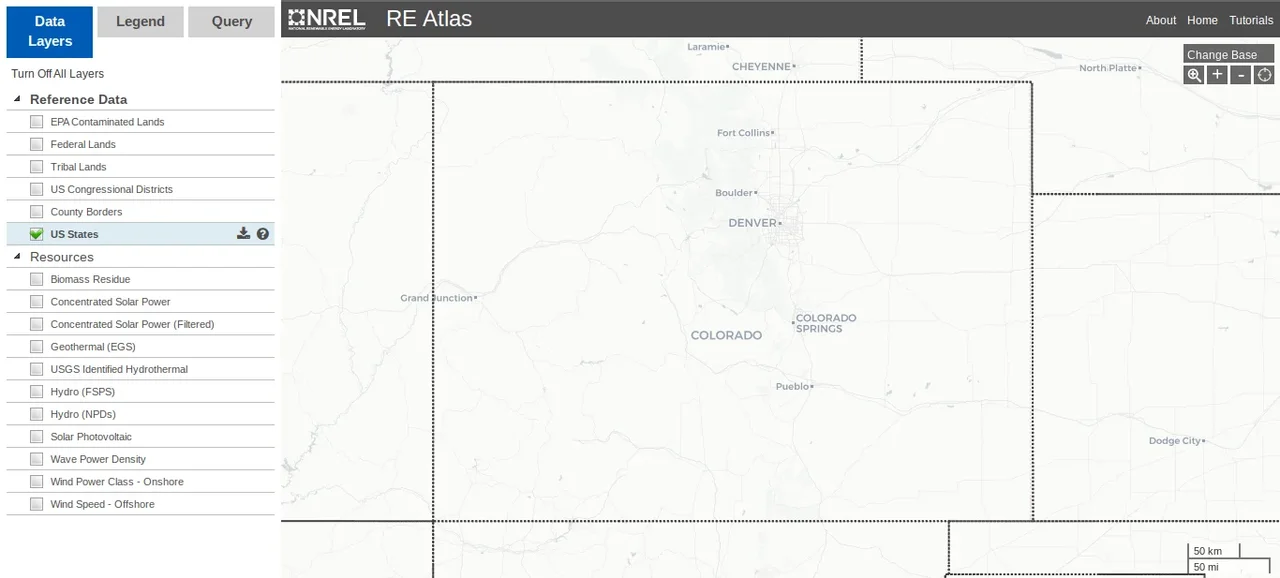 On the map, use the zoom and pan tool to find locations.Copyright 2022 Renewable Energy Living Lab, Colorado School of Mines.
 - Guide students to complete the "Engage" section of the worksheet. Show them the links about how solar works and direct them to explore the links to improve their understanding.
 A brief description of solar energy, as found on the Renewable Energy Living Lab introduction page. Note the "How It Works" hot link.Copyright 2012 Renewable Energy Living Lab, Colorado School of Mines
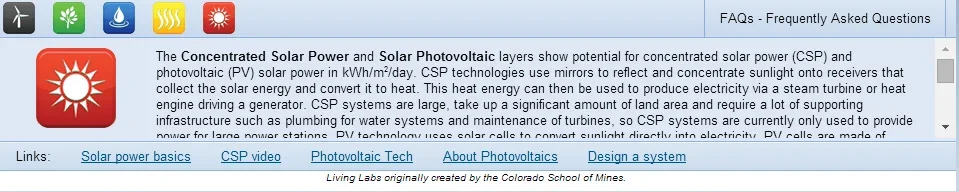 Example Renewable Energy Living Lab screen showing solar power information and additional links.Copyright 2012 Renewable Energy Living Lab, Colorado School of Mines
 - Guide students to complete the "Explore" and "Elaborate" sections of the worksheet.
- Guide students to complete the "Evaluate" section of the worksheet. Answers may vary, but the obvious best energy source choices for the targeted cities are listed below:
- Minneapolis: biomass or solar
- Las Vegas: geothermal or solar
- Portland: biomass
- San Antonio: solar, biomass, geothermal
- Conclude by facilitating a class discussion to share results and conclusions, as described in the Assessment section. Have students turn in their worksheets for grading.
- biomass
- Biological (organic) material from living or dead organisms (especially plants) used as an energy source. Biomass used for electricity generation varies widely by region. Examples: Forest and wild plant growth (trees, branches, stumps), industrial wastes (such as from lumber and paper mills), urban waste (park trimmings, yard clippings, municipal solid waste, animal matter, sewage, food scraps), agricultural residues and fuel crops (corn, sugarcane, bamboo, hemp, wheat, straw, rice husks, grasses, algae, seaweed, animal fats, vegetable oils), etc.
- fossil fuel
- A type of fuel formed by the decay and decomposition process of dead organisms buried in the Earth for millions of years. Examples: Petroleum, natural gas, coal.
- geothermal energy
- Thermal (heat) energy from heat present under the Earth's surface.
- hydropower
- Power created from the movement (falling) of water. Dams are often used to create hydropower that can be converted to electricity.
- renewable energy
- Energy obtained from natural resources that are continually replenished, for example, regardless of how much of the Sun's heat energy is "used" today, more is received by the Earth tomorrow. Examples: Sunlight (solar energy), water (hydropower), geothermal, biomass.
- wind turbine
- A device similar to a windmill that moves with the wind to convert the kinetic energy created by the wind to mechanical energy. This mechanical energy can be converted to electrical energy as well.
Pre-Activity Assessment
Questions: Introduce the topic and gauge students' knowledge about it by leading a discussion using the questions provided in the Introduction/Motivation section.
Activity Embedded Assessment
Observation & Data Checks: Check for understanding through questioning and monitoring of student work while they access data and evaluate maps. As students navigate the website and complete their worksheets, walk around and notice their data and answers. Ask them about units of measure and geographic trends.
Post-Activity Assessment
Discussion & Worksheet: After students have completed the activity, have them share their results with the class. Point out similarities and differences within their solutions/difficulties. Review the accuracy of calculations and completeness of answers on their worksheet answers to gauge their understanding.
- For lower grades, lead the "Elaborate" section as a class, instead of in groups.
- For lower grades, explore just the maps, and skip the calculations.
Teacher resources: http://www.teachengineering.org/livinglabs/renewable_energy/educators.php
This activity is designed around the Renewable Energy Living Lab, a resource of current and real-world scientific data, in this case a culmination of available renewable energy data from across the U.S. The data is available in a database with a graphical interface using a scaling map for viewing of regions as large as the continental U.S. and as small as a town. It is rare that students have access to query such as extensive body of scientific data to support their own inquiry-based questions. Additional background information is provided in the living lab interface including source information used to compile the data.
Contributors
Mike Mooney; Minal Parekh; Scott Schankweiler; Jessica Noffsinger; Karen Johnson; Jonathan Knudtsen
Supporting Program
Civil and Environmental Engineering Department, Colorado School of Mines
Acknowledgements
This curriculum was created with the support of National Science Foundation grant no. DUE 0532684. However, these contents do not necessarily represent the policies of the National Science Foundation, and you should not assume endorsement by the federal government.
Copyright
2013 by Regents of the University of Colorado; original © 2012 Colorado School of Mines