
Reverse Engineering Project: Disassemble, Sketch & Recap
Student pairs reverse engineer objects of their choice, learning what it takes to be an engineer. Groups each make a proposal, create a team work contract, use tools to disassemble a device, and sketch and document their full understanding of how it works. They compile what they learned into a manual and write-up that summarizes the object's purpose, bill of materials and operation procedure with orthographic and isometric sketches. Then they apply some of the steps of the engineering design process to come up with ideas for how the product or device could be improved for the benefit of the end user, manufacturer and/or environment. They describe and sketch their ideas for re-imagined designs (no prototyping or testing is done). To conclude, teams compile full reports and then recap their reverse engineering projects and investigation discoveries in brief class presentations. A PowerPoint® presentation, written report and oral presentation rubrics, and peer evaluation form are provided.
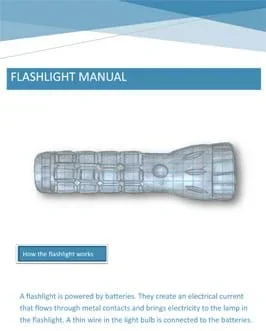 The first page of a student team's manual shows a drawing of a flashlight.Copyright 2015 Alexa Garfinkel, Colorado State University
One of the best ways to understand a product or device is through reverse engineering—it's a hands-on way to satisfy one's curiosity about what's inside a product and how it works, or to fix a device when instructions are lost or unclear. Reverse engineering is often part of the engineering design process—used to make imitation products or innovate improvements. Reverse engineering cultivates many skills that are important in engineering, including teamwork, tool usage, communication (writing a manual and report, creating graphic images, giving oral presentation), sketching and coming up with design improvements.
After this activity, students should be able to:
- Write a basic proposal.
- Write a team contract and prepare a bill of materials.
- Use the reverse engineering process to understand how a device works.
- Write a manual that explains how to put together a device.
- Apply the engineering design process to improve a device design.
- Give a presentation to summarize a long, multi-faceted project.
- Use information and communication technology tools to gather information from credible sources, analyze findings, and draw conclusions to create and justify an evidence-based scientific explanation
Grade 7
Do you agree with this alignment?
- Students will develop an understanding of the attributes of design.
Grades K-12
Do you agree with this alignment? - Students will develop an understanding of engineering design.
Grades K-12
Do you agree with this alignment? - The design needs to be continually checked and critiqued, and the ideas of the design must be redefined and improved.
Grades 9-12
Do you agree with this alignment? - STEL-2X Cite examples of the criteria and constraints of a product or system and how they affect the final design.
Grades 9-12
Do you agree with this alignment? - STEL-7W Determine the best approach by evaluating the purpose of the design.
Grades 9-12
Do you agree with this alignment? - STEL-8N Use various approaches to communicate processes and procedures for using, maintaining, and assessing technological products and systems.
Grades 9-12
Do you agree with this alignment?
- HS-ETS1-2 Design a solution to a complex real-world problem by breaking it down into smaller, more manageable problems that can be solved through engineering.
Grades 9-12
This resource focuses on the following Three Dimensional Learning aspects of NGSS:
Science & Engineering Practices- Design a solution to a complex real-world problem, based on scientific knowledge, student-generated sources of evidence, prioritized criteria, and tradeoff considerations.Do you agree with this alignment?
Disciplinary Core Ideas- Criteria may need to be broken down into simpler ones that can be approached systematically, and decisions about the priority of certain criteria over others (trade-offs) may be needed.Do you agree with this alignment?
Do you agree with this alignment? - Design a solution to a complex real-world problem, based on scientific knowledge, student-generated sources of evidence, prioritized criteria, and tradeoff considerations.
- HS-ETS1-3 Evaluate a solution to a complex real-world problem based on prioritized criteria and trade-offs that account for a range of constraints, including cost, safety, reliability, and aesthetics, as well as possible social, cultural, and environmental impacts.
Grades 9-12
This resource focuses on the following Three Dimensional Learning aspects of NGSS:
Science & Engineering Practices- Evaluate a solution to a complex real-world problem, based on scientific knowledge, student-generated sources of evidence, prioritized criteria, and tradeoff considerations.Do you agree with this alignment?
Disciplinary Core Ideas- When evaluating solutions it is important to take into account a range of constraints including cost, safety, reliability and aesthetics and to consider social, cultural and environmental impacts.Do you agree with this alignment?
Crosscutting Concepts- New technologies can have deep impacts on society and the environment, including some that were not anticipated. Analysis of costs and benefits is a critical aspect of decisions about technology.Do you agree with this alignment?
Do you agree with this alignment? - Evaluate a solution to a complex real-world problem, based on scientific knowledge, student-generated sources of evidence, prioritized criteria, and tradeoff considerations.
For the teacher's introductory presentation:
- Reverse Engineering Intro Presentation (PPTX), a Microsoft PowerPoint® file
- Reverse Engineering Grading Rubrics (PDF)
- computer and projector to show an online video, slide presentation and rubrics
Each group needs:
- a device to take apart; must meet the guidelines specified in the Procedure section and in the presentation; ask groups to scavenge, bring from home or purchase for no more than $5 per person; examples include: flashlight, fishing pole spinning reel, tape dispenser, water gun, bicycle, toy truck, toy rocket, mechanical pencil, remote-controlled car
- pencil and paper
- safety glasses, one pair per student
- computer with access to Microsoft Word® and/or PowerPoint® (for creating final reports and presentations), scanner (for hand sketches), SolidWorks® (the latter is optional)
- (optional) camera, such as the camera in a cell phone
- Peer Evaluation Form (PDF), one table per student (four provided per file)
To share with the entire class:
- tools such as screwdrivers, wrenches, pliers, hand drills, hammers; provide a variety of tools for students to use to take apart their devices
- measuring devices such as rulers, measuring tapes and calipers
- Reverse Engineering Intro Presentation (pptx)
- Reverse Engineering Intro Presentation (pdf)
- Reverse Engineering Grading Rubrics (docx)
- Reverse Engineering Grading Rubrics (pdf)
- Peer Evaluation Form (docx)
- Peer Evaluation Form (pdf)
- Reverse Engineering Student Example (docx)
- Reverse Engineering Student Example (pdf)
Before starting this project, students should be familiar with the following:
- Engineering design process
- Sketching orthographic and isometric views of objects
- Documenting sketches, notes and ideas in an engineering notebook
- Writing a proposal
- Negotiating and preparing team work contracts
- Preparing a bill of materials
Today, we will learn about reverse engineering through a video that I'm about to show you. In the meantime, think about what reverse engineering might mean. The Khan Academy website shows the process of reverse engineering on a few different devices; we will watch the one about tap lights. This video is about six minutes long, and I expect you to pay close attention.
(Show the class the video; the website address is provided in the Procedure and Additional Multimedia Support sections.)
Before the Activity
- Gather materials and make copies of the Peer Evaluation Form (PDF) (four forms per file).
- Set up a computer and projector to show the class a six-minute online video, the 14-slide Reverse Engineering Intro Presentation (PPTX) (a PowerPoint® file), and the Reverse Engineering Grading Rubrics (PDF) (also slide 13). Consider making handouts for each team (or student) of both of these documents for students to refer to during the project since they include the proposal questions, example team contract, example bill of materials, list of report requirements, sketching examples, object requirements and ideas, overall project schedule, rubrics and steps of the design process. Or, make one master printout available in the classroom for everyone's reference.
- A suggested script for the 14 slides is provided in the next section. Depending on your teaching style, educational questioning/inquiry may be helpful to get students to learn the concepts without direct lecturing. Educational questioning is guiding students instead of lecturing them. This approach helps them to think on their own.
- Refer to the Reverse Engineering Student Example (PDF) to see a high school student-created manual for a flashlight. You may want to print out this 10-page manual as an example for students to examine.
- Decide how you will divide the class into teams of one, two and/or three students each.
- You may want to add the deadline dates throughout the presentation slides. Especially take a look at the overall project schedule (slide 12) and decide what level of guidance you want to provide for students and modify it to be more flexible or stricter, depending on your preference for your class and the time available. Consider incorporating "check-in" interim deadlines into the schedule, as described in the Assessment section. If you have students who need to be reminded of due dates to stay on track, it may be necessary, while self-starter students or those who need to work around other commitments can be given the freedom to work ahead of the schedule without waiting for everyone else.
With the Students: Day 1
- Administer the pre-assessment—a quick class discussion and/or review of the pre-requisite topics and concepts, as well as the idea of reverse engineering, as described in the Assessment section.
- Present the Introduction/Motivation content and then show students the tap light disassembly video to introduce the concept of reverse engineering.
- Go through the slides with the class to introduce the concept of reverse engineering and the project requirements. Suggested topics to cover for each slide are provided below:
Slide 1: From the video you just saw, what is reverse engineering? And why is it important? (Listen to student explanations and ideas.) Reverse engineering is the process of taking apart an object. But why do engineers use this process?
Slide 2: Reverse engineering is a way to help us fully understand a device. We do this to learn how a product works. It is a way to study a device so we learn the details of its construction and operation. This is useful if we want to repair, duplicate or improve the product. Why might we want to improve a product? Improvements might be to reduce its cost or increase its efficiency or reliability or adjust its suitability for specific purposes. For example, within the Apple company, someone had the idea to make the fourth-generation iPod smaller (aka iPod Nano) in order to make the device better for people who like to run with it and prefer that it be smaller and lighter. As you can guess, we are going to embark on a reverse engineering project. As I will explain later in more detail, you will work in groups of one, two or three students to reverse engineer a device that you choose.
Slide 3: In the context of an engineering project, what is a proposal? Is it when a person proposes marriage to someone? (Wait for students to respond.) Well that's a different kind of proposal! In the context of research and engineering, a proposal is a description of the work someone intends to complete on a project. But why? Often, a proposal is for a project that is expensive and/or time-consuming, so the proposal seeks approval before the work begins. For example, in a company, a manager might be required to approve a proposal before the project can move forward.
So why am I asking you to write me a proposal? Because I need to be sure that your device meets the activity requirements. The object that your team will reverse engineer must be from either something found or from home, or purchased for less than $5 per person. For example, a group of three may buy a device for no more than $15—that's $5 per person—perhaps from a thrift store. Your proposal will document for me that you kept within the budget and that the device you bring to school is safe and appropriate. I will also look to make sure that the product is not going to take you too long or be completed too quickly. I want this project to be a good challenge for each of you.
Use the bullet points on this slide to guide you in preparing your proposal, which is due by [Day 2]. Make sure you answer these questions: What is your project? (Describe the device and its cost and source.) What does the device do? How are you going to take it apart? What tools do you need? How many parts do you think it contains? What kinds of parts do you think you will find inside? Also make a rough sketch of the overall device.
Slide 4: Depending on what you bring as your device to reverse engineer, how will you take it apart? Think about what tools might be needed, such as screwdrivers, pliers and wrenches. Maybe even a drill.
For safety, what do you need to do before using any tools? Safety glasses! Make sure you wear them to protect your eyes while using the tools or when near others who are using tools. Be aware of your surroundings as well!
What about measuring? You will need to sketch and record part measurements. How will you do this? Do you remember how to use calipers and rulers? (Review if needed.)
Slide 5: Your group will also need to complete a team contract. What is this? A team contract describes each person's role within the team. Even though all team members are jointly responsible for every part of the project, a contract is a way to clearly communicate each person's contribution for special jobs. For example, maybe Jerry is best at reading over people's work as a final editor and Caitlyn is great at organizing. Look at the overall tasks and deliverables for the entire project. Then have all team members agree on mutual and specific responsibilities and sign a contract to make it official.
Slide 6: The next thing you'll need to create is a bill of materials (BoM). What is this? A BoM is a list of all the parts that compose a device. For example, the BoM for a remote-controlled car would include four wheels, two to four doors, a steering wheel, etc. Each of these parts would be listed along with details such as description, material, quantity, dimensions, function, its interaction with other parts, source and cost. So when an engineer makes a sketch, s/he identifies each part by a number or letter, which can be looked up on the BoM document where much more information is provided about each part.
Slide 7: Don't let this slide scare you! Yes, writing will be involved, but it is very purposeful writing that will make sense to you. In addition to the proposal and a BoM, I need to understand the device's purpose and procedure. What do you think I mean by purpose and procedure of the device? I mean: Why was this device invented (or innovated)? The purpose of a remote-controlled car is to keep a person busy and entertained. We could write-up a procedure that describes how to operate the device or how to assemble the device. What is another name for this besides a "procedure"? A manual. What is a manual? It is essentially a "how-to" document. Everyone appreciates a well-written manual. As you write the manual, your challenge is to determine how specific to be when describing how to put together your device. In the case of a remote-controlled car, it needs to be clear enough for a person who has no knowledge of RC cars to be able to put it together, because if a step is skipped, the device will not work for the customer. So the manual is an important deliverable for this project. Make sure everyone on your team contributes to, edits and agrees on the final manual. Some tips:
- Have people outside of your group read the manual. Ask your parents, siblings and/or peers to read the manual and try the procedure themselves, giving you feedback and suggestions for improvements.
- What else besides words could be included in a manual to help readers visualize the steps? Pictures and sketches can be a huge help!
- As you take apart your device, take pictures of every step along the way. Then, reversing the order of the photos prompts you on how to write the manual and gives you images to use to illustrate what you mean by "screwing on the steering wheel," for example.
As part of your report, include your team contract and conclusion of the overall project.
Then, once you have a good understanding of the device, follow the steps of the engineering design process to figure out how to make the device better—maybe for the end use customers or the manufacturer and/or impact on the environment. As necessary, include drawings to better explain your suggested changes and improvements. Please also provide feedback on how you would do things differently, or the same, in future projects. I would also like feedback to help me make this reverse engineering project better for future students.
Slides 8 and 9: When writing-up a manual, what types of device and parts sketches are good to include? Draw parts orthographically and isometrically. Orthogonal sketches are engineering drawing that show the top, right and front views, and an isometric view is a 3D sketch of the part. (As necessary, draw examples on the classroom board for review.) It is also very useful to draw devices and parts in an "exploded view" because that helps a person understand how the parts are put together, such as where screws go. Remember to label each sketched part and tie the identifying labels to the bill of materials.
Slide 10: Let's review the project. Here is what is expected. (Go down the list on the slide.)
- Assigned teams of 1, 2 or 3 students each
- Object/product/device requirements:
- Number of parts: a group of one must propose an item with at least seven parts; groups of two must propose an item with at least 10 parts; groups of three must propose an item with at least 15 parts
- It must be a low-voltage device; for example, no plug-ins, but battery-driven is okay.
- Try to find an unwanted item (for free) or a device that costs at most $5 per person.
- Note: The object may not work after we're done!
- Deadlines: project approval per group by [Day 2] and final project due [Day 12]
Slide 11: What are possible objects for the reverse engineering project? This slide shows some examples of devices and products to give you some ideas. Examples pictured include: fishing pole spinning reel, tape dispenser, water gun, bicycle, toy truck, toy rocket, mechanical pencil, remote-controlled car.
Slide 12: Since this is a multi-day project with many deliverables to complete, it is helpful to plan out what you need to do and create milestones for your team—so you don't end up with not enough time at the end. The overall project schedule listed on this slide suggests a plan for what to accomplish every day so your team will make all the deadlines. Working in your teams, you can adjust the schedule a little bit and even get some work done earlier, without waiting for other teams.
Days 1-2: Assign teams, brainstorm and write-up proposal
Day 2: Proposal due (approved or revised); draft team contract (who does what)
Days 2-3: Team contract completed, bring device/product from home
Days 4-6: Take apart the device, with thorough documentation (descriptions, photos, measurements)
Days 6-9: Sketch parts, prepare bill of materials and manual
Days 9-11: Write report, get feedback, come up with improvement ideas, prepare conclusion
Days 11-12: Organize, edit, wrap-up
Days 13-14: Class oral presentations
Slide 13: Show students the grading rubrics, both the written report and presentation parts. (Either show slide 13 or bring up the separate Word or PDF file versions; they are the same rubrics.) Review your expectations for project success.
Slide 14: This circular graphic shows the steps of the engineering design process. (Available to show students if needed.)
With the Students: Days 2-14
- Generally following the overall project schedule, mentor teams as they work through the requirements of the reverse engineering project. Assign teams. Advise on device selection. Approve/revise proposals. Check on team contracts. Provide the necessary tools. Observe progress. Coach through difficulties. Remind of upcoming interim deadlines. Etc. Depending on your students, let the project be as hands-off by the teacher as possible since students have been given plenty of materials that explain project expectations.
- Have groups turn in their final written reports for grading and make brief class presentations to share their project highlights with everyone, as described in the Assessment section.
- Conclude by having students individually complete peer evaluation forms, as described in the Assessment section.
- bill of materials
- A list of the parts or components required to create a product. Often includes materials, descriptions, manufacturers' part numbers, quantities and costs; sometimes in spreadsheet format.
- isometric
- A two-dimensional sketch of a three dimensional object in which the angle between the projection of each dimension is equal (120 degrees); this sketch shows all sides of the object.
- manual
- A booklet that describes how something works or how to do something.
- orthogonal
- A two-dimensional sketch of a three dimensional object in which each view shows one side of the object as if looking at it straight on; typically three views are drawn to show all the dimensions of the object.
- proposal
- A document that describes the work a person or team intends to complete on a project; the document seeks approval before the team may move forward to work on the project.
- reverse engineering
- The process of taking apart an object to further and fully understand it.
Pre-Activity Assessment
Review: Verbally quiz students about the pre-requisite knowledge topics pertaining to the engineering design process, sketching, engineering notebook documentation, proposal writing, team contracts and bill of materials. Find out what they know and, as necessary, clarify and supplement their base knowledge.
Class Discussion: Before presenting the Introduction/Motivation and showing the video, lead an informal class discussion to gauge students' understanding of reverse engineering. Ask the students:
- Who thinks they know what reverse engineering is? Describe it for me.
- Why might reverse engineering be beneficial?
- Who might benefit from this process?
Activity Embedded Assessment
Schedule Check-In: As the project is happening, observe and check-in with students to make sure everyone is engaged, making progress and aware of the timeline. Consider providing check-in deadlines for every major project component to help teams stay on task. For example, schedule the deadline for proposal approval for one week after the project is assigned, and then require the devices be brought to school a few days after the proposal approval deadline. Having continuous upcoming deadlines, even if not specific, helps keep students on track.
Post-Activity Assessment
Grading Rubrics: Use the Reverse Engineering Grading Rubrics (PDF) to evaluate students' learning and accomplishments for their reverse engineering project work and analysis, written reports and class presentations. For the class presentation, give teams a time limit to force them to briefly recap the key elements of their projects in order to share with everyone what they did and what they learned.
Peer Evaluation: To better understand individual contributions to the team projects, have students use the Peer Evaluation Form (PDF) to evaluate their fellow peers. Incorporate this feedback into final grades.
When reviewing team proposals, do not accept devices that would be too complex or require too much time. For example, a team that reverse engineered a 1990s laptop was unable to finish in time. Optionally, provide a maximum numbers of parts proposed devices may have.
If students have extra time before the final project due date, have them try to put back together the devices/products and see if they can get them to work again. If not already included in the rubric, for extra credit have them employ the steps of the engineering design process to guide them to making improved device designs.
- For lower grades, provide step-by-step instructions on what to do for those with IEP (individualized education plan) or a language-barrier. For some students, this can be a challenging project because it has so many steps. While this project is not meant to be overwhelming, it may seem that way to some students unless they receive a lot of support and guidance.
- For upper grades, have students go more in-depth in the engineering re-design process. Have them make detailed prototypes of the improved products in the form of modified devices and/or paper or CAD drawings.
To kick off the activity, show the class the following six-minute online Khan Academy video, What is inside a tap light? at https://www.khanacademy.org/science/discoveries-projects/Reverse-Eng/reverse-engineering/v/what-is-inside-a-tap-light. Other Khan Academy reverse engineering videos show the disassembly of a coffee maker, alarm clock radio, hair dryer, DVD player and digital camera.
Contributors
Alexa Garfinkel
Supporting Program
Engineering Research Center for Extreme Ultraviolet Science and Technology RET, Colorado State University
Acknowledgements
This curriculum was developed under National Science Foundation EUV ERC Research Experience for Teachers (RET) in Engineering & Computer Science grant no. EEC 1301436. However, these contents do not necessarily represent the policies of the National Science Foundation, and you should not assume endorsement by the federal government.
Special thanks to Michael De Miranda and Kaarin Goncz.
Copyright
2015 by Regents of the University of Colorado; original © 2015 Colorado State University