
Monitoring Noise Levels with a Smart Device
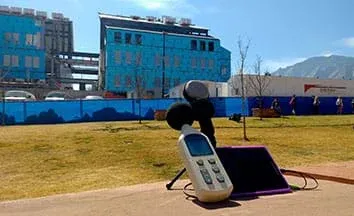 This sound monitoring setup is collecting data on construction noise near a school.
Students learn the physical properties of sound, how it travels and how noise impacts human health—including the quality of student learning. They learn different techniques that engineers use in industry to monitor noise level exposure and then put their knowledge to work by using a smart phone noise meter app to measure the noise level at an area of interest, such as busy roadways near the school. They devise an experimental procedure to measure sound levels in their classroom, at the source of loud noise (such as a busy road or construction site), and in between. Teams collect data using smart phones/tablets, microphones and noise apps. They calculate wave properties, including frequency, wavelength and amplitude. A PowerPoint® presentation, three worksheets and a quiz are provided.
Many engineers are concerned with noise and its potential to impact human health. Engineers who oversee construction projects make sure that the work does not generate unacceptable noise levels for workers and nearby residents. Engineers who design new equipment make sure that machine noise levels do not exceed designated standards. For example, a power generator may have been designed with acceptable noise levels, but if installed too close to residences, could be considered too loud. Ways to fix the situation include modifying the generator to reduce its noise output, building a noise reduction wall or relocating the generator.
After this activity, students should be able to:
- Calculate the frequency, wavelength and amplitude of waves.
- Describe how sound travels through various media.
- Explain the difference between sound and noise.
- Devise an experimental procedure to collect data.
- Analyze collected data and draw conclusions.
- Determine unhealthy noise levels.
- HS.1.2.a Reason quantitatively and use units to solve problems.
Grades 9-12
Do you agree with this alignment? - HS.2.4.a.iv Rearrange formulas to highlight a quantity of interest, using the same reasoning as in solving equations.
Grades 9-12
Do you agree with this alignment? - HS.2.4.c.i Solve linear equations and inequalities in one variable, including equations with coefficients represented by letters.
Grades 9-12
Do you agree with this alignment? - HS.3.1.a Summarize, represent, and interpret data on a single count or measurement variable.
Grades 9-12
Do you agree with this alignment? - HS.3.1.b.ii Represent data on two quantitative variables on a scatter plot, and describe how the variables are related.
Grades 9-12
Do you agree with this alignment?
- Compare and contrast different types of waves
Grade 8
Do you agree with this alignment? - Describe for various waves the amplitude, frequency, wavelength, and speed
Grade 8
Do you agree with this alignment?
- CCSS.Math.Content.HSA-CED.A.4 Rearrange formulas to highlight a quantity of interest, using the same reasoning as in solving equations.
Grades 9-12
Do you agree with this alignment? - CCSS.Math.Content.HSA-REI.B.3 Solve linear equations and inequalities in one variable, including equations with coefficients represented by letters.
Grades 9-12
Do you agree with this alignment? - CCSS.Math.Content.HSN-Q.A Reason quantitatively and use units to solve problems.
Grades 9-12
Do you agree with this alignment? - CCSS.Math.Content.HSS-ID.A Summarize, represent, and interpret data on a single count or measurement variable
Grades 9-12
Do you agree with this alignment? - CCSS.Math.Content.HSS-ID.B.6 Represent data on two quantitative variables on a scatter plot, and describe how the variables are related.
Grades 9-12
Do you agree with this alignment? - CCSS.Math.Practice.MP2 Reason abstractly and quantitatively.
Grades K-12
Do you agree with this alignment? - CCSS.Math.Practice.MP4 Model with mathematics.
Grades K-12
Do you agree with this alignment? - CCSS.Math.Practice.MP5 Use appropriate tools strategically.
Grades K-12
Do you agree with this alignment?
- Students will develop an understanding of the relationships among technologies and the connections between technology and other fields of study.
Grades K-12
Do you agree with this alignment? - STEL-8Q Synthesize data and analyze trends to make decisions about technological products, systems, or processes.
Grades 9-12
Do you agree with this alignment?
- HS-PS4-1 Use mathematical representations to support a claim regarding relationships among the frequency, wavelength, and speed of waves traveling in various media.
Grades 9-12
This resource focuses on the following Three Dimensional Learning aspects of NGSS:
Science & Engineering Practices- Use mathematical representations of phenomena or design solutions to describe and/or support claims and/or explanations.Do you agree with this alignment?
Disciplinary Core Ideas- The wavelength and frequency of a wave are related to one another by the speed of travel of the wave, which depends on the type of wave and the medium through which it is passing.Do you agree with this alignment?
Crosscutting Concepts- Empirical evidence is required to differentiate between cause and correlation and make claims about specific causes and effects.Do you agree with this alignment?
Do you agree with this alignment? - Use mathematical representations of phenomena or design solutions to describe and/or support claims and/or explanations.
Each group needs:
- smart phone or tablet with a noise monitoring app such as the following:
- A free noise-monitoring app for Android devices is Decibel Pro: dB sound level meter
- An $8 app for Android devices is Audio Tool, which is optimal if you have a high-quality sound level meter that you can use to calibrate each smart device; this app is purchased for use on school tablets; the app only needs to be purchased once; by logging into the appropriate Google account, the app can be loaded onto all tablets
- A $10 app for Apple devices is SPL Graph
- (optional) external microphone, to connect to smart phone or tablet
- stopwatch
- computer with Excel® or other spreadsheet software
- Physics of Sound Worksheet (PDF), one per student
- Observations Worksheet (PDF)
- Data Analysis Worksheet (PDF)
- Physics of Sound Quiz (PDF), one per student
To share with the entire class:
- capability to show the class the Physics of Sound Presentation (PPTX), a PowerPoint® file
- Physics of Sound Presentation (pptx)
- Physics of Sound Presentation (pdf)
- Physics of Sound Worksheet (docx)
- Physics of Sound Worksheet (pdf)
- Physics of Sound Worksheet Answer Key (docx)
- Physics of Sound Worksheet Answer Key (pdf)
- Observations Worksheet (docx)
- Observations Worksheet (pdf)
- Data Analysis Worksheet (docx)
- Data Analysis Worksheet (pdf)
- Data Analysis Worksheet Example Answers (docx)
- Data Analysis Worksheet Example Answers (pdf)
- Physics of Sound Quiz (docx)
- Physics of Sound Quiz (pdf)
- Physics of Sound Quiz Answer Key (docx)
- Physics of Sound Quiz Answer Key (pdf)
Having basic knowledge of wave properties is useful, but is also covered in the slides and worksheets.
Have you ever heard something that was too loud? Did you feel that the loud sound was hurting your ears? Did you think that it might affect your hearing? (Listen to student responses.)
What are some noises that you cannot stand, but may not bother someone else? (Direct students to talk amongst themselves in small groups and discuss noises they do not like. After a few minutes, ask students if within their groups they came up with some sounds or noises that bother some students but that other students don’t mind. For example, one person may not like the sound of nails on a chalkboard, while another person may not mind it, or the sound of rain may soothe one person and irritate another.)
If you walk by a construction area where a jackhammer is being used, you might cover your ears or walk faster to minimize or avoid the loud noise. Now imagine that instead of walking by the construction site, you live across the street from it. The loud noise might disrupt your sleep if it starts early in the morning or goes on into the night. If the construction hours are set and unchangeable, what might an engineer do in order to reduce the noise level so that you could sleep better? (Listen to student answers. Possible answers: Make/choose/use machinery that is not so noisy in the first place or build noise dampeners around the work area such as sound-absorbing walls and boxes.)
Now that we have discussed what sounds bother some people and not others and how engineers might reduce noise levels, who can describe a time when something physical changed the sound of an object so that it made a different sound? (Listen to student answers; expect them to vary. Possible answer: A friend yelling at them in a swimming pool sounds different than out of the pool. This is a good/correct answer; follow up with an example of trying to talk to a person through a wall.)
We have been hearing and interacting with sound since the moment we were born. Sound is such an important part of our lives, yet we usually take it for granted. We rarely stop to think how sound travels distances to make it to our ears or how sounds affect our well-being.
For example, teaching and learning requires a quiet environment. According to the World Health Organization, a noise level less than 35 dB is considered the optimal classroom level (Forns et al., 2015). Noise levels above 35 dB can impact a person’s ability to focus and learn. Some studies suggest that road traffic and aircraft noise heard in school classrooms may have a larger negative impact on cognitive development in children than that of air pollution (Clark et al., 2012; Hygge et al., 2002; van Kempen et al., 2010, 2012).
Today, you are acting as if you are teams of environmental engineers who are given the challenge to make sure that the noise level in our school is within an acceptable range for student learning. To do this, you will experiment with new smart devices as your sound level meters.
Let’s first take a look at sound and how to measure it. (At this point, segue into the slide presentation.)
As environmental engineers, it is your job to conduct research to determine if the noise level in the school is acceptable for student learning. Let’s get started!
Background
Sound is due to vibrations through the air, or other media, that can be heard when the vibrations enter the ear. The difference between sound and noise is subjective. Noise is unwanted or unpleasant sound, which is a perception that varies from person to person.
As the molecules in a medium vibrate, a longitudinal wave is formed that travels through the medium. Sound travels faster in tightly packed media, such as solids, and slower in loosely packed media such as gases. Since wave properties are vital to sound, it is important to understand and have the ability to calculate wave properties. These properties include: frequency, wavelength and amplitude.
F = v/λ
λ = v/f
f = frequency
v = wave velocity
λ = wavelength
T = time or period
Before the Activity
- Gather materials, which may include school-supplied tablets and borrowed external microphones, and/or students’ smart phones.
- Make copies of the worksheets and quiz.
- Review the Physics of Sound Presentation (PPTX) slides to make sure you comprehend the concepts. Suggested teacher script and comments are included in the notes section of each slide.
- Load the noise app on to the tablets or phones, or have students load the app before class.
- Prepare to show the class the Physics of Sound Presentation (PPTX), a PowerPoint® file.
With the Students
- (30-35 minutes) Introduce students to the topic of the physics of sound by presenting the Introduction/Motivation section content and the slide presentation.
- (15-20 minutes) Hand out the Physics of Sound Worksheet (PDF) and direct students to individually complete the worksheet while working together in student pairs. Provide assistance as necessary.
- Reiterate the fact that noise hinders a person’s ability to focus and perform in school. Organize the class into groups of four students each. Distribute the Observations Worksheet (PDF) and Data Analysis Worksheet (PDF).
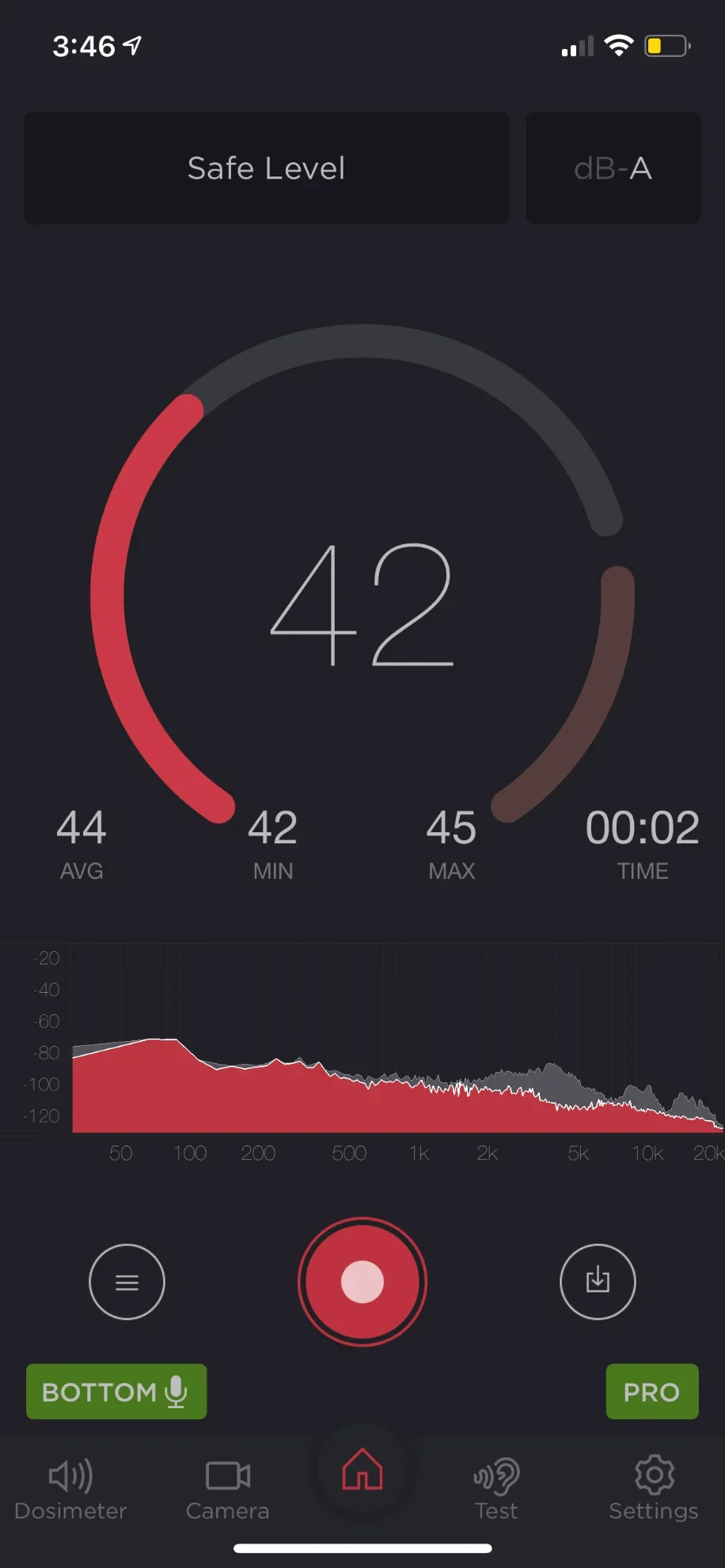
- Introduce the noise monitoring app and equipment. Setup tips for Android devices using Decibel: dB sound level meter:
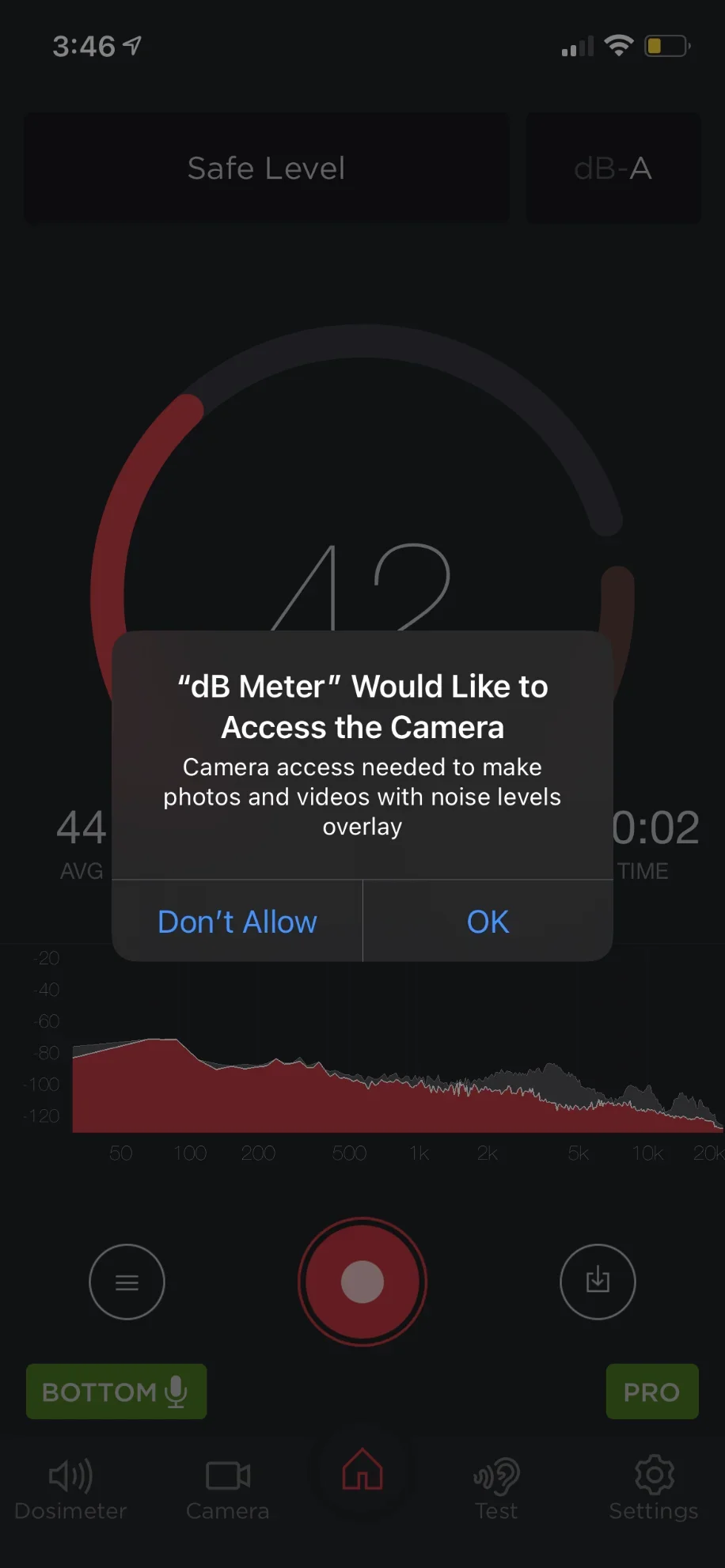
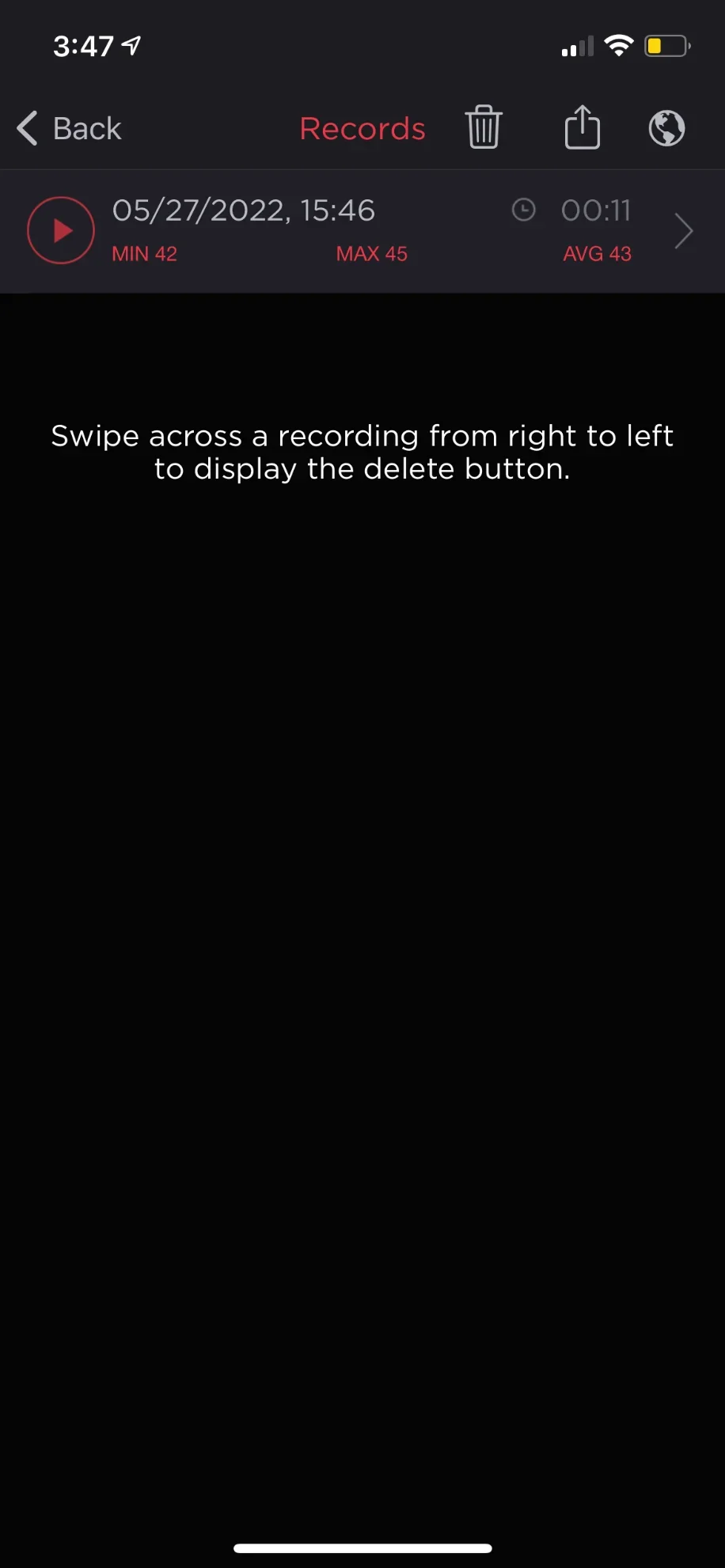
- When you first open the app it will be recording, but it will not save this data. Start by clicking the camera icon and enabling access.
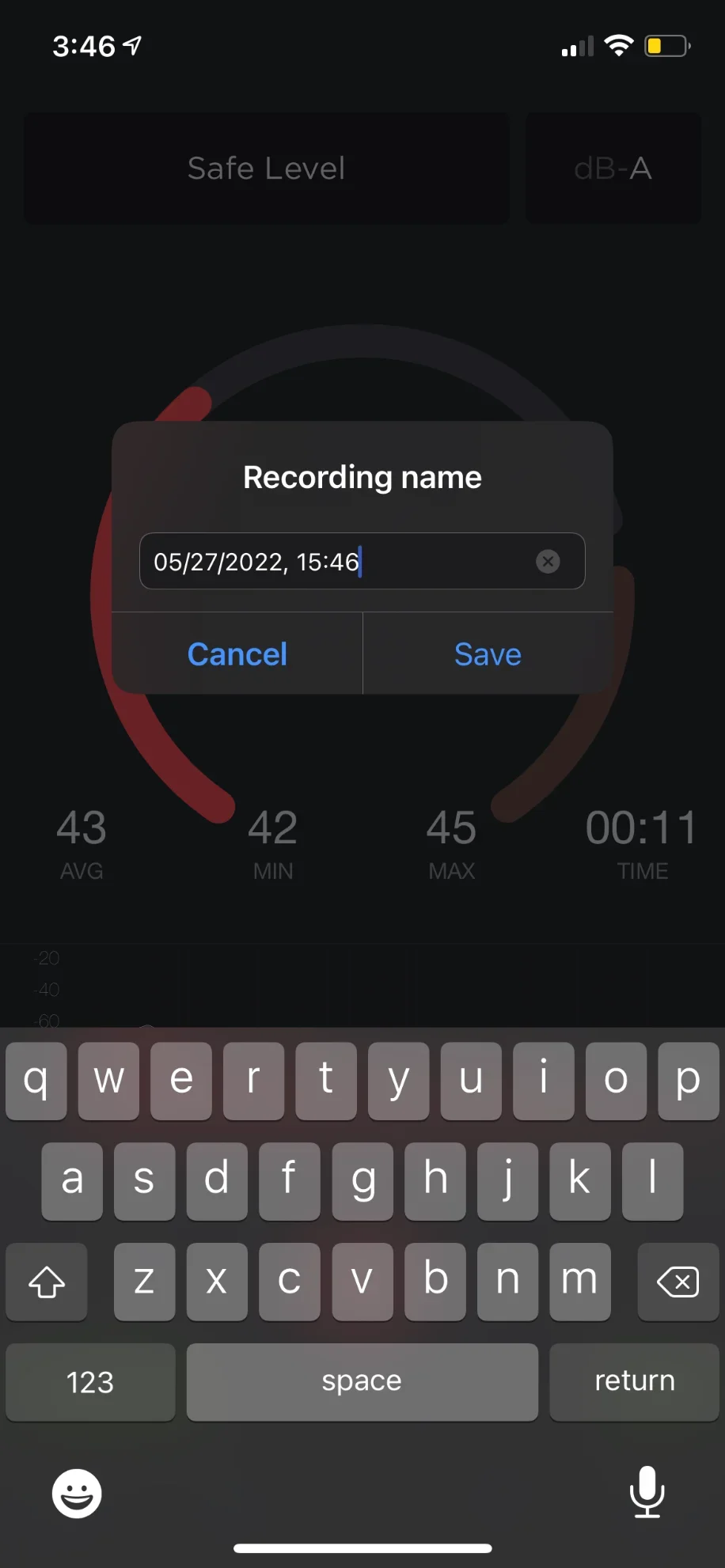
- Next start recording with the red button in the middle section of the bottom of the screen. Once you are done hit this button again. Next, hit the download button to the right of this to name and save the file. If you click the button to the left (three lines), you can see your saved audio files and data here.
 Copyright 2022 Rachel Diamond
 Copyright 2022 Rachel Diamond
 Copyright 2022 Rachel Diamond
 Copyright 2022 Rachel Diamond
- Pose the problem, for which the environmental engineering teams will follow the scientific method to learn more about, towards solving it: Your research task is to take measurements around the school to determine if the noise level in the classroom is acceptable.
- If the classroom noise level is acceptable, then determine where the noise level is unacceptable, for example near a busy road next to the school.
- If the noise level next to the busy road is unacceptable, then take measurements 1) at the road, 2) between the road and the school, and 3) in the classroom, to see how the three locations vary in their noise levels.
- Guide students through the scientific process to address the problem. To begin, have groups each come up with a hypothesis and write it on the Data Analysis Worksheet (PDF).
- Discuss and determine the procedure and experiment setup. Suggested prompts and tips:
- How can you determine if your noise app/meter is accurate? Have all teams measure noise in the same location at the same time in order to get a baseline/comparison. While taking these measurements, remind students to be quiet so as to not impact the data.
- Where will you measure noise? (At three locations: 1] next to the noise source, 2] between the source and school, and 3] in the classroom.) Will you stand in a cluster to measure the noise or a straight line from the source to the classroom?)
- How many noise meters will be in each location?
- How long will you measure? (At least 5 minutes to gather useful data.)
- Will you repeat the measurement? How many times?
- When you record the data, use a stopwatch so you know when you have reached 5 minutes.
- Inform students that it is important that they all start logging at the same time so that the data can be compared with as little error as possible
- Remind students to record on the Observations Worksheet (PDF) the times they start and stop measuring, as well as notes about any noises that might impact the data. For example, “a garbage truck drives by the source at 2:32.”
- Log each location as its own measurement. For example, if students measure noise levels in the classroom, next to the school, and next to a road, that’s three data streams to log, for example: InClassroom_StudentName, Next2School_StudentName, and AtRoad_StudentName.
- After the data is done being collected, have the students copy the recorded data into a spreadsheet by min, max, and average data.
- Direct students back to the Data Analysis Worksheet (PDF).
- Based on how students measured the noise, they may need to share the Excel® data in order to compare the noise at different locations. If all students stood in a line from the source to the classroom to record data, then all of the students’ data from a specific iteration needs to be shared so that they can compare the data. If they plot the data as a time series line graph, then expect to see that the device closest to the source has the highest dB measurement, with the dB level decreasing as the measurement device gets further from the source.
- Have students select the dB column and create a scatter plot.
- Right click the data in the scatter plot to select the data.
- Name the data and select the time column to be the x-axis.
- Repeat this step to get all data onto the scatter plot.
- Have students discuss in their groups what the data means, and then as a class. Does the data support their hypotheses?
- As a class, go over the Investigating Questions.
- Administer the post-activity quiz.
- amplitude
- The distance from the center line to the top of a crest or to the bottom of a trough, when measuring a wave.
- decibel
- The unit used to measure sound pressure. The unit expresses the intensity of a sound wave. The unit symbol is dB.
- frequency
- The number of waves passing a point during a specific time period.
- longitudinal wave
- When wave particles vibrate in a direction that is parallel to the wave direction.
- noise
- An unwanted or unpleasant sound.
- transverse wave
- When wave particles vibrate in a direction that is at a right angle (perpendicular) to the wave direction.
- wavelength
- The distance from a particular point on a wave to the next point that is at the same height, going in the same direction.
Post-Introduction Assessment
Worksheet: After presenting the introductory information and slides, administer the Physics of Sound Worksheet (PDF). Review students’ answers to gauge their understanding of wave properties.
Activity Embedded Assessment
Accuracy Observations: Observe students as they collect data. Make sure that they are working collaboratively in their teams and are recording accurate and detailed time notations and observations on the Observations Worksheet (PDF).
Post-Activity Assessment
Post-Quiz: Administer the Physics of Sound Quiz (PDF) to assess students’ knowledge of waves, sound and noise. Review their answers to gauge their depth of comprehension.
If collecting data near busy streets or construction sites, make sure that the junior engineers are aware of their surroundings.
If the devices go to sleep, they stop recording data. To avoid this, under Settings > select Screen > Keep screen on, which keeps the screen on while taking measurements.
If the data measured at the selected locations does not provide enough information for good statistical comparison, then continue taking measurements at new locations to collect additional data.
For lower grades, pool all data and create the graphs as a class.
Clark, Charlotte, et al. “Does Traffic-Related Air Pollution Explain Associations of Aircraft and Road Traffic Noise Exposure on Children's Health and Cognition? A Secondary Analysis of the United Kingdom Sample from the RANCH Project.” American Journal of Epidemiology, vol. 176, no. 4, 2012, pp. 327–337, August 2012; doi:10.1093/aje/kws012. https://www.ncbi.nlm.nih.gov/pmc/articles/PMC3415279/
Forns, Joan, et al. “Traffic-Related Air Pollution, Noise at School, and Behavioral Problems in Barcelona Schoolchildren: A Cross-Sectional Study.” Environmental Health Perspectives, vol. 124, no. 4, April 2015; doi:10.1289/ehp.1409449. https://www.ncbi.nlm.nih.gov/pmc/articles/PMC4829987/
Hygge, Steffan, Evans, Gary W., Bullinger, Monika. “A Prospective Study of Some Effects of Aircraft Noise on Cognitive Performance in Schoolchildren.” Psychological Science, vol. 13, issue 5, pp. 469–474, September 2002. http://journals.sagepub.com/doi/abs/10.1111/1467-9280.00483?url_ver=Z39.88-2003&rfr_id=ori%3Arid%3Acrossref.org&rfr_dat=cr_pub%3Dpubmed&
van Kempen Elise, et al. “Neurobehavioral Effects of Transportation Noise in Primary Schoolchildren: A Cross Sectional Study. Environmental Health, vol. 9, no. 25, June 2010; doi:10.1186/1476-069X-9-25. https://www.ncbi.nlm.nih.gov/pmc/articles/PMC2898757/
van Kempen Elise, et al. “Neurobehavioral Effects of Exposure to Traffic-Related Air Pollution and Transportation Noise in Primary Schoolchildren.” Environmental Research, vol. 115, pp. 18–25, May 2012; doi:10.1016/j.envres.2012.03.002. http://www.sciencedirect.com/science/article/pii/S0013935112000850?via%3Dihub
Contributors
Kent Kurashima; Jana B. Milford
Supporting Program
Integrated Teaching and Learning Program, College of Engineering, University of Colorado Boulder
Acknowledgements
The contents of these digital library curricula were developed by the Integrated Teaching and Learning Program under National Science Foundation GK-12 grant no. DGE 0946502. However, these contents do not necessarily represent the policies of the National Science Foundation, and you should not assume endorsement by the federal government.
Copyright
2016 by Regents of the University of Colorado