
Can Crusher Challenge
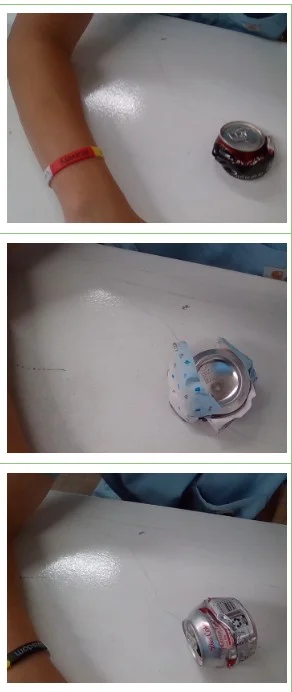 Students evaluate the work done by their can crushers. Finding the exact threshold of energy needed to fully crush these cans was the primary goal of the engineering challenge.Copyright Rachel Kenning
Students explore potential and kinetic energy by testing a manual can crusher. Working in teams, students investigate how changing the mass of a water-filled bottle and the height from which it is dropped affects the energy available to crush an aluminum can. Students plan and test multiple configurations, collect and compare data, and identify the lowest-energy configuration they tested that successfully crushes the can. They then refine their setup based on test results. Through this engineering challenge, students investigate energy transformations, identify factors that affect potential and kinetic energy, and use experimental evidence to optimize a solution.
Engineers design systems that control and transfer energy to accomplish specific tasks efficiently and safely. They consider variables such as mass, height, and velocity when predicting how much energy a system can store or transfer. For example, civil and mechanical engineers design dams to harness the gravitational potential energy of stored water, while automotive engineers design airbags and other safety systems to manage energy during collisions. Mechanical engineers also optimize industrial machinery, including material crushers, by evaluating how energy is transferred to perform work while minimizing unnecessary energy consumption.
After this activity, students should be able to:
- Identify the variables that affect kinetic energy, including mass and speed.
- Identify the variables that affect potential energy, including mass and height.
- Model the transformation of potential to kinetic energy.
- CCSS.Math.Practice.MP1 Make sense of problems and persevere in solving them.
Grades K-12
Do you agree with this alignment? - CCSS.Math.Practice.MP2 Reason abstractly and quantitatively.
Grades K-12
Do you agree with this alignment? - CCSS.Math.Practice.MP8 Look for and express regularity in repeated reasoning.
Grades K-12
Do you agree with this alignment?
- STEL-7Q Apply the technology and engineering design process.
Grades 6-8
Do you agree with this alignment? - STEL-7R Refine design solutions to address criteria and constraints.
Grades 6-8
Do you agree with this alignment? - STEL-7T Assess design quality based upon established principles and elements of design.
Grades 6-8
Do you agree with this alignment?
- MS-ETS1-1 Define the criteria and constraints of a design problem with sufficient precision to ensure a successful solution, taking into account relevant scientific principles and potential impacts on people and the natural environment that may limit possible solutions.
Grades 6-8
This resource focuses on the following Three Dimensional Learning aspects of NGSS:
Science & Engineering Practices- Define a design problem that can be solved through the development of an object, tool, process or system and includes multiple criteria and constraints, including scientific knowledge that may limit possible solutions.Do you agree with this alignment?
Disciplinary Core Ideas- The more precisely a design task's criteria and constraints can be defined, the more likely it is that the designed solution will be successful. Specification of constraints includes consideration of scientific principles and other relevant knowledge that is likely to limit possible solutions.Do you agree with this alignment?
Crosscutting Concepts- The uses of technologies and any limitations on their use are driven by individual or societal needs, desires, and values; by the findings of scientific research; and by differences in such factors as climate, natural resources, and economic conditions.Do you agree with this alignment?
- All human activity draws on natural resources and has both short and long-term consequences, positive as well as negative, for the health of people and the natural environment.Do you agree with this alignment?
Do you agree with this alignment? - Define a design problem that can be solved through the development of an object, tool, process or system and includes multiple criteria and constraints, including scientific knowledge that may limit possible solutions.
- MS-ETS1-2 Evaluate competing design solutions using a systematic process to determine how well they meet the criteria and constraints of the problem.
Grades 6-8
This resource focuses on the following Three Dimensional Learning aspects of NGSS:
Science & Engineering Practices- Evaluate competing design solutions based on jointly developed and agreed-upon design criteria.Do you agree with this alignment?
Disciplinary Core Ideas- There are systematic processes for evaluating solutions with respect to how well they meet the criteria and constraints of a problem.Do you agree with this alignment?
Do you agree with this alignment? - Evaluate competing design solutions based on jointly developed and agreed-upon design criteria.
- MS-PS3-2 Develop a model to describe that when the arrangement of objects interacting at a distance changes, different amounts of potential energy are stored in the system.
Grades 6-8
This resource focuses on the following Three Dimensional Learning aspects of NGSS:
Science & Engineering Practices- Develop a model to describe unobservable mechanisms.Do you agree with this alignment?
Disciplinary Core Ideas- A system of objects may also contain stored (potential) energy, depending on their relative positions.Do you agree with this alignment?
- When two objects interact, each one exerts a force on the other that can cause energy to be transferred to or from the object.Do you agree with this alignment?
Crosscutting Concepts- Models can be used to represent systems and their interactions—such as inputs, processes and outputs—and energy and matter flows within systems.Do you agree with this alignment?
Do you agree with this alignment? - Develop a model to describe unobservable mechanisms.
- 8.2.1.a Use computational thinking to analyze data about the relationship between the mass and speed of objects and the relative amount of kinetic energy of the objects.
Grade 8
Do you agree with this alignment? - 8.2.2.a Ask questions about how the amount of potential energy varies as distance within the system changes.
Grade 8
Do you agree with this alignment?
Each group needs:
- 1 8 ft x 4 in irrigation PVC pipe with holes
- 1 4 in drain pipe cap
- 1 12 in nail
- 1 heavy duty disposable water bottle
- water
- at least 6 empty soda cans of the same shape and size, plus additional aluminum cans for redesign testing
- 1 measuring tape or meter stick to measure drop height
- 1 graduated measuring container to measure the volume of water added to the bottle
- Can Crusher Challenge Worksheet (PDF) (1 per student)
For the entire class to share:
- laptop/computer with internet access and a projector or digital display to show the YouTube video
- access to water
- extra heavy-duty water bottles to replace damaged bottles
Students should:
- Have a basic understanding of the concept of work and energy.
- Be familiar with using simple diagrams to represent objects and their interactions within a system.
Some of you are probably getting excited about getting your driver’s permit. Many of you have probably imagined driving to school in the car of your dreams.
Today I’d like to take a minute to have you consider two cars: a Ford F-150 and a Tesla Model X. I’ve given you some specs on the two vehicles for you to think about. (See Part 1 of the Can Crusher Challenge Worksheet (PDF).) One of the things you will practice when you start driving is navigating tight spaces like parking lots and garages.
Let’s consider a “Would You Rather” scenario. Would you rather drive an F-150 or a Model X if you were to accidentally bump into your garage door? Which one would cause the least amount of damage? Take a couple minutes to think it over, pick a vehicle, and then explain your reasoning in the most scientific way possible. (Give students a couple minutes to record their ideas in the student handout.)
Now let’s vote. How many of you chose the F-150? (Record the number on the board.) How many of you chose the Model X? (Record the number on the board.) It seems like we don’t all agree. Let’s hear from a few students. Write down a few ideas that are different from your own. (Call on several students to read what they wrote).
No one wants to bump into their garage, but bumping into something with your car is a pretty common thing to do. We all would want to bend the garage door as little as possible. We would want to do as little work on the door as possible to minimize the repairs needed.
Today we are going to explore the factors that affect how metal is bent. Let’s watch this YouTube video of a wrecking yard crushing junked cars. After we watch for a minute, record what questions you have about the way it works in your Can Crusher Challenge Worksheet (PDF). (Show the first minute of the YouTube video “Car crusher crushing cars 38” [9:27 minutes].)
Today you are going to make your own metal crusher out of the materials you see. I will demonstrate how to set up your metal crusher.
Your task is to make a metal crusher that uses the least amount of energy to fully crush a metal soda can. Let’s get started!
Background
Energy, Work, and Energy Transfer
Before beginning this activity, students should understand energy as the ability to do work. In physics, work occurs when a force causes an object to move or change. In this activity, work is done on the aluminum can when the falling water bottle exerts a force that physically deforms, or crushes, the can. The greater the deformation of the can, the more work has been done on it.
Energy can be stored in a system as potential energy (PE) or associated with the motion of an object as kinetic energy (KE). Before the water bottle is released, it possesses gravitational potential energy (GPE) because of its position above the can. The amount of gravitational potential energy depends on three factors: the mass of the object (m), the acceleration due to gravity (g), and the object's height above a reference point (h). This relationship is represented by the equation PE = mgh.
As the bottle drops, its potential energy is transformed into kinetic energy, or the energy of motion. Kinetic energy is determined by the object's mass (m) and its velocity (v), represented by the formula KE = ½mv².
At the middle school level, this concept can be simplified by focusing on how mass (the amount of water) and drop height affect the energy available to be transferred to the can. Increasing the amount of water increases the bottle's mass, while increasing the drop height allows the bottle to accelerate over a greater distance and reach a higher speed before impact. Both factors affect the amount of energy the falling bottle can transfer to the can upon impact.
How to test for the "least amount of energy" without calculations:
While middle school students will not be calculating exact Joules of energy using these formulas, they can use relative comparisons to determine which test conditions require more or less potential energy. Because the same type of aluminum can should require a similar amount of work to fully crush under consistent testing conditions, students are challenged to find the lowest tested combination of mass and drop height that successfully crushes the can.
For example, if two groups fully crush a can using the same mass of water, but Group A drops it from 3 feet and Group B drops it from 2 feet, Group B used less potential energy to accomplish the same work. By systematically lowering the height or decreasing the mass until the can no longer crushes, students identify the minimum energy required for the system. They prove their success not through equations, but by finding the physical breaking point where any less height or mass results in a failure to crush the can.
When comparing configurations, students should change only one variable at a time. If bottle mass remains constant, a lower drop height represents less initial potential energy. If drop height remains constant, a lower bottle mass represents less initial potential energy. However, when both mass and height change, students cannot reliably determine which configuration has less potential energy by comparing either variable independently. To compare these configurations, students can use the product of mass and height as a relative measure of potential energy, since gravitational acceleration remains constant.
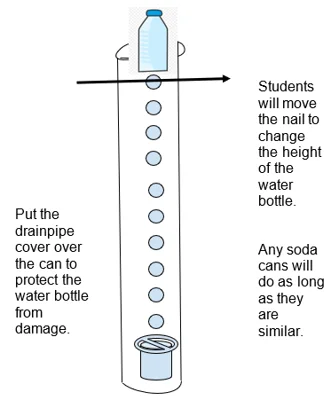 A cross-section schematic of the can crusher testing rig, demonstrating how the nail is used to adjust the starting height of the water mass.Copyright Image created by Rachel Kenning, author of this activity.
Before the Activity
- Gather one set of materials per group (see Equipment and Materials list).
- Make copies of the Can Crusher Challenge Worksheet (PDF) (1 per student).
- Set up laptop/computer with internet access to show the YouTube video “Car crusher crushing cars 38” (9:27 minutes).
- Access to water will be needed to allow students to change the mass in their water bottles.
- Select an appropriate testing location, preferably outdoors, with sufficient vertical clearance and space for students to remain clear of the apparatus during testing.
During the Activity
Part 1
- Divide the students into groups of 3 or 4.
- Hand out one Can Crusher Challenge Worksheet (PDF) to each student.
- Read through the Introduction and Motivation section above.
- Ask the students to consider the opening question about the Tesla and the Ford F-150 on their own.
- Have students vote on a vehicle and record it on the board.
- Call on students to share their explanations with the whole class, focusing on how mass and speed affect the work being done (bending metal).
Part 2
- Ask:
- Present the engineering challenge: Students must build and operate a manual metal crusher to fully crush a metal soda can using the least amount of energy possible.
- Research:
- After watching the first minute of the car crusher video, have students individually record their observations and write down questions they have about the way it works in their Can Crusher Challenge Worksheet (PDF).
- As a class, have students share their questions and discuss a few out loud.
- Explain that industrial crushers use mechanical systems to apply forces and transfer energy to crush materials. Many are powered by electric motors or hydraulic systems.
- Imagine:
- Reiterate the challenge: “Today, we are going to build a machine that will crush metal without using electricity or fuel.”
- Direct students to read about the challenge in Part 2 of the worksheet.
- Have students write down any questions they have before they begin the activity in their worksheet.
- Have students brainstorm and identify the variables they are able to change in their system (e.g., the amount of water in the water bottle, or the height of the drop).
- Plan:
- Have teams work together to formulate a plan for which setup will fully crush a can using minimal energy.
- Instruct students to plan six testing configurations by systematically varying bottle mass and drop height.
- Encourage students to change only one variable at a time so they can determine how each variable affects the outcome.
- Have students record their plans in their worksheet.
- Create:
- Demonstrate the assembled can crusher apparatus, including how the bottle is positioned, how drop height is measured, and how the apparatus is operated safely. (Note: Do not crush any cans in front of them, to save the “wow” factor.)
- Hand out materials to each group.
- Have students assemble their 8 ft PVC pipe, pipe cap, nail, and heavy-duty water bottle.
- Remind them to record testing configurations, including bottle mass, drop height, and the resulting condition of the can, in their worksheets. Note: If the handout is done digitally, have students take pictures of their cans. If you print out the handout, have them draw the can or measure its height and record it.
- Test:
- Instruct students to test their six different designs, carefully recording their data for each drop.
- Once they complete the six tests, have them describe the setup that crushed the can using the least amount of energy in their worksheet.
Students evaluate the work done by their can crushers. Finding the exact threshold of energy needed to fully crush these cans was the primary goal of the engineering challenge.Copyright Rachel Kenning7.Improve:
- Based on the data collected from their initial drops, allow students to iterate on their design by tweaking the mass or the height to find the absolute threshold (i.e., the exact point where the can is fully crushed, but any less energy would result in a failure.) Encourage students to use evidence from previous trials to guide their adjustments.
- Once they complete their top design, have them describe the redesign setup that crushed the can using the least amount of energy in their worksheet.
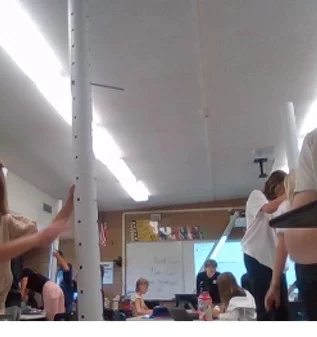 A student tests their manual can crusher prototype, adjusting the drop height of the water bottle to find the minimum energy required.Copyright Rachel Kenning
Part 3: Conclusion, Summary, and Reflection
- Have students share their results with the class and decide which group actually used the least energy overall. You may want to have two groups “compete” against each other and argue it out using their data to determine the winner.
- Summarize: Instruct each student to make a model of the can crusher that worked best for them in their Can Crusher Challenge Worksheet (PDF). They should identify energy in the system and which variables can be changed.
- Finally, have students summarize what they have learned from the activity. You should expect to see summaries that relate the amount of energy in the system to weight (or mass) and the height of an object.
- energy
- The ability to do work.
- potential energy
- The stored energy an object has because of its position or condition.
- kinetic energy
- The energy an object possesses because of its motion.
- mass
- The quantity of matter contained in an object.
- height
- The distance of an object above a reference point, such as the ground.
- work
- The transfer of energy that occurs when a force causes an object to move or change.
- gravitational potential energy
- Energy stored in a system because of an object's position, or height, in a gravitational field.
- velocity
- The speed of an object in a particular direction.
- energy transfer
- The movement of energy from one object or system to another.
Pre-Activity Assessment
Ford F-150 vs. Tesla Model X: Have students independently consider which vehicle they think would cause less damage if it bumped into a garage door and explain their reasoning as scientifically as possible. Have students vote and share their explanations with the class. Use their responses to assess prior understanding of how factors such as mass and speed affect the energy of a moving object and the amount of work it can do.
Activity-Embedded (Formative) Assessment
Can Crusher Testing: As students plan and test their can crusher configurations, review their Can Crusher Challenge Worksheet (PDF) and observe group discussions. Look for evidence that students recognize mass and drop height as variables that affect the energy in the system and that they use data from each test to make decisions about subsequent configurations.
Redesigned Can Crusher Testing: During the Improve phase, assess whether students can use evidence from their initial tests to adjust the mass and/or drop height and identify a lower-energy configuration that still fully crushes the can.
Post-Activity (Summative) Assessment
Can Crusher Model and Reflection: Have each student create a model of the can crusher system and identify where potential and kinetic energy are present and how energy is transformed as the bottle falls and strikes the can. Students should identify the variables that can be changed within the system and summarize how mass and drop height affect the energy available to crush the can. Have students use evidence from their testing to explain which configuration successfully crushed the can using the least amount of energy among the configurations they tested.
- Apparatus stability: Ensure the PVC pipe is securely supported and cannot tip or shift during testing. Inspect the apparatus before each use and discontinue testing if any component becomes loose or damaged.
- Falling objects: Establish a designated testing area around the apparatus. Keep students clear of the pipe opening, bottle-release area, and impact zone during testing. Require your supervision for all drops.
- Sharp components: If the apparatus uses a metal nail or spike, ensure it is securely installed and that exposed sharp points cannot be contacted during normal operation.
- Water bottle failure: Inspect bottles after each drop for cracks, leaks, or deformation. Replace damaged bottles immediately.
- Consistent testing: Use aluminum cans of the same size and type. Ensure each can is positioned consistently and use a new can for each trial.
- Water bottle durability: Finding water bottles that can withstand repeated drops can be challenging. Use heavy-duty disposable water bottles and have several extras available in case bottles crack or break during testing. Replace any bottle that shows signs of damage before conducting another test.
- Collecting cans: Begin collecting empty aluminum cans several weeks before the activity. Consider asking other teachers, families, or students to donate cans. Each team will need at least six cans for its initial tests, plus additional cans if students conduct further tests during the Improve phase, so plan accordingly.
- Outdoor testing: It is recommended that this activity be conducted outside whenever possible. Water bottles can crack or break during repeated drops, and conducting the activity outside minimizes the risk of water or equipment damaging classroom materials and reduces concerns about spilled water on classroom floors.
Contributors
Rachel Kenning with support from Hillary Swanson, Karen Merritt, Idris Solola
Supporting Program
Engineering Research Center for Advancing Sustainability through Powered Infrastructure for Roadway Electrification (ASPIRE) in the College of Engineering, Utah State University
Acknowledgements
This material was developed based upon work supported by the National Science Foundation under grant no. EEC 1941524—Engineering Research Center for Advancing Sustainability through Powered Infrastructure for Roadway Electrification (ASPIRE) in the College of Engineering, Utah State University. Any opinions, findings, and conclusions or recommendations expressed in this material are those of the authors and do not necessarily reflect the views of the National Science Foundation.
Copyright
2026 by Regents of the University of Colorado; original © 2025 Utah State University