
Exploring Magnetic Fields: From Ferrofluid to Wireless EV Charging
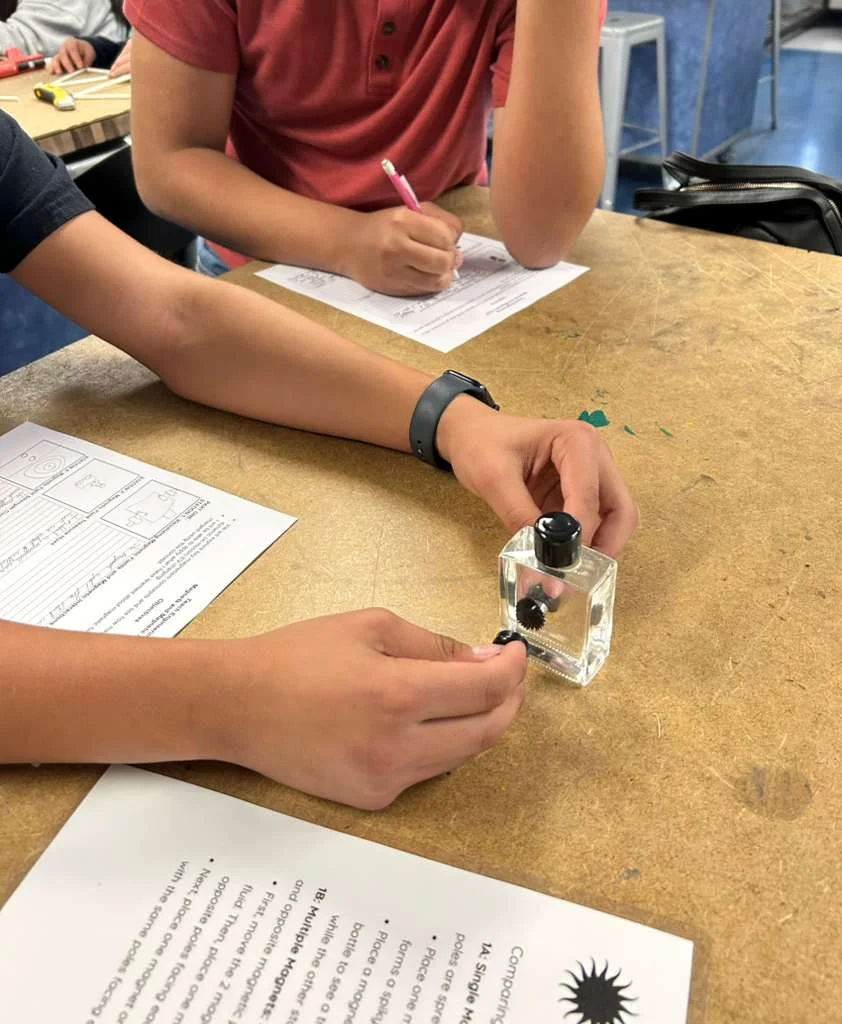 Students exploring magnetic fields with a ferrofluid bottle and magnets.Copyright Katherine Meraz, UTEP
Students explore key concepts of magnetism and discover how magnetic fields make technologies such as dynamic (in-motion) wireless electric vehicle (EV) charging possible. Working in small groups, students rotate through four hands-on stations where they visualize magnetic fields, investigate how different materials interact with magnetic fields, sort magnetic and non-magnetic objects, explore how magnetic force changes with distance, and experiment with magnetic attraction and repulsion. After completing the stations, students apply their understanding to an engineering design challenge by designing a concept to improve the efficiency of wireless EV charging using magnetic fields.
Engineers apply their understanding of magnetism and magnetic fields to design technologies such as wireless electric vehicle (EV) charging systems. At the ASPIRE Engineering Research Center, engineers are developing innovative wireless charging technologies by studying how electromagnets generate and shape magnetic fields. They use specialized magnetic materials and other technologies to direct and concentrate these magnetic fields so that nearly all of the magnetic energy from the ground charging pad is transferred to the vehicle rather than lost to the surrounding environment. By optimizing the transfer of magnetic energy, ASPIRE has developed wireless EV charging systems that achieve approximately 90–95% efficiency, demonstrating how engineers use scientific principles to solve real-world transportation and energy challenges.
After this series of activities, students should be able to:
Station 1
Parts 1a and 1b: Visualizing Magnetic Fields
- Describe how magnets create invisible magnetic fields and explain how tools such as ferrofluid and iron filings can be used to visualize their shapes.
- Explain that every magnet has two poles, with opposite poles attracting and like poles repelling because of the way their magnetic fields interact.
- Recognize that Earth acts like a giant magnet and that compasses work by responding to Earth's magnetic field.
Part 2: Material Magnetic Interactions Experiment
- Explain that different materials interact with magnetic fields in different ways and investigate how material type and thickness affect those interactions.
- Understand that magnetic fields pass through most everyday materials with little interaction, which is why humans cannot directly feel magnetism.
- Recognize that engineers apply their understanding of magnetic field interactions to develop technologies such as MRI systems and wireless electric vehicle charging.
Station 2: Magnetic Field Treasure Hunt
- Distinguish between magnetic and non-magnetic materials, recognizing that not all metals are magnetic.
- Identify that materials have different physical properties, some of which require tools or testing to observe and measure.
- Recognize that scientists and engineers study material properties to better understand the world and develop new technologies.
Station 3: Magnetic Field Strength Curling
- Explain that magnetic forces are strongest close to a magnet and weaken as the distance increases.
- Predict how changing the distance between magnets affects the motion of magnetic objects.
- Recognize that scientists and engineers use this relationship when designing technologies such as electric motors, generators, and wireless charging systems.
Station 4: Magnet and Paperclip Play
- Explain that magnetic fields can temporarily magnetize certain materials and extend magnetic effects through connected objects.
- Describe how magnets have two poles, with opposite poles attracting and like poles repelling.
- Explain that magnetic forces become stronger as the distance to a magnet decreases and distinguish between temporary and permanent magnetization.
- STEL-1J Develop innovative products and systems that solve problems and extend capabilities based on individual or collective needs and wants.
Grades 6-8
Do you agree with this alignment?
- MS-ETS1-1 Define the criteria and constraints of a design problem with sufficient precision to ensure a successful solution, taking into account relevant scientific principles and potential impacts on people and the natural environment that may limit possible solutions.
Grades 6-8
This resource focuses on the following Three Dimensional Learning aspects of NGSS:
Science & Engineering Practices- Define a design problem that can be solved through the development of an object, tool, process or system and includes multiple criteria and constraints, including scientific knowledge that may limit possible solutions.Do you agree with this alignment?
Disciplinary Core Ideas- The more precisely a design task's criteria and constraints can be defined, the more likely it is that the designed solution will be successful. Specification of constraints includes consideration of scientific principles and other relevant knowledge that is likely to limit possible solutions.Do you agree with this alignment?
Crosscutting Concepts- The uses of technologies and any limitations on their use are driven by individual or societal needs, desires, and values; by the findings of scientific research; and by differences in such factors as climate, natural resources, and economic conditions.Do you agree with this alignment?
- All human activity draws on natural resources and has both short and long-term consequences, positive as well as negative, for the health of people and the natural environment.Do you agree with this alignment?
Do you agree with this alignment? - Define a design problem that can be solved through the development of an object, tool, process or system and includes multiple criteria and constraints, including scientific knowledge that may limit possible solutions.
- MS-PS2-3 Ask questions about data to determine the factors that affect the strength of electric and magnetic forces.
Grades 6-8
This resource focuses on the following Three Dimensional Learning aspects of NGSS:
Science & Engineering Practices- Ask questions that can be investigated within the scope of the classroom, outdoor environment, and museums and other public facilities with available resources and, when appropriate, frame a hypothesis based on observations and scientific principles.Do you agree with this alignment?
Disciplinary Core Ideas- Electric and magnetic (electromagnetic) forces can be attractive or repulsive, and their sizes depend on the magnitudes of the charges, currents, or magnetic strengths involved and on the distances between the interacting objects.Do you agree with this alignment?
Crosscutting Concepts- Cause and effect relationships may be used to predict phenomena in natural or designed systems.Do you agree with this alignment?
Do you agree with this alignment? - Ask questions that can be investigated within the scope of the classroom, outdoor environment, and museums and other public facilities with available resources and, when appropriate, frame a hypothesis based on observations and scientific principles.
- MS-PS2-5 Conduct an investigation and evaluate the experimental design to provide evidence that fields exist between objects exerting forces on each other even though the objects are not in contact.
Grades 6-8
This resource focuses on the following Three Dimensional Learning aspects of NGSS:
Science & Engineering Practices- Conduct an investigation and evaluate the experimental design to produce data to serve as the basis for evidence that can meet the goals of the investigation.Do you agree with this alignment?
Disciplinary Core Ideas- Forces that act at a distance (electric, magnetic, and gravitational) can be explained by fields that extend through space and can be mapped by their effect on a test object (a charged object, or a ball, respectively).Do you agree with this alignment?
Crosscutting Concepts- Cause and effect relationships may be used to predict phenomena in natural or designed systems.Do you agree with this alignment?
Do you agree with this alignment? - Conduct an investigation and evaluate the experimental design to produce data to serve as the basis for evidence that can meet the goals of the investigation.
Each station needs:
Station 1 (Parts 1a and 1b) Magnetic Fields Visualized
- 1 Station Instruction Sheet (PDF) (Station 1 pages)
- ferrofluid in a bottle
- Available for purchase from retailers such as Amazon.
- Many how-to guides are available online for making your own ferrofluid display.
- A simple, low-cost alternative is to make an iron filing container with a clear CD case. This option slightly changes the activity because the visualization is 2D rather than 3D.
- magnets
- Stronger and larger magnets of any shape work best, though small magnets are also effective.
- magnetic field line images
- Printed images of magnetic field lines are easy to find online and can be used for comparison and discussion.
Station 1 (Part 2) Material Magnetic Interactions Experiment
- ferrofluid in a bottle or iron filings in a CD case to visualize a magnetic field
- magnet (e.g., a stack of medium-sized neodymium disk magnets)
- The magnet should be strong enough for the ferrofluid (or other magnetic viewing device) to detect the magnetic field from a short distance (approximately 1 inch away)
- various thin, flat materials (some magnetic and some non-magnetic) to test magnetic field permeability
- non-magnetic materials:
- flat sheets of paper
- cardboard
- plastic
- aluminum
- stone or concrete
- magnetic materials:
- steel sheet
- ferrite block (many options are available online)
- additional optional materials:
- a slice of deli meat (e.g., cold cuts, salami, or beef jerky) to demonstrate that magnetic fields do not interact with people or animals
- expanded metal, steel mesh, a strainer, or another non-solid ferrous material
- This can demonstrate that magnetic fields are disrupted similarly to a solid sheet, even when gaps are present.
- This highlights how magnetic fields differ from light, which produces discrete shadows rather than continuous field effects.
- a zip-lock bag filled with water to demonstrate that magnetic fields are not affected by water
- (optional) ferrofluid bottle and magnet holder
- a small 3D-printed holder to keep the magnet stationary and create a gap for inserting materials between the magnet and the ferrofluid
Station 2: Magnetic Field Treasure Hunt
- 1 Station Instruction Sheet (PDF) (Station 2 page)
- numerous bowls to separate magnetic and non-magnetic items
- a variety of magnets to separate magnetic and non-magnetic items
- washers or coins made from different metals (magnetic and non‑magnetic items that look identical or nearly identical are ideal for this activity)
Station 3: Magnetic Field Strength Curling Game
- 1 Station Instruction Sheet (PDF) (Station 3 page)
- two large disk magnets (the “launchers”) and several smaller disk magnets (the “disks”)
- four disks per launcher work well
- permanent markers to label the disks and draw lines on the curling field
- all disks must be oriented with the same magnetic pole facing up, so that the disks repel each other
- playing field board (e.g., a clear acrylic or plastic square, approximately 1’ × 1’)
- a playing field that includes a starting line behind which the launching magnets must be kept
- a “target” made of concentric circles, similar to a dartboard, drawn a few inches beyond the line
- Each circle is assigned a point value, with higher points awarded closer to the center.
Station 4: Magnet and Paperclip Play
- 1 Station Instruction Sheet (PDF) (Station 4 page)
- a variety of magnets (e.g., a variety pack of neodymium disk magnets, but any type of magnet works)
- paperclips (smaller paperclips are preferred, as they allow students to pick up many clips at once, making the activity more engaging)
- containers or bowls to hold the paperclips
Today we're going to investigate something that we use every day but almost never see: magnetic fields.
Let's start with a question. Where have you seen or used magnets before? (Allow students to respond. Possible answers: refrigerator magnets, speakers, toys, compasses, headphones, cabinet latches, motors.) Those are all great examples. Magnets are all around us, but there's something interesting about them. Even though we can see the magnet itself, we can't actually see the magnetic field surrounding it. A magnetic field is an invisible region around a magnet where magnetic forces can act.
If we can't see magnetic fields, how do we know they're there? (Allow students to respond. Possible answers: Objects move; magnets attract or repel; a compass points north.) Exactly! Scientists and engineers often study things they can't see directly. Instead, they look for evidence of how those invisible things affect the world around them. Today, you'll do the same thing.
As you investigate, you'll discover that not all materials behave the same way around magnets. Some materials, like iron and steel, interact strongly with magnetic fields, while others, like paper, plastic, and cardboard, have little or no effect. You'll also explore how the distance between magnets changes the strength of their interaction and how different materials can redirect magnetic fields.
Why does any of this matter? Engineers use these same ideas to design technologies that many of us use every day. Magnets help power electric motors, generators, speakers, MRI machines, computer hard drives, and even wireless charging systems.
One exciting application is wireless charging for electric vehicles. Instead of plugging a car into a charging cable, engineers are developing systems that transfer electricity using changing magnetic fields. A charging pad beneath the vehicle creates a magnetic field, and a coil underneath the vehicle captures that energy to charge the battery, and this all happens without any wires touching!
Designing these systems isn't easy. Engineers must create magnetic fields that are strong enough to transfer energy efficiently while making sure they remain safe for people, animals, and nearby electronics. They also need the systems to work through concrete or asphalt roads and in different weather conditions. These are real engineering challenges that researchers are solving today.
Over the next two days, you'll become magnetism investigators and engineers. Today, you'll rotate through four investigation stations where you'll explore magnetic fields, test different materials, and observe how magnets behave in different situations. As you work, record your observations and look for patterns. There may be times when your observations don't match your predictions, and that's okay! Scientists and engineers learn by collecting evidence and revising their ideas.
Tomorrow, you'll use everything you've learned to tackle your own engineering challenge. You'll design a wireless charging system for an electric vehicle and explain how your design uses magnetic fields to transfer energy efficiently while reducing energy loss.
As you move through today's stations, keep asking yourself these questions:
- What evidence tells me a magnetic field is present?
- How do distance and different materials affect magnetic fields?
- How might an engineer use what I'm discovering to solve a real-world problem?
Let's get started and see what these invisible forces can teach us.
Background
Magnets and Magnetic Fields
Magnets produce invisible magnetic fields that exert forces on certain materials and other magnets. Every magnet has two poles, called the north and south poles. Opposite poles attract each other, while like poles repel. A magnetic field is the region around a magnet where magnetic forces can be detected. Although magnetic fields cannot be seen directly, they can be visualized using tools such as ferrofluid, iron filings, or magnetic viewing film. Magnetic field lines are a model used to represent the direction and relative strength of the field. These lines are closest together near the poles, where the magnetic field is strongest, and spread farther apart as the field weakens with increasing distance. Magnetic fields are continuous rather than being made of individual lines; the lines shown in diagrams simply help visualize their shape and direction.
Magnetic and Non-Magnetic Materials
Not all materials interact with magnetic fields in the same way. Materials such as iron, nickel, cobalt, and many types of steel are ferromagnetic, meaning they are strongly attracted to magnets and can become temporarily magnetized when placed near a magnet. In contrast, materials such as paper, cardboard, plastic, wood, glass, and most metals—including aluminum, copper, brass, gold, and silver—have little or no noticeable interaction with magnetic fields. Magnetic materials can redirect, concentrate, or weaken magnetic fields, while most non-magnetic materials allow magnetic fields to pass through with little effect. Engineers take advantage of these differences when designing devices such as electric motors, transformers, MRI machines, and wireless charging systems.
Visualizing Magnetic Fields
Because magnetic fields are invisible, scientists and engineers use several methods to observe their behavior. Iron filings align with the magnetic field to reveal its overall pattern, while ferrofluid forms three-dimensional spikes as tiny magnetic particles align with the field. Magnetic viewing film contains microscopic nickel particles that create dark and light patterns corresponding to the magnetic field. Although these tools make magnetic fields visible, they do not show the field itself. Instead, they reveal how materials respond to the magnetic field. Likewise, the field lines commonly shown in diagrams are not physical lines but a visual model that helps describe the field's shape, direction, and relative strength. Students may notice that ferrofluid spikes vary in size, but larger spikes do not necessarily indicate a stronger magnetic field. Instead, the spikes form as the ferrofluid redistributes itself along the magnetic field.
Earth's Magnetic Field
Earth behaves like a giant magnet because the movement of molten iron and nickel within its outer core generates a magnetic field. This field extends far into space and protects the planet from many charged particles emitted by the Sun. Earth's magnetic field also allows compasses to point north and helps many animals, including birds, sea turtles, and some fish, navigate during long migrations. Although Earth's magnetic field is much weaker than that of a handheld magnet, it demonstrates that magnetic fields can exist on both small and planetary scales. This same magnetic field serves as a real-world example of how magnetic forces can act over large distances, even though they are invisible.
Wireless EV Charging and Electromagnetic Induction
Wireless charging systems transfer electrical energy without direct physical contact by using changing magnetic fields. Electricity flowing through a coil in a charging pad creates a changing magnetic field. When a second coil in an electric vehicle (EV) is positioned nearby, the changing magnetic field induces an electric current in that coil, which is then used to charge the vehicle's battery. This process, known as electromagnetic induction, forms the basis of many modern technologies, including wireless phone chargers, electric toothbrushes, transformers, and wireless EV charging systems.
Engineers continually work to improve the efficiency, safety, and reliability of wireless charging. For example, the National Science Foundation-funded Advancing Sustainability through Powered Infrastructure for Roadway Electrification (ASPIRE) Engineering Research Center develops wireless charging systems that generate strong magnetic fields directly beneath a vehicle while keeping the fields much weaker just a short distance away, such as near the edges of the vehicle. This helps prevent interference with nearby electronic devices, including radios and medical devices such as pacemakers. ASPIRE engineers also develop dynamic wireless charging systems by embedding charging coils beneath concrete or asphalt roadways. These systems transfer energy through the road surface to charge electric vehicles while they are parked or even driving, and they continue to function in a variety of weather conditions, including rain and snow. Although people may wonder whether these magnetic fields affect pedestrians or animals, living organisms are not made of materials that strongly interact with magnetic fields. In addition, the magnetic fields produced by wireless EV chargers are only a small fraction of the strength of those used in medical MRI machines. Overall, ASPIRE's research demonstrates that wireless EV charging can be an efficient, safe, and reliable technology for powering future electric vehicles.
Before the Activity
- Gather sufficient materials for students to work at each activity station, as outlined in the Materials section.
- Print copies of magnetic field line images from the internet, including extras.
- Prepare copies of the Station Instruction Sheet (PDF) (1 for each activity station) and the Magnets and Magnetic Field Worksheet (PDF) (1 per student).
- Optionally, place each Station Instruction Sheet in a clear sheet protector at the station.
- Set up materials for all four stations around the classroom or learning space.
- Review the engineering connections, learning objectives, and background knowledge sections to become familiar with the magnetism concepts students will explore.
- Optional: Instead of using the guided version of Station 1, implement an open-exploration approach by withholding the magnetic field line images until after students have investigated. Allow students to freely explore magnetic fields using magnets and ferrofluid (or iron filings), draw their own magnetic field diagrams, and compare their observations with the official magnetic field line images during a whole-class discussion. If desired, provide magnetic viewing film or additional iron filing setups to support student investigations.
During the Activity
Day 1 (50 minutes)
Introduction to the Stations
- Present a 5‑minute overview of the four stations. Because this is an exploratory activity, do not provide direct content instruction during the overview. (Reference Station Instruction Sheet (PDF).)
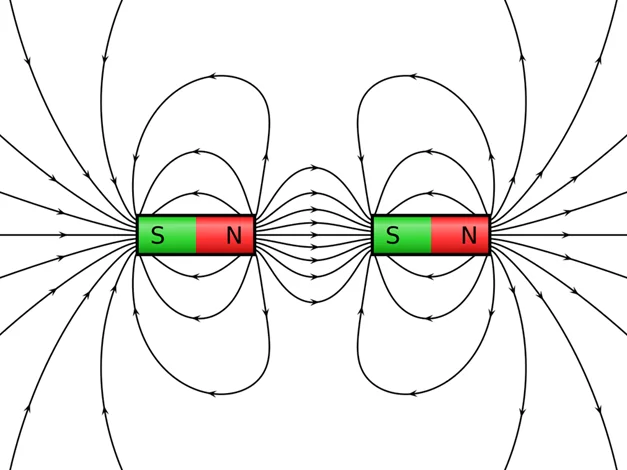 Magnetic Field Line Shapes: 1a Magnetic field lines for opposite poles facing each other (magnetic attraction)Copyright Wikimedia Commons 1a Magnetic Attraction https://commons.wikimedia.org/wiki/File:VFPt_cylindrical_magnets_attracting.svg
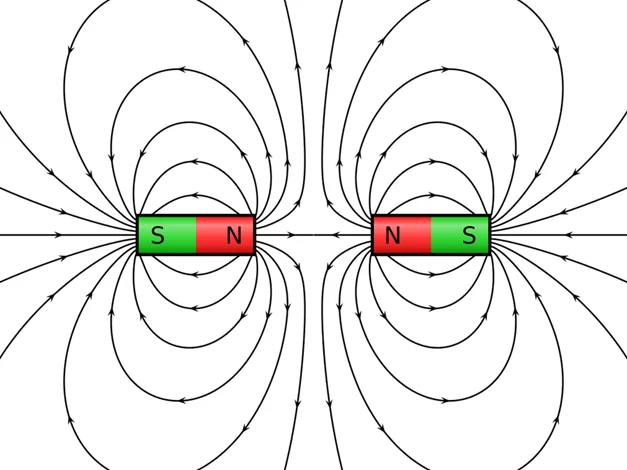 Magnetic Field Line Shapes: 1b Magnetic field lines for the same poles facing each other (magnetic repulsion)Copyright Wikimedia Commons 1b Magnetic Repulsion https://commons.wikimedia.org/wiki/File:VFPt_cylindrical_magnets_repelling.svg
- Station 1: Visualizing Magnetic Fields (Part 1) and Magnetic Interactions Experiment (Part 2)
The Earth behaves like a giant magnet because it is surrounded by a magnetic field.
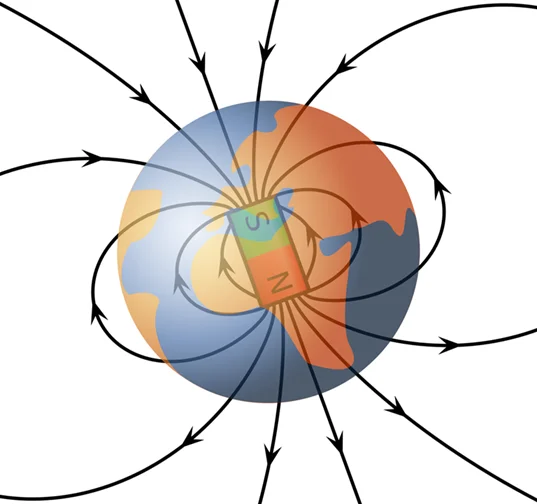 An illustration showing Earth as a natural magnet and magnetic field lines being attracted from the planet’s south pole to the north pole.Copyright Wikimedia commons https://commons.wikimedia.org/wiki/File:VFPt_Earths_Magnetic_Field_Confusion_overlay.svg
This station has two parts. In Part 1, you will use ferrofluid (or iron filings) and magnets to explore how magnetic fields change with distance, magnet strength, and the orientation of magnetic poles.
Students exploring magnetic fields with a ferrofluid bottle and magnets.Copyright Katherine Meraz, UTEPIn Part 2, you will investigate how different materials affect magnetic fields by placing them between a magnet and the ferrofluid (or iron filings).
- Station 2: Magnetic Field Treasure Hunt
At this station, you will use a magnet to "fish" through a bowl of mixed washers, separating magnetic washers from non-magnetic washers. You will then compare the properties of the two types of washers.
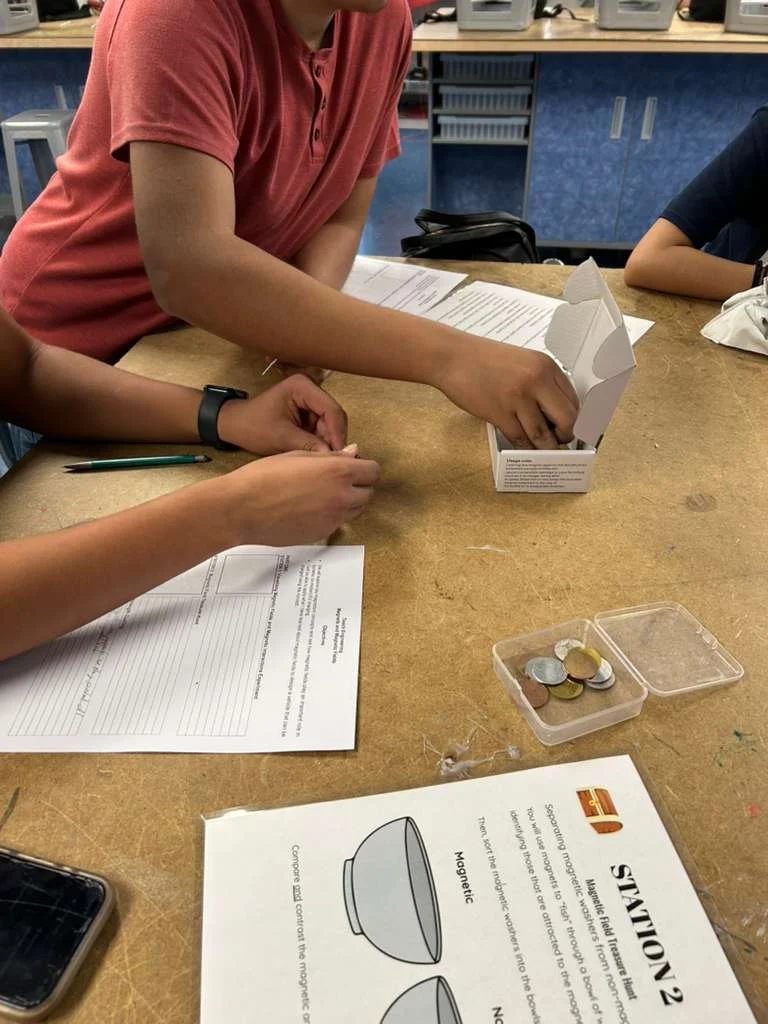 Students using magnets to identify whether objects are made of magnetic material or not.Copyright Katherine Meraz, UTEP
- Station 3: Magnetic Field Strength Curling Game
At this station, you are going to use a large “launcher” magnet to propel small magnetic disks toward a target. Your goal is to land as close to the center as possible to score the most points.
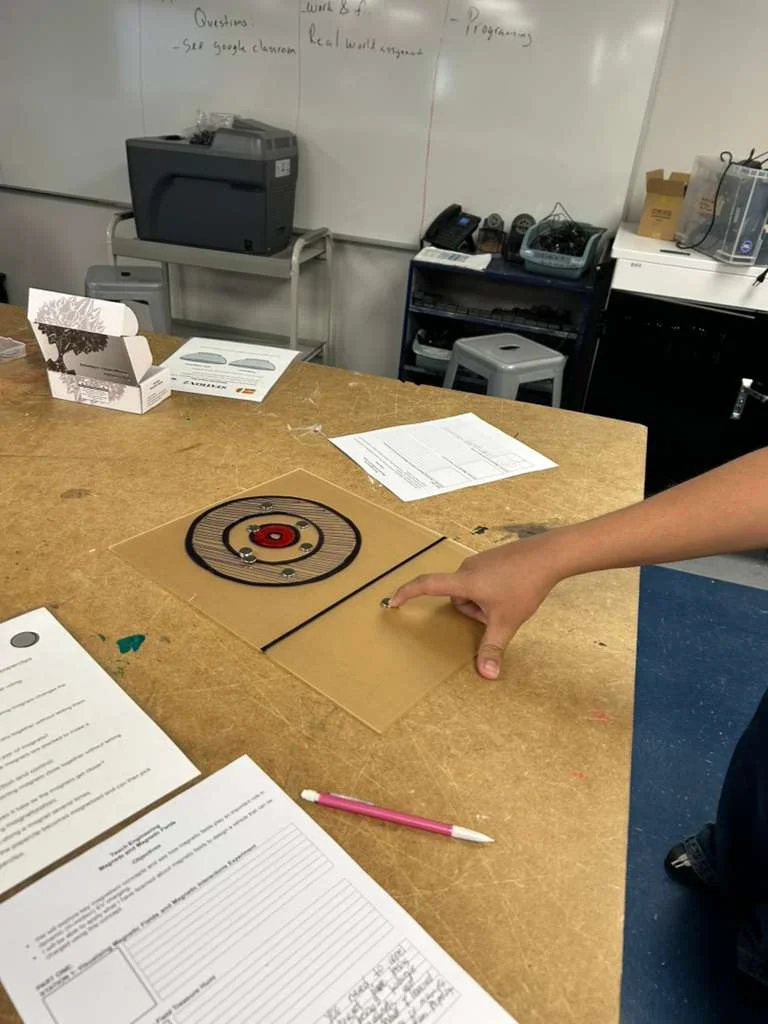 A game showing how using a magnet with the same polarity as another will repel each other and “push” one magnet away.Copyright Katherine Meraz, UTEP
- Station 4: Magnet and Paperclip Exploration
At this station, you will be able to see how magnets interact with paper clips and investigate different ways magnets can temporarily magnetize objects.
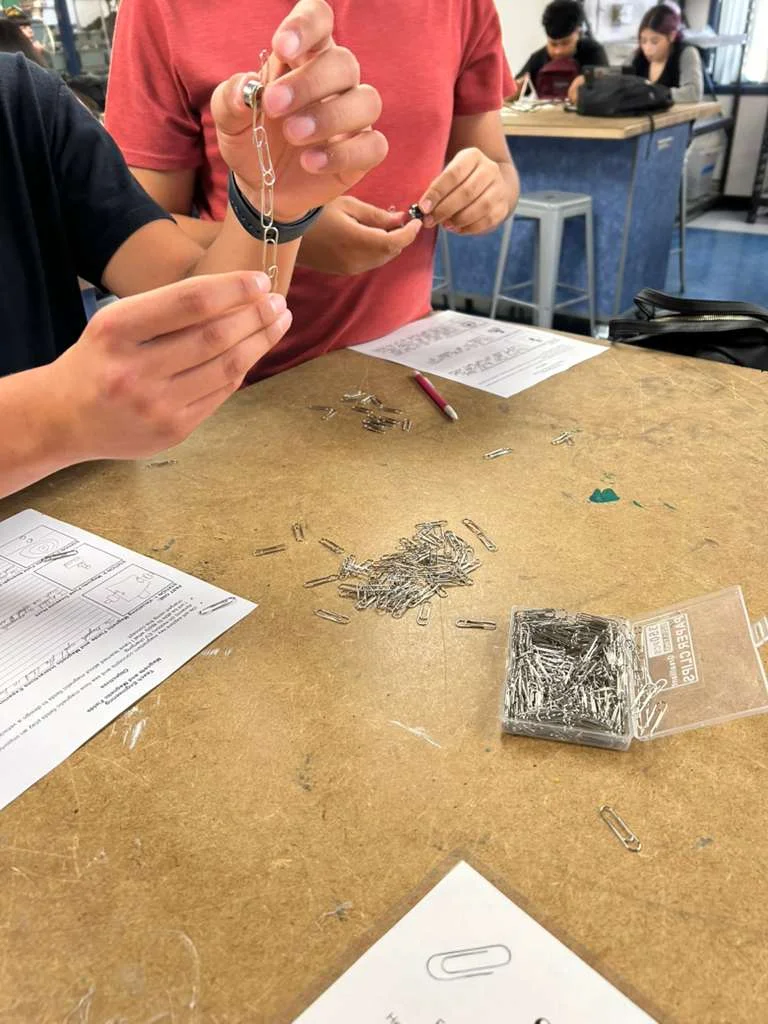 A magnet can be used to attract paper clips in a chain that align to the magnetic field.Copyright Katherine Meraz, UTEP
Station Rotations
- Divide students into four groups with 3–6 students per group.
- Distribute one Magnets and Magnetic Field Worksheet (PDF) to each student. Students should complete the corresponding sections of the worksheet as they rotate through each station.
- Assign each group to a different station.
- Review the following handling instructions before students begin:
- Do not shake the ferrofluid. Shaking can trap bubbles of the clear carrier fluid inside the ferrofluid and reduce its performance. Rapidly moving a magnet near the container can produce the same effect.
- If bubbles form, place strong magnets on opposite sides of the container and slowly move the ferrofluid back and forth for several minutes. The trapped fluid will often separate on its own.
- Most ferrofluid containers contain a small air bubble. If ferrofluid sticks to the bubble, gently sweep a magnet along the side of the container to release it.
- Do not leave a strong magnet pressed against the ferrofluid container for extended periods, as the ferrofluid can become magnetized and respond less effectively during future demonstrations.
- Allow groups 8-10 minutes at each station to explore the materials and complete the activities.
- Rotate groups through all four stations so that each group experiences every activity.
- Once groups have finished all stations, lead a whole-class discussion about what students observed, the concepts they explored, and any questions they still have.
Day 2 (50 minutes)
Wireless EV Charging “Air Gap” Design Challenge
- Introduce the Wireless EV Charging "Air Gap" Design Challenge.
- Explain that wireless charging uses changing magnetic fields to transfer electrical energy without direct physical contact.
- Electricity flows through a coil in the charging pad.
- The flowing electricity creates a changing magnetic field.
- A second coil beneath the vehicle is exposed to this magnetic field.
- The changing magnetic field induces (creates) an electric current in the vehicle's coil.
- The induced current is used to charge the vehicle's battery.
- Present the design challenge:
- Using what you have learned about magnets and magnetic fields, design a system that wirelessly charges an electric vehicle.
- Draw and label your design.
- Explain how energy is transferred from the ground coil to the vehicle coil using a magnetic field.
- Explain how your design helps keep the magnetic field concentrated between the charging pad and the vehicle coil, reducing the "air gap" (the space between the coils where the magnetic field spreads out and energy is lost), improving charging speed and efficiency.
- Remind students to consider how magnetic and non-magnetic materials affect magnetic fields as they develop their designs.
- Allow students time to brainstorm, sketch, label, and explain their solutions.
- Invite students or groups to share their designs and explain how they addressed the air gap challenge.
- Teacher Note: This is an open-ended engineering design challenge intended to encourage students to apply their understanding of magnetic fields to a real-world engineering problem. There is no single correct solution; students should justify their designs using evidence from the station investigations.
- ferrofluid
- A liquid that interacts with magnets. It is used to show the shape of the magnet’s magnetic field, like spikes and balls.
- magnetic fields
- An invisible "force field" or "bubble" surrounding a magnet or electric current that pushes or pulls on magnetic materials (like iron) without touching them.
- magnetic poles
- The two ends of a magnet (north and south), where its pulling power is strongest. Opposite poles (N+S) attract and stick together, while same poles (N+N or S+S) push away.
- magnetism
- An invisible force created by magnets that can pull (attract) or push (repel) certain metals, such as iron and nickel, without touching them. It works through an invisible area around the magnet called a magnetic field.
- magnets
- Objects that produce an invisible force field, attracting materials such as iron, nickel, and cobalt.
Pre-Activity Assessment
Pre-Activity Questions: Lead a brief discussion to activate prior knowledge about magnets and magnetic fields. These can be useful in informal and/or non-formal learning settings. Possible questions include:
- What do you already know about magnets and magnetic fields? (Possible answers: Magnets attract certain materials; magnets have two poles (north and south); opposite poles attract while like poles repel; magnetic fields are invisible regions around magnets where magnetic forces act.)
- How do magnets interact with objects, other magnets, or even Earth? (Possible answers: Magnets attract magnetic materials such as iron, nickel, and cobalt; opposite poles attract and like poles repel; a compass needle aligns with Earth's magnetic field and points north.)
- How could you determine whether an object is magnetic, and what tools or tests would you use? (Possible answers: Bring a magnet close to the object and observe whether it is attracted; compare how different materials respond to the same magnet; test materials such as paper, plastic, aluminum, steel, and ferrite.)
- How do you think distance and different materials affect magnetic interactions? (Possible answers: Magnetic forces are stronger when magnets are closer together and weaker as distance increases; some materials have little or no effect on magnetic fields, while magnetic materials can redirect, weaken, or concentrate them.)
- What do you predict will happen when magnets are moved closer together, farther apart, or separated by different materials? (Possible answers: Magnets placed closer together will attract or repel more strongly; magnets moved farther apart will interact less strongly; paper, plastic, and cardboard will have little effect on the magnetic field.)
Formative Assessment
Building Knowledge Questions: During the station investigations, ask students questions to guide observations and monitor understanding. These questions can also be used in informal and non-formal learning settings. Possible questions include:
- What do you notice happening when the magnet interacts with objects or other magnets? (Possible answers: Opposite poles attract and like poles repel; magnets attract magnetic materials but not most other materials; magnetic forces act without direct contact.)
- How are your observations similar to or different from what you predicted? What do they tell you about magnetic fields? (Possible answers: Observations may confirm or challenge predictions; magnetic fields behave consistently and can be detected through their effects even though they are invisible; ferrofluid, iron filings, or magnetic viewing film reveal magnetic field patterns.)
- How can you tell whether an object is magnetic, and what evidence supports your conclusion? (Possible answers: Magnetic objects are attracted to a magnet or noticeably affect the magnetic field; non-magnetic objects show little or no interaction; comparing multiple materials helps identify magnetic properties.)
- What changes when you move magnets closer together, farther apart, or place different materials between them? (Possible answers: Magnetic attraction and repulsion become stronger as magnets move closer together and weaker as they move farther apart; magnetic materials can redirect or weaken magnetic fields, while most non-magnetic materials have little effect.)
- What patterns do you notice about how distance and different materials affect magnetic field behavior? (Possible answers: Magnetic field strength decreases with distance; magnetic materials can redirect, weaken, or concentrate magnetic fields, while most non-magnetic materials have little or no effect.)
Magnets and Magnetic Fields Worksheet: As students rotate through the four stations, have them complete the accompanying worksheet by making predictions, recording observations, answering questions, and explaining patterns they observe. Monitor student discussions and responses to assess their understanding of:
- Magnetic field behavior around single and multiple magnets.
- The effects of distance and magnet strength on magnetic fields.
- Differences between magnetic and non-magnetic materials.
- Temporary magnetization of paper clips and other ferromagnetic materials.
- Evidence-based explanations supported by observations.
Whole-Class Reflection: Following the station rotations, facilitate a class discussion in which students share observations, compare results, explain magnetic phenomena, and ask questions. Use student responses to identify misconceptions and reinforce key concepts before the engineering design challenge.
Summative Assessment
Post Activity Reinforcing Questions): Lead a discussion to reinforce what students learned about magnets and magnetic fields. These questions can also be used in informal and non-formal learning settings. Possible questions include:
- What did you observe about magnetic fields, even though you could not see them directly? (Possible answers: Magnetic fields are invisible but can be visualized using ferrofluid, iron filings, or magnetic viewing film; they are strongest near the poles and weaken with increasing distance.)
- What evidence helped you understand the shape, strength, or direction of magnetic fields? (Possible answers: Ferrofluid, iron filings, and magnetic viewing film revealed magnetic field patterns; opposite poles produced connected field lines, while like poles pushed field patterns apart.)
- How did distance and different materials affect magnetic interactions? (Possible answers: Magnetic forces became stronger as magnets moved closer together and weaker as they moved farther apart; magnetic materials redirected or weakened magnetic fields, while most non-magnetic materials had little or no effect.)
- Which materials had little or no effect on magnetic fields, and which changed the magnetic field?
(Possible answers: Paper, cardboard, plastic, and aluminum had little or no effect; steel and ferrite redirected, weakened, or concentrated magnetic fields.) - How do the investigations connect to real-world uses of magnets? (Possible answers: Electric motors, generators, wireless charging systems, MRI machines, compasses, maglev trains, and magnetic shielding all rely on magnetic fields.)
Wireless EV Charging "Air Gap" Design Challenge: Students apply their understanding of magnetic fields by designing a wireless charging system for an electric vehicle. Student designs should:
- Include a labeled diagram of the charging system.
- Explain how magnetic fields transfer energy from the charging pad to the vehicle.
- Describe how the design minimizes the "air gap" to improve charging efficiency.
- Justify design decisions using evidence and concepts learned during the station investigations.
Design Presentations: Have students or groups present their designs to the class, explaining how their solution addresses the engineering challenge and applying appropriate scientific vocabulary related to magnetic fields, magnetic materials, and energy transfer.
- Have students investigate additional materials (wood, glass, copper, brass, stainless steel, coins, rocks, etc.) and classify them based on their interaction with magnetic fields.
- Compare the behavior of magnets with different strengths or sizes and relate observations to magnetic field strength.
- Use magnetic viewing film to compare field patterns produced by bar magnets, horseshoe magnets, and stacked magnets.
- Research real-world applications of magnetism, such as MRI machines, maglev trains, electric motors, generators, loudspeakers, hard drives, and recycling systems.
- Extend the engineering challenge by asking students to redesign their wireless charging system to maximize charging efficiency while minimizing cost and material use.
- Have students build and test a simple electromagnet and compare its behavior to that of a permanent magnet.
For younger students:
- Focus on identifying magnetic and non-magnetic materials rather than explaining magnetic fields in detail.
- Demonstrate ferrofluid or iron filings as a whole-class activity before students explore independently.
- Reduce the number of materials tested during the material interactions investigation.
- Simplify the engineering challenge by asking students to draw a basic wireless charging system instead of explaining how the magnetic field is focused.
For older or more advanced students:
- Introduce more advanced magnetic concepts, including how magnetic field strength decreases with distance, how changing magnetic fields induce electric current (Faraday's Law), and how ferrite materials concentrate magnetic fields to improve wireless charging efficiency.
- Have students analyze and compare magnetic materials, explaining why different materials interact with magnetic fields differently and how engineers use these properties to redirect, concentrate, or reduce magnetic fields.
- Require students to justify and refine their wireless EV charging designs using evidence collected during the station investigations, while considering engineering constraints such as efficiency, safety, cost, manufacturability, and sustainability.
- Extend the engineering challenge by having students research existing wireless EV charging technologies, compare their designs to commercial systems, identify engineering trade-offs, and propose evidence-based design improvements.
Adaptations
Limited Materials
- Set up Station 1 as a teacher-led demonstration if only one ferrofluid bottle or iron filing setup is available.
- Have students rotate through fewer stations or work in larger groups.
- Substitute magnetic viewing film or iron filings for ferrofluid if ferrofluid is unavailable.
Time Constraints
- Reduce station rotations to 5–6 minutes each.
- Select two or three stations instead of completing all four.
- Conduct the wireless EV charging design challenge as a homework assignment or extension activity.
Technology Integration
- Use simulation software (such as PhET simulations) to explore magnetic fields before or after the hands-on stations.
- Have students create digital engineering sketches or presentations of their wireless charging designs.
- Encourage students to use AI tools to brainstorm design improvements, identify engineering constraints, or compare their designs with existing wireless charging technologies while critically evaluating the AI-generated suggestions.
Contributors
Matt Jones, Ryan Cook, Seth Patterson of the ASPIRE Electric Vehicle & Roadway facility at Utah State University, Jennifer Taylor of the Pre-College Engineering Program at the University of Colorado (CU) Boulder, and University of Texas at El Paso Pre-Service Teaching ASPIRE Scholars (classroom pilot)
Supporting Program
The Colorado Department of Transportation Office (CDOT) Office of Innovative Mobility and the National Science Foundation ASPIRE Engineering Research Center
Acknowledgements
This curriculum was developed under the CDOT E-Mobility Education and Awareness Grant award 25-HAA-ZL-00103 and the NSF award 1941524. Any opinions, findings, and conclusions, or recommendations expressed in this material are those of the authors and do not necessarily reflect the views of the Colorado Department of Transportation or the National Science Foundation.
Copyright
2026 by Regents of the University of Colorado