
Balloons
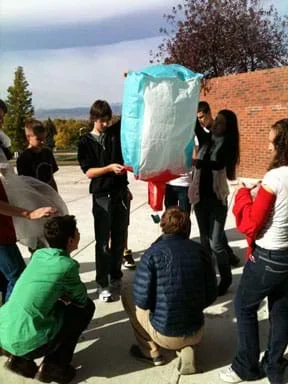 Students release a hot air balloon.
Students follow the steps of the engineering design process as they design and construct balloons for aerial surveillance. After their first attempts to create balloons, they are given the associated Estimating Buoyancy lesson to learn about volume, buoyancy and density to help them iterate more successful balloon designs. Applying their newfound knowledge, the young engineers build and test balloons that fly carrying small flip cameras that capture aerial images of their school. Students use the aerial footage to draw maps and estimate areas.
Engineers apply the principles of buoyancy to design many useful items, such as boats and hot air balloons. Engineers and scientists often employ balloons to take atmospheric measurements or gather data in sensitive, dangerous or remote areas. Balloons can fly much higher than airplanes, beyond the first layer of the Earth's atmosphere (up to 37 km or 120,000 ft high), which is high enough to see the Earth's curvature. Because balloons are filled with gases naturally found in our atmosphere and do not require fuel, they are a "green" way to gather atmospheric data! Those with GPS tracking systems and tags can be returned to the launching organization for re-use of their components.
After this activity, students should be able to:
- Explain why hot air balloons fly and boats float.
- Design and build a hot air balloon that can fly.
- Describe the steps of the engineering design process.
- HS.2.4.c.i Solve linear equations and inequalities in one variable, including equations with coefficients represented by letters.
Grades 9-12
Do you agree with this alignment? - HS.3.1.b Summarize, represent, and interpret data on two categorical and quantitative variables.
Grades 9-12
Do you agree with this alignment? - HS.3.1.b.ii Represent data on two quantitative variables on a scatter plot, and describe how the variables are related.
Grades 9-12
Do you agree with this alignment? - HS.3.1.b.ii.3 Fit a linear function for a scatter plot that suggests a linear association.
Grades 9-12
Do you agree with this alignment? - HS.1.2.a.i Use units as a way to understand problems and to guide the solution of multi-step problems.
Grades 9-12
Do you agree with this alignment? - HS.4.4.a.ii Use volume formulas for cylinders, pyramids, cones, and spheres to solve problems.
Grades 9-12
Do you agree with this alignment?
- Newton's laws of motion and gravitation describe the relationships among forces acting on and between objects, their masses, and changes in their motion – but have limitations
Grades 9-12
Do you agree with this alignment? - Use specific equipment, technology, and resources such as satellite imagery, global positioning systems (GPS), global information systems (GIS), telescopes, video and image libraries, and computers to explore the universe )
Grades 9-12
Do you agree with this alignment?
- CCSS.Math.Content.HSA-REI.B.3 Solve linear equations and inequalities in one variable, including equations with coefficients represented by letters.
Grades 9-12
Do you agree with this alignment? - CCSS.Math.Content.HSG-GMD.A.3 Use volume formulas for cylinders, pyramids, cones, and spheres to solve problems.
Grades 9-12
Do you agree with this alignment? - CCSS.Math.Content.HSN-Q.A.1 Use units as a way to understand problems and to guide the solution of multi-step problems; choose and interpret units consistently in formulas; choose and interpret the scale and the origin in graphs and data displays.
Grades 9-12
Do you agree with this alignment? - CCSS.Math.Content.HSS-ID.B Summarize, represent, and interpret data on two categorical and quantitative variables
Grades 9-12
Do you agree with this alignment? - CCSS.Math.Content.HSS-ID.B.6 Represent data on two quantitative variables on a scatter plot, and describe how the variables are related.
Grades 9-12
Do you agree with this alignment? - CCSS.Math.Content.HSS-ID.B.6c Fit a linear function for a scatter plot that suggests a linear association.
Grades 9-12
Do you agree with this alignment? - CCSS.Math.Practice.MP2 Reason abstractly and quantitatively.
Grades K-12
Do you agree with this alignment? - CCSS.Math.Practice.MP4 Model with mathematics.
Grades K-12
Do you agree with this alignment?
- Students will develop an understanding of the attributes of design.
Grades K-12
Do you agree with this alignment? - Students will develop an understanding of engineering design.
Grades K-12
Do you agree with this alignment? - Students will develop abilities to apply the design process.
Grades K-12
Do you agree with this alignment? - STEL-7AA Illustrate principles, elements, and factors of design.
Grades 9-12
Do you agree with this alignment?
- HS-ETS1-2 Design a solution to a complex real-world problem by breaking it down into smaller, more manageable problems that can be solved through engineering.
Grades 9-12
This resource focuses on the following Three Dimensional Learning aspects of NGSS:
Science & Engineering Practices- Design a solution to a complex real-world problem, based on scientific knowledge, student-generated sources of evidence, prioritized criteria, and tradeoff considerations.Do you agree with this alignment?
Disciplinary Core Ideas- Criteria may need to be broken down into simpler ones that can be approached systematically, and decisions about the priority of certain criteria over others (trade-offs) may be needed.Do you agree with this alignment?
Do you agree with this alignment? - Design a solution to a complex real-world problem, based on scientific knowledge, student-generated sources of evidence, prioritized criteria, and tradeoff considerations.
- HS-ETS1-3 Evaluate a solution to a complex real-world problem based on prioritized criteria and trade-offs that account for a range of constraints, including cost, safety, reliability, and aesthetics, as well as possible social, cultural, and environmental impacts.
Grades 9-12
This resource focuses on the following Three Dimensional Learning aspects of NGSS:
Science & Engineering Practices- Evaluate a solution to a complex real-world problem, based on scientific knowledge, student-generated sources of evidence, prioritized criteria, and tradeoff considerations.Do you agree with this alignment?
Disciplinary Core Ideas- When evaluating solutions it is important to take into account a range of constraints including cost, safety, reliability and aesthetics and to consider social, cultural and environmental impacts.Do you agree with this alignment?
Crosscutting Concepts- New technologies can have deep impacts on society and the environment, including some that were not anticipated. Analysis of costs and benefits is a critical aspect of decisions about technology.Do you agree with this alignment?
Do you agree with this alignment? - Evaluate a solution to a complex real-world problem, based on scientific knowledge, student-generated sources of evidence, prioritized criteria, and tradeoff considerations.
For pre-activity boat-building assessment activity, each student needs:
- 5 index cards
- 2 ft masking tape
- 5 Popsicle sticks
- 100 g of weight, for testing
- bucket or sink of water
Each group needs:
- thin nylon cord, 100 ft
- spring scale
- computers with PowerPoint and video editing capability
- Balloons Worksheet (PDF), one per student
- Balloon Budget Worksheet (PDF), one per group
To share with the entire class:
- flip video camera, such as: https://www.amazon.com/Flip-UltraHD-Video-Camera-Generation/dp/B0040702HA
- painter's plastic
- 2 hairdryers
- (optional, to replace hairdryers above) Indoor Balloon Tester: https://www.pitsco.com/products/indoor-balloon-tester?srsltid=AfmBOooyYl9lNMhADk8_xDI302QTkpedl51dkZUul4ASMhjPF2MFvGMb
- tissue paper
- trash bags
- 17-inch balloons
- 5-10 large helium balloons (purchased on test day or 1 day prior)
- thick string (twine)
- thin string (thread)
- bamboo skewers
- cardboard
- wire
- styrofoam
- fabric (1m x 1m)
- computer with internet access, and projector, to show short video documentary
- printer, for printing out images from camera video footage
Familiarity with algebra and basic density calculations.
 Thousands of sky lanterns released during a Chinese Buddhist ceremony in Thailand.Copyright 2008 Takeaway, Wikimedia Commons http://en.wikipedia.org/wiki/File:LK_03_loy_krathong_yi_peng_san_sai.jpg
(Be prepared to show students a seven-minute video available on the internet during this introductory section.)
What do you think of when I mention balloons? (Listen to student responses.) Most likely, balloons bring to mind images of birthday parties and celebrations. But balloons are used for more than just fun. Scientists use gas balloons to gather atmospheric measurements and observations. In fact, more than 1,600 weather balloons are launched around the globe every day! Large, gas-filled balloons can easily exit the first layer of the Earth's atmosphere, much higher than airplanes can fly, and high enough to see Earth's curvature. You might think sending a balloon to the edge of the Earth and space would be an impossible task, but the principles behind balloons are so easy.
Even a father and his young son successfully built a balloon that travelled to space. They made it out of simple materials and tracked it with an iphone! Their straightforward, homemade balloon travelled 19 miles high before bursting and heading back to the Earth's surface, and the journey was captured on a camera attached to the balloon! (To give students inspiration and ideas for this activity, show them a seven-minute Space Balloon documentary about this incredible project, at https://www.youtube.com/watch?v=y0WtEMt8tnI.)
Similar to what this father and son team accomplished, your team of engineers has been hired to design a device that can provide aerial imagery of your school grounds! Your team will design a balloon that can securely hold a video camera to provide aerial images. To abide by FAA regulations, your balloon must be tethered to the ground at all times. The higher your balloon flies, the better aerial images you will gather. You will want to provide contact information with the balloon so that if it escapes, the equipment can be returned. Your balloon must also provide some protection for the camera in case it fails. Once the images are retrieved, your group will use them to calculate the area of your school building and present your findings, which describe the layout of the school grounds.
Background
Students are presented with the engineering challenge to construct balloons that can gather aerial images of the school, and begin by exploring balloons with guidance from a worksheet. They attempt to create balloons and then receive a lesson on volume, buoyancy and density with the purpose to help them iterate more successful balloon designs.Then, students return to the engineering challenge and apply their newfound knowledge in a brainstorming sessions. Teams bring their balloon designs to fruition and are given time for preliminary testing and modifications before a final test day. After successfully flying the balloons above the school (while tethered to the ground), students analyze their aerial images, make maps and present their findings to the class.
Before the Activity
- Gather materials.
- Make copies of the Balloons Worksheet (PDF), one per student.
- Make copies of the Balloon Budget Worksheet (PDF), one per group.
- Divide the class into groups of three or four students each.
With the Students
Day 1: Exploring Hot Air Balloons
- Give each group a spring scale, trash bag, rubber band or twist tie, and thermometer.
- Hand out the Buoyancy Worksheets.
- Have students use the spring scale to measure the mass of the empty trash bag plus the rubber band or twist tie.Then, instruct students to measure the air temperature of the classroom. Record these two measurements as their first data point on the worksheet graph.
- Have students spend two to three minutes heating up the air inside the trash bag with the hairdryer, being careful not to seal the bag around the hair dryer. If no air can escape, the bag pops! Also, do not let the trash bag come in direct contact with the hairdryer.
- Show students how to seal off the trash bag with the rubber band or twist tie and record the mass of the bag full of hot air using the spring scale. Insert the thermometer and record the temperature of the air inside the bag. Have students record these two measurements as the next data point on the worksheet graph.
- Instruct students to repeat this process three additional times, so that the air is hotter and the bag is lighter each time it is measured. Each time, record the masses and temperatures.
- Have students plot the masses and temperatures on the worksheet graph. Expect students to see a decrease of mass corresponding to the increase in temperature.
- Have students estimate (by interpolating a line through their scatter plots) the temperature their bag would need to reach in order to fly. This temperature is found at the point on the line when the mass of the bag is zero. With the temperature on the x-axis and mass on the y-axis, this is the x-intercept of the line.
- Now, let students explore helium gas-filled balloons in class. Each group still needs their spring scales and un-inflated 17-inch balloons.
- Have students measure and record the mass of the empty balloon.
- Instruct students to attach masses to the balloon until it no longer floats. What is the maximum amount of mass the balloon can lift?
- Have students estimate the volume of the balloon, using the assumption that the balloon is a sphere. (V=4/3 pi*r3)
- Make sure that students record all of their answers and data on their worksheets.
Day 2: Learning about Buoyancy
Present to students the associated lesson, Estimating Buoyancy.
Day 3-4: Brainstorming
- Hand out one Balloon Budget Worksheet to each group.
- Have students begin to brainstorm designs for their balloons. If possible, arrange for them to use computers to help with the brainstorming process.
- Remind students that the balloons must fulfill the following constraints:
- The balloon must be tethered to the ground at all times.
- The balloon must be able to fly carrying the camera.
- The camera must be able to be easily attached/detached from the device. It should take less than two minutes to attach or detach the camera.
- The balloon must have contact information attached to it.
- Provide some protection for the camera in case the balloon fails and the camera falls.
- The balloon must be cost efficient. Record the materials used on the Balloon Budget Worksheet.
- Once students draw and present an acceptable design idea to the teacher, direct them to gather materials and begin building.
Day 5: First Test Day
- Direct student groups to test their balloons. Have them take turns attaching the flip camera to their designs as they perform tests indoors. Provide some sort of weight (such as a weight-lifting weight or sand bag) to which students can tether their balloons. To keep things moving, choose a test order in advance and time students as they attach the camera. If teams are unable to attach the camera in less than two minutes, move on to the next group, and remind them that they must meet all the design requirements. If students planning on using hot air to let their balloon fly, give them time to pre-heat their balloons using a hairdryer.
- For the first test, simply record whether or not the balloon was able to float on its own, and if it met the requirements for attaching/detaching the camera. Have students record the total flight time and maximum height (use the tethered nylon cord to measure the height).
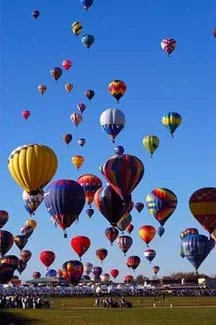 Hot air balloons take off at the Albuquerque International Balloon Fiesta.Copyright 2006 Eric Ward, Wikimedia Commons http://commons.wikimedia.org/wiki/File:Albuquerque_BalloonFiesta.jpg
Day 6: Re-Design
Give students an additional day to re-design their balloons and make modifications.
Day 7: Final Test Day
- On the final test day, test outside near the school. Once again, provide a weight for tethering the balloons, and have groups take turns testing.
- Lay out a measured piece of fabric (1 m x 1 m) and explain that the fabric will help them estimate dimensions from their aerial images.
- Similar to the first test day, time how long it takes teams to attach the camera to their balloons.
- Turn on the video camera.
- Let students release their balloons.
- As soon as students let go, start timing the "time of flight." Time a balloon's flight from when it is let go until it falls to the ground. If the balloon stays airborne more than 5 minutes, have students pull the balloon down using the tether and record that the balloon stayed afloat more than 5 minutes.
- Use the tether to measure the maximum height the balloons reach during flight.
Day 8: Wrap-Up Assignment
- Give each group their flight videos. Direct students to watch their flight movies and capture a few screen images of their school grounds.
- Using the image of the 1m x 1m piece of fabric, have students estimate the size of something in their image (such as a school building, parking lot or athletic field).
- Have students draw maps of the school grounds and organize their findings in PowerPoint presentations. Assign teams to make two-minute presentations of their findings, during which they justify their design decisions and explain how they could improve their designs if given another opportunity to build a balloon.
- Have the class listen to the team presentations, providing questions and feedback.
- displace
- When one thing moves something else out of the way.
- density
- The amount of mass per unit volume (mass/volume).
- buoyancy
- A property that describes whether an object will float or sink in a given fluid.
Pre-Activity Assessment
Quick Boat Build & Test: Have students each build boats using five index cards, two feet of masking tape, and five Popsicle sticks, with the requirement that the boat must hold 100 grams of weight. Let students try out their boats. Then, ask students: What worked well? What didn't work? Why? What do boats and hot air balloons have in common?
Activity Embedded Assessment
Worksheets: Have students complete the activity worksheets. Review their answers to gauge their comprehension.
Post-Activity Assessment
Class Presentation: From their aerial balloon images, have teams draw scaled maps of the area around their school and organize their findings in PowerPoint presentations. Require each group to make two-minute presentations of their results, including justifications for their design decisions and ideas for how they might improve their designs if given another chance to build balloons. Have student groups present to the class, encouraging questions and feedback.
- Do not allow students to inhale helium. While funny, repeated inhalation of helium can cause suffocation. Inhaling helium directly from the tank can be especially dangerous due to the high pressures.
- If you plan on releasing free floating balloons, please follow FAA unmanned balloon regulations.
- Balloons have more trouble flying on hot days and at higher elevations. If possible, schedule testing during a chilly day or in the morning.
- Helium leaks from the balloons over time. Finding a balloon vendor that coats the inside of the balloon with a gel such as Super Hi-Float will extend the balloon's lifespan for a matter of weeks.
- Encourage students to use Hot Air over Helium balloons by making the price of helium balloons very high. This makes students think more critically about their design! Cite a (factual) world helium shortage to justify the high price.
To extend this activity, consider making your own class weather balloon that travels into space! Remember to design a device that can easily be seen and recovered (even if it lands in water), and abide by all local and FAA regulations. Research to determine a launch day with favorable conditions so the balloon is recoverable (for example, if you live on the coast, avoid launching on a day when winds would carry it towards the ocean).
After completing the activity, have students use their math skills to estimate how many balloons would be needed to lift the house in the movie "Up!"
- For lower grades, skip the buoyancy and density lesson and see if students can measure the buoyant force of one balloon, and then estimate the number of balloons they'll need to fly.
- For upper grades, consider making a real weather balloon (see the Activity Extensions section) or limiting the amount of helium balloons, forcing students to think about making solar-heated balloons.
- Estimating Buoyancy
- Balloons
Contributors
Mike Soltys; Marissa H. Forbes
Supporting Program
Integrated Teaching and Learning Program, College of Engineering, University of Colorado Boulder
Acknowledgements
This digital library content was developed by the Integrated Teaching and Learning Program under National Science Foundation GK-12 grant no. DGE 0338326. However, these contents do not necessarily represent the policies of the National Science Foundation, and you should not assume endorsement by the federal government.
Copyright
2012 by Regents of the University of Colorado