
Curing Cancer
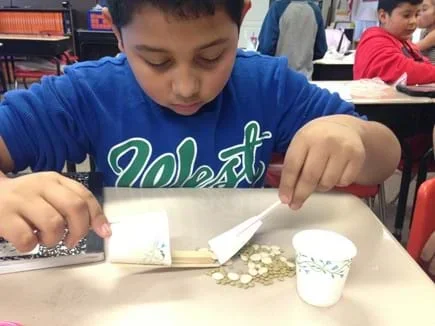 A fifth-grade student tests his cancer-removal tool.
Students learn about biomedical engineering while designing, building and testing prototype surgical tools to treat cancer. Students also learn that if cancer cells are not removed quickly enough during testing, a cancerous tumor may grow exponentially and become more challenging to eliminate. Students practice iterative design as they improve their surgical tools during the activity.
Biomedical engineers design tools, devices and medicines to help prevent people from getting—or help them heal from—certain illnesses and injuries. In this activity, students practice engineering design to create tools to surgically remove cancer cells. Engineers also apply their math skills to create innovative design solutions to everyday challenges. Through learning about exponential growth in this activity, students also gain biomedical engineering experience in using math to help understand and solve human health problems.
After this activity, students should be able to:
- Describe at least one method that doctors use to treat cancer.
- Explain at least one major limitation of current cancer treatments (for example, damage to healthy cells).
- Explain what exponential growth means in the context of tumor growth.
- Apply the engineering design process to design, build and test a device to remove cancer cells.
- 5.2.1 Number patterns are based on operations and relationships.
Grade 5
Do you agree with this alignment? - 5.3.1 Visual displays are used to interpret data.
Grade 5
Do you agree with this alignment? - 5.3.1.a Represent and interpret data.
Grade 5
Do you agree with this alignment?
- Assess further scientific explanations regarding basic human body system functions
Grade 5
Do you agree with this alignment?
- CCSS.Math.Content.5.MD.B Represent and interpret data.
Grade 5
Do you agree with this alignment? - CCSS.Math.Practice.MP2 Reason abstractly and quantitatively.
Grades K-12
Do you agree with this alignment? - CCSS.Math.Practice.MP4 Model with mathematics.
Grades K-12
Do you agree with this alignment?
- Students will develop an understanding of the attributes of design.
Grades K-12
Do you agree with this alignment? - Students will develop an understanding of engineering design.
Grades K-12
Do you agree with this alignment? - Requirements for design are made up of criteria and constraints.
Grades 6-8
Do you agree with this alignment? - Models are used to communicate and test design ideas and processes.
Grades 3-5
Do you agree with this alignment? - Design involves a set of steps, which can be performed in different sequences and repeated as needed.
Grades 6-8
Do you agree with this alignment? - Brainstorming is a group problem-solving design process in which each person in the group presents his or her ideas in an open forum.
Grades 6-8
Do you agree with this alignment? - Invention and innovation are creative ways to turn ideas into real things.
Grades 3-5
Do you agree with this alignment? - STEL-7H Illustrate that there are multiple approaches to design.
Grades 3-5
Do you agree with this alignment? - STEL-7I Apply the technology and engineering design process.
Grades 3-5
Do you agree with this alignment? - STEL-7J Evaluate designs based on criteria, constraints, and standards.
Grades 3-5
Do you agree with this alignment? - STEL-7Q Apply the technology and engineering design process.
Grades 6-8
Do you agree with this alignment? - STEL-7S Create solutions to problems by identifying and applying human factors in design.
Grades 6-8
Do you agree with this alignment?
- 3-5-ETS1-1 Define a simple design problem reflecting a need or a want that includes specified criteria for success and constraints on materials, time, or cost.
Grades 3-5
This resource focuses on the following Three Dimensional Learning aspects of NGSS:
Science & Engineering Practices- Define a simple design problem that can be solved through the development of an object, tool, process, or system and includes several criteria for success and constraints on materials, time, or cost.Do you agree with this alignment?
Disciplinary Core Ideas- Possible solutions to a problem are limited by available materials and resources (constraints). The success of a designed solution is determined by considering the desired features of a solution (criteria). Different proposals for solutions can be compared on the basis of how well each one meets the specified criteria for success or how well each takes the constraints into account.Do you agree with this alignment?
Crosscutting Concepts- People's needs and wants change over time, as do their demands for new and improved technologies.Do you agree with this alignment?
Do you agree with this alignment? - Define a simple design problem that can be solved through the development of an object, tool, process, or system and includes several criteria for success and constraints on materials, time, or cost.
- 3-5-ETS1-3 Plan and carry out fair tests in which variables are controlled and failure points are considered to identify aspects of a model or prototype that can be improved.
Grades 3-5
This resource focuses on the following Three Dimensional Learning aspects of NGSS:
Science & Engineering Practices- Plan and conduct an investigation collaboratively to produce data to serve as the basis for evidence, using fair tests in which variables are controlled and the number of trials considered.Do you agree with this alignment?
Disciplinary Core Ideas- Tests are often designed to identify failure points or difficulties, which suggest the elements of the design that need to be improved.Do you agree with this alignment?
- Different solutions need to be tested in order to determine which of them best solves the problem, given the criteria and the constraints.Do you agree with this alignment?
Do you agree with this alignment? - Plan and conduct an investigation collaboratively to produce data to serve as the basis for evidence, using fair tests in which variables are controlled and the number of trials considered.
- MS-ETS1-1 Define the criteria and constraints of a design problem with sufficient precision to ensure a successful solution, taking into account relevant scientific principles and potential impacts on people and the natural environment that may limit possible solutions.
Grades 6-8
This resource focuses on the following Three Dimensional Learning aspects of NGSS:
Science & Engineering Practices- Define a design problem that can be solved through the development of an object, tool, process or system and includes multiple criteria and constraints, including scientific knowledge that may limit possible solutions.Do you agree with this alignment?
Disciplinary Core Ideas- The more precisely a design task's criteria and constraints can be defined, the more likely it is that the designed solution will be successful. Specification of constraints includes consideration of scientific principles and other relevant knowledge that is likely to limit possible solutions.Do you agree with this alignment?
Crosscutting Concepts- The uses of technologies and any limitations on their use are driven by individual or societal needs, desires, and values; by the findings of scientific research; and by differences in such factors as climate, natural resources, and economic conditions.Do you agree with this alignment?
- All human activity draws on natural resources and has both short and long-term consequences, positive as well as negative, for the health of people and the natural environment.Do you agree with this alignment?
Do you agree with this alignment? - Define a design problem that can be solved through the development of an object, tool, process or system and includes multiple criteria and constraints, including scientific knowledge that may limit possible solutions.
- MS-ETS1-2 Evaluate competing design solutions using a systematic process to determine how well they meet the criteria and constraints of the problem.
Grades 6-8
This resource focuses on the following Three Dimensional Learning aspects of NGSS:
Science & Engineering Practices- Evaluate competing design solutions based on jointly developed and agreed-upon design criteria.Do you agree with this alignment?
Disciplinary Core Ideas- There are systematic processes for evaluating solutions with respect to how well they meet the criteria and constraints of a problem.Do you agree with this alignment?
Do you agree with this alignment? - Evaluate competing design solutions based on jointly developed and agreed-upon design criteria.
Each group needs:
- 1 sandwich bag with 20 lentils
- 1 sandwich bag with ~100 lima beans
- 1 4-6 oz. paper cup
- stopwatch or timer
Each group may choose materials from the following supplies to build its cancer removing tool:
- popsicle sticks
- drinking straws
- toothpicks
- aluminum foil
- index cards
- string
- pipe cleaners
- various-sized paper cups
- Curing Cancer Worksheet (PDF), one per group
Please note: These are suggested materials only; successful tools can be made with a wide variety of other craft materials as well.
To share with the entire class:
- hot glue sticks and hot glue gun
- masking tape
Students should be comfortable with multiplication.
Cancer is very common in the United States: more than 1.6 million people are estimated to be diagnosed with cancer each year. Many different kinds of cancer exist, affecting many different parts of the body. Cancer occurs in people of all ages, even children. What is common to all types of cancer is that some of the body's cells start to divide without stopping. Normal, healthy human cells grow and occasionally divide (one cell becomes two cells) to make new cells when the old cells are worn out or damaged. This helps keep the body working well. However, in cancer, cells start acting strangely and start dividing too much. When cells divide without stopping, a growth called a tumor is formed. Most cancers, except cancers of the blood, form a solid tumor from all these extra cells. These tumors keep growing, often interfering with normal organ function, which makes people sick.
Cancer cells from tumors can also break off and travel to other places in the body and form new tumors. This happens when cancerous tumors are malignant—or contagious or spreadable (see Figure 1). Tumors are not always malignant, sometimes they are benign. Benign tumors do not spread into other tissues or organs, though they can still be very large.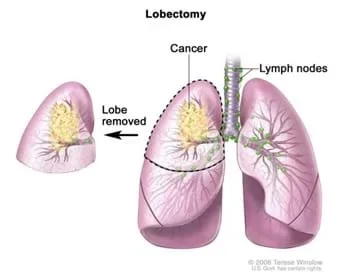 Figure 1. A cancerous tumor in the lungs interferes with normal organ function and can spread throughout the body. Removing this tumor through a lobectomy requires destroying healthy lung cells in addition to the cancerous cells.Copyright 2015 National Cancer Institute https://visualsonline.cancer.gov/details.cfm?imageid=7237
Cancer is a genetic disease, which means that it happens because of changes to our DNA, which give cells their normal instructions. Cancer cells usually have mutated—or permanently changed—DNA compared to normal cells. This DNA mutation means that they have the wrong instructions and divide too much, which we know is not a good thing! Sometimes these genetic changes are inherited from our parents. For other cancers, such as lung cancer, damage to cell DNA happens because of inhaling chemicals and particulates when smoking cigarettes or living or working in environments with poor air quality. The good news is that for lung cancer, choosing to not smoke or removing ourselves from harmful environments reduces our chances of having lung cancer. Another example of a cancer that can be largely prevented is skin cancer. Does anyone know what you can do to avoid having skin cancer? (Use sunblock and other sun protection, and limit time in the sun.)
Oncologists are doctors who treat cancer. They use three main kinds of treatments. One method is surgery. A surgeon removes tumors by cutting them out of the body. However, sometimes a tumor is hard to tell apart from healthy tissue and so some healthy cells are removed, too. This is not good, since healthy tissue has a job to do. For example, imagine a patient has a tumor on the bottom of his tongue (this could happen!). The surgeon must be very careful to remove only the cancerous cells, leaving as much of the healthy tongue as possible. Otherwise, the recovered patient might have a hard time eating and talking. Surgeons look to biomedical engineers to design tools to help them carefully remove tumors.
Doctors also treat cancer by the use of chemotherapy—which is when patients are given chemicals that kill fast-growing cells. Because tumors grow quickly, they are targeted by the chemotherapy medicine. Unfortunately, other cells that grow quickly, but may be healthy cells, are also affected by this medicine. For example, hair follicles and cells that line the stomach grow quickly, so they too are affected by chemotherapy treatment. This is why many people undergoing chemotherapy lose their hair and have upset stomachs. However, while the cancerous tumor is destroyed by chemotherapy, hair and stomach cells eventually get better after the chemotherapy is stopped. So, just like surgery, chemotherapy also affects more than just the cancerous cells. Biomedical engineers strive to design medicines to more specifically target and destroy cancer cells, while leaving healthy tissue as safe as possible.
A third way doctors try to make cancerous tumors go away is with radiation. In radiation therapy, a patient lays in a machine that emits high-energy electromagnetic waves (such as x-rays and gamma waves). The radiation is specifically focused on the tumor so that the high-energy waves kill the cancer cells. As with surgery and chemotherapy, it is challenging to not kill healthy cells while trying to eliminate the cancer. Biomedical engineers help design ways to deliver radiation to patients, whether through designing radiation-producing machines or designing alternate solutions such as small capsules embedded in the body to deliver radiation directly to the tumor area.
Biomedical engineers help medical doctors improve cancer treatment by designing the best tools, medicines and machines that selectively remove the cancer cells while leaving healthy cells. In today's activity, we are going to design a tool to surgically remove cancer cells. The cancer cells will be represented by lima beans (show the class). The lima beans will be mixed up with lentil beans, which represent healthy cells (show the class the lentils). Your engineering challenge is to design a tool that can quickly remove the cancer cells but leave as many healthy cells as possible. If you cannot remove the cancer cells quickly enough, they will start to multiply. This means that the tumor will grow bigger and be even more difficult to remove. In this engineering design challenge, your group will brainstorm solutions, build a prototype, test your solution, and then keep improving the solution as best as you can during the activity. Your goal is to make the best tool possible.
Background
A cancerous tumor forms when cells divide many times in an out-of-control way. Though we call it cell division, it is really more like multiplication: one cell splits and becomes two cells. If these two cells both split into two, you have four cells (2 x 2). If these four cells all split, you have eight cells (4 x 2). Each time the cells divide, you multiply the number of cells by two. How many rounds of cell divisions do you think are needed so that just one cell grows to more than one million cells? (Work this out on the board with student help; see Figure 2.)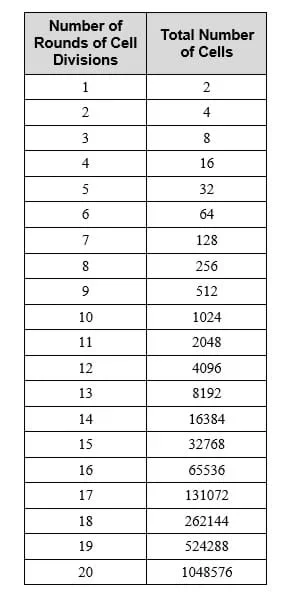 Figure 2. The exponential growth of one cell.Copyright 2015 Chelsea Heveran, University of Colorado Boulder
Wow, in only 20 rounds of cell division, one cell grows to be more than one million cells! We call this exponential growth. If we plot the number of cells versus the number of rounds of cell divisions, we can see a very interesting pattern (create this graph on the board with student help; see Figure 3). The curve becomes steeper and steeper with increasing number of cell divisions. How many cells would we have if the cells divided once more?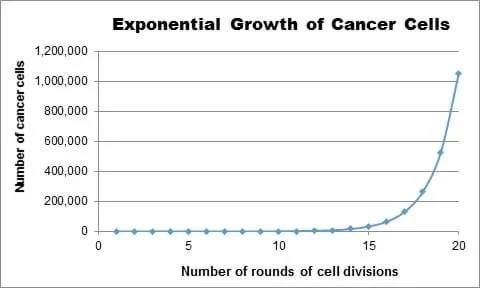 Figure 3. The exponential growth of one cell illustrated in a line graph.Copyright 2015 Chelsea Heveran, University of Colorado Boulder
Why do you think that exponential growth matters when we are trying to treat cancer? Exponential growth matters a lot because the earlier tumors are smaller than later tumors. If you let cancer cells divide more, the tumor size can become very large, very quickly. The smaller the tumor, the easier it is for doctors to treat and the less likely it is to spread to other parts of the body. These two factors mean that it is less likely, then, that healthy tissue will be damaged during treatment.
During this activity, your group designs and tests a tool to surgically remove cancer. You want your tool to quickly remove as many cancer cells as possible—before it becomes large and even more difficult to destroy.
Before the Activity
- Gather materials and make copies of the Curing Cancer Worksheet (PDF), one per group.
- Prepare the supplies, putting the specific number of lima beans and lentils in sandwich bags.
- Get extra lima beans (cancer cells) ready to add to student trials, if necessary.
With the Students
Activity Introduction: Part 1
- Introduce the information about cancer and cancer treatments, as explained in the Introduction/Motivation section. (15 minutes)
- Teach students about exponential growth, as explained in the Background section. (10 minutes)
- Describe the cancer removal tool testing rules (refer to the Curing Cancer Worksheet Example (PDF) for your introduction; students should not get this handout). Go through the worksheet with students to clarify the testing rules and practice exponential growth calculations. (10 minutes)
- Inform students of the following criteria:
- Students test in one-minute trials. In each of these rounds, the surgeon must use the tool to remove as many cancer cells (lima beans) from the healthy cells (lentils) as possible. Place the "removed" beans in the paper cup—our biomedical "trash can."
- To beat cancer, all the cancer cells must be removed. Conversely, if the tumor grows to greater or equal to 100 cancer cells, the tumor is too large to be treated. (LOST) Alternatively, if more than 10 lentils are removed by accident, the patient has lost too many healthy cells. (LOSE)
- If in Trial 1, all the cancer cells are removed but fewer than 10 lentils are removed, great. (BEAT) You beat cancer! If not, the number of remaining cancer cells DOUBLES, which causes exponential growth, before Trial 2. The number of lentils stays the same. Have students fill out the worksheet with the results of each trial to keep track of numbers of cancerous and healthy cells.
- Students complete additional one-minute trials of testing until either 1) all the cancer cells are removed, 2) the cancerous tumor has 100 or more cells or 3) 10 or more healthy cells are removed total (in all testing trials).
- Upon winning or losing the battle against cancer, have groups modify their surgical tools to improve them. Then make the game easier or harder as required through adjusting the number of cancer cells to start. Then, start the testing procedure over with Trial 1.
- A recommended starting number of cancer cells is 10, with 20 healthy cells. Many groups will eventually succeed with upwards of 50 cancer cells to start.
Group Activity: Part 2
- Divide the class into groups of three students each.
- Hand out a worksheet to each group.
- Instruct students to adopt a role for this activity. Potential roles within the group include surgeon, cell counter, materials manager, timer, note-taker, etc.
- Have each group brainstorm designs for its cancer removal tool, select the most promising design, and make an engineering drawing on the back of the worksheet that includes labels of all materials they plan to use.
- When the drawings are finished, groups show them to the teacher. Upon teacher approval, groups each team receive a bag of lentils, bag of lima beans, paper cup (the biomedical "trash can"), a stopwatch/timer and the requested materials, as specified in their approved designs. Note: A group may not receive any supply that is not illustrated in its design drawing. (10 minutes)
- Give groups time to build their designs. (15 minutes)
- When a tool is built, a group may immediately start testing. After beating or losing the battle with cancer, students improve their designs when possible and then start the battle again at Trial 1 (with an appropriately challenging number of cancer cells). (20-30 minutes)
- Conclude by leading a class discussion using the post-activity assessment questions. (10 minutes)
- benign tumor
- A non-cancerous growth that cannot invade other parts of the body.
- cancer
- A disease in which abnormal cells divide uncontrollably and destroy body tissue.
- chemotherapy
- he treatment of diseases, such as cancer, with chemical substances that are toxic to fast-growing cells.
- deoxyribonucleic acid
- abbreviated DNA, a self-replicating material present in nearly all living organisms as the main constituent of chromosomes. It is the carrier of genetic information.
- malignant tumor
- A tumor capable of spreading to other parts of the body.
- oncologist
- A doctor who specializes in treating people with cancer.
- radiation therapy
- The treatment of disease, especially cancer, using high-energy radiation, such as x-rays or gamma rays.
- tissue
- A group of similar cells that work together to carry out a specific function (such as skin, bone, muscle).
- tumor
- A swelling of a part of the body caused by an abnormal growth of tissue, whether benign or malignant.
Pre-Activity Assessment
Questions/Answers: Ask students: Why is it important to remove tumors from the body? How can tumors be removed? Why do biomedical engineers think about protecting healthy cells when designing surgical removal tools?
Activity Embedded Assessment
Questions/Answers: During testing, ask students: Have you observed exponential growth? What would exponential growth look like? If they have not yet observed this growth pattern, the group should start with more cancer cells.
Post-Activity Assessment
Discussion: Lead a concluding class discussion. Ask students: What different kinds of tools did the groups design? (Expect that many creative design solutions were made.) What were the limitations of each tool? (Hard to avoid healthy cells, difficult to use.) How did groups make their tools better through improving upon their designs? What kinds of design criteria do biomedical engineers think about when designing tools like these in real life? (Ease of use, cost, size, etc.) What choices can you make to lower your risk of having cancer?
Provide adult supervision of hot glue gun usage.
Make sure groups start with an appropriate number of lima beans (cancer cells). Start with 10 lima beans and increase this number as tool usage becomes more efficient.
An important aspect of surgical tool design is making sure that the tool can be used by all surgeons and not just by the designers. Have students switch tools with another group and try testing again. Lead a discussion about which tools were easier/harder to use and give groups an opportunity to provide feedback to each other.
- For lower grades, minimize the discussion of exponential growth. Focus the challenge to designing a tool to remove the greatest number of lima beans (cancer cells) from lentils (healthy cells) in a short amount of time.
- For higher grades, aggressively increase the number of lima beans at the start of the timed experiment such that students are working hard to avoid exponential growth conditions. Have groups switch the surgeon within their group between trials. Consider placing a cost on each item and enforcing a price cap.
Cancer statistics. National Cancer Institute. Accessed June 25, 2015. http://seer.cancer.gov/statfacts/html/all.html
Chemotherapy. National Cancer Institute. Accessed June 25, 2015. http://www.cancer.gov/about-cancer/treatment/types/chemotherapy
Radiation therapy. National Cancer Institute. Accessed June 25, 2015. http://www.cancer.gov/about-cancer/treatment/types/radiation-therapy/radiation-fact-sheet#q1
Contributors
Chelsea Heveran
Supporting Program
Integrated Teaching and Learning Program, College of Engineering, University of Colorado Boulder
Acknowledgements
This digital library content was developed by the Integrated Teaching and Learning Program under National Science Foundation GK-12 grant no. DGE 0338326. However, these contents do not necessarily represent the policies of the NSF, and you should not assume endorsement by the federal government.
Copyright
2013 by Regents of the University of Colorado