
Saltwater Circuit
Students build a saltwater circuit, which is an electrical circuit that uses saltwater as part of the circuit. Students investigate the conductivity of saltwater, and develop an understanding of how the amount of salt in a solution impacts how much electrical current flows through the circuit. They learn about one real-world application of a saltwater circuit — as a desalination plant tool to test for the removal of salt from ocean water.
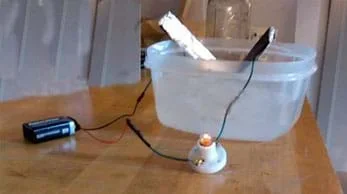 A working saltwater circuit. If the circuit conducts electricity, then we know salt is present in the water. If the circuit does not conduct electricity, then no significant amount of salt is present in the water.
Electrical engineers design and build small- and large-scale electrical systems. In the circuit design sub-discipline of electrical engineering, engineers use their knowledge of the conductivity of materials to design circuit boards that are used in cell phones, TVs, toaster ovens, computers, and uncountable other devices. Understanding the dangers and opportunities of mixing electricity and water helps engineers design for safety as well as creative measurement tools.
After this activity, students should be able to:
- Run an experiment.
- Collect and analyze data.
- Work as part of a team.
- 7.1.1.d Use proportional relationships to solve multistep ratio and percent problems.
Grade 7
Do you agree with this alignment? - 8.4.2 Direct and indirect measurement can be used to describe and make comparisons.
Grade 8
Do you agree with this alignment? - 8.3.1.a Construct and interpret scatter plots for bivariate measurement data to investigate patterns of association between two quantities.
Grade 8
Do you agree with this alignment?
- Gather, analyze and interpret data on chemical and physical properties of elements such as density, melting point, boiling point, and conductivity
Grades 9-12
Do you agree with this alignment? - Gather, analyze, and interpret data that show mass is conserved in a given chemical or physical change
Grade 8
Do you agree with this alignment? - Use tools to gather, view, analyze, and report results for scientific investigations about the relationships among mass, weight, volume, and density
Grade 6
Do you agree with this alignment?
- CCSS.Math.Content.7.RP.A.3 Use proportional relationships to solve multistep ratio and percent problems.
Grade 7
Do you agree with this alignment? - CCSS.Math.Content.8.SP.A.1 Construct and interpret scatter plots for bivariate measurement data to investigate patterns of association between two quantities. Describe patterns such as clustering, outliers, positive or negative association, linear association, and nonlinear association.
Grade 8
Do you agree with this alignment? - CCSS.Math.Practice.MP6 Attend to precision.
Grades K-12
Do you agree with this alignment?
- STEL-3G Explain how knowledge gained from other content areas affects the development of technological products and systems.
Grades 6-8
Do you agree with this alignment?
- HS-PS1-3 Plan and conduct an investigation to gather evidence to compare the structure of substances at the bulk scale to infer the strength of electrical forces between particles.
Grades 9-12
This resource focuses on the following Three Dimensional Learning aspects of NGSS:
Science & Engineering Practices- Plan and conduct an investigation individually and collaboratively to produce data to serve as the basis for evidence, and in the design: decide on types, how much, and accuracy of data needed to produce reliable measurements and consider limitations on the precision of the data (e.g., number of trials, cost, risk, time), and refine the design accordingly.Do you agree with this alignment?
Disciplinary Core Ideas- The structure and interactions of matter at the bulk scale are determined by electrical forces within and between atoms.Do you agree with this alignment?
Crosscutting Concepts- Different patterns may be observed at each of the scales at which a system is studied and can provide evidence for causality in explanations of phenomena.Do you agree with this alignment?
Do you agree with this alignment? - Plan and conduct an investigation individually and collaboratively to produce data to serve as the basis for evidence, and in the design: decide on types, how much, and accuracy of data needed to produce reliable measurements and consider limitations on the precision of the data (e.g., number of trials, cost, risk, time), and refine the design accordingly.
Each group needs:
- 2 large, wooden Popsicle sticks (available at craft stores)
- 4 pieces insulated copper wire, each 4-6 inches (10-15 cm) long
- 3 plastic cups, 16 ounce (473 ml) size
- 2 plastic spoons
- 9-volt battery
- battery cap, usually with red and black wire leads (available at hardware stores)
- 3.7 volt light bulb (available at hardware stores)
- 1 miniature light bulb socket (available at hardware stores; use with the 3.7 volt light bulb)
- eye protection (goggles or safety glasses)
- (optional) multimeter and multimeter leads with alligator clips (available at hardware stores)
- Reflection Worksheet (PDF), one per person
- Saltwater Cards (PDF), one card per group
- Saltwater Circuit Worksheet (without Multimeter) (PDF)or Saltwater Circuit Worksheet (with Multimeter) (PDF), one per group
For the entire class to share:
- electrical tape
- salt, one 26 oz (737 g) container is enough for all groups, plus some extra
- screwdrivers, to tighten wires in light bulb sockets
- roll of aluminum foil
- water
- triple beam or digital scale, to measure grams of salt
- measuring cups or graduated cylinders, to measure ml of water
- projector, to show the attached Saltwater Circuit Presentation (PPTX)PowerPoint
- Saltwater Circuit Presentation (pptx)
- Saltwater Circuit Presentation (pdf)
- Reflection Worksheet (docx)
- Reflection Worksheet (pdf)
- Saltwater Cards (docx)
- Saltwater Cards (pdf)
- Saltwater Circuit Worksheet without Multimeter (docx)
- Saltwater Circuit Worksheet without Multimeter (pdf)
- Saltwater Circuit Worksheet with Multimeter (docx)
- Saltwater Circuit Worksheet with Multimeter (pdf)
(Before beginning, gather materials to conduct a classroom demonstration of a saltwater circuit, as described in the Materials List and Procedure sections. Create two saltwater concentrations, one that allows the light bulb to turn on but stay dim and another selected to allow the light bulb to be bright. Suggested concentrations: Solution A: 300 ml water and 1 gram salt. Solution B: 300 ml water and 11 grams salt. Solution A will be much dimmer than Solution B.)
(Also prepare a projector to show the attached Saltwater Circuit Presentation (PPTX) [PowerPoint] at the end of the Introduction/Motivation session.)
Do you think water and electricity should ever be mixed? (Answer: Usually no.) What if you could safely mix water and electricity? Can you think of any cool technologies that could come from this? (Give the students a few minutes to think.) Today, we are going to work on answering this question. In fact, we are going to join water and electricity in a special way that is safe.
Has anyone ever built any type of electrical circuit before? (Pause to give students a minute or two to think about this.) Well, today we are going to build a saltwater circuit and we are going to investigate the conductivity of saltwater. In particular, we are going to answer the question: "How does the amount of salt in a saltwater circuit affect the electric current flowing through the circuit?"
(Conduct the saltwater circuit demo.)
Our question is a scientific question, but it also has an engineering application. After all, engineering is the application of math and science to create technologies that make the world a better place. One engineering application for this science is the development of a tool to test the efficiency of a water desalination plant.
A water desalination plant is a system that takes in saltwater and produces clean drinking water. If one were to design a water desalination plant, a saltwater circuit could be incorporated as a tool to detect the presence of salt at the output of the desalination plant. If the saltwater circuit conducts electricity, then the plant did not remove a significant amount of salt, and if it does not conduct electricity, then the plant did remove a significant amount of salt from the water input.
(Show students the attached Saltwater Circuit Presentation (PPTX) [PowerPoint].)
Background
Saltwater Circuit — A saltwater circuit consists of a battery, wire, light bulb, light bulb socket, and two electrodes (see Figure 1). When the battery is connected and the electrodes are touched together we have a closed circuit and electrons flow from the positive terminal of the battery to the negative terminal of the battery. This flow causes the light bulb to light up. When the electrodes are not touching, the circuit is "open" and electrons do not flow; this is called an open circuit. In our saltwater circuit, the electrodes act as a switch.
If you submerge the electrodes in regular tap water, the light bulb does not turn on because no medium exists to transfer electrons from one side of the water to the other. But if you submerge the electrodes in saltwater, the light bulb turns on. In addition, the amount of salt in the saltwater solution influences how much current flows through the circuit, and in turn, how bright the light bulb glows.
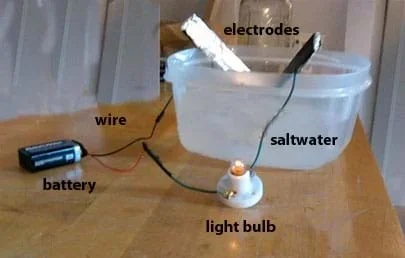 Figure 1. A working saltwater circuit. The presence of sodium and chloride ions carries electricity through the water, completing the circuit. If you replace the saltwater with tap water, the circuit won't work.Copyright Carleigh Samson, ITL Program, College of Engineering, University of Colorado at Boulder
Why Does the Saltwater Circuit Work? — An ion is an atom that has an electrical charge, either positive or negative. Salt molecules are made of sodium and chlorine. When salt enters water, the water causes the salt's sodium and chloride atoms to pull apart and make the salt crystals begin to disappear. As a result, a sodium ion and a chlorine ion are formed. The sodium ion is missing an electron, which gives it a positive change. The chlorine ion has an extra electron, which gives it a negative charge.
When an electric potential is applied, the positively-charged sodium ions are attracted to the negative pole and the negatively-charged chlorine ions are attracted to the positive pole. These ions carry the electricity through water. The essence of the above process is that an "invisible wire" is formed that allows electrons to move from ion to ion across the water.
Before the Activity
- Gather materials.
- Cut enough 4-6 inch pieces of insulated copper so each group has four pieces.
- Print out and cut apart the attached Saltwater Cards (PDF), enough so you have one card per group (the two-page attachment contains 20 different cards, each providing the salt and water measurements to make three different saltwater concentration solutions).
- Make copies of the Saltwater Circuit Worksheet (without Multimeter) (PDF)or Saltwater Circuit Worksheet (with Multimeter) (PDF), one per group, depending on whether or not multimeters are available to use.
- Divide the class into groups of two or three students each.
With the Students — Building the Saltwater Circuit
1. Individually wrap two large Popsicle sticks in aluminum foil (see Figure 2-left). These are your electrodes.
2. Connect one wire to each electrode using electrical tape. Make sure the bare end of the wire touches the aluminum foil (see Figure 2-left).
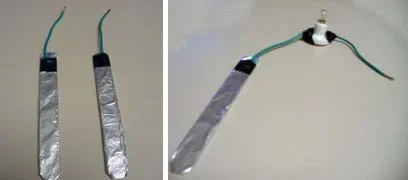 Figure 2. (left) Make electrodes by wrapping large Popsicle sticks in aluminum foil and attaching wires. (right) Then connect one electrode to the miniature light bulb socket.Copyright Juan Ramirez Jr., ITL Program, College of Engineering, University of Colorado at Boulder
3. Connect the opposite end of the wire from one electrode to one terminal of the light bulb socket. Insert the bare wire around the socket terminal and tighten with a screwdriver. Add a piece of electrical tape to secure the connection (see Figure 2-right).
4. Connect a wire to the opposite terminal of the light bulb socket. Again tighten with a screwdriver and cover with a piece of electrical tape (see Figure 2-right).
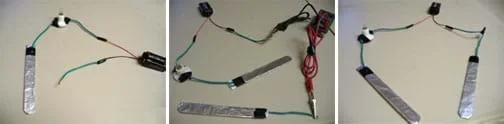 Figure 3. (left) Connect the light bulb socket to the battery. (middle) If using a multimeter, connect it between the battery and the second electrode. (right) If not using a multimeter, connect the battery to the second electrode.Copyright Juan Ramirez Jr., ITL Program, College of Engineering, University of Colorado at Boulder
5. Use electrical tape to connect the wire from the light bulb socket to the red wire of the 9-volt battery cap (see Figure 3-left).
6. Use electrical tape to connect a wire to the black wire of the 9-volt battery cap (see Figure 3-left).
7. If using a multimeter: Connect the free wire to the negative terminal of the multimeter. Then connect the positive terminal of the multimeter to the free electrode (see Figure 3-middle).
8. If not using a multimeter: Use electrical tape to connect the free wire of the battery cap to the free electrode (see Figure 3-right).
9. Test your circuit by touching the two electrodes together. This completes the circuit, allowing electricity to flow from one terminal of the battery to the other, and illuminates the light bulb in the process. If the bulb does not light up, check your wire connections to make sure they are all secure and try again. (See Figure 4.)
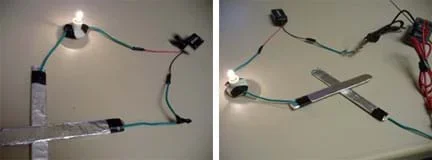 Figure 4. A completed saltwater circuit setup, without multimeter (left) and with multimeter (right).Copyright Juan Ramirez Jr., ITL Program, College of Engineering, University of Colorado at Boulder
With the Students — Solutions, Data Collection and Analysis
1. Hand out the Saltwater Circuit Worksheet (PDF) and the Saltwater Cards (PDF)to each group.
2. Direct teams to use the information provided on the card to make three different saltwater solutions. Label the cups A, B, C, from highest to lowest salt concentration. Have students calculate the density (mass/volume) for each mixture and record in Table 1 of the worksheet.
3. Data Collection Have students insert both electrodes in one saltwater solution (without touching electrodes) and observe how bright the light bulb becomes and record the current reading from the multimeter. (If multimeters are unavailable, making a visual observation is sufficient.) Record measurements and/or observations on the worksheets.
4. Data Analysis Rank the solutions from dimmest to brightest by visual observation.
5. (If using multimeters) Once the solutions have been ranked, have students plot the electrical current readings vs. density.
6. Have students calculate the percent of the solution's mass that is salt [(Mass of Salt / Total Mass of Salt and Water)*100%].
7. Conclude the activity by having students complete the Reflection Worksheet, as described in the Assessment section.
- closed circuit
- An electrical circuit that is conducting electricity.
- density
- Mass per unit volume.
- electrical circuit
- A chain of connected circuit elements.
- electric current
- The rate of flow of electric charge, measured in amperes (A).
- input
- The object going into a system.
- ion
- An atom that has an electrical charge because it has either gained or lost an electron.
- multimeter
- An electronic measuring device that combines several measurement functions into one unit.
- open circuit
- An electrical circuit that is not conducting electricity.
- output
- The object coming out of a system.
- short circuit
- When electrical current is diverted from all circuit elements to few or no circuit elements other then the battery.
- system
- An object that receives inputs and transforms them into output.
- voltage
- Electrical potential difference, measured in volts (V).
Pre-Activity Assessment
Class Discussion: During the Saltwater Circuit Presentation (PPTX)(PowerPoint), create an environment in which students can be actively involved in the discussion.
Activity Embedded Assessment
Data Analysis Worksheet: During the data collection phase of the activity procedure, have student teams fill out the attached the Saltwater Circuit Worksheet (two versions: without multimeter (PDF)and with multimeter (PDF)).
Post-Activity Assessment
Reflection: Have students answer questions about concepts learned and their participation in the Reflection Worksheet (PDF). Review worksheets to gauge students' mastery of the subject matter.
- Have students use goggles or safety glasses for eye protection.
- If not using a battery cap, it is easy to short circuit the battery if the wire ends that are connected to the positive and negative terminals of the battery touch. If they touch, the battery overheats and can cause severe burns.
- Passing electricity through saltwater can cause minor electrolysis, producing trace amounts of hydrogen and chlorine gas. At the low voltage specified (9V battery) these amounts are minimal and not hazardous, but the activity should be conducted in a well-ventilated classroom and only with the recommended power source.
If the light bulb does not light up, make sure all wire connections are tight.
Continue the activity by conducting the associated Water Desalination Plant activity in which students design/build/test a model desalination plant using inexpensive materials.
- For lower grades, only use visual observations (eliminate the multimeter).
- For upper grades, allow students to select several salt-to-water ratios to test electrical conductivity.
PBS Kids Go. Zoom-Saltwater Rocks. WGBH Educational Foundation. Accessed May 1, 2010. http://pbskids.org/zoom/activities/sci/saltwatertester.html
Wikipedia.org, Wikipedia Foundation Inc., Accessed May 1, 2010. (Source of vocabulary definitions, with some adaptation.) http://wikipedia.org
- Ocean Water Desalination
- Saltwater Circuit
- Water Desalination Plant
Browse the NGSS Engineering-aligned Physics Curriculum hub for additional Physics and Physical Science curriculum featuring Engineering.
Contributors
Juan Ramirez Jr.; Carleigh Samson; Stephanie Rivale; Denise W. Carlson
Supporting Program
Integrated Teaching and Learning Program, College of Engineering, University of Colorado Boulder
Acknowledgements
The contents of this digital library curriculum were developed under a grant from the Fund for the Improvement of Postsecondary Education (FIPSE), U.S. Department of Education and National Science Foundation GK-12 grant no. 0338326. However, these contents do not necessarily represent the policies of the Department of Education or National Science Foundation, and you should not assume endorsement by the federal government.
Copyright
2009 by Regents of the University of Colorado