
Class Lava Crossing Challenge: Hot Problem Solving
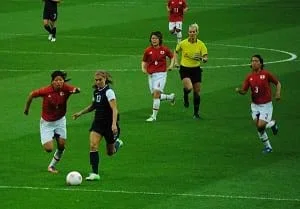 Teamwork is essential in soccer as well as engineering problem solving!Copyright 2012 Joel Solomon, Flickr via Wikimedia Commons https://commons.wikimedia.org/wiki/File:Women%27s_Soccer_-_USA_vs_Japan_(1).jpg
In this physically engaging activity, students are challenged to figure out how to get the entire class from one location on the playground to the sidewalk 20 feet away without touching the ground between—which is (hypothetically) covered in dangerous hot lava! Guided by the steps of the engineering design process, students brainstorm and sketch as they work together to develop a well thought-out plan. Then they test the solution by going outside and trying it out, improving as needed to achieve success. Through the post-activity assessment, students compare their problem-solving experience to real-life engineering challenges such as creating new forms of transportation, inventing new products or figuring out a better way to run a factory. A design and brainstorming handout is provided. This open-ended activity is ideal for ice-breakers, clubs, scouts and camps. Many variations and extensions are possible.
Engineers follow the steps of the engineering design process all the time, helping them to recognize a need, organize their ideas and determine the best solution to a problem. The design process can aid in re-engineering existing products, creating new products in response to customer needs, and developing never-before-imagined inventions that benefit communities and society. Teamwork is an important aspect of the design process as it helps to incorporate a range of perspectives that contribute to better end products and processes.
After this activity, students should be able to:
- Explain the important steps of the engineering design process.
- Relate how engineering incorporates this design process in many applications.
- Apply the engineering design process to multiple design challenges.
- Students will develop an understanding of the attributes of design.
Grades K-12
Do you agree with this alignment? - STEL-7H Illustrate that there are multiple approaches to design.
Grades 3-5
Do you agree with this alignment? - STEL-7I Apply the technology and engineering design process.
Grades 3-5
Do you agree with this alignment?
- 3-5-ETS1-1 Define a simple design problem reflecting a need or a want that includes specified criteria for success and constraints on materials, time, or cost.
Grades 3-5
This resource focuses on the following Three Dimensional Learning aspects of NGSS:
Science & Engineering Practices- Define a simple design problem that can be solved through the development of an object, tool, process, or system and includes several criteria for success and constraints on materials, time, or cost.Do you agree with this alignment?
Disciplinary Core Ideas- Possible solutions to a problem are limited by available materials and resources (constraints). The success of a designed solution is determined by considering the desired features of a solution (criteria). Different proposals for solutions can be compared on the basis of how well each one meets the specified criteria for success or how well each takes the constraints into account.Do you agree with this alignment?
Crosscutting Concepts- People's needs and wants change over time, as do their demands for new and improved technologies.Do you agree with this alignment?
Do you agree with this alignment? - Define a simple design problem that can be solved through the development of an object, tool, process, or system and includes several criteria for success and constraints on materials, time, or cost.
- 3-5-ETS1-3 Plan and carry out fair tests in which variables are controlled and failure points are considered to identify aspects of a model or prototype that can be improved.
Grades 3-5
This resource focuses on the following Three Dimensional Learning aspects of NGSS:
Science & Engineering Practices- Plan and conduct an investigation collaboratively to produce data to serve as the basis for evidence, using fair tests in which variables are controlled and the number of trials considered.Do you agree with this alignment?
Disciplinary Core Ideas- Tests are often designed to identify failure points or difficulties, which suggest the elements of the design that need to be improved.Do you agree with this alignment?
- Different solutions need to be tested in order to determine which of them best solves the problem, given the criteria and the constraints.Do you agree with this alignment?
Do you agree with this alignment? - Plan and conduct an investigation collaboratively to produce data to serve as the basis for evidence, using fair tests in which variables are controlled and the number of trials considered.
Suggested materials for the entire class to share:
- 4 baseball base plates or square pieces of cardboard (~12 x 12 inches, or .3 x .3 m)
- string or rope, ~20 feet (6 m)
- duct tape
- 2-4 small buckets
- clipboard and paper to write down the problem statement and record brainstorming ideas
- (optional) Design & Brainstorming Handout (PDF)
Note: Limiting the amount of materials limits the choices for solutions. So, the more materials made available to the students, the more interesting the activity.
A basic understanding of the steps of the engineering design process and brainstorming, as described in the associated lesson, Time for Design, and at Teach Engineering's design process web page.
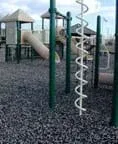 Students come up with the best way to get from A to B without touching the ground.Copyright U.S. Environmental Protection Agency http://www.epa.gov/ epaoswer/non-hw/muncpl/tires/ images/playground.jpg
What do we know about the engineering design process? Remember that the design process can be used with any type of problem, and it can help us pick the best solution for that challenge. Who remembers some of the important steps? (Hand out the Design & Brainstorming Handout (PDF) (optional) or write the steps on the classroom board as you go through the next paragraph.)
Stating the problem helps us identify what we will be doing. Coming up with many ideas through brainstorming helps give us a variety of possible solutions. Picking one of the solutions is the next step, the one we think is best. Then we explain our choice, so that everyone can understand why it might work and give more input to polish the solution. Next, we test the design to make sure it works. We review and decide if the design was the best solution or if we should iterate, meaning start over at some point in the design process to improve it and make it better.
So, should we try the engineering design process ourselves and see if it works for us?
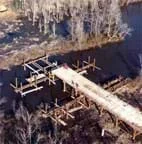 The process students go through in this activity relates to real-world design problems such as building a bridge.Copyright Delaware Department of Transportation http://www.deldot.gov/ static/projects/sr1/ images/dover_smyrna/ leipsic_river_.jpg
Today, our entire class will work together as a team and follow the steps of the engineering design process to solve the following challenge, which is what engineers do in their jobs.
The challenge: Imagine that the gravel (or ground) of the playground is hot lava. Everything you put in the lava will burn and sink, unless it is larger than one square foot (.3 meter). The entire class begins on the play set (or at one location on the playground). Somehow, we must figure out a way to get everyone safely to the sidewalk (or the other side, or somewhere about 20 feet away), untouched by the dangerous hot lava.
Wow, this activity will involve a lot of teamwork! Who can explain why teamwork is important for engineers? (Listen to student explanations.) We need everyone's ideas. So, teamwork is important because having many ideas helps engineers come up with great designs. Engineers use teamwork to build off each others' ideas and trigger even better ideas.
Do you think we can do it? Let's use the engineering design process to help us come up with a solution!
Before the Activity
- This is an open-ended activity for the entire class.
- Decide where to conduct the activity. If your school does not have a playground or if the weather is bad, conduct this activity in the gym or classroom. Establish a starting point and an ending point and say that the floor/ground between is lava. Define the starting and ending points by desks, chairs, mats or gym floor lines. Make the start at least 20 feet (6 m) from the end.
- Gather materials and make copies of the handout if desired.
With the Students
- Perform the pre-activity assessment activities as described in the Assessment section.
- Problem: As a class, come up with a problem statement and write it on the board. Suggestions: Make it a short, carefully thought-out sentence explaining the problem in a way that is open to multiple solutions. For example, instead of: "Find a way to step across the lava without touching it," a more general statement might be: "Get the class to the sidewalk (other side) without touching the lava."
 Imagine hot lava blocks our route!Copyright NOAA http://www.esdim.noaa.gov/story/ngdc/volcano.html
- Write on the board a list of the available materials. Remind students that in the real world, engineers creatively work within given limitations, which might be materials, budget, safety considerations and/or time.
- Brainstorming: As a class, brainstorm different ways to solve the lava challenge, keeping the available materials in mind. Remind students that in brainstorming, no idea or suggestion is "silly." All ideas should be respectfully heard and recorded. Take an uncritical position, encourage wild ideas and discourage criticism of ideas. Have students raise their hands to respond. Write their ideas on the board. Suggestions and prompts:
- The most obvious way to solve this problem might be to set something (working with the available materials) down on the gravel and step on it. But what if you don't have enough materials to cross the entire lava field? What if those materials sink in the lava? Think a little harder. What might be some less obvious ways?
- Brainstorm to come up with wild and creative ideas that might prompt some doable ideas you didn't think of right away. Examples: Use a rope that kids could swing on or make a pair of special protective shoes that everyone could take turns using.
- Also consider the route. Brainstorm the best path from the playground to the sidewalk. Have everyone sketch a diagram of the playground and a proposed path, including where and how materials are used, and then share them with the class. Float the idea that the best path may not be the shortest path. For example, if your solution is to swing by a rope, you would need to swing from a relatively high place on the playground.
- Come up with lots of possible solutions. Consider combining various solutions in different ways.
- Pick one solution: Take a class vote to agree on the best method and the best path to try out.
- Explain: Write the chosen method and/or draw the path on the board. Explain the plan again to make sure everyone understands the proposed solution.
- Test: Take the class and materials to the playground (or gym) to try out the solution the class designed.
- Review: Does it work?
- If not, do some on-the-spot brainstorming as a class and figure out why it's not working, or try another one of the class ideas.
- If it does work, ask the class if they can think of ways to make the solution work even better!
- Remind students that engineers are constantly improving their designs.
- If the solution worked really well, challenge the students to find a way to re-design their method to make the process faster.
- Conclude by conducting the post-activity assessment described in the Assessment section.
- brainstorming
- Thinking of ideas as a group.
- engineer
- A person who applies her/his understanding of science and mathematics to creating things for the benefit of society and our world.
- engineering
- Creating new things for the benefit of society and our world.
- engineering design process
- A structured way to help engineers come up with the best design to solve a specific problem.
- iteration
- Doing something again, like starting over at certain steps of the design process.
Pre-Activity Assessment
Shout It Out: Ask the class to tell you the key steps of the engineering design process, in typical order. Have them say the steps out loud as you write them on the board. (Answer: State the problem clearly, brainstorm possible solutions, select the best design solution, explain your design, create and test your design, and review/decide on any design improvements, iterate if necessary or desired.)
Activity Embedded Assessment
Drawing: Have students draw a diagram of the playground and the path they plan to take. Have them label any important materials on the design plan. Tell them that these are similar to engineering drawings that help engineers explain their design to others.
Post-Activity Assessment
Discussion Questions: Solicit, integrate and summarize student responses. Ask the students:
- What are some examples of how we used teamwork to help us get a solution? Do you think engineers use teamwork when they are developing a solution?
- Getting from the play set to the sidewalk without touching the ground is not a real-life problem. What are some real-life challenges that are similar to the one we solved? (Examples: Building a bridge over a river or a highway overpass, walking on the moon, exploring the earth at the bottom of the ocean.)
- Engineers are always designing products to help people do something that they could not do before. For example, biomedical engineers design cool new medical equipment that helps people walk better after they have been injured. Engineers design toothbrushes that clean our teeth better. Engineers even design cool roller coaster rides to swing people upside down and go really fast. Can you think of any challenges for which you would like to see an engineer design?
- What steps do engineers take to solve these real-life challenges? (Answer: The steps of the engineering design process.)
Re-Engineering: Ask students how they could improve the final design. Have them sketch and/or test their ideas.
Be aware of safety on the play set, especially if many students are crowded into a small space.
If the initial class design solution does not work, and the class cannot come up with a new plan that works, try the following example solution: Say the materials include four cardboard squares and some string. Two students use the string to tie a piece of cardboard to each foot. With these special "boots," they can walk safely on the lava to the sidewalk. At the sidewalk, one student takes off the boots, and gives them to the other student to transport back to the play set for another student to use. With one student transporting the materials back and forth, all students can safely reach the sidewalk.
Add another dimension to the lava crossing challenge by adding a time constraint—the best design is the one that moves everyone in the shortest amount of time. Use a stopwatch to time how long it takes students/teams to get across the lava.
Have students find a way to get across the lava by using materials they might use in lessons later in the school year. For example, make available several simple machines to help them get across the lava, such as pulleys and inclined planes.
Split the class into groups. Have each student team work within a particular constraint to solve the problem of crossing the lava (time, materials, distance, etc.). Then have the teams work together to develop a final class strategy for crossing the hot lava. Remind students that engineers often work in small teams to solve specific problem constraints, and then they bring all of the solutions together to devise a final solution or project.
Have students apply the design process approach to solve some everyday student-relevant problems such as crowded lunch lines, reaching something high on a shelf, getting ready for school in the morning, or keeping your hand from hurting when writing too much.
Have students participate in other teamwork-based activities and discuss how teamwork is important in finding creative design solutions for engineering problems.
- For lower grades, include more materials to give students more options for solutions. More materials also help students come up with many ideas in the brainstorming step. You don't have to know how materials might be used in order to include them as available materials; see what students devise!
- For upper grades, divide the class into two or three teams. Have each team go through the design process independently, writing down on paper everything that was written on the board in the Procedure section. Then, have each team test its design plans. You may want to make the activity into a contest to see which teams were successful, and which solution was the fastest or most efficient.
Abarca, J., Bedard, A.J., Carlson, D.W., Carlson, L.E., Hertzberg, J., Louie, B., Milford, J., Reitsma, R.F., Schwartz, T.L. and Sullivan, J.F. (2000) "Introductory Engineering Design: A Projects-Based Approach," Third Edition, Textbook for GEEN 1400: First-Year Engineering Projects and GEEN 3400: Innovation and Invention, Integrated Teaching and Learning Program, College of Engineering and Applied Science, University of Colorado at Boulder. http://itll.colorado.edu/index.php/courses_workshops/geen_1400/resources/textbook/
- Time for Design
- Class Lava Crossing Challenge: Hot Problem Solving
- Problem Solve Your School
Contributors
Megan Podlogar; Malinda Schaefer Zarske; Denise W. Carlson; Jackie Sullivan
Supporting Program
Integrated Teaching and Learning Program, College of Engineering, University of Colorado Boulder
Acknowledgements
The contents of these digital library curricula were developed by the Integrated Teaching and Learning Program under National Science Foundation GK-12 grant no. 0338326. However, these contents do not necessarily represent the policies of the National Science Foundation, and you should not assume endorsement by the federal government.
Copyright
2006 by Regents of the University of Colorado