
Magnetic Attraction
Students complete a series of six short investigations involving magnets to learn more about their properties. Students also discuss engineering uses for magnets and brainstorm examples of magnets in use in their everyday lives.
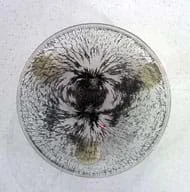 Figure 1. Pattern of iron filings caused by a bar magnet.
While engineers use magnets many purposes, one important use is information storage, or "magnetic memory." We see this everyday in credit cards, VCRs, cassette tapes, computers and zip disks. Magnets are also used in motors and acoustics. Engineers apply their understanding of magnetic fields to design satellites that withstand the effects of the earth's strong magnetic field, which can affect a satellite's orientation around the planet and disrupt sensitive electronics. Engineers design magnetic resonance imaging (MRI) techniques to create computerized images of internal human body tissues using the nuclear magnetic resonance of atoms in the body with the application of radio waves.
After this activity, students should be able to:
- Describe some basic properties of magnets.
- Explain that magnets have two different poles that attract or repel other magnets or objects.
- List several devices that engineers have designed using magnets.
- List everyday devices that use magnets.
- Identify and describe the variety of energy sources
Grade 4
Do you agree with this alignment? - Describe the energy transformation that takes place in electrical circuits where light, heat, sound, and magnetic effects are produced
Grade 4
Do you agree with this alignment?
- Energy comes in different forms.
Grades 3-5
Do you agree with this alignment? - STEL-2I Describe the properties of different materials.
Grades 3-5
Do you agree with this alignment?
- 3-PS2-3 Ask questions to determine cause and effect relationships of electric or magnetic interactions between two objects not in contact with each other.
Grade 3
This resource focuses on the following Three Dimensional Learning aspects of NGSS:
Science & Engineering Practices- Ask questions that can be investigated based on patterns such as cause and effect relationships.Do you agree with this alignment?
Disciplinary Core Ideas- Electric, and magnetic forces between a pair of objects do not require that the objects be in contact. The sizes of the forces in each situation depend on the properties of the objects and their distances apart and, for forces between two magnets, on their orientation relative to each other.Do you agree with this alignment?
Crosscutting Concepts- Cause and effect relationships are routinely identified, tested, and used to explain change.Do you agree with this alignment?
Do you agree with this alignment? - Ask questions that can be investigated based on patterns such as cause and effect relationships.
Each group needs:
- Magnetic Attraction Station Worksheet (PDF)
- Magnetic Attraction Station Instruction Sheet (PDF)(or, print out one sheet, cut it up and place portions at each station.
Set up the following stations for use by the entire class:
Station 1: Ring Magnets
- 2-4 ring magnets (magnets available at most hardware stores)
- 1 pencil
Station 2: Magnetic Separation
- ½ teaspoon (2.5 grams) sugar
- 1 teaspoon (5 grams) iron filings (available at hardware stores)
- 1 cup (.24 liter) water
- 2 beakers
Station 3: Magnetic Pole Identification
- 1 large bar magnet
- 1 small bar magnet
- 1 orienteering compass
- masking tape
Station 4: Magnetic Loops
- 1 piece thin Plexiglas or a Petri dish
- 4 small items of identical height (corks or blocks), to securely prop up the Plexiglas or Petri dish
- a few differently-shaped magnets (For example, bar, ring or u-shaped magnets)
- a small container of iron filings.
Station 5: Magnetic Prediction
- 1-2 bar magnets
- several test objects, such as corks, erasers, paper clips, coins, cloth, aluminum foil, plastic pen, mechanical pencil graphite, ceramic, Popsicle sticks, etc.
Station 6: Make Your Own Magnet
- 2 bar magnets
- 2 nails (made of zinc, iron or steel, but not aluminum)
- 10-20 paper clips
- Magnetic Attraction Station Instruction Sheet (doc)
- Magnetic Attraction Station Instruction Sheet (pdf)
- Magnetic Attraction Worksheet (doc)
- Magnetic Attraction Worksheet (pdf)
- Magnetic Attraction Worksheet Answers (doc)
- Magnetic Attraction Worksheet Answers (pdf)
- Worksheet (Spanish) (pdf)
- Worksheet (Spanish) (doc)
Magnets are fun to play with! Today we're going to have the chance to try many different magnet activities. First, what do you know about magnets? Can you name the properties of magnets? Here are some magnet properties: (List them on the board.)
- All magnets have a north pole (N) and a south pole (S).
- Opposite magnet poles attract each other whereas like poles repel or push each other away.
- Magnets have invisible magnetic fields around them (the space around the magnet where the magnet's forces can be felt).
- Some materials can become magnetized by rubbing them in one direction with a magnet or by placing them near a strong magnet.
- Heating, dropping or hammering a magnet decreases its strength and may demagnetize it.
Did you know that engineers use magnets to make many things, including speakers? That's right the speakers in your stereo or your parents' cars have magnets in them that help them produce sound waves. Engineers also use magnets in many other devices such as motors, television sets, and magnetic information storage in a computer or on a credit card. This magnetic memory storage process records movies on VCR tapes and saves information to a computer. Without engineers, you might not be able to watch your favorite movie, listen to your favorite song, or save photographs onto a computer hard drive!
Engineers must understand everything about the properties of magnets, including how the earth's magnetic field works. Yes, the planet we live on has one gigantic magnetic field. Engineers who work with satellites learn how the magnetic field works so they can get satellites into space. Biomedical engineers design ways to make computer images of the inside of your body using the magnetic fields of atoms in the body, called an MRI (magnetic resonance imaging). Many other types of engineers — if they work with motors — also must understand magnets.
Now that we've talked a little about magnets, who wants to use what we know about magnets and try some activities? There are six different magnet activities for you to try today. Make sure to take your worksheet with you (one per team) and fill it out as you go through the stations.
Background
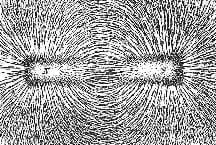 Magnetic lines of force of a bar magnet are shown by iron filings on paper. Note the north and south poles.Copyright Practical Physics, 1914 (public domain) http://en.wikipedia.org/wiki/File:Magnet0873.png
A magnet is an object that attracts ferrous objects and has a magnetic field. A ferrous object is one that contains some amount of iron. Ferrous metals include steel and alloys of iron with other metals, including stainless steel. A magnetic field is the space surrounding a magnet where magnetic forces are exerted on ferrous objects. For example, if an iron nail was placed near a bar magnet, the nail would experience a magnetic force. However, once the nail was removed, the bar magnet's magnetic field would continue to exist. The direction of the magnetic field at any point is in the same direction as the magnetic force at that point.
One of the most common types of magnets is a bar magnet. It is a long uniform rectangle with a north pole on one end and a south pole on the other. The ends are called "north pole" and "south pole" because a magnet that is free to pivot around a vertical axis always points in a north-south direction. This can be seen on a compass. The end that points in the north direction is called the north pole of the magnet and the end that points in the south direction is called the south pole of the magnet. Like ends of a magnet repel each other and unlike poles attract each other.
Before the Activity
- Make copies of the Magnetic Attraction Station Worksheet (PDF), one for each student pair, and the Magnetic Attraction Station Instruction Sheet (PDF). Either make enough copies to give each team a copy of the full instruction sheet, or cut up one copy of the instruction sheet to post portions at each station.
- Gather materials and assemble a station for each of the magnet demonstrations.
- At Station 1: Ring Magnets, place 2-4 ring magnets and a pencil.
- At Station 2: Magnetic Separation, mix ½ teaspoon (2.5 g) of sugar with ½ teaspoon (2.5 g) of iron filings in a beaker. Place ½ teaspoon (2.5 g) of iron filings in a second beaker with 1 cup (.24 l) of water.
- At Station 3: Magnetic Pole Identification, place 1 large bar magnet, 1 small bar magnet and a compass. Use masking tape to label the poles 1 and 2, making sure to cover any existing N or S pole identification on the bar magnet.
- At Station 4: Magnetic Loops, create a small elevated surface or table by placing a piece of thin Plexiglas on top of four items of identical height (such as corks or blocks). Place a few differently-shaped magnets nearby, along with a small container of iron filings.
- At Station 5: Magnetic Prediction, place a variety of test objects (see Materials List for ideas) along with one or two magnets.
- At Station 6: Make Your Own Magnet, place 2 rectangular magnets, 2 nails, and a small pile of paper clips.
With the Students
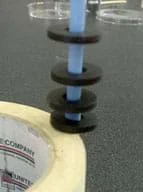 Figure 2. Experimenting with ring magnets.Copyright Joe Friedrichsen, ITL Program, College of Engineering, University of Colorado at Boulder.
- Divide the class into teams of two students each. Pass out the worksheet, one per team. Pass out a station instruction sheet to each team, or provide instructions at each station.
- Have the student pairs work through the stations, filling out their worksheet as they go.
- Station 1: Ring Magnets — Put two ring magnets on the pencil so that the magnets repel each other (see Figure 2). Hold the bottom ring and move it up and down along the pencil. What happens? Next, hold one ring between your thumb and forefinger. Hang the second ring on the first ring edge to edge. Can you make the second ring travel round the first ring in a circle?
- Station 2: Magnetic Separation — Use a magnet to remove iron filings from the mixtures in the beakers. Why can you separate the mixtures with a magnet?
- Station 3: Magnetic Pole Identification — Use the small magnet or a compass to determine which pole of the large magnet is the N pole and which is the S pole. Which is the N pole of the large magnet, pole 1 or 2?
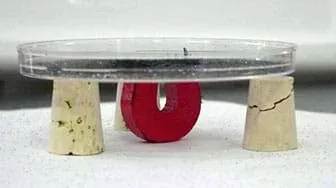 Figure 3. Station 4 set-up using a Petri dish, corks and a u-shaped magnet.Copyright Joe Friedrichsen, ITL Program, College of Engineering, University of Colorado at Boulder.
- Station 4: Magnetic Loops — Put a magnet under the Petri dish (or Plexiglas) (see Figure 3). Sprinkle some iron filings on the surface of Petri dish. What shapes and patterns do the iron filings make? Try this with magnets of different shapes and sizes. Do they make different shapes? (See Figure 1 for an example of what the filings might look like.)
- Station 5: Magnetic Prediction — Which objects do you think will be attracted to the magnet? Touch the magnet to each of the items. Which objects stick to the magnet? Which do not? What do the objects that are attracted to the magnet have in common?
- Station 6: Make Your Own Magnet — Rub the magnet against a nail (in one direction only) to magnetize it. How many paper clips can you pick up with the nail (see Figure 4)? Demagnetize the nail. How do you know it's demagnetized? Now magnetize the nail again. How can you make the nail a stronger magnet using only the materials at the station? How can you test your idea? Demagnetize the nail when you're finished.
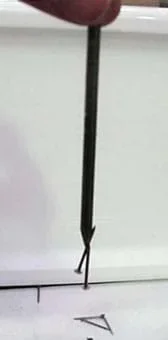 Figure 4. A magnetized nail attracts smaller nails and paperclips.Copyright Joe Friedrichsen, ITL Program, College of Engineering, University of Colorado at Boulder.
- attract
- To cause to draw near by physical force.
- engineer
- A person who applies her/his understanding of science and mathematics to create things for the benefit of humanity and our planet. This includes the design, manufacture and operation of efficient and economical structures, machines, products, processes and systems.
- magnet
- Something that attracts iron and generates a magnetic field.
- magnetic field
- The portion of space around a magnet where the magnetic forces of the object can be detected.
- magnetic memory storage
- Using magnets to store information. For example, computer hard drives, flash drives, floppy drives, zip drives.
- magnetic pole
- One of the two ends of a magnet where the magnetic field is most intense.
- repel
- To push back or away by a force.
Pre-Activity Assessment
Class Definition: Have students develop a class definition for a magnet. Write the definition on the board. Lead them towards an explanation that involves anything that creates a magnetic field, or that attracts or repels other objects such as iron or steel.
Activity Embedded Assessment
Worksheet/Pairs Check: To start the activity, hand out the Magnetic Attraction Worksheet (PDF), having students work in pairs to visit each station and complete the worksheet. Have the students check each other's answers.
Prediction: Ask students predict the outcome of the activity before the activity is performed.
- For the Station 5: Magnetic Attraction, ask students to predict on their worksheet which objects will be attracted to the magnet.
Class Discussion: Lead a class discussion and ask the students:
- How can you use a compass to test the poles of a magnet? (Answer: The red [or north] arrow of the compass will point to the north pole of the magnet and the white [or south] arrow of the compass will point to the south pole of the magnet.)
- What did the iron filings do when you held the magnet underneath them? (Answer: The iron filings traced out the invisible magnetic field around the magnet.)
- What were some of the objects around the room that were magnetic? Where were some of the objects that were not magnetic? (Answers may vary.)
- What are some of the devices that engineers have created that use magnets? (Answers may vary).
Post-Activity Assessment
One and Done: Ask students to think of examples of: 1) uses for magnets around their homes, 2) objects that contain magnets and 3) items that contain magnetic memory storage. Have them raise their hands (or indicate thumbs up) when they have an example. Call on students at random to state their answer (either a use or an object). Have students put their hands down once they have contributed an answer. No repeat answers permitted. (Possible example uses: To post papers to the refrigerator, to store information, to find [or hold] pins and needles. Possible example objects that contain magnets: Refrigerator, hair dryer, appliances, anything with a motor. Possible example items that contain magnetic memory storage: Credit card, VCR tape, cassette tape, computer hard drive, zip disk, flash drive, floppy disk.)
Informal Engineering Discussion: Engage students in a discussion to gauge their understanding of the subject. Ask the students:
- Engineers use magnets when designing information storage devices for computers, including hard drives and flash drives. They use strong magnets to read or write information to these devices. Why might you need to be careful with magnets around credit cards, VCR tapes, cassette tapes, zip disks, and floppy disks? (Answer: Magnets can not only read and write information on these items; they can also erase the data or information stored on them.)
- Engineers design ways to recycle thrown-away materials. How could magnets be used to sort recyclable materials? (Example: Magnets are used to separate steel cans from other [non-metal] trash. Refer to what they learned at Station 5: Magnetic Prediction.)
For the iron filings station, supply magnets that are pre-wrapped in paper towels to assure the iron filings will not stick to the magnets.
To magnetize a nail, students must stroke it in one direction only. Before they leave the station, remind them to demagnetize the nail by hitting it against the tabletop.
It may take some finesse to sprinkle the iron filings on the plastic surface to show the magnetic loops. Practice in advance to be able to help students who have trouble.
Silly Magnetic Pictures: Laminate an image of the face a person (maybe the teacher). Have students place the laminated sheet on top of four blocks. Pour a small amount of iron filings on top of the image. Using a bar magnet underneath the picture, have the students move the filings to create hair, a beard, a mustache or eyebrows on the image.
Construct a series circuit with two batteries, one bulb and a switch. Have the students use a compass to investigate the magnetic field of a current-carrying wire.
- For lower grades, conduct the test stations as group demonstrations or at students' desks while they follow along with the teacher.
- For an upper grades math extension, make a graph showing the number of times the nail was stroked with the magnet and the strength the nail's magnetic field (how many paper clips the magnetized nail could attract). Have students use their graph to predict the number of paper clips the nail could pick up if it were stroked an intermediate number of times.
Dictionary.com. Lexico Publishing Group, LLC. Accessed April 26, 2006. (Source of some vocabulary definitions, with some adaptation) http://www.dictionary.com
Space Radiation Analysis Group. Last updated March 4, 2005. Johnson Space Center, NASA. Accessed April 26, 2006. http://srag-nt.jsc.nasa.gov/
- A Magnetic Personality
- Magnetic Attraction
Contributors
Xochitl Zamora Thompson; Joe Friedrichsen; Abigail Watrous; Malinda Schaefer Zarske; Denise W. Carlson; Leslie Herrmann
Supporting Program
Integrated Teaching and Learning Program, College of Engineering, University of Colorado Boulder
Acknowledgements
The contents of this digital library curriculum were developed under a grant from the Fund for the Improvement of Postsecondary Education (FIPSE), U.S. Department of Education, and National Science Foundation GK-12 grant no 0338326. However, these contents do not necessarily represent the policies of the Department of Education or National Science Foundation, and you should not assume endorsement by the federal government.
Copyright
2004 by Regents of the University of Colorado.