
In and Out Reactor
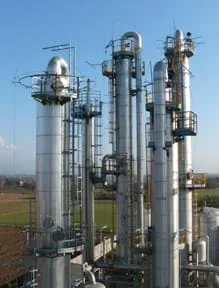 These distillation columns at a distillation plant separate oil into all its different hydrocarbon components. Mole balances are used to better design and control these complex pieces of equipment.Copyright 2006 Luigi Chiesa, Wikipedia, GNU Free Documentation License http://en.wikipedia.org/wiki/File:Colonne_distillazione.jpg
Students learn about material balances, a fundamental concept of chemical engineering. They use stoichiometry to predict the mass of carbon dioxide that escapes after reacting measured quantities of sodium bicarbonate with dilute acetic acid. Students then produce the reactions of the chemicals in a small reactor made from a plastic water bottle and balloon.
Chemical and biological engineers apply the basic principles of conservation of mass and energy to design and control chemical and biological systems. Chemical engineers calculate energy balances to help them design equipment used to separate crude oil into useable components. Chemical engineers use material balances to predict how much product will be produced in chemical reactions. A biological engineer uses material balances to calculate the efficiency of a cell's metabolism, or to predict how fast medicines dissipate in the body. Engineers use these concepts to produce new materials and re-analyze old manufacturing processes to make them safer, more efficient and less harmful to the environment.
After this activity, students should be able to:
- Explain how the conservation of mass can be used to predict the products of a chemical reaction.
- Compute molar-mass conversions.
- Give examples of chemical engineering projects and products.
- HS.1.2.a Reason quantitatively and use units to solve problems.
Grades 9-12
Do you agree with this alignment?
- Recognize, analyze, interpret, and balance chemical equations (synthesis, decomposition, combustion, and replacement) or nuclear equations (fusion and fission)
Grades 9-12
Do you agree with this alignment? - Predict and calculate the amount of products produced in a chemical reaction based on the amount of reactants
Grades 9-12
Do you agree with this alignment?
- CCSS.Math.Content.HSN-Q.A.1 Use units as a way to understand problems and to guide the solution of multi-step problems; choose and interpret units consistently in formulas; choose and interpret the scale and the origin in graphs and data displays.
Grades 9-12
Do you agree with this alignment?
- Energy can be grouped into major forms: thermal, radiant, electrical, mechanical, chemical, nuclear, and others.
Grades 9-12
Do you agree with this alignment?
- HS-PS1-7 Use mathematical representations to support the claim that atoms, and therefore mass, are conserved during a chemical reaction.
Grades 9-12
This resource focuses on the following Three Dimensional Learning aspects of NGSS:
Science & Engineering Practices- Use mathematical representations of phenomena to support claims.Do you agree with this alignment?
Disciplinary Core Ideas- The fact that atoms are conserved, together with knowledge of the chemical properties of the elements involved, can be used to describe and predict chemical reactions.Do you agree with this alignment?
Crosscutting Concepts- The total amount of energy and matter in closed systems is conserved.Do you agree with this alignment?
- Science assumes the universe is a vast single system in which basic laws are consistent.Do you agree with this alignment?
Do you agree with this alignment? - Use mathematical representations of phenomena to support claims.
Each group needs:
- plastic water bottle, 16-oz (480-ml) size is good (rinse one from the recycle bin; no lid)
- balloon
- spoon
- beaker
- Material Balances Reading (PDF), one per student
- Heavy Balloon-Mass Balance Worksheet (PDF), one per group
- Evaluation & Enhancement Worksheet (PDF), one per student
For the entire class to share:
- funnels (several)
- measuring scale
- baking soda, 1 16-oz (454-g) box is sufficient
- white vinegar, half-gallon (1.9 liter)
- Material Balances Reading (doc)
- Material Balances Reading (pdf)
- Heavy Balloon-Mass Balance Worksheet (doc)
- Heavy Balloon-Mass Balance Worksheet (pdf)
- Heavy Balloon-Mass Balance Worksheet Answers (doc)
- Heavy Balloon-Mass Balance Worksheet Answers (pdf)
- Evaluation & Enhancement Worksheet (doc)
- Evaluation & Enhancement Worksheet (pdf)
- Evaluation & Enhancement Worksheet Answers (doc)
- Evaluation & Enhancement Worksheet Answers (pdf)
Basic math, algebra, chemistry (stoichiometry and unit conversion)
What does a person, an engine and a chemical plant all have in common? Each is a type of chemical reactor! A chemical reactor is a vessel designed to contain chemical reactions. Material and energy go in, useful products are created, and waste goes out. This is the fundamental concept for chemical engineering.
Engineers use this process to model medicine in a person, gas in an engine, and hydrocarbon in a chemical factory. What goes into a system must either stay there or come out. The same applies to energy. In a hot water heater, water enters at a certain temperature; heat energy is supplied to the water, and exits at a higher temperature. For this activity, we will focus on material balances.
(Hand out the Material Balances Reading to students to read before beginning the activity procedures.)
Background
Following is the information provided in the Material Balances Reading:
What is a material balance? The idea that "what goes in must come out" (unless it has stayed in the system) seems pretty straight forward, but it can get complicated quickly. Is it how much volume goes in and out that must be conserved? Or is it mass? Could it be moles of a substance? What about when a chemical reaction occurs, or when one of the components undergoes a phase change by boiling or freezing? In the most general sense, a material balance refers to mass. In phase changes and in some chemical reactions, the volume changes substantially, and can vary depending on temperature and pressure. In some systems, we can balance moles of a compound, but in chemical reactions the number of moles changes as well. However, mass is always conserved in chemical and physical systems. This means that mass can be neither created nor destroyed. It can only be rearranged. Based on this principle, called the conservation of mass, engineers use the following equation on which to base their material balance calculations (write this on the board).
In – Out + Generation – Consumption = Accumulation
In this equation, In refers to anything that is in or flows into the system. Out refers to anything taken out or flowing out of the system. Generation accounts for anything that is generated in the system from a chemical reaction, while Consumption refers to what is used as fuel or changes form. Finally, Accumulation is whatever stays in the system. It is important to recognize that this refers to a specific species or part of a system.
Imagine a campfire. Wood logs are burning to create smoke and ashes. Now let's imagine that we are also adding logs to the fire once per hour. A material balance around the wood would look like:
Wood In – Wood Burned = Wood Accumulated
The input is the quantity of wood being put on the fire every hour, and the consumption is the amount of wood burned away or consumed in the fire. The accumulation is whatever is left over as charred wood pieces in the morning. The balance on the smoke looks different:
–Smoke Out + Smoke Generated = 0
Because all of the smoke floats away, none accumulates. No smoke is being added to the fire, and the fire is not fueled by smoke, so there are no input or consumption terms. There is only the smoke generated by burning, and the smoke floating out of the system. The balances on the wood and smoke are called species mass balances, because they are a balance of a specific part of the system.
By measuring the mass of wood we put into the system, how much is left, and how much is turned to ash, we can calculate the mass of smoke produced by the fire. This is called an overall mass balance. Remember, mass cannot be generated or destroyed, so there is only an input and an output term in an overall mass balance.
For this activity, we will be doing a species mass balance and an overall mass balance for a reaction of baking soda and vinegar to predict how much carbon dioxide is produced. We will then react the two chemicals and capture the carbon dioxide in a balloon. Finally, we will weigh the balloon and compare the mass of the carbon dioxide to the predicted mass.
Before the Activity
- Gather materials and make copies of the Material Balances Reading (PDF), Heavy Balloon-Mass Balance Worksheet (PDF), Evaluation & Enhancement Worksheet (PDF).
- Prior to the experiment, hand out and have students read the Material Balances Reading.
With the Students
1. After students finish reading the Material Balances Reading, divide the class into groups of two or three students each.
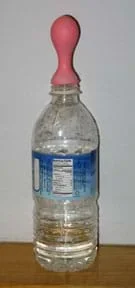 Figure 1. As the reaction takes place, the balloon inflates and the solution in the water bottle bubbles.Copyright James Prager, ITL Program, College of Engineering, University of Colorado at Boulder
2. Give each group a Heavy Balloon-Mass Balance Worksheet. The procedure is as follows:
- Complete the calculations on the worksheet.
- Obtain an empty water bottle, a balloon and a funnel. Weigh the balloon and the bottle and record their masses in your data table.
- Measure out 0.1 moles (8.4 grams) of baking soda and put it in your water bottle.
- Pour 0.1 moles (~120 mL vinegar) of acetic acid into a beaker.
- With one person ready to put the balloon on the top of the bottle, use the funnel to pour your vinegar into the bottle. Quickly cover the bottle neck with a balloon (see Figure 1).
- Gently swirl the solution to make sure it reacts.
- When the solution has stopped bubbling and the reaction seems complete, find the mass of the entire apparatus and record it in your data table.
- Carefully remove the balloon from the bottle, making sure not to let any gas escape from the balloon. Tie it off to be sure none escapes.
- Weigh the balloon and record your findings.
3. As a class, review the Heavy Balloon-Mass Balance Worksheet.
4. Have each student complete his or her own Evaluation & Enhancement Worksheet.
5. Conclude with a class discussion that puts the experiment into a real-world context, such as the chemical engineering that might be done in a petroleum refinery. Ask students the questions in the Investigating Questions section.
- mass balance
- A type of material balance in which we balance the mass of material entering and leaving the system.
- material balance
- Accounting for all material in a system in moles or mass.
- mole balance
- A type of material balance in which we balance the moles of material entering and leaving the system.
- species balance
- A type of material balance in which we balance the amount of one specific component entering and leaving the system.
- stoichiometry
- The calculation of the quantities of chemical elements or compounds involved in chemical reactions.
Pre-Activity Assessment
Discussion: Solicit, integrate and summarize student responses
- What is conservation of mass? (Answer: Mass can neither be created nor destroyed in these conditions, it can only change forms.)
- What is conservation of energy? (Answer: The first law of thermodynamics: Energy [and mass] can be neither created nor destroyed, it can just change forms.)
- Are they related? (Answer: They are related by E=mc2, which implies that mass is a form of energy. This is important in nuclear and quantum applications.)
- Can you think of any applications of this knowledge? (Answer: Manufacturing, chemical processes, cooking, etc.)
Activity Embedded Assessment
Worksheet: Have student teams complete the Heavy Balloon-Mass Balance Worksheet (PDF). Review their answers as a class to gauge their mastery of the subject matter.
Post-Activity Assessment
Worksheet: Have students individually complete the Evaluation & Enhancement Worksheet (PDF)at the conclusion of the lab experiment. Review their answers to gauge their mastery of the subject matter.
Concluding Discussion: Review the experiment briefly, putting it into a real-world context: This type of distillation is similar to the chemical engineering that turns crude oil into the many products in our lives. Ask students the questions in the Investigating Questions section.
Do not consume the chemicals used in this experiment.
Make sure to put the balloon on the bottle quickly.
Make sure the balloon is pulled down securely to cover the top of the bottle neck so that no gas escapes.
Have students research some of the applications of material and energy balances and write a short report on the topic.
- For lower grades, provide a table at the end of the Heavy Balloon-Mass Balance Worksheet.
- For upper grades, have students squeeze the balloon while the reaction proceeds so as to observe the effect that increasing the pressure of the system has on the reaction.
Oil (petroleum) Basics. EIA Energy Kids, US Energy Information Administration. Accessed July 28, 2010. (Good discussion of the petroleum chemical distillation process under the Separation and Conversion headings, plus a great diagram under the Refining Process heading that shows what goes on inside distillation towers) http://www.eia.doe.gov/kids/energy.cfm?page=oil_home-basics
"stoichiometry." Dictionary.com Unabridged. Random House, Inc. Dictionary.com. Accessed July 28, 2010. http://dictionary.reference.com/browse/stoichiometry
Contributors
James Prager; Megan Schroeder; Stephanie Rivale
Supporting Program
Integrated Teaching and Learning Program, College of Engineering, University of Colorado Boulder
Acknowledgements
The contents of this digital library curriculum were developed under a grant from the Fund for the Improvement of Postsecondary Education (FIPSE), U.S. Department of Education, and National Science Foundation GK-12 grant no 0338326. However, these contents do not necessarily represent the policies of the Department of Education or National Science Foundation, and you should not assume endorsement by the federal government.
Copyright
2009 by Regents of the University of Colorado.