
Exploring Variables While Testing & Improving Mint-Mobiles (for Elementary School)
Students design, build and test model race cars made from simple materials (lifesaver-shaped candies, plastic drinking straws, Popsicle sticks, index cards, tape) as a way to explore independent, dependent and control variables. As they test their “mint-mobiles” on a ramp, students investigate how forces (pushes and pulls), motion, and energy transfer affect the distance their cars travel. They measure changes in distance when mass is added, discovering patterns in how gravity, friction, and potential and kinetic energy interact. Students also practice the steps of the engineering design process by brainstorming, planning, building, testing, and improving their "mint-mobiles."
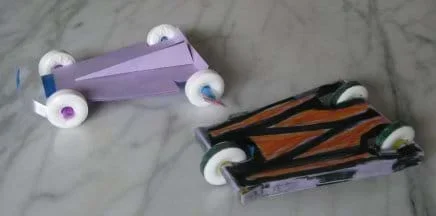 Example mint-mobiles.Copyright 2010 Denise W. Carlson, ITL Program, College of Engineering, University of Colorado Boulder
When developing a new product or device, engineers go through many iterations of the engineering design process. First, they imagine lots of ideas and share them with their teammates. Then, the team decides on one best design and plans its final materials, specifications, functionality and aesthetics. Before building a full-scale prototype, they create a small model on which they perform many tests with different independent variables to optimize performance and cost. Once a model has been perfected, they build at full scale.
After this activity, students should be able to:
- Explain the steps of the engineering design process.
- Identify dependent and independent variables.
- Identify control variables.
- Describe how forces (gravity, friction, and pushes/pulls) affect the motion of their mint mobile.
- Explain how energy changes from potential to kinetic as the mint-mobile moves down the ramp.
- Identify and interpret patterns in data that show how mass affects motion.
- 4.3.1 Visual displays are used to represent data.
Grade 4
Do you agree with this alignment? - 4.4.1 Appropriate measurement tools, units, and systems are used to measure different attributes of objects and time.
Grade 4
Do you agree with this alignment? - 5.3.1.a Represent and interpret data.
Grade 5
Do you agree with this alignment? - 5.4.2.b Represent real world and mathematical problems by graphing points in the first quadrant of the coordinate plane, and interpret coordinate values of points in the context of the situation.
Grade 5
Do you agree with this alignment?
- CCSS.Math.Content.4.MD.B Represent and interpret data.
Grade 4
Do you agree with this alignment? - CCSS.Math.Content.5.G.A.2 Represent real world and mathematical problems by graphing points in the first quadrant of the coordinate plane, and interpret coordinate values of points in the context of the situation.
Grade 5
Do you agree with this alignment?
- Students will develop an understanding of the attributes of design.
Grades K-12
Do you agree with this alignment? - Students will develop an understanding of engineering design.
Grades K-12
Do you agree with this alignment? - Models are used to communicate and test design ideas and processes.
Grades 3-5
Do you agree with this alignment? - Test and evaluate the solutions for the design problem.
Grades 3-5
Do you agree with this alignment? - STEL-7H Illustrate that there are multiple approaches to design.
Grades 3-5
Do you agree with this alignment? - STEL-7I Apply the technology and engineering design process.
Grades 3-5
Do you agree with this alignment?
- 3-5-ETS1-1 Define a simple design problem reflecting a need or a want that includes specified criteria for success and constraints on materials, time, or cost.
Grades 3-5
This resource focuses on the following Three Dimensional Learning aspects of NGSS:
Science & Engineering Practices- Define a simple design problem that can be solved through the development of an object, tool, process, or system and includes several criteria for success and constraints on materials, time, or cost.Do you agree with this alignment?
Disciplinary Core Ideas- Possible solutions to a problem are limited by available materials and resources (constraints). The success of a designed solution is determined by considering the desired features of a solution (criteria). Different proposals for solutions can be compared on the basis of how well each one meets the specified criteria for success or how well each takes the constraints into account.Do you agree with this alignment?
Crosscutting Concepts- People's needs and wants change over time, as do their demands for new and improved technologies.Do you agree with this alignment?
Do you agree with this alignment? - Define a simple design problem that can be solved through the development of an object, tool, process, or system and includes several criteria for success and constraints on materials, time, or cost.
- 3-5-ETS1-2 Generate and compare multiple possible solutions to a problem based on how well each is likely to meet the criteria and constraints of the problem.
Grades 3-5
This resource focuses on the following Three Dimensional Learning aspects of NGSS:
Science & Engineering Practices- Generate and compare multiple solutions to a problem based on how well they meet the criteria and constraints of the design problem.Do you agree with this alignment?
Disciplinary Core Ideas- Research on a problem should be carried out before beginning to design a solution. Testing a solution involves investigating how well it performs under a range of likely conditions.Do you agree with this alignment?
- At whatever stage, communicating with peers about proposed solutions is an important part of the design process, and shared ideas can lead to improved designs.Do you agree with this alignment?
Crosscutting Concepts- Engineers improve existing technologies or develop new ones to increase their benefits, to decrease known risks, and to meet societal demands.Do you agree with this alignment?
Do you agree with this alignment? - Generate and compare multiple solutions to a problem based on how well they meet the criteria and constraints of the design problem.
- 3-5-ETS1-3 Plan and carry out fair tests in which variables are controlled and failure points are considered to identify aspects of a model or prototype that can be improved.
Grades 3-5
This resource focuses on the following Three Dimensional Learning aspects of NGSS:
Science & Engineering Practices- Plan and conduct an investigation collaboratively to produce data to serve as the basis for evidence, using fair tests in which variables are controlled and the number of trials considered.Do you agree with this alignment?
- Analyze and interpret data to make sense of phenomena using logical reasoning.Do you agree with this alignment?
- Develop models to describe phenomena.Do you agree with this alignment?
Disciplinary Core Ideas- Tests are often designed to identify failure points or difficulties, which suggest the elements of the design that need to be improved.Do you agree with this alignment?
- Different solutions need to be tested in order to determine which of them best solves the problem, given the criteria and the constraints.Do you agree with this alignment?
Crosscutting Concepts- A system can be described in terms of its components and their interactions.Do you agree with this alignment?
- Cause and effect relationships are routinely identified.Do you agree with this alignment?
Do you agree with this alignment? - Plan and conduct an investigation collaboratively to produce data to serve as the basis for evidence, using fair tests in which variables are controlled and the number of trials considered.
- 3-PS2-1 Plan and conduct an investigation to provide evidence of the effects of balanced and unbalanced forces on the motion of an object.
Grade 3
This resource focuses on the following Three Dimensional Learning aspects of NGSS:
Science & Engineering Practices- Plan and conduct an investigation collaboratively to produce data to serve as the basis for evidence, using fair tests in which variables are controlled and the number of trials considered.Do you agree with this alignment?
- Science investigations use a variety of methods, tools, and techniques.Do you agree with this alignment?
Disciplinary Core Ideas- Each force acts on one particular object and has both strength and a direction. An object at rest typically has multiple forces acting on it, but they add to give zero net force on the object. Forces that do not sum to zero can cause changes in the object's speed or direction of motion. (Boundary: Qualitative and conceptual, but not quantitative addition of forces are used at this level.)Do you agree with this alignment?
- Objects in contact exert forces on each other.Do you agree with this alignment?
Crosscutting Concepts- Cause and effect relationships are routinely identified.Do you agree with this alignment?
Do you agree with this alignment? - Plan and conduct an investigation collaboratively to produce data to serve as the basis for evidence, using fair tests in which variables are controlled and the number of trials considered.
- 3-PS2-2 Make observations and/or measurements of an object's motion to provide evidence that a pattern can be used to predict future motion.
Grade 3
This resource focuses on the following Three Dimensional Learning aspects of NGSS:
Science & Engineering Practices- Make observations and/or measurements to produce data to serve as the basis for evidence for an explanation of a phenomenon or test a design solution.Do you agree with this alignment?
- Science findings are based on recognizing patterns.Do you agree with this alignment?
Disciplinary Core Ideas- The patterns of an object's motion in various situations can be observed and measured; when that past motion exhibits a regular pattern, future motion can be predicted from it. (Boundary: Technical terms, such as magnitude, velocity, momentum, and vector quantity, are not introduced at this level, but the concept that some quantities need both size and direction to be described is developed.)Do you agree with this alignment?
Crosscutting Concepts- Patterns of change can be used to make predictions.Do you agree with this alignment?
Do you agree with this alignment? - Make observations and/or measurements to produce data to serve as the basis for evidence for an explanation of a phenomenon or test a design solution.
- 4-PS3-1 Use evidence to construct an explanation relating the speed of an object to the energy of that object.
Grade 4
This resource focuses on the following Three Dimensional Learning aspects of NGSS:
Science & Engineering Practices- Use evidence (e.g., measurements, observations, patterns) to construct an explanation.Do you agree with this alignment?
Disciplinary Core Ideas- The faster a given object is moving, the more energy it possesses.Do you agree with this alignment?
Crosscutting Concepts- Energy can be transferred in various ways and between objects.Do you agree with this alignment?
Do you agree with this alignment? - Use evidence (e.g., measurements, observations, patterns) to construct an explanation.
- 4-PS3-4 Apply scientific ideas to design, test, and refine a device that converts energy from one form to another.
Grade 4
This resource focuses on the following Three Dimensional Learning aspects of NGSS:
Science & Engineering Practices- Apply scientific ideas to solve design problems.Do you agree with this alignment?
Disciplinary Core Ideas- Possible solutions to a problem are limited by available materials and resources (constraints). The success of a designed solution is determined by considering the desired features of a solution (criteria). Different proposals for solutions can be compared on the basis of how well each one meets the specified criteria for success or how well each takes the constraints into account.Do you agree with this alignment?
- Energy can also be transferred from place to place by electric currents, which can then be used locally to produce motion, sound, heat, or light. The currents may have been produced to begin with by transforming the energy of motion into electrical energy.Do you agree with this alignment?
- The expression "produce energy" typically refers to the conversion of stored energy into a desired form for practical use.Do you agree with this alignment?
Crosscutting Concepts- Science affects everyday life.Do you agree with this alignment?
- Energy can be transferred in various ways and between objects.Do you agree with this alignment?
- Engineers improve existing technologies or develop new ones.Do you agree with this alignment?
- Most scientists and engineers work in teams.Do you agree with this alignment?
Do you agree with this alignment? - Apply scientific ideas to solve design problems.
- 5-PS2-1 Support an argument that the gravitational force exerted by Earth on objects is directed down.
Grade 5
This resource focuses on the following Three Dimensional Learning aspects of NGSS:
Science & Engineering Practices- Support an argument with evidence, data, or a model.Do you agree with this alignment?
Disciplinary Core Ideas- The gravitational force of Earth acting on an object near Earth's surface pulls that object toward the planet's center.Do you agree with this alignment?
Crosscutting Concepts- Cause and effect relationships are routinely identified and used to explain change.Do you agree with this alignment?
Do you agree with this alignment? - Support an argument with evidence, data, or a model.
 Copyright 2010 Denise W. Carlson, ITL Program, College of Engineering, University of Colorado Boulder
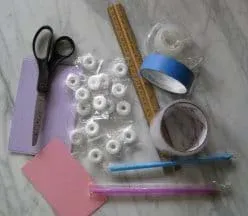
Each group needs:
- Note: for mint-mobile construction supplies, the exact amounts required depend on the team's vehicle design; rough estimates are provided
- plastic drinking straws (estimated 4-6; make sure the straw diameter is smaller than the mint candy's hole diameter)
- Popsicle sticks (estimated 2-4)
- lifesaver-shaped candies, such as Lifesaver® mints (estimated 3-6)
- index cards (estimated 1-2; or thin cardboard or poster board scraps)
- tape, any type; duct or masking preferred
- scissors
- paper and pencil
For the entire class to share:
- ramp, for testing, made from sturdy poster board, rigid cardboard or thin wood
- meter stick, for measuring the distance traveled
- pennies, for added mass during testing (estimated 10-30 pennies; depending on robustness of mint-mobiles, individually tape pennies on vehicles, or tape a little baggie or film canister of pennies
- tape, for securing the ramp, meter stick and pennies
- (optional) hot glue gun and glue sticks (requires adult supervision)
Ability to make measurements using a meter stick.
(Write Figure 1 on the board as each step is discussed. Start by drawing an arrow in the shape of a circle.)
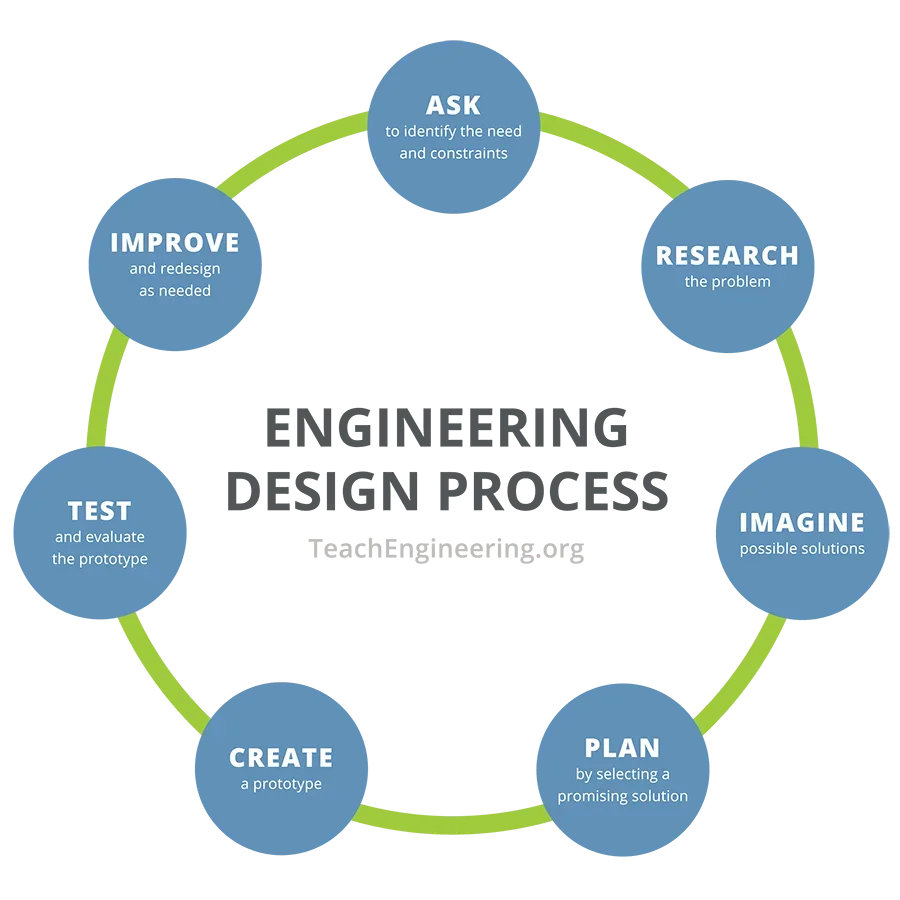 Figure 1. The basic steps of the engineering design process.Copyright TeachEngineering.org
What do you think engineers do first when they begin to create a new product, say a new type of race car, a new style of backpack, or a new type of skis? That's right, the first thing engineers do is ask; that is, they ask what the product will do, what need they are addressing and what others have done. This also requires conducting research of the problem. Then, an engineer imagines all the possible features and qualities of the product. This takes a lot of creative brainstorming! After an engineer has made a list and some sketches of her/his ideas, all of the engineers in a team get together and share what they have come up with. As a team, they plan on one design by working with the best ideas. Once the details of the design have been decided, the team creates the product; then they get to test it out!
Tests are made on models of the product or device, which are often at a smaller than full-scale size. In the testing phase, the team pays attention to what needs to be changed to the model to make the product work better. The last step of the engineering design process is to improve the design.
While the engineering team tests the product, they pay close attention to all the variables associated with their design. Two important types of variables are: independent and dependent variables. An independent variable is something that an engineer decides to change during each test to see how the results differ. A dependent variable is something that changes as a result of varying the independent variable. In testing, we also have what is called a control. A control is the part of the experiment that is neither changed by the engineer nor is affected by the independent variable. To help explain these new terms let's apply them to an example.
Say I am an engineer testing a roller coaster. I want the cart to go as fast as possible on a track that I have already built. I can change some things to make the cart go as fast as possible—such as its mass, its length, or the type of wheels I use. Can anyone tell me what the independent and dependent variables are in this example? (The independent variables are the mass, length, and types of wheels that the engineer chooses. The dependent variable is the speed of the cart.) Control variables are independent variables that are held constant in an experiment. If you were testing variables that that influence a dependent variable, like speed, you would not test all the variables at the same time because then you would not know which variable(s) influenced the results. So, for example, if you were testing the influence of mass, you would hold the other variables (like length and type of wheels) constant, and test varying masses. So, length and type of wheels would be the control variables. On the contrary, if you were testing length, then you would hold mass constant and it would be a control variable. Thus, control variables are the variables you do not change in an experiment.
Today, working as engineers, we are going to follow the engineering design process and design and build mint-mobiles! As we test our cars, we’ll also be scientists, exploring how forces and motion affect how far and how fast our cars travel. When the car is at the top of the ramp, it has potential energy, which changes into kinetic energy as it moves. By adding more mass (such as pennies to represent a driver and passenger), we’ll investigate how that extra weight changes the distance our cars can go. Think in your heads for a moment: what are the independent and dependent variables in this activity and what is the control? (Allow three minutes for a group discussion.) Now- are you ready to brainstorm? Great! Let's get started!
Background
As this activity is written, student teams design their cars on paper first, working from a list of possible materials and then make a list of their needed supplies (including exactly how many wheels, straws, etc.) to request from the teacher. Activity variations are many. For example, limit the number of each type of material, require that each team use the exact same number and type of construction materials, or define a competitive objective to determine the best materials based on vehicle stability or speed with a certain mass.
In addition to exploring design choices, students also investigate important science concepts about forces, motion, and energy. When the mint-mobiles are placed at the top of the ramp, they have gravitational potential energy. As they roll down, that energy changes into kinetic energy, or the energy of motion. The distance each vehicle travels is affected by the balance of forces acting on it: gravity pulls the car down the ramp, while friction between the wheels and the ramp or floor slows it down. Changing the mass of the mint-mobile (by adding pennies) also changes the way forces and motion interact, allowing students to look for patterns in their data and connect cause and effect.
Engineers use the engineering design process when they are creating new devices. The main seven steps of the engineering design process are: ask, imagine, research, plan, create, test, and improve. The improving step involves starting over again at the beginning of the design process with "ask," that is, "Where does this device need improvement? How can it be made to perform better?" Once a device has been built the first time, it is never complete! Engineers are always improving what they design. Imagine if the cellular phone had never been improved. Or cars, or computers.
Before the Activity
- Gather materials and list them on the board: plastic drinking straws, Popsicle sticks, lifesaver-shaped mint candies, index cards (or your own modified list of what's available).
- Set up a testing ramp by placing sturdy poster board or a thin wooden board at an angle over a smooth surface (such as a tabletop). Use tape to secure the ramp. Tape a meter stick from the bottom of the ramp along the table, so students can measure the distances traveled.
- Divide the class into teams of two students each.
With the Students
1. To begin planning their mint-mobile designs, give the class three minutes for students to individually brainstorm what their designs might look like. Point out the list of available materials listed on the board. Briefly remind them that forces (a push or a pull) are what make objects move, and that their cars will need to roll smoothly so that gravity can act as the “engine” pulling them down the ramp.
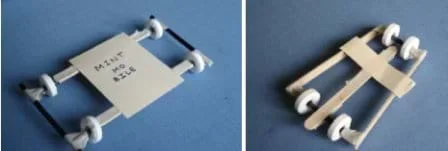 Example student-created mint-mobiles of different structural designs.Copyright 2009 Lesley Herrmann, ITL Program, College of Engineering, University of Colorado Boulder
2. Next, working with their partners, direct students to share their ideas and discuss how well each is likely to meet the criteria and constraints of the problem. Then, make drawings of their final, agreed-upon designs. Require the drawings to list the materials and amounts needed to build their mint-mobiles. Remind them that their designs must be able to carry the added mass of a driver and passenger (represented by pennies) during testing. Encourage them to think about how weight (mass) might change the amount of energy their cars have when released from the top of the ramp.
3. Once teams have finished their designs, distribute materials and give them time to build. As students work, ask guiding questions: How will your wheels reduce friction? Where will your car store energy before being released?
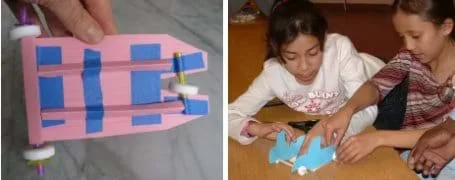 More example student-designed mint-mobiles. How can they be improved?Copyright 2010 Denise W. Carlson (left) 2005 Sara Born (right), ITL Program, College of Engineering, University of Colorado at Boulder
4. Test the mint-mobiles by sending them down the ramp. Have students record their measurements of distance traveled. Emphasize that when the car is at the top of the ramp, it has potential energy that changes into kinetic energy as it moves. Ask: How does the ramp’s angle affect the speed or distance? How does friction slow the car down? Allow time for modifications to improve designs.
5. Now, have the students add pennies to their mint-mobiles, representing the mass of a driver and a passenger. Secure the pennies with tape. Have each group test their design with two different amounts of pennies (same for all groups). Explain that this is a way of testing how added mass affects motion.
6. Take a moment as a class to have students identify (and list) the independent, dependent and control variables in the activity. (The independent variable is the added mass of the cart, the dependent variable is the distance the cart travels, and the controls are the length and angle of the ramp.) Reinforce that these variables help scientists and engineers figure out cause and effect in experiments.
7. Before they test their cars with the additional pennies, ask each group to predict which trial will travel the furthest and why they believe this. Encourage them to use science ideas in their justification- for example: “I think the car with more mass will travel farther because gravity is pulling on it with more force.”
8. Retest the mint-mobiles and record the new distances traveled with the two amounts of pennies. Remind students to observe how speed and distance might change with added mass.
9. On the board, have each group record their initial distance, distance with first amount of pennies and distance with a larger amount of pennies. Use this chart as data evidence, just like scientists do.
10. As a class, review the collection of results on the board. Conclude with a class discussion (using questions provided in the Assessment section) about the experiment variables, how increased mass impacted the distance traveled by the cars, and the design process. During this discussion, highlight key science concepts: forces cause motion, gravity provides the force down the ramp, friction resists motion, and energy changes from potential to kinetic. Address any misconceptions the students identified during their predictions.
- brainstorming
- A technique of solving specific problems, stimulating creative thinking and developing new ideas by unrestrained and spontaneous discussion.
- control variable
- A variable that is neither changed by the engineer/tester nor affected by the independent variable.
- dependent variable
- A variable that changes as a result of changing the independent variable.
- engineering design process
- The cycle engineers go through while creating a new device: Ask; Research; Imagine; Plan; Create; Test; Improve.
- independent variable
- A variable that is intentionally changed by the engineer or tester.
- variable
- Something that changes while testing an idea, device or system.
- force
- A push or pull on an object.
- gravity
- The force that pulls objects toward the center of the Earth.
- friction
- A force that opposes motion when two surfaces rub together.
- mass
- How much matter is in an object; how heavy it is.
- kinetic energy
- The energy of motion; energy an object has because it is moving.
- potential energy
- Energy stored due to an object’s height above the ground.
Pre-Activity Assessment
Identifying Variables: Have students categorize variables from different examples as independent, dependent, or control variables. For example (as explained in the Intro/Motivation section), use the roller coaster design scenario: mass, length, and type of wheels are independent variables; speed is the dependent variable; and other features held constant are controls. Then, have students talk in groups to identify the different variables involved in the mint-mobile activity.
Forces & Motion Warm-Up: Ask students to explain why objects always roll down ramps (gravity), and brainstorm what might cause some objects to roll farther than others (mass, shape, friction).
Activity Embedded Assessment
Brainstorming Design Work: Have students follow the engineering design process by brainstorming different designs on paper; then have them share these ideas with their teammate(s). Have them draw their final group design, listing the exact materials they plan to use.
Theory to Practice: At the point of testing, have students identify (and list) the independent variables they will be testing, as well as the dependent, and control variables. (Note: The independent variable is the added mass of the cart, the dependent variable is the distance the cart travels, and the controls are the length and angle of the ramp.)
Prediction: Before testing with the additional pennies, ask each group to predict which trial will travel the farthest and explain why using science ideas (forces, motion, energy). For example, some may argue that more mass could increase momentum, while others may think it could create more friction.
Graphing: Have students plot the distances the cars go for the three different masses; one without pennies, and the two with different numbers of pennies. Allow them to interpret results graphically and discuss the relationship between mass, motion, and distance traveled.
Post-Activity Assessment
Class Discussion: Ask students the following questions and discuss as a class.
- What were the independent, dependent and control variables in this test? (Answer: The independent variable was the added mass, the dependent variable was the distance the cart travels, and the controls were the length and angle/tilt of the ramp.)
- Looking at everyone's results, how did mass affect the distance traveled by the mint-mobile? Did it travel a shorter or greater distance? (Answer: Adding mass caused the cars to travel greater distances; the greater the mass, the further the cars travel.)
- How could you get your mint-mobile to travel a longer distance while carrying the same number of pennies? (Possible answers: Improve design to reduce friction/drag, adjust wheel alignment, or modify ramp height to add more potential energy.)
- What other independent variables could you change to test the model car's distance? ((Possible answers: Ramp angle, ramp length, wheel type, or surface texture.)
- What sorts of things did you do at each step of the design process? (Have students share their own experiences, in their own words, that describe the repeating seven-step-loop of the engineering design process: ask, research, imagine, plan, create, test, improve.)
Making Sense: Have students reflect about the science phenomena they explored and/or the science and engineering skills they used by completing the Making Sense Assessment (PDF).
If students use the straws as axles and find that the straws are bigger than the candy hole diameter, they can use scissors to slit the straws lengthwise, then curl and tape them tighter (so they are narrower) to make straws that spin better in the candy holes.
The mint-mobiles roll best on smooth surfaces rather than the textured surfaces of carpets, so build the testing ramp on a tabletop and place a thin poster board at the bottom of the ramp.
If students' mint-mobiles are quite small, they may not be able to hold many pennies. If so, tape on a few pennies at a time to determine a reasonable maximum amount.
Team Test Your Instructions: In addition to each team designing a mint-mobile with a sketch and list of materials, have them write instructions on how to build the mint-mobile and exchange designs with another group. Tell the students to build the other team's mint-mobile following the instructions using only the supplies listed. This exercise sharpens students' awareness of the importance of accuracy and clear communication in their engineering plans. Or similarly, conduct The Universal Language of Engineering Drawings activity, in which students practice the ability to produce clear, complete, accurate and detailed design drawings for a mint-mobile-type model car, using only specified materials. Teams trade drawings and attempt to construct the model cars in order to determine how successfully the original design intentions were communicated through sketches, dimensions and instructions.
- For lower grades, conduct the activity as a class demonstration, asking students to predict whether the mint-mobile will travel a shorter or greater distance with the added mass. Emphasize the role of gravity pulling the car down the ramp and how the added weight might change the car’s motion. Students can share their reasoning in simple terms (e.g., “heavier cars roll faster” or “too heavy makes it stop sooner”) and then compare predictions to the actual results.
- For middle school, have students decide on their own which independent variables they want to test. Have them list the independent variable, the dependent variable, and all of the controls in the test they perform. Ideas for other independent variables: the angle of the ramp, the length of the ramp, the number of wheels, the width and height of the mint-mobile. Students should connect their tests to science concepts such as potential and kinetic energy, Newton’s laws of motion, and the effect of friction. See Exploring Variables While Testing & Improving Mint-Mobiles (for Middle School).
- For high school, have students focus on following the engineering design process to build and test their mint-mobiles while balancing tradeoffs between safety, design materials, and cost. Then, students test how changing the mass of their mint-mobile mass affects distance traveled. Students should analyze their data in terms of Newton’s second law (F = ma), conservation of energy, and momentum to deepen their understanding of the underlying physics. See Exploring Variables While Testing & Improving Mint-Mobiles (for High School).
- Measure Twice, Cut Once
- Give an Inch, Take a Foot
- Exploring Variables While Testing & Improving Mint-Mobiles (for Elementary School)
Contributors
Lesley Herrmann; Stephanie Rivale; Denise W. Carlson
Supporting Program
Integrated Teaching and Learning Program, College of Engineering, University of Colorado Boulder
Acknowledgements
The contents of this digital library curriculum were developed under grants from the Fund for the Improvement of Postsecondary Education (FIPSE), U.S. Department of Education, and National Science Foundation (GK-12 grant no 0338326). However, these contents do not necessarily represent the policies of the Department of Education or National Science Foundation, and you should not assume endorsement by the federal government.
Copyright
2010 by Regents of the University of Colorado