
Obi-Wan Adobe: Engineering for Strength
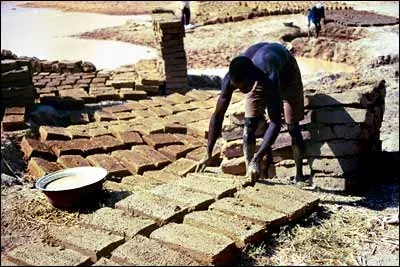 Making adobe bricks in Africa.Copyright 1999 US Peace Corps http://www.peacecorps.gov/wws/educators/enrichment/africa/countries/niger/NE0219.jpg
Students conduct an experiment to determine how varying the composition of a construction material affects its strength. They make several adobe bricks with differing percentages of sand, soil, fibrous material and water. They test the bricks for strength by dropping them onto a concrete surface from progressively greater heights. Students graph the experiment results and use what they learn to design their own special mix that maximizes the bricks' strength. During the course of the experiment, students learn about variables (independent, dependent, control) and the steps of the engineering design process.
Many construction materials can be classified as mixtures. The concentration of the various components in these mixtures determines how well the materials perform. For instance, the percent composition of water, cement, sand, aggregate, and various admixtures in concrete determines the strength of the concrete as well as other important qualities. Adobe bricks are another construction material that can be classified as a mixture. They are also one of the most widely used construction materials in the world today, particularly in developing countries. Determining the best proportion of the various components in these mixtures to minimize cost and maximize strength under specific conditions is the work of civil and materials engineers.
After this activity, students should be able to:
- Describe the steps in the engineering design process.
- Explain how engineers use experiments to develop strong construction materials.
- Explain the difference between a mixture and a solution.
- Explain the difference between an independent and dependent variable.
- Graph the result of a simple experiment.
- 5.4.2.a Graph points on the coordinate plane to solve real-world and mathematical problems.
Grade 5
Do you agree with this alignment? - 6.2.2.g Represent and analyze quantitative relationships between dependent and independent variables.
Grade 6
Do you agree with this alignment? - 6.2.2.g.iii Analyze the relationship between the dependent and independent variables using graphs and tables, and relate these to the equation.
Grade 6
Do you agree with this alignment?
- Develop, communicate, and justify a procedure to separate simple mixtures based on physical properties
Grade 5
Do you agree with this alignment? - Develop and communicate a scientific explanation addressing a question of local relevance about resources generated by the sun or Earth
Grade 5
Do you agree with this alignment?
- CCSS.Math.Content.5.G.A.2 Represent real world and mathematical problems by graphing points in the first quadrant of the coordinate plane, and interpret coordinate values of points in the context of the situation.
Grade 5
Do you agree with this alignment? - CCSS.Math.Content.6.EE.C Represent and analyze quantitative relationships between dependent and independent variables.
Grade 6
Do you agree with this alignment? - CCSS.Math.Content.6.EE.C.9 Use variables to represent two quantities in a real-world problem that change in relationship to one another; write an equation to express one quantity, thought of as the dependent variable, in terms of the other quantity, thought of as the independent variable. Analyze the relationship between the dependent and independent variables using graphs and tables, and relate these to the equation.
Grade 6
Do you agree with this alignment?
- Students will develop an understanding of the attributes of design.
Grades K-12
Do you agree with this alignment? - Students will develop an understanding of the role of troubleshooting, research and development, invention and innovation, and experimentation in problem solving.
Grades K-12
Do you agree with this alignment? - Identify and collect information about everyday problems that can be solved by technology, and generate ideas and requirements for solving a problem.
Grades 3-5
Do you agree with this alignment? - STEL-7I Apply the technology and engineering design process.
Grades 3-5
Do you agree with this alignment?
- 3-5-ETS1-3 Plan and carry out fair tests in which variables are controlled and failure points are considered to identify aspects of a model or prototype that can be improved.
Grades 3-5
This resource focuses on the following Three Dimensional Learning aspects of NGSS:
Science & Engineering Practices- Plan and conduct an investigation collaboratively to produce data to serve as the basis for evidence, using fair tests in which variables are controlled and the number of trials considered.Do you agree with this alignment?
Disciplinary Core Ideas- Tests are often designed to identify failure points or difficulties, which suggest the elements of the design that need to be improved.Do you agree with this alignment?
- Different solutions need to be tested in order to determine which of them best solves the problem, given the criteria and the constraints.Do you agree with this alignment?
Do you agree with this alignment? - Plan and conduct an investigation collaboratively to produce data to serve as the basis for evidence, using fair tests in which variables are controlled and the number of trials considered.
- MS-ETS1-3 Analyze data from tests to determine similarities and differences among several design solutions to identify the best characteristics of each that can be combined into a new solution to better meet the criteria for success.
Grades 6-8
This resource focuses on the following Three Dimensional Learning aspects of NGSS:
Science & Engineering Practices- Analyze and interpret data to determine similarities and differences in findings.Do you agree with this alignment?
Disciplinary Core Ideas- There are systematic processes for evaluating solutions with respect to how well they meet the criteria and constraints of a problem.Do you agree with this alignment?
- Sometimes parts of different solutions can be combined to create a solution that is better than any of its predecessors.Do you agree with this alignment?
- Although one design may not perform the best across all tests, identifying the characteristics of the design that performed the best in each test can provide useful information for the redesign process—that is, some of the characteristics may be incorporated into the new design.Do you agree with this alignment?
Do you agree with this alignment? - Analyze and interpret data to determine similarities and differences in findings.
- MS-ETS1-4 Develop a model to generate data for iterative testing and modification of a proposed object, tool, or process such that an optimal design can be achieved.
Grades 6-8
This resource focuses on the following Three Dimensional Learning aspects of NGSS:
Science & Engineering Practices- Develop a model to generate data to test ideas about designed systems, including those representing inputs and outputs.Do you agree with this alignment?
Disciplinary Core Ideas- Models of all kinds are important for testing solutions.Do you agree with this alignment?
- The iterative process of testing the most promising solutions and modifying what is proposed on the basis of the test results leads to greater refinement and ultimately to an optimal solution.Do you agree with this alignment?
Do you agree with this alignment? - Develop a model to generate data to test ideas about designed systems, including those representing inputs and outputs.
Each group needs:
- 1 adobe mold and extruder (see below)
- 10 paper Dixie cups (5 oz or ~150 ml) of clayey soil (potting soil will not work)
- 10 paper Dixie cups (5 oz or ~150 ml) of playground sand
- 1/2 gallon (2.2 l) container of fibrous material, loosely packed (dead grass, straw, pine needles, etc.)
- 3 one-gallon (4.4 l) plastic bags, to separately hold the soil, sand, and fibrous material
- 1 large (24 oz or ~700 ml) container (bowl, re-usable plastic, or gallon jug with the top cut off)
- 1 piece of cardboard, 16-in x 16-in (~ 40 cm x 40 cm)
- 1 container of water, ~16 oz (500 ml)
- 1 paper Dixie cup (5 oz or ~150 ml) for measuring
- 1 permanent marker
- Design Worksheet (PDF), one per student
- (optional) Pre/Post Quiz (PDF), two per student
For teacher to make adobe molds and extruders (one set per group):
- wooden board, 16-in x 1-in x 2-in (41 cm x 2.5 cm x 5 cm), to make an adobe mold (cut into 4 boards that are 4-in [10 cm] long)
- foam core board, 4-in x 6-in (10 cm x 16 cm), for the extruder
- foam core board scrap, to make a handle for the extruder
- eight 2-in nails per mold
- hammer
- hand saw
- hot glue gun and glue sticks
For the entire class to share:
- meter or yard stick
- projector to show two Microsoft PowerPoint presentations to the class
- (optional) disposable gloves
- (optional) newspaper or butcher paper to cover work surfaces
- (optional) box or desk fan, to aid in brick drying
- (optional) small step ladder, for standing on when drop testing bricks
- Pre/Post Quiz (doc)
- Pre/Post Quiz (pdf)
- Pre/Post Quiz Answers (doc)
- Pre/Post Quiz Answers (pdf)
- Design Worksheet (doc)
- Design Worksheet (pdf)
- Design Worksheet Example Answers (doc)
- Design Worksheet Example Answers (pdf)
- Day 1 Engineering for Strength! Presentation – Mixtures and Solutions (ppt)
- Day 1 Engineering for Strength! Presentation – Mixtures and Solutions (pdf)
- Day 2 Engineering for Strength! Presentation – Variables (pptx)
- Day 2 Engineering for Strength! Presentation – Variables (pdf)
(To conduct the pre/post quiz assessment, administer the attached nine-question Pre/Post Quiz (PDF)to the students before beginning this section. See the Assessment section for details.)
Can you list a few of the different materials used in the construction of buildings? (Take ideas from students. Possible answers: wood, bricks, concrete, steel.) Did any of you know that mud is also a building material? It may sound strange, but mud mixed with straw was one of the earliest building materials ever used and it is still in use today because it works! This special mixture is called adobe. Many people, especially those who live in developing countries, use adobe to build houses and other buildings. Some of the oldest buildings in the world are made with adobe. If adobe is carefully mixed in the right proportions, it can last hundreds and thousands of years in very dry climates.
Many construction materials are classified as mixtures. A mixture describes a combination of two or more materials in which you can still see each of the different ingredients. It is different from a pure substance or a solution because the individual parts are still visible and can be separated from one another relatively easily. The amount of each of the different ingredients compared to the total mixture is called the concentration. When the concentration of an ingredient in a mixture is changed, it can have a huge impact on how the mixture behaves. For instance, in both concrete and adobe, the concentration of water in the mixture can drastically change how strong the mixture is when it dries.
Today, we will be doing some experiments to figure out the best concentration of each ingredient in order to maximize the strength of an adobe brick.
Because the concentration of each of the ingredients in a construction material has such a large impact on how the material behaves, civil and material engineers perform experiments to figure out what concentration of each ingredient creates the best results. Once the right mixture is determined, engineers make sure that every time that material is used its ingredient concentrations are close to the ones determined during the experiment. On most construction projects, a technician runs tests on all the concrete used to make sure that the engineer-specified mixture was actually used on the project.
Today, we are going to help a village in Peru make the best adobe bricks possible by doing experiments just like civil engineers. To do this, we must first choose a variable. A variable is something that you allow to change in an experiment. The opposite of a variable is a control. A control is something that you are very careful to keep exactly the same during the experiment. In this experiment, we select a variable that relates to the concentration of ingredients in each brick. For instance, we may change the amount of water that we put in several different bricks to see how it changes the strength of each brick. In this case, the amount of water is the independent variable because we intentionally changed it. The strength of the brick is called the dependent variable because it changes as a result of the changes we made to the dependent variable (the amount of water). Once we've chosen our variables, we must be very careful to control everything else so that we get really good results. Let's get started!
Before the Activity
- Use the hammer, nails, wood and hand saw to make one small adobe mold for each group. A finished mold should have an opening that is approximately 3½-in x 1½-in x 1½-in (8.9 cm x 3.8 cm x 3.8 cm), with no top or bottom, as shown in Figure 1.
- Use foam core board to make a "brick extruder" for each group. The extruder is used to push each individual brick out of its mold. Make sure it fits almost perfectly inside the mold opening and has a small handle.
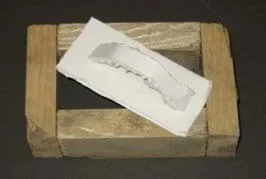 Figure 1. An adobe brick mold and an extruder, which is similar to a trowel.Copyright 2010 Jake Crosby, ITL Program, College of Engineering, University of Colorado at Boulder
 - Measure each group's supply of soil, sand and fibrous material and place each into the three plastic bags for each team.
- Make copies of the Design Worksheet (PDF), one per student. Do not staple the pages so they can be handed out at different times.
- On Day 1 and Day 2, set up a projector to show a PowerPoint presentation to the class.
With the Students: Day 1
- (optional) Administer the Pre/Post Quiz. See the Assessment section for details.
- After the Introduction/Motivation section, introduce the activity using the Day 1 Presentation (PDF).
- Divide the class into groups of three students each.
- Hand out to each student a copy of worksheet page 1.
- Assign each group a different variable to test (water content, straw content, sand content). Have the students circle on their worksheet the variable they are testing.
- Make an example brick in front of the class to show students how adobes are made. (Steps: Carefully mix the ingredients in a bowl with your hands, wet the mold, place the mixed ingredients inside the mold, gently pack the ingredients into the mold, scrape the top flat, use the extruder to push the completed brick onto a piece of cardboard.)
- Distribute the materials and molds to each group, along with a piece of cardboard.
- Have students begin mixing and forming their own bricks. When a brick is complete, have them label it on the piece of cardboard with the marker (A, B or C).
- When all three bricks are complete, have each group write their names at the top of the pieces of cardboard with the marker and store the bricks in a sunny place to dry. The bricks need at least 3–4 days to dry completely. Drying them in front of a blowing fan takes about two days.
With the Students: Day 2
- Hand out to each student a copy of worksheet pages 2-5.
- Have students carry their labeled bricks to a designated test area, such as a level concrete surface outside.
- Test the bricks by dropping them from progressively higher heights until they show substantial failure. You may need a small step ladder to get high enough so they break when dropped. Do this either as a class activity in which each group tests their own bricks, or as an observation time in which the entire class watches you test each brick. Make sure students record their test information on their worksheets.
- If the testing is done as an observation time, have each student record the data of at least three other groups (two of which tested separate independent variables) on their worksheets. If each group tests their own bricks, have students gather information from several other groups after testing is complete.
- Return to the classroom and show the Day 2 Presentation (PDF).
- Have each student graph test results for each of the three variables on pages 3-4 of the worksheet.
- Spend a few minutes leading a class discussion to analyze experimental results so far (as described in the Assessment section). Why might team results be different from each other? What other variables might be affecting brick strength? How can make our manufacturing process more uniform to reduce some of these differences among teams?
- Challenge each group to develop an ideal adobe brick design based on analysis of the test results and graphs.
- Give teams time to each make one brick following their own "recipe," using a procedure similar to Day 1. Make sure each group labels its brick. Have them fill in the "model brick recipe" information on worksheet page 5. Store the bricks in a sunny place to dry.
With the Students: Day 3
- Make sure students still have worksheet page 5 (which was handed out on Day 2).
- Test each group's brick in a manner similar to that on Day 2.
- Have each student keep track on their worksheets of the "recipes" and drop heights for all groups.
- Lead a class discussion to explore what was discovered during these testing experiments. (See a list of suggested post-activity questions and topics in the Assessment section.)
- (optional) Administer the Pre/Post Quiz. See the Assessment section for details.
- adobe
- A sun-dried brick composed clay mud and straw. A common building material used in countries having little rainfall.
- admixtures
- Ingredients other than water, aggregates, cement and fibers that are added to a concrete batch immediately before or during mixing to provide beneficial effects to concrete. Source: US Dept. of Transportation, http://www.fhwa.dot.gov/infrastructure/materialsgrp/admixture.html
- concentration
- The percent amount of one ingredient compared to the total mixture or solution.
- control variable
- A variable that is neither changed by the engineer/tester nor affected by the independent variable.
- dependent variable
- A variable that changes as a result of changing the independent variable.
- engineering design process
- The cycle engineers go through while creating a new device: ask; imagine; plan; build; test; improve.
- independent variable
- A variable that is intentionally changed by the engineer or tester.
- material
- A substance or substances of which a thing is made or composed.
- mixture
- A combination of two or more materials in which you can still see each of the different ingredients.
- solution
- A combination of two or more different substances in which you can no longer see the different ingredients.
- variable
- Something that you allow to change in an experiment, or while testing an idea, device or system.
Pre-Activity Assessment
Pre/Post Activity Quiz: To conduct an overall pre/post assessment of the activity to gauge student learning, administer the nine-question Obi-Wan Adobe Quiz (PDF) to the students before beginning any discussion on variables, mixtures and solutions, or adobe bricks. After activity completion, administer the same quiz to the same students and compare pre- to post- scores.
Class Voting: Show the class the images in the Day 1 Presentation. (PPT)Have them vote on whether the substances shown are mixtures or solutions. Call on students to justify their choices.
Activity Embedded Assessment
Worksheet: Have students follow along with the activity using the Design Worksheet (PDF). Make sure they fill in the appropriate tables and graphs during the course of each day. Check their answers between days to gauge their understanding.
Experiment Analysis: After the first round of bricks have been tested, discuss as a class why different groups who made the same bricks may have come up with different results. Make a connection to the topic of variables and ask students to list all of the additional variables they can think of that may have affected the strength of the bricks. (Possible answers: How hard the material was packed in the mold, the size of fibrous material, the position when drying, bricks not fully dry, the amount of mixing, moisture content of sand, etc.). During Day 2, have students create and incorporate uniform instructions for their brick-making that eliminate as many of these variables as possible; for example, 1) Thoroughly mix all dry ingredients, 2) Add water, 3) Mix for 30 seconds, etc.
Post-Activity Assessment
Class Discussion: As a class, discuss the results of all of the experiments and graphs (refer to the attached Design Worksheet Example Answers (PDF)). Ask the students:
- Looking at all the graphs, what combination of ingredients would maximize the strength of the adobe bricks? Let's decide as a class.
- What is a variable? What is a control?
- What is the difference between an independent and dependent variable?
- In our experiments, which were these variables?
- Why do we test one variable in an experiment?
- Why is it important to test and conduct experiments in engineering?
Pre/Post Activity Quiz: After activity completion, administer the Obi-Wan Adobe Quiz (PDF)to compare students' pre- to post- knowledge of the subject matter.
Since this activity can be messy, covering the desks with butcher paper or newspaper makes clean up much easier.
Be sure to provide a visual demonstration of brick-making since oral instructions alone can be confusing.
Writing: Challenge students to write a short paragraph based on the following scenario: You are a civil engineer who is designing a building constructed of concrete. The concrete must be as strong as possible. How would you figure out what amount of each ingredient (sand, cement, gravel, and water) to use in the concrete in order to maximize its strength?
- For lower grades, only test one variable rather than three. Varying the soil/sand ratio has the most noticeable effect on strength.
- For lower grades, eliminate some of the more complicated math activities, such as graphing, or walk through the graphing as a class, calling on individual students to plot points on a large graph created on the board.
- For upper grades, have the groups choose their own variables to test. Eliminate the values given for bricks A and C, and challenge the groups to develop their own "recipes" to test their chosen variable, using brick B as a standard brick.
Dictionary.com. Lexico Publishing Group, LLC. Accessed April 28, 2010. (Source of some vocabulary definitions, with some modifications) http://www.dictionary.com
Contributors
Jacob Crosby; Malinda Schaefer Zarske; Stephanie Rivale
Supporting Program
Integrated Teaching and Learning Program, College of Engineering, University of Colorado Boulder
Acknowledgements
The contents of these digital library curricula were developed by the Integrated Teaching and Learning Program under National Science Foundation GK-12 grant no. 0338326. However, these contents do not necessarily represent the policies of the National Science Foundation, and you should not assume endorsement by the federal government.
Copyright
2009 by Regents of the University of Colorado.