
Biomimicry Project: Do Ptarmigans Have Snowshoes?
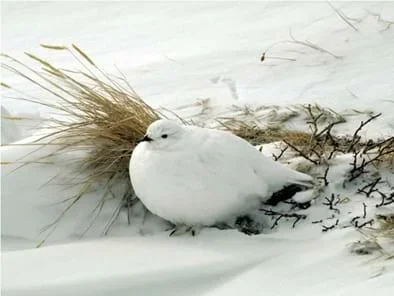 A ptarmigan during winter in the tundraCopyright Rocky Mountain National Park http://www.nps.gov/romo/ptarmigan_camouflage.htm
Students learn about the amazing adaptations of the ptarmigan to the alpine tundra. They focus on one adaptation, the feathered feet of the ptarmigan, and ask whether the feathers serve to only keep the feet warm or to also provide the bird with floatation capability. They create model ptarmigan feet, with and without feathers, and test the hypothesis on the function of the feathers. Ultimately, students make a claim about whether the feathers provide floatation and support this claim with their testing evidence.
Engineers often design using inspiration from the incredible adaptations of plants and animals in their natural environments—an approach called biomimicry. When engineers and researchers observe an interesting adaptation, such as feathered feet on a ptarmigan, they make a hypothesis about the function of the adaptation. Then, they design experiments to test the hypothesis and support their conclusion with evidence. In this activity, students practice this method through making a hypothesis about the function of an adaptation and then generating a claim based on their experimental evidence.
After this activity, students should be able to:
- Develop and test a hypothesis.
- Define the term adaptation, describe how the ptarmigan is adapted to its harsh and challenging environment, and provide examples.
- Define the term floatation, and explain how snowshoes provide floatation.
- Use a protractor for constructing a model with a specified angle.
- Provide evidence to support the claim that the feathers on ptarmigan feet provide floatation to the bird.
- 4.4.1.b.ii Measure angles in whole-number degrees using a protractor. Sketch angles of specified measure.
Grade 4
Do you agree with this alignment?
- Create and evaluate models of plant and/or animal systems or parts
Grade 5
Do you agree with this alignment? - Use evidence to develop a scientific explanation on how organisms adapt to their habitat
Grade 4
Do you agree with this alignment? - Identify the components that make a habitat type unique
Grade 4
Do you agree with this alignment?
- In order to realize the attributes of design, students should learn that:
Grades K-12
Do you agree with this alignment? - In order to comprehend engineering design, students should learn that:
Grades K-12
Do you agree with this alignment? - Asking questions and making observations helps a person to figure out how things work.
Grades K-2
Do you agree with this alignment? - Invention and innovation are creative ways to turn ideas into real things.
Grades 3-5
Do you agree with this alignment? - STEL-7H Illustrate that there are multiple approaches to design.
Grades 3-5
Do you agree with this alignment? - STEL-7I Apply the technology and engineering design process.
Grades 3-5
Do you agree with this alignment?
- 3-5-ETS1-2 Generate and compare multiple possible solutions to a problem based on how well each is likely to meet the criteria and constraints of the problem.
Grades 3-5
This resource focuses on the following Three Dimensional Learning aspects of NGSS:
Science & Engineering Practices- Generate and compare multiple solutions to a problem based on how well they meet the criteria and constraints of the design problem.Do you agree with this alignment?
Disciplinary Core Ideas- Research on a problem should be carried out before beginning to design a solution. Testing a solution involves investigating how well it performs under a range of likely conditions.Do you agree with this alignment?
- At whatever stage, communicating with peers about proposed solutions is an important part of the design process, and shared ideas can lead to improved designs.Do you agree with this alignment?
Crosscutting Concepts- Engineers improve existing technologies or develop new ones to increase their benefits, to decrease known risks, and to meet societal demands.Do you agree with this alignment?
Do you agree with this alignment? - Generate and compare multiple solutions to a problem based on how well they meet the criteria and constraints of the design problem.
- MS-ETS1-2 Evaluate competing design solutions using a systematic process to determine how well they meet the criteria and constraints of the problem.
Grades 6-8
This resource focuses on the following Three Dimensional Learning aspects of NGSS:
Science & Engineering Practices- Evaluate competing design solutions based on jointly developed and agreed-upon design criteria.Do you agree with this alignment?
Disciplinary Core Ideas- There are systematic processes for evaluating solutions with respect to how well they meet the criteria and constraints of a problem.Do you agree with this alignment?
Do you agree with this alignment? - Evaluate competing design solutions based on jointly developed and agreed-upon design criteria.
- MS-LS4-4 Construct an explanation based on evidence that describes how genetic variations of traits in a population increase some individuals' probability of surviving and reproducing in a specific environment.
Grades 6-8
This resource focuses on the following Three Dimensional Learning aspects of NGSS:
Science & Engineering Practices- Construct an explanation that includes qualitative or quantitative relationships between variables that describe phenomena.Do you agree with this alignment?
Disciplinary Core Ideas- Natural selection leads to the predominance of certain traits in a population, and the suppression of others.Do you agree with this alignment?
Crosscutting Concepts- Phenomena may have more than one cause, and some cause and effect relationships in systems can only be described using probability.Do you agree with this alignment?
Do you agree with this alignment? - Construct an explanation that includes qualitative or quantitative relationships between variables that describe phenomena.
Each group needs:
- 4 craft sticks
- craft feathers, enough to cover the craft sticks of one model foot
- protractor
- 1 sheet blank paper
- hot glue (use with adult supervision)
To share with the entire class:
- plastic tub, approximately 12 x 8 x 4 inches in size
- dried beans, enough to fill at least ont-third of the plastic tub; small white beans work well, but any kind of dried bean is acceptable
- bathroom scale; analog scales works best
The tundra is a harsh and beautiful place. Cold temperatures, strong winds and a short growing season limit which plants can grow in the tundra. Tundra occurs above tree line because trees cannot survive the difficult conditions in this biome. Tundra is common in the arctic and also in the high mountains much further south. In Colorado, alpine tundra can be found starting around 11,000 - 11,500 feet (the highest elevation in the state is 14,433 feet). Plants and animals that can survive in the tundra have amazing features. For example, many plants are short and group together, helping each other stay warm and escaping the strong winds blowing higher above them. Many flowering plants in the tundra have hairs on their stems that trap pockets of air. These pockets of air heat up in the sun and serve as a blanket for the plant. In addition, these plants often have a red-colored pigment called anthocyanin in their stems and leaves. Anthocyanin absorbs ultraviolet radiation from the sun and converts it into heat for the plant.
We call these amazing features adaptations. An adaptation is a change in structure or function that helps organisms survive in a particular place or habitat. As with plants, the animals of the tundra have incredible adaptations. Can you think of any? The white coat of the Arctic Fox makes it hard to see in the snow. The marmot, another tundra animal, has adapted to hibernate through the winter. The marmot eats and eats all summer while food is plentiful to build up layers of fat. While hibernating, the marmot's body temperature is much lower and it also takes fewer breaths. In this way, the marmot needs much less energy to hibernate than to be awake. This helps the marmot live through cold, snowy winters with a scarcity of food.
The ptarmigan is a chicken-sized bird that lives in the tundra and has many amazing adaptations. First, it changes color from summer to winter. In the winter, the ptarmigan has a white coat to blend in with snow. In the summer, the ptarmigan's coat is a speckled brownish grey, which helps it look like a rock to predators. The ptarmigan does not migrate in the winter. It stays in the tundra, so it must be able to stay warm. Some of the ptarmigan's adaptations are behavioral. The ptarmigan has learned, for example, how to burrow into snow banks to stay warm. Snow banks may seem cold to us, but they can provide a lot of insulation; the temperature inside a snow bank may be as warm as 32 °F while the outside temperature is below 0 °F. The ptarmigan also has a double-coat of feathers. The inner coat (down) traps the heat while the outer coat of longer feathers keeps out the wind and snow. Muscles connected to the feathers enable these birds to fluff themselves up when it is cold to stay even warmer. Ptarmigans have feathers everywhere—on their eyelids, nostrils and even their feet! With these adaptations, every inch of the ptarmigan can stay warm in the winter.
Sometimes, adaptations can have more than one purpose. Looking at the ptarmigan foot (see Figure 1), how else does it look unusual compared with the feet of other birds?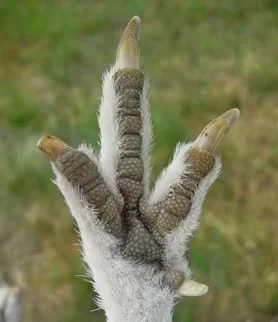 Figure 1. The feathers of a ptarmigan's foot help it stay warm in the winter.Copyright 2011 Arnstein Rønning, Wikimedia Commons {PD} http://commons.wikimedia.org/wiki/File:Lagopus_lagopus_foot.jpg
We talked about feathers on the ptarmigan's feet providing warmth. How else could these feathers help the ptarmigan? (Guide the class discussion to the possibility that the feet act as snowshoes.) Yes, feathers on ptarmigan feet could act like snowshoes. Some other animals, such as snowshoe hares, have extra-large feet so that they can better walk through deep snow. Let's take a look at a snowshoe to see how it works (see Figure 2).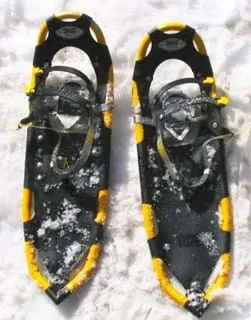 Figure 2. Snowshoes increase floatation by distributing weight over a larger surface area.Copyright 2005 Willmcw, Wikimedia Commons {PD} http://commons.wikimedia.org/wiki/File:Atlas_snowshoes.jpg
Snowshoes work by spreading out a person's weight over a larger area than usual. We call this floatation. We can define floatation as the resistance to sinking into the snow. So, when using snowshoes, you have more floatation and it is harder for you to sink into the snow! But, if you wore a really heavy backpack and increased your weight, the weight could be great enough for you to sink, even when wearing snowshoes. That is why snowshoes come in different sizes; you need bigger snowshoes if you are a bigger person or plan on carrying a really heavy backpack.
I have not told you whether or not feathers act like snowshoes for the ptarmigan; I have only suggested that perhaps they might. What is your hypothesis about whether these feathered feet give the ptarmigan more floatation? (Ask students to talk with nearby students first, and then ask several students to explain their hypotheses and reasoning.) How could we test whether ptarmigan feet act like snowshoes? (Lead a few minutes of class brainstorming.) Do we need to bring in real ptarmigans to test our hypothesis? This could be a challenge. Could we model them instead?
Engineers use models all the time when testing a hypothesis or designing a solution to a problem. How could we model a ptarmigan foot using simple materials available to us? (Show some of the activity materials and also a photograph of a ptarmigan foot. Lead groups to agree on modeling two ptarmigan "toes" with craft sticks at a set angle, with and without feathers.) Today, each group will make model ptarmigan feet with and without feathers, and test how much weight each one takes to sink.
Before the Activity
- Gather all necessary materials.
- Make available for display a photograph of a ptarmigan foot, such as Figure 1.
With the Students
- Divide the class into groups of two to four students each.
- Give the groups a few minutes to talk about and write down their hypotheses. Direct each student to write down his/her own hypothesis on a blank sheet of paper in the form of: "My hypothesis is that the feathers on the ptarmigan's foot give it (more / the same / less) floatation compared to feet without feathers, because (reason). If my hypothesis is correct, then the model feet with feathers will support (more / less / the same) weight (than / as) the feet without feathers."
- Demonstrate how to build the two ptarmigan feet (refer to Figure 3):
- Non-feathered: Place the ends of two craft sticks together at a 40° angle. Have students use protractors to measure the 40° angle and use hot glue to secure the craft sticks. If students do not already know, instruct them on how to use a protractor.
- Feathered: Begin by making the non-feathered foot as described above. Then, hot glue feathers along the foot. Craft feathers are often long enough such that one per "toe" (2 per foot) is sufficient.
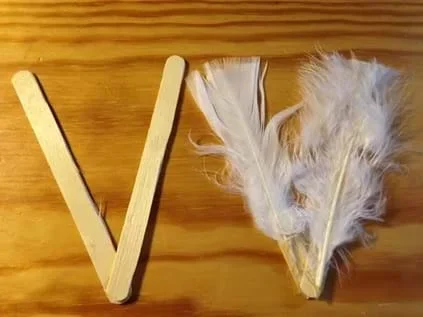 Figure 3. The activity setup of two craft stick "feet" models, with and without feathers.Copyright 2015 Chelsea Heveran, University of Colorado Boulder.
- On the reverse side of their hypothesis papers, direct students to make blank data tables to record their test results (refer to Table 1). Explain the table rows and columns to students. The "weight of the beans" is the weight of the testing apparatus on the bathroom scale, without the ptarmigan foot. The "weight to sink" is the number that students read on the bathroom scale when the ptarmigan foot is just barely submerged. The "weight supported" is the "weight to sink" minus the "weight of the beans."
 Table 1. A table to record model ptarmigan feet testing results.Copyright 2015 Chelsea Heveran, University of Colorado Boulder
 - Demonstrate how to test the model ptarmigan feet:
- Place the tub of beans on the bathroom scale. Write down in the table the weight of the tub of beans.
- Place one model foot into the tub of beans that is on the bathroom scale. Using a closed fist, push down evenly on the ptarmigan foot until it just sinks. As a class, set a criterion for what is defined by sinking.
- The weight supported is the weight to sink minus the weight of the beans.
- Once each group member has prepared a table and written down a hypothesis, a group may have its materials and begin creating its model ptarmigan feet.
- Have each group member write down the team results in his/her table.
- As a class, graph the results (see example in Figure 4). Expect each group to generate two data points: a weight supported for feathered and non-feathered feet.
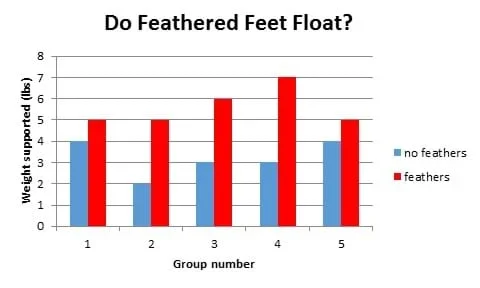 Figure 4. Example class data graph of model feet data, showing weight supported, with and without feathers.Copyright 2015 Chelsea Heveran, University of Colorado Boulder
 - To conclude, lead a class discussion about this graph, as described in the Assessment section.
- adaptation
- A change in structure or function that helps organisms survive in a particular place or habitat.
- biomimicry
- Using inspiration from the incredible adaptations of plants and animals in their natural environments to design something.
- flotation
- Resistance to sinking; for example, into the water or snow.
- hypothesis
- A proposed explanation for a phenomenon.
- model
- (noun) A representation of something for imitation, comparison or analysis, sometimes on a different scale. (verb) To make something to help learn about something else that cannot be directly observed or experimented upon.
- natural selection
- The gradual process by which heritable biological traits become either more or less common in a population as a function of the effect of inherited traits on the differential reproductive success of organisms interacting with their environment. It is a key mechanism of evolution.
- tundra
- A biome where tree growth is hindered by low temperatures and short growing seasons.
Pre-Activity Assessment
Hypotheses: Have every student write down his/her own hypothesis on a blank sheet of paper in the form of: "My hypothesis is that the feathers on the ptarmigan's foot give it (more / the same / less) floatation compared to feet without feathers, because (reason). If my hypothesis is correct, then the model feet with feathers will support (more / less / the same) weight (than / as) the feet without feathers."
Embedded Assessment
Question/Answer: Ask students if they can think of other types of animals that might use their feet for floatation. What environments specifically support animals with floatation-capable feet? What other parts of animals' bodies would be useful for making them capable of floatation?
Post-Activity Assessment
Graph Comparison: After all groups have tested their model ptarmigan feet and marked their results on the class graph, lead a group discussion about the data.
- Ask students to make a claim about the function of the feathers, using evidence from the graph. Expect students to explain their ideas using the concept of floatation.
- Ask students if any of their conclusions were different from their hypotheses and discuss.
Provide adult supervision for use of the hot glue gun.
- If time is limited, having several hot glue guns available is helpful.
- If students are not observing a difference in weight required to submerge the feathered and not-feathered feet, make sure that they are 1) comparing model feet with similar angles between the toes and 2) pressing steadily to just the point when the feet begin to submerge.
Challenge students to design ptarmigan feet with the greatest floatation. They could investigate how the number and positioning of feathers affects the floatation. They could also explore how the angle of the model foot changes the floatation.
For older students, such as those in grades 5-6, have them test each model foot multiple times and average the results. Also have them discuss genetic variation; what would happen if in nature some ptarmigans had feathered feet and others did not? Based on the data generated by the experiment, would you expect that in the future, more ptarmigan would have feathered feet? Why? Discuss feathering from the perspective of natural selection.
Alpine Tundra Eosystem. Last updated May 30, 2015. Rocky Mountain National Park, Colorado, National Park Service. Accessed June 4, 2015. http://www.nps.gov/romo/learn/nature/alpine_tundra_ecosystem.htm
Ptarmigan. Last updated May 30, 2015. Denali National Park & Preserve, Alaska, National Park Service. Accessed June 4, 2015. http://www.nps.gov/dena/naturescience/ptarmigan.htm
Rock Ptarmigan (Lagopus mutus). Published 2000. Bird Species and Distributions in Yukon-Charley Rivers National Preserve, National Park Service. Accessed June 4, 2015. http://home.nps.gov/yuch/learn/nature/birds.htm
Yuhas, Daisy. Published February 14, 2014. "Ptarmigan May Be Tops in Adapting to Winter Weather: Only one bird genus molts into all-white feathers each year." Audubon, National Audubon Society. Accessed June 4, 2015. http://www.audubonmagazine.org/articles/birds/ptarmigan-may-be-tops-adapting-winter-weather
The Tundra Biome. The World's Bioimes, University of California Museum of Paleontology, Berkeley Natural History Museums. Accessed June 4, 2015. http://www.ucmp.berkeley.edu/glossary/gloss5/biome/tundra.html
Contributors
Chelsea Heveran
Supporting Program
Integrated Teaching and Learning Program, College of Engineering, University of Colorado Boulder
Acknowledgements
The contents of these digital library curricula were developed by the Integrated Teaching and Learning Program under National Science Foundation GK-12 grant no. 0946502. However, these contents do not necessarily represent the policies of the National Science Foundation, and you should not assume endorsement by the federal government.
Copyright
2011 by Regents of the University of Colorado