
Rooftop Gardens
Students explore whether rooftop gardens are a viable option for combating the urban heat island effect. Can rooftop gardens reduce the temperature inside and outside houses? Teams each design and construct two model buildings using foam core board, one with a "green roof" and the other with a black tar paper roof. They measure and graph the ambient and inside building temperatures while under heat lamps and fans. Then students analyze the data and determine whether the rooftop gardens are beneficial to the inhabitants.
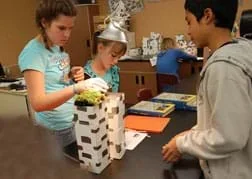 What are the benefits of green roofs?
To see if a system or design has the intended effect, engineers model and test it. They take measurements and analyze the results. The creation of green roofs involves many types of expertise and many factors that impact its success. Engineers apply the science and math of forces and loads, heat transfer, material properties, energy and ecology to make sure a building provides a total system that supports the ecosystem of a rooftop garden.
After this activity, students should be able to:
- List and explain reasons why rooftop gardens are beneficial.
- Predict which materials absorb more or less heat energy, showing their understanding of material and color properties.
- Predict which materials absorb more or less heat energy, showing their understanding of material and color properties.
- Describe the engineering design process.
- 6.1.1.c.iii Solve unit rate problems including those involving unit pricing and constant speed.
Grade 6
Do you agree with this alignment? - 6.1.2.b Fluently add, subtract, multiply, and divide multidigit decimals using standard algorithms for each operation.
Grade 6
Do you agree with this alignment? - 6.3.1.d.ii Summarize numerical data sets in relation to their context.
Grade 6
Do you agree with this alignment? - 7.1.1.c.i Determine whether two quantities are in a proportional relationship.
Grade 7
Do you agree with this alignment? - 8.3.1.a Construct and interpret scatter plots for bivariate measurement data to investigate patterns of association between two quantities.
Grade 8
Do you agree with this alignment?
- Photosynthesis and cellular respiration are important processes by which energy is acquired and utilized by organisms
Grade 7
Do you agree with this alignment?
- CCSS.Math.Content.6.NS.B.3 Fluently add, subtract, multiply, and divide multi-digit decimals using the standard algorithm for each operation.
Grade 6
Do you agree with this alignment? - CCSS.Math.Content.6.RP.A.3b Solve unit rate problems including those involving unit pricing and constant speed.
Grade 6
Do you agree with this alignment? - CCSS.Math.Content.6.SP.B.5 Summarize numerical data sets in relation to their context, such as by:
Grade 6
Do you agree with this alignment? - CCSS.Math.Content.7.RP.A.2a Decide whether two quantities are in a proportional relationship, e.g., by testing for equivalent ratios in a table or graphing on a coordinate plane and observing whether the graph is a straight line through the origin.
Grade 7
Do you agree with this alignment? - CCSS.Math.Content.8.SP.A.1 Construct and interpret scatter plots for bivariate measurement data to investigate patterns of association between two quantities. Describe patterns such as clustering, outliers, positive or negative association, linear association, and nonlinear association.
Grade 8
Do you agree with this alignment? - CCSS.Math.Practice.MP2 Reason abstractly and quantitatively.
Grades K-12
Do you agree with this alignment? - CCSS.Math.Practice.MP4 Model with mathematics.
Grades K-12
Do you agree with this alignment? - CCSS.Math.Practice.MP5 Use appropriate tools strategically.
Grades K-12
Do you agree with this alignment?
- Students will develop an understanding of the attributes of design.
Grades K-12
Do you agree with this alignment? - Students will develop an understanding of engineering design.
Grades K-12
Do you agree with this alignment? - Students will develop abilities to apply the design process.
Grades K-12
Do you agree with this alignment? - STEL-1J Develop innovative products and systems that solve problems and extend capabilities based on individual or collective needs and wants.
Grades 6-8
Do you agree with this alignment? - STEL-7Q Apply the technology and engineering design process.
Grades 6-8
Do you agree with this alignment?
- MS-ETS1-1 Define the criteria and constraints of a design problem with sufficient precision to ensure a successful solution, taking into account relevant scientific principles and potential impacts on people and the natural environment that may limit possible solutions.
Grades 6-8
This resource focuses on the following Three Dimensional Learning aspects of NGSS:
Science & Engineering Practices- Define a design problem that can be solved through the development of an object, tool, process or system and includes multiple criteria and constraints, including scientific knowledge that may limit possible solutions.Do you agree with this alignment?
Disciplinary Core Ideas- The more precisely a design task's criteria and constraints can be defined, the more likely it is that the designed solution will be successful. Specification of constraints includes consideration of scientific principles and other relevant knowledge that is likely to limit possible solutions.Do you agree with this alignment?
Crosscutting Concepts- The uses of technologies and any limitations on their use are driven by individual or societal needs, desires, and values; by the findings of scientific research; and by differences in such factors as climate, natural resources, and economic conditions.Do you agree with this alignment?
- All human activity draws on natural resources and has both short and long-term consequences, positive as well as negative, for the health of people and the natural environment.Do you agree with this alignment?
Do you agree with this alignment? - Define a design problem that can be solved through the development of an object, tool, process or system and includes multiple criteria and constraints, including scientific knowledge that may limit possible solutions.
- MS-ETS1-2 Evaluate competing design solutions using a systematic process to determine how well they meet the criteria and constraints of the problem.
Grades 6-8
This resource focuses on the following Three Dimensional Learning aspects of NGSS:
Science & Engineering Practices- Evaluate competing design solutions based on jointly developed and agreed-upon design criteria.Do you agree with this alignment?
Disciplinary Core Ideas- There are systematic processes for evaluating solutions with respect to how well they meet the criteria and constraints of a problem.Do you agree with this alignment?
Do you agree with this alignment? - Evaluate competing design solutions based on jointly developed and agreed-upon design criteria.
- MS-ETS1-3 Analyze data from tests to determine similarities and differences among several design solutions to identify the best characteristics of each that can be combined into a new solution to better meet the criteria for success.
Grades 6-8
This resource focuses on the following Three Dimensional Learning aspects of NGSS:
Science & Engineering Practices- Analyze and interpret data to determine similarities and differences in findings.Do you agree with this alignment?
Disciplinary Core Ideas- There are systematic processes for evaluating solutions with respect to how well they meet the criteria and constraints of a problem.Do you agree with this alignment?
- Sometimes parts of different solutions can be combined to create a solution that is better than any of its predecessors.Do you agree with this alignment?
- Although one design may not perform the best across all tests, identifying the characteristics of the design that performed the best in each test can provide useful information for the redesign process—that is, some of the characteristics may be incorporated into the new design.Do you agree with this alignment?
Do you agree with this alignment? - Analyze and interpret data to determine similarities and differences in findings.
Each group needs:
- foam core board or heavy cardboard (for creating two model buildings), ~15 x 20-inch [38 x 51-cm] sheet (which is half of the 30 x 40-in [~76 x 102-cm] size foam core board sheets typically available)
- 1-2 pieces of black tar paper, ~ 6 x 6-inch [15 x 15-cm] (available at hardware, lumber and home improvement stores), or use black sandpaper, or black construction paper to represent the black tar surface typically found on city building roofs
- 1-2 pieces of sod (turf) and/or other sod or moss-like plants, ~ 6 x 6-inch [15 x 15-cm] piece (available in rolls or trays at garden centers or florist shops)
- 1 piece of plastic sheeting (for roof deck insulation and waterproofing layer), 30 x 30-cm; cut from plastic wrap or plastic trash bags
- duct tape and hot glue gun (alternative: just use duct tape)
- X-ACTO knife, utility knife and/or scissors, to cut foam core board, black paper, sod, tape, etc.
- 2 thermometers (at least one long thermometer so you can access the interior of the model structures)
- 1 heat lamp
- 1 electric fan
- timer or stop watch
- paper, for sketching dimensioned designs
- pencils, for drawing, data collection and graph creation
- 4 sheets of graph paper
- (optional) soil (if not enough soil comes with sod)
- Materials and Cost Worksheet (PDF)
- Temperature Data Sheet (PDF)
Construction supplies for the teacher to have on hand for groups to purchase (as their budgets permit), as listed on the Materials and Cost Worksheet:
- foam core board (or heavy cardboard), ~ one extra sheet should be enough
- black tar paper, ~ one extra piece per team
- pre-cut sod pieces (15 x 15cm), ~ one extra piece per team
- plastic wrap or plastic trash bags, for more waterproofing membrane material
- duct tape
- hot glue gun sticks
For the entire class to share:
- (optional) timer/stop watch (to synchronize students' time pieces; alternative idea: use a free online timer and project it in the room for all teams to see; go to http://www.online-stopwatch.com/
- (optional) HOBO data logger with probe (available at electronics and hardware stores; this instrument records temperatures at set intervals over a period of time and creates data tables and graphs; usually requires a computer; see Gempler's HOBO Data Logger FAQs for more information)
- (optional) laptop/desktop computer with LDC projector, Excel software, Internet access
A basic understanding of ecology (the study of the relationships between organisms, including humans, and the environment), and experience reading graphs. Ability to calculate area.
Has anyone ever seen a rooftop garden? Where? Rooftop gardens exist in many cities all around the world. What are some reasons people might build rooftop gardens? (Possible answers: To grow food, provide shade, absorb rainwater, make the environment more beautiful, cool the environment.) Rooftop gardens affect the temperature on the roofs of buildings. The science behind these "green roofs" involves plant cycles such as photosynthesis and transpiration. Plants help absorb light and heat, and through both photosynthesis and transpiration, they help to cool the environment around them. Photosynthesis also helps improve air quality because plants take in carbon dioxide and release oxygen. Some roof gardens are even used for agriculture since cities have little land for growing food. Many people enjoy rooftop gardens because they also add to the beauty of a city.
Once engineers see the need for a rooftop garden, they are the ones who figure out how to make it work! Structural engineers design or reinforce buildings so they are strong enough to support rooftop gardens. They might also determine how best to direct water to flow from the roof of the building to the ground, and how people gain access the roof to care for the garden. Environmental engineers play a role in determining how effective the garden might be at improving air quality, while agricultural engineers find ways to improve crop yield so that people in the city can grow their own food! It is easy to see that rooftop gardens can benefit our lives, and it is engineers who that make that dream a reality!
As engineers, we must model and test our designs to make sure they work as intended. We've discussed many ways that rooftop gardens (sometimes called "green roofs") could benefit our lives, so now we can put them to the test. In many cities, the ability to cool the temperature of the environment is very important during the summer. In this project, we will work in groups to design and build two identical model buildings, one with a "green roof" and one with a traditional black tar roof. To determine if the rooftop gardens affect the temperature, each group will record the temperatures on the roof and inside each building while under heat lamps, representing direct sunlight, and then under blowing fans, to represent nighttime. Then we'll take a look at our data to see what conclusions we can draw from this experiment.
Teacher Background
Activity Overview — In this activity, student teams design and construct model buildings with the goal to minimize the temperature changes resulting from heat lamps placed nearby. They test to see if rooftop gardens reduce the temperature of the roofs of their buildings and/or have impacts on the temperature inside the buildings. Through this project, students learn about the importance of design and the process of modeling systems to test the effects of engineered buildings with rooftop gardens with the potential to help to control temperature fluctuations, provide space for agriculture, and improve the aesthetic quality of the local environment. Students incorporate principles of structural and architectural engineering to ensure that their buildings support the plants and soil necessary for a rooftop garden. Once the buildings are built, students gather temperature data, and analyze it by creating graphs of the temperature as a function of time.
Give teams a full class period and half the next class to design and build. Require teams to incorporate a plastic layer into their green roof design to help insulate and waterproof the building. (The sod may not be that wet, but this reinforces the idea of considering the material layers necessary to support a rooftop garden system.) Have students begin testing when they have completely built both buildings. For testing, thermometers are placed in each building and directly outside of each building, four different locations. With the heat lamps on, groups record on data sheets the temperatures, taking two readings on each of the two thermometers every minute for a total of four readings per minute. After 15 minutes, turn off the heat lamps and turn on fans to blow cooler air for 10 minutes, as if it were nighttime (when temperatures are usually cooler), continuing to take temperature data. Have each team member use the collected data to create graphs that plot temperature vs. time for one location's set of temperatures. Together, each group will have four graphs, which they can compare to determine whether the rooftop gardens affected the temperature inside and/or outside of their buildings. If time permits, have students make adjustments and retest their buildings.
Data Analysis and Graphs — Just like engineers, students must be able to interpret results found during the testing stage. As needed, provide students with a review of how to create and read coordinate (x-y) graphs, so they have confidence in using this tool for analyzing data.
Alternative Data Collection Idea — If available, use HOBO data loggers to measure the temperature of some of the groups' buildings during the activity. After heating and cooling the buildings, show the class the HOBO temperature/time data using a computer and LCD projector, as well as graphs of the data. This supplements the activity and shows students how a computer can produce a graph just like the ones they created by hand.
Urban Heat Island Effect — Rooftop gardens have many benefits to people, especially those in urban settings. One reason for rooftop gardens is to reduce the urban heat island effect, a phenomenon in which urban areas are hotter than surrounding suburban and rural areas. The urban heat island effect is caused primarily by the existence of materials that are common in urban development, such as concrete and asphalt. These materials absorb more sunlight than natural, plant-based landscapes and then radiate the sun's energy as heat when the air cools. Tall buildings with more surface area absorb and reflect the sun's light, adding to the effect. An additional cause of the urban heat island effect is waste energy generated by energy usage. Rooftop gardens have been shown to dramatically decrease the temperature on roofs in cities.
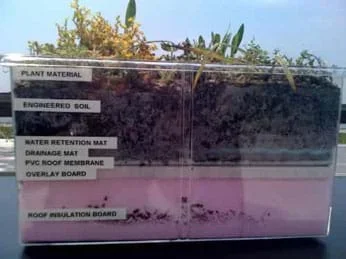 The composition of the green roof at the U.S. Postal Service's processing center in New York City is more energy efficient than a traditional roof and saves the Postal Service $30,000 annually in heating and cooling costs.Copyright U.S. Postal Service http://www.usps.com/communications/newsroom/greennews/assets/images/roof/lg/greenimg_gm12.jpg
Benefits of Rooftop Gardens — Rooftop gardens, or green roofs, have many benefits. They are aesthetically pleasing, reduce the heat island effect, reduce the amount of carbon dioxide that affects the temperature of the Earth and contributes to global climate change, reduce air pollution, reduce heating and cooling loads, lengthen roof life by two to three times, reduce sound reflectance and transmission, reduce rainfall run-off impacts, and remove nitrogen pollution in storm water runoff. See the associated lesson, Ecology at Work for further details. Source: City of Chicago's Green Roof Fact Sheet collectionv.cityofchicago.org/webportal/COCWebPortal/COC_ATTACH/Green_Roof_Fact_Sheet.pdf .
Engineering Design Process — To create the best design possible, engineers use the engineering design loop to guide the process. The design process describes how engineers recognize a need, brainstorm ideas, draw designs, build, and test. This process is considered a loop because the steps may need to be repeated or revisited, depending on testing results. (See more about the engineering design process at https://www.teachengineering.org/engrdesignprocess.php.)
Before the Activity
- Gather materials and make copies of the Materials and Cost Worksheet (PDF)and Temperature Data Sheet (PDF).
- Make available an equal amount of foam core board for each group, from which teams will design model buildings of their own dimensions and further cut the boards themselves, as needed for their designs.
- Have available additional construction supplies (as listed on the worksheet) for groups to purchase, within their budget, using the worksheet pricing.
- Set up a tabletop space for each group.
With the Students
- Divide the class into groups of four students each. (As necessary, a few groups of three or five students are okay.)
- Introduce the project to students (see the Introduction/Motivation section), including the PowerPoint® presentation in the associated lesson, Ecology at Work .
- Hand out one worksheet to each group and have students read them.
- Clarify the activity to students: The first step for each group is to design and build two buildings. To make sure the only variable we are testing for is a different rooftop, the buildings must be otherwise identical. The entire surface of both roofs must be covered with black tar paper. Then, the "green roof" must also have a plastic layer, representing the insulation and waterproofing necessary to make sure a roof can support a rooftop garden.
- Provide more instruction and details: As a group, choose how large to make your building, but keep in mind that you must purchase the materials within a $200 budget per team. Your team designs the shape of your building and its roof design. It might be flat or angled or even an "A-frame" (having two slanted surfaces forming the roof). You will be given one piece of foam core board to get started (free), but you'll have to purchase other materials, such as black tar paper, the plants (sod) and a plastic membrane (required on green roofs) that goes under your plants, as well as tape and glue. See the worksheet for what construction materials are available and their prices. Calculate the total surface area of your buildings (in square cm), so you know the exact amounts of additional construction materials you need to buy. Before you begin construction, you must have a drawing of your building, showing all dimensions and your plan for additional materials to purchase.
- Clarify timing and process: You have a full class period and half of the next class to design and build. You may use duct tape and/or hot glue to construct the buildings. Teams can begin testing when they have completely built both buildings. For testing, each group needs a heat lamp, fan, two thermometers, and a stopwatch. Place a thermometer in each building and one directly outside each building. We'll first turn on heat lamps (representing sunny daytime) and later fans (representing nighttime when temperatures are usually cooler) as you record temperatures on your data sheets for four thermometer locations every miniute. Then you'll graph your data.
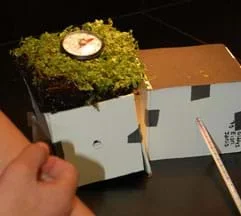 Example student-created model buildings being tested for temperature under a lamp, one with a "green roof," and the other with a typical black roof.Copyright 2010 Carleigh Samson, ITL Program, University of Colorado Boulder
- Have each group proceed to design their model buildings by drawing designs. They are to build two identical buildings, one building's roof finished with tar paper and the other roof deck further covered with a plastic layer, soil and plants. Require that they calculate the surface area and volume of their buildings, and use the worksheets to prepare buy-lists of materials needed to make the models, staying within budget for the total cost of those materials.
- Have one student from each team purchase additional construction materials from the teacher's supply, using the items, measurements and prices provided on the worksheet. Have the teacher or students cut the purchased amounts, as needed.
- Have the teams build their two identical model buildings with different roofs.
- Give each group two thermometers to place inside and on the roof of each building, alternating from one building to the other in one-minute increments. Direct students to make small openings or flaps in one wall of each building to allow thermometers to slip in. Position the opening so a thermometer can be easily removed for a quick reading, but not at the base of the building where it might record the table temperature instead of the air temperature inside the building. [Alternative: Use HOBO data loggers to take and record temperature readings in each building.]
- Pass out the data sheets, heat lamps and fans, one per group.
- Have students assign different roles for their team members: one person in charge of the time, one in charge of roof temperatures, one in charge of inside temperatures, and one as a data recorder.
- Have each team turn on its heat lamp and adjust its position to make sure both buildings receive equal amounts of light and heat. Groups will take two readings on each of the two thermometers every minute, for a total of four readings per minute, which are recorded on the data sheets.
- Have students place one thermometer on the roof of one building and the other thermometer inside that building.
- After 30 seconds, have students read and record the temperatures, and then move the two thermometers to the same locations in the second building. Make sure to leave the thermometers in place for at least 15 seconds before reading and recording new temperatures. Continue this temperature-taking process every minute until 15 minutes have passed.
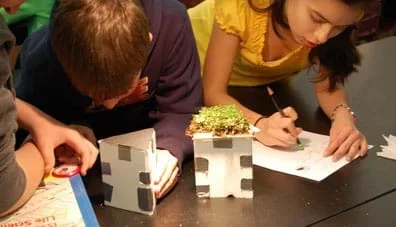 Students record the temperatures of their two model buildings, one with a black roof and the other covered with plants.Copyright 2010 Carleigh Samson, ITL Program, University of Colorado Boulder
- After 15 minutes, turn off the heat lamps and turn on the fans to blow cooler air. Continue taking the "nighttime" temperature data for 10 minutes. Then turn off the fans, too.
- Hand out graph paper. Direct the groups to create four graphs of temperature vs. time for their four temperature data sets. Have each team member create a graph for one location, for example, inside the rooftop garden building. As necessary, show students how to set up a graph on graph paper and plot an example point.
- Have students answer the data analysis questions on the second page of the data sheet.
- Once each group has four graphs, have the members of each group compare the graphs to determine if the rooftop gardens affected the temperature inside and/or outside of their buildings.
- (optional) If time permits, have groups make adjustments and retest their buildings.
- Conclude with a class discussion to share and review experiment results and determine whether or not the rooftop gardens reduced the temperature outside and/or inside the buildings. Incorporate the Investigating Questions into the discussion. [Supplemental idea: Use a computer with LCD projector so the class can view the results found by the HOBO data loggers in table format and as graphs.]
- (optional) Remember to administer the pre/post Rooftop Gardens Quiz if given at the beginning of the associated lesson.
- ambient
- The surrounding area or environment.
- cycle
- Any complete round or series of occurrences that repeats or is repeated.
- model
- (noun) A representation of something for imitation, comparison or analysis, sometimes on a different scale. (verb) To simulate, make or construct something to help visualize or learn about something else (as a product, process or system) that is difficult to directly observe or experiment upon.
- photosynthesis
- The synthesis of complex organic materials, esp. carbohydrates, from carbon dioxide, water, and inorganic salts, using sunlight as the source of energy and with the aid of chlorophyll and associated pigments.
- plant
- A member of the kingdom Plantae, comprising multi-cellular organisms that typically produce their own food from inorganic matter by the process of photosynthesis and that have more or less rigid cell walls containing cellulose.
- sod
- A section cut or torn from the surface of grassland, containing the matted roots of grass.
- tar paper
- A heavy-duty paper impregnated with tar, producing a waterproof underlayment material useful for roof construction.
- temperature
- A measure of the warmth or coldness of an object or substance with reference to some standard value.
- thermometer
- An instrument for measuring temperature, often a sealed glass tube that contains a column of liquid, as mercury, that expands and contracts, or rises and falls, with temperature changes, the temperature being read where the top of the column coincides with a calibrated scale marked on the tube or its frame.
- transpiration
- The passage of water through a plant from the roots through the vascular system to the atmosphere.
- urban heat island effect
- A phenomenon in which a metropolitan area is significantly warmer than its surrounding rural areas.
Pre-Activity Assessment
Prediction: Have students predict what will happen in the activity. Student predictions reflect their understanding of the information covered in the associated Ecology at Work lesson and their level of knowledge prior to the activity.
- How will the roof temperatures compare between the building with a black roof and the building with plants on its roof?
- What do you predict will happen to the temperatures inside each building for the building with a black roof and the building with plants?
Activity Embedded Assessment
Worksheet/Graph: Have student teams complete the Materials and Cost Worksheet (PDF)and the Temperature Data Sheet (PDF). Also have each student plot a temperature vs. time line graph for one location of the thermometer. By completing these worksheets and graphs, students demonstrate that they are on task and reveal their level of comprehension.
Observations: Observe students throughout the activity. Watch that: they keep track of materials and expenses, everyone in the group is participating, they are working efficiently and orderly, they record measurements correctly for all thermometer locations, and they plot the graphs accurately.
Post-Activity Assessment
Concluding Discussion: After the activity, engage the class in a discussion about the activity results and the implied benefits of rooftop gardens in the real world. Ask the Investigating Questions to assess students' comprehension of the activity content.
- If students are permitted to cut the foam core board and sod using X-ACTO blades or utility knives, alert them to the dangers and instruct them on how to use the tools safely.
- Warn students that they can get burned using a hot glue gun and a heat lamp, and instruct them on how to use these tools safely.
Building construction sometimes takes longer than expected; encourage students to keep their designs simple.
Be careful that the thermometers placed inside the buildings do not rest on the tables; you want them to measure the air temperature inside the structures and not the temperature of the table below
- For lower grades and/or younger students, skip the building process by using shoeboxes for the buildings. Or simplify building construction by making duct tape the only material to hold the foam core board pieces together (eliminating use of the hot glue guns), or by limiting materials to supplied pre-cut pieces.
- For lower grades and/or younger students, have the teacher walk through creating the entire graph with the class or have the teacher collect data from all students and create graphs for the students.
- If understanding the graphs is beyond the ability-level of the students, provide a guided class discussion of the temperature difference in the different buildings, as a way to analyze the data.
- For upper grades/older/more advanced students, give more specific requirements for how the buildings must be built. Require that teams perform a classroom-wide analysis of the green roof buildings to determine which team built a structure that kept the coolest under the heat lamp, warmest under the fan, maintained its temperature the best, the least expensive, the most expensive, and maintained temperature the best for the cost.
Learn more about the engineering design process at https://www.teachengineering.org/engrdesignprocess.php.
Make use of a free online stopwatch at: http://www.online-stopwatch.com/
The City of Chicago's City Hall Rooftop Garden: Green Buildings, Roofs & Homes. The City of Chicago's Official Site. Accessed December 18, 2009. http://www.explorechicago.org/city/en/about_the_city/green_chicago/Green_Roofs_.html
Dictionary.com. Lexico Publishing Group, LLC. Accessed December 21, 2009. (Source of some vocabulary definitions, with some adaptation)
Green Roof Basics. City of Chicago. Accessed January 4, 2010. http://www.explorechicago.org/city/en/about_the_city/green_chicago/Green_Roofs_.html
Green Roof: Morgan Processing and Distribution Center, USPS Sustainability Fact Sheet. Last updated August 2010. U.S. Postal Service. about.usps.com/news/electronic-press-kits/greennews/greenkit-5.pdf Accessed January 16, 2011.
Roof Garden. Last modified June 24, 2010. Wikipeida, The Free Encyclopedia. Wikimedia Foundation, Inc. Accessed June 24, 2010. http://en.wikipedia.org/wiki/Rooftop_gardens
Roof Top Gardening. Published December 1999. City Farmer, Canada's Office of Urban Agriculture. Global Ecovillage Network Oceania & Asia Inc. http://genoa.ecovillage.org/genoceania/newsletter/archive/articles/pages/rooftop.html Accessed December 20, 2009.
Rooftop Gardens. USA Home and Garden. Accessed December 21, 2009. http://usahomeandgarden.com/garden/garden-rooftop/garden-rooftop.html
Rooftop Gardens from Around the World, Garden Plants and Gardening Forum. Updated December 7, 2007. The Grow Spot. Accessed January 4, 2010. http://www.thegrowspot.com/know/f5/rooftop-gardens-from-around-the-world-54020.html
Slutz, Sandra (Science Buddies). Rooftop Gardens: Are They a Cool Idea? Last edit date: May 12, 2008. Science Buddies. Accessed August 12, 2009. http://www.sciencebuddies.org/science-fair-projects/project_ideas/EnvEng_p026.shtml
Urban Heat Island. Last modified July 29, 2010. Wikipeida, The Free Encyclopedia. Wikimedia Foundation, Inc. Accessed June 24, 2010. http://en.wikipedia.org/wiki/Urban_heat_island
- Ecology at Work
- Rooftop Gardens
Contributors
Carleigh Samson; Stephanie Rivale; Denise W. Carlson
Supporting Program
Integrated Teaching and Learning Program, College of Engineering and Applied Science, University of Colorado Boulder
Acknowledgements
The contents of this digital library curriculum were developed under grants from the Fund for the Improvement of Postsecondary Education (FIPSE), U.S. Department of Education, and National Science Foundation (GK-12 grant no 0338326). However, these contents do not necessarily represent the policies of the Department of Education or National Science Foundation, and you should not assume endorsement by the federal government.
Copyright
2009 by Regents of the University of Colorado