
Challenges of Laparoscopic Surgery
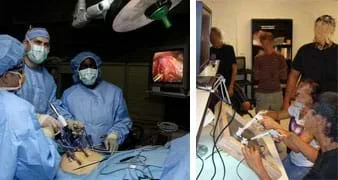 Figure 1. Laparoscopic surgery on the stomach, in real-life (left) and in a classroom simulation activity (right).
Students teams use a laparoscopic surgical trainer to perform simple laparoscopic surgery tasks (dissections, sutures) using laparoscopic tools. Just like in the operating room, where the purpose is to perform surgery carefully and quickly to minimize patient trauma, students' surgery time and mistakes are observed and recorded to quantify their performances. They learn about the engineering component of surgery.
Engineers bring their understanding of anatomy, physiology and surgery to collaborations with physicians and other medical professionals to develop procedures and tools for surgery. Engineers partner with surgeons to continually create, design, test and manufacture new tools and procedures that are the least invasive and traumatic for patients. This includes designing computer and physical simulators so surgeons and medical interns can practice technique, as well as specialty tools, equipment and cameras, not to mention nearly everything found in operating rooms, from lighting fixtures to computers and monitors to adjustable tables and disposable gloves.
After this activity, students should be able to:
- Identify common laparoscopic tools.
- Perform simple simulated laparoscopic surgical procedures such as stretching and dissection, tissue identification and manipulation, and suturing.
- Brainstorm and generate concepts for new laparoscopic surgical tools that improve upon the state-of-the-art.
- CCSS.Math.Content.HSS-ID.A Summarize, represent, and interpret data on a single count or measurement variable
Grades 9-12
Do you agree with this alignment?
- STEL-5F Analyze how an invention or innovation was influenced by its historical context.
Grades 6-8
Do you agree with this alignment? - STEL-7S Create solutions to problems by identifying and applying human factors in design.
Grades 6-8
Do you agree with this alignment?
- Summarize, represent, and interpret data on a single count or measurement variable
Grades 9-12
Do you agree with this alignment?
- CCC.4.9-12.10 Models (e.g., physical, mathematical, computer models) can be used to simulate systems and interactions—including energy, matter, and information flows—within and between systems at different scales.
Grades 9-12
Do you agree with this alignment? - SEP.8.6 New technologies advance scientific knowledge.
Grades 9-12
Do you agree with this alignment?
Supplies to build one laparoscopic trainer, stretch and dissect block and puffball holder (students take turns using these items):
- 1-in x 2-in x 22-ft wood board; such as three 1-in x 2-in x 8-ft premium furring strips at $0.85 each, $2.55
- PVC shower pan liner; such as Oatey 60-in x 72-in PVC shower pan liner from Home Depot, $30
- 2½-in wood screws, quantity 16; $2
- 1½-in wood screws, quantity 20; $2
- wood glue; $3
- 4-in corner braces, quantity 2; such as Everbilt 2-pack from Home Depot, $2.87
- 2 x 2 x 7-in wood block; $1.50
- 4 alligator clips; such as Gardner Bender 22-14 AWG Barrel-Ins alligator clip 2-pack at $1.98 per pack, $4
- 4 x 5-in acrylic sheet; $2
- clear PVC tubing with 3/8-in inner diameter; $4.15
- Liquid Nails small projects and repairs adhesive, 4 oz; $2.78
- mini colorful cotton balls, four different colors; $1.49
- black pen or marker
- Building Instructions for Laparoscopic Surgical Trainer (PDF), one copy for teacher
Instruments for the class to share:
- 34 cm long laparoscopic grasper (forceps) tool, quantity 2; purchase used online, $50 each
- 34 cm long laparoscopic scissors tool, quantity 1; such as Endopath endoscopic linear cutter, purchase used online, $49
- 2 cannulas; such as Disposable Inner Cannula size 8 from allegromedical.com, $5.55 each (see Figure 2)
- scalpel with disposable blades, $8
- pen-shaped USB digital microscope; such as example
- laptop, or other portable PC capable of displaying video from the USB microscope camera
Each group needs:
- 2 rubber bands, $4
- string, 2 ft, $2
Note: Expendable costs are estimated at $6 per group. All other "start-up" non-expendable material costs are for reusable items shared by the class, such as the laparoscopic tools, microscope camera, and supplies to build the surgical trainer, and comes to ~$266.
Tips for obtaining laparoscopic tools: Do a browser search with the terms: buy used laparoscopic tools. Or from the ebay "endoscopy & laparoscopy" category at https://www.ebay.com/sch/i.html?_from=R40&_trksid=p2499334.m570.l1312&_nkw=endoscopy+%26+laparoscopy&_sacat=184518, separately search for "grasper" and "scissors" to find the tools for ~$50 each. From the main ebay website, the path is: business and industrial > healthcare, lab, and life science > medical equipment > endoscopy & laparoscopy. If you run into a medical equipment disclaimer, just go ahead and make the purchase.
Present the associated lesson prior to teaching this activity.
Laparoscopic surgery (see Figure 1) is a surgical technique in which operations in the abdomen are performed through small incisions made in the abdominal or pelvic cavities. A trocar creates these incisions in the abdomen and provides a sealed conduit, using the cannula, for various instruments used to perform the surgery (see Figure 2). Typically, three incisions are made during each surgery: one for a laparoscope and two dedicated ports for the surgical instruments. The laparoscope consists of a telescopic lens system that is connected to an ex vivo video camera. Light is usually provided by a powerful bulb and is piped into the abdominal cavity via a fiber optic or gel cable. The abdomen is insufflated with carbon dioxide gas to create a region large enough to work in and view.
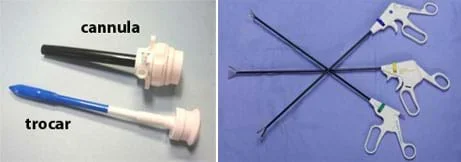 Figure 2. Example trocar and cannula (left) and laparoscopic hand tools (right) used in laparoscopic surgery.Copyright 2010 Benjamin S. Terry, ITL Program, College of Engineering, University of Colorado Boulder and (right) ignis, Wikipedia http://en.wikipedia.org/wiki/File:Laparoscopic_Hand_Instruments_001_JPN.jpg
In this activity, you will perform laparoscopic surgical tasks that are used to assess the validity and maneuverability of new innovative surgical tools using laparoscopic tools and a handmade surgical trainer. In the operating room, physicians perform surgery as carefully and quickly as possible to reduce trauma to the patient. In this activity, your surgery time and mistakes will be recorded to quantify your performance.
Before the Activity
- Follow the attached Building Instructions (PDF)to build the laparoscopic surgical trainer, stretch and dissect block, and puffball holder.
- Into the finished laparoscopic surgical trainer (see Figure 3), cut a small hole in the shower pan liner to permit entry of the digital microscope camera. Place the camera towards the left or right side of the surgical trainer to leave the center of the shower pan liner available for access of the laparoscopic tools. Place the camera in the hole and ensure that it is stable.
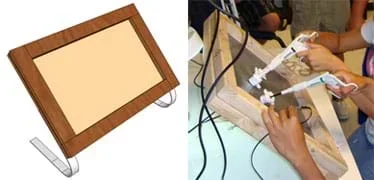 Figure 3. Students test their skills with the handmade laparoscopic trainer.Copyright 2010 Benjamin S. Terry, ITL Program, College of Engineering, University of Colorado Boulder
- To prepare for Task 1: Cut rubber bands into strips that are approximately one inch in length. Prepare four strips per student or per group, depending on how many times the activity is performed. Draw a line using either a black pen or black marker approximately ¾-in to 3/8-in from one end each rubber band. Then clamp a rubber band piece in each alligator clip of the stretch and dissect block, as shown in see Figure 4.
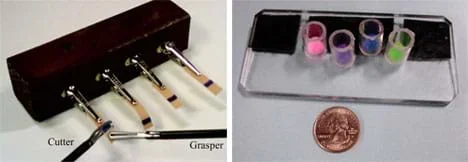 Figure 4. The stretch and dissect block (left), and puffball placement in the holder (right).Copyright 2010 Benjamin S. Terry, ITL Program, College of Engineering, University of Colorado Boulder
- To prepare for Task 2: Gather eight puffballs of four different colors, so that you have two puffballs per color. Put one different color puffball into each tube (see Figure 4). Scatter the remaining four puffballs on the table behind the surgical trainer for students to find with the camera.
- To prepare for Task 3: Cut four pieces of string, each about 6-in long. Clamp one piece of string in each alligator clip of the stretch and dissect block.
- Place behind the surgical trainer the supplies for the tasks that are to be performed, so they are out of view of the students.
- (optional) Show students a 3:19-min video that demonstrates how laparoscopic surgery is performed; see the link provided in the Additional Multimedia Support section.
With the Students
- Direct each student to use a scalpel blade to carefully cut two small incisions (in a location of his/her choice) in the lining of the surgical trainer just big enough for the laparoscopic tools, and then puncture the two cannulas through the two holes. The cannulas are used to stabilize and provide entry conduits for the surgical tools (see Figure 3).
- Insert laparoscopic tools through the cannula.
- Direct students to perform Tasks 1-3 using the laparoscopic tools and microscope camera. One student can manipulate the camera at different angles to improve viewing and one or two other students can operate the laparoscopic tools (see Figure 3). Time and record how long it takes to complete each task, keeping track of errors (see below).
- Task 1: Stretch and Dissect: Repeat the following steps until all rubber bands have been cut.
- Locate the stretch and dissect block with rubber band pieces in the clips.
- Using a laparoscopic grasper, grab one of the rubber bands and stretch it slightly.
- Using a laparoscopic cutter, cut along the black line of the rubber band.
- Using a laparoscopic grasper, remove the piece of rubber band from behind the surgical trainer.
- Task 2: Tissue Identification and Manipulation:
- Locate the puffball holder.
- Locate the colored puffballs outside of the holder.
- Using up to two laparoscopic graspers, put the puffballs in the tubes so two of the same color puffballs are in each tube.
- Task 3: Suturing:
- Locate the stretch and dissect block with strings in the clips.
- Using two laparoscopic graspers, grab two pieces of string and tie them together three times.
- Repeat for the next set of strings.
- Task Evaluation and Errors: After each task, assess how successful students were in performing the surgical procedures. Record the number of errors. Possible errors for each task include:
- Task 1: Not cutting along the black line. To be considered accurate (and successful), cut within 1 mm of the black line.
- Task 2: Matching the wrong colors in the tubes or not placing the puffballs into the holders.
- Task 3: Not tying knots successfully three times per pair of strings.
- Task Scoring: Score students on time and accuracy. For each error, add 30 seconds to the final time for that task. Announce the student(s) with the least amount of time as the "Surgeon(s) of the Day." (optional) Reward the winner(s) with a small prize such as credit to the school store, a free homework pass, candy, a new pen, etc.
- Clean-up
- cannula
- A surgical tube that is inserted into the body to provide a sealed conduit for surgical tools
- ex vivo
- Signifying outside the living body.
- insufflation
- Pressurizing or filling with air. The abdominal cavity is insufflated prior to surgery to create a space for the surgeon to work in.
- in vitro
- Signifying in a laboratory or controlled environment.
- in vivo
- Signifying inside the living body.
- laparoscope
- A camera attached to a long, slender light pipe that allows a laparoscopic surgeon to view inside the abdominal cavity without invasive surgery.
- laparotomy
- Open surgery on the abdominal cavity (surgery through a large incision).
- suturing
- A joining of the edges of a wound by stitching.
- trocar
- A specialized surgical knife used for creating small incisions for the introduction of a surgical tool through the abdominal wall.
Pre-Activity Assessment
Research: Assign students to research laparoscopic surgery on the Internet or at the library and answer the following questions:
- In what area of the body is laparoscopic surgery usually performed?
- Name three conditions that laparoscopic surgery is used to treat or diagnose.
- List five advantages and five disadvantages of laparoscopic surgery.
- Describe what the following tools are used for during surgery: cannula, trocar, laparoscope
- How many incisions are usually made when performing laparoscopic surgery?
- What gas is used to insufflate the abdomen during laparoscopic surgery?
Activity Embedded Assessment
Participation: Give students participation points for attempting the tasks.
Post-Activity Assessment
Reflection Writing & Brainstorming: Ask students to write paragraphs discussing the limitations and difficulties of laparoscopic surgery based on their experiences from this activity. Then have students brainstorm and discuss ideas for improvements that would increase the ease, efficiency and accuracy of laparoscopic surgery.
- Handle scalpels with care since they are sharp blades with a high risk of accidental cutting.
- For lower grades, have the teacher cut the holes used for the tools and insert the tools for the students. Also eliminate Task 3 (suturing) due to its higher level of difficulty.
- For upper grades, give students a time limit to complete all of the tasks and record how many they were able to complete and number of errors. For each task successfully completed, students earn 10 points, and for each error, subtract 5 points.
Show students a 3:19-minute animation of laparoscopic surgery on YouTube. This 3D medical animation depicts the surgical removal of an appendix using laparoscopic instruments. The animation begins by showing an inflamed appendix (appendicitis), followed by the placement of the laparoscope. Afterward, one can see the surgical device staple, cut and remove the inflamed appendix. Then the abdomen is flushed with a sterile saline solution. See Nucleus Medical Arts's Laparoscopic Appendectomy Surgery for Appendicitis clip at https://www.youtube.com/watch?v=MAppEy9Umcg
Contributors
Benjamin S. Terry; Brandi N. Briggs; Stephanie Rivale; Denise W. Carlson
Supporting Program
Integrated Teaching and Learning Program, College of Engineering, University of Colorado Boulder
Acknowledgements
The contents of these digital library curricula were developed by the Integrated Teaching and Learning Program under National Science Foundation GK-12 grant no. 0338326. However, these contents do not necessarily represent the policies of the National Science Foundation, and you should not assume endorsement by the federal government.
Copyright
2011 by Regents of the University of Colorado.