
Truss Destruction
Students work within constraints to construct model trusses and then test them to failure as a way to evaluate the relative strength of different truss configurations and construction styles. Each student group uses Popsicle sticks and hot glue to build a different truss configuration from a provided diagram of truss styles. Within each group, each student builds two exact copies of the team's truss configuration using his/her own construction method, one of which is tested under shear conditions and the other tested under compression conditions. Results are compiled and reviewed as a class to analyze the strength of different types of shapes and construction methods under the two types of loads. Students make and review predictions, and normalize strengths. Teams give brief presentations to recap their decisions, results and analysis.
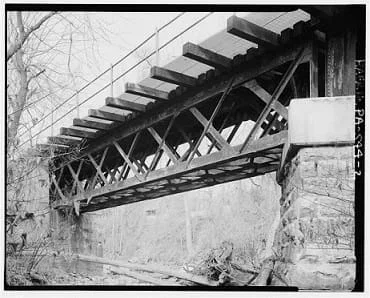 Trusses are tried and true designs for bridges.Copyright US Department of Labor http://www.osha.gov/doc/guidance.html
Structural engineers are involved in the design and engineering of many objects we encounter in our daily lives, from bridges to buildings. When designing a structure, engineers rely on the results of many empirical tests to predict the performance of their structures. In this activity, students engage in the engineering design process to determine a structure's maximum strength under two different load configurations, shear and compression forces. Students rely on known truss configurations, but are given the freedom to engineer their own construction methods, and then compare their relative performance.
After this activity, students should be able to:
- Describe the difference between shear and compression testing.
- Analyze data on configurations and construction methods and report which proved to be the strongest under two load conditions.
- Communicate how structural engineers use load-failure data to design structures.
- HS.4.5.a.iii Apply geometric methods to solve design problems.
Grades 9-12
Do you agree with this alignment? - HS.1.2 Quantitative reasoning is used to make sense of quantities and their relationships in problem situations.
Grades 9-12
Do you agree with this alignment?
- CCSS.Math.Content.HSG-MG.A.3 Apply geometric methods to solve design problems (e.g., designing an object or structure to satisfy physical constraints or minimize cost; working with typographic grid systems based on ratios).
Grades 9-12
Do you agree with this alignment? - CCSS.Math.Practice.MP2 Reason abstractly and quantitatively.
Grades K-12
Do you agree with this alignment?
- Students will develop an understanding of the attributes of design.
Grades K-12
Do you agree with this alignment? - Students will develop an understanding of engineering design.
Grades K-12
Do you agree with this alignment? - A prototype is a working model used to test a design concept by making actual observations and necessary adjustments.
Grades 9-12
Do you agree with this alignment? - Infrastructure is the underlying base or basic framework of a system.
Grades 9-12
Do you agree with this alignment? - STEL-7AA Illustrate principles, elements, and factors of design.
Grades 9-12
Do you agree with this alignment? - STEL-7W Determine the best approach by evaluating the purpose of the design.
Grades 9-12
Do you agree with this alignment?
- analyze properties and determine attributes of two- and three-dimensional objects
Grades 9-12
Do you agree with this alignment?
- HS-ETS1-2 Design a solution to a complex real-world problem by breaking it down into smaller, more manageable problems that can be solved through engineering.
Grades 9-12
This resource focuses on the following Three Dimensional Learning aspects of NGSS:
Science & Engineering Practices- Design a solution to a complex real-world problem, based on scientific knowledge, student-generated sources of evidence, prioritized criteria, and tradeoff considerations.Do you agree with this alignment?
Disciplinary Core Ideas- Criteria may need to be broken down into simpler ones that can be approached systematically, and decisions about the priority of certain criteria over others (trade-offs) may be needed.Do you agree with this alignment?
Do you agree with this alignment? - Design a solution to a complex real-world problem, based on scientific knowledge, student-generated sources of evidence, prioritized criteria, and tradeoff considerations.
- HS-ETS1-3 Evaluate a solution to a complex real-world problem based on prioritized criteria and trade-offs that account for a range of constraints, including cost, safety, reliability, and aesthetics, as well as possible social, cultural, and environmental impacts.
Grades 9-12
This resource focuses on the following Three Dimensional Learning aspects of NGSS:
Science & Engineering Practices- Evaluate a solution to a complex real-world problem, based on scientific knowledge, student-generated sources of evidence, prioritized criteria, and tradeoff considerations.Do you agree with this alignment?
Disciplinary Core Ideas- When evaluating solutions it is important to take into account a range of constraints including cost, safety, reliability and aesthetics and to consider social, cultural and environmental impacts.Do you agree with this alignment?
Crosscutting Concepts- New technologies can have deep impacts on society and the environment, including some that were not anticipated. Analysis of costs and benefits is a critical aspect of decisions about technology.Do you agree with this alignment?
Do you agree with this alignment? - Evaluate a solution to a complex real-world problem, based on scientific knowledge, student-generated sources of evidence, prioritized criteria, and tradeoff considerations.
Each group needs:
- pencil and paper
- 70 Popsicle sticks per student
- craft scissors, to cut Popsicle sticks
- glue sticks and glue gun
- safety glasses, pair per student
- Truss Destruction Worksheet (PDF), one per student
To share with the entire class:
- (2) 20-gallon buckets (one will suffice, but testing takes longer)
- sand to fill buckets
- scale to weigh sand-filled buckets
- rope, any type, of sufficient length to suspend a bucket over a model truss for testing, so the bucket is off the ground (see Figure 6)
- (2) 14-inch long 2x4 wooden board (~16 cm long, ~ 5 cm x 10 cm)
- 2 tables, or one table and two saw horses (see Figure 6)
- 2 clamps (optional: a few small pieces of wood to aid in clamping)
- camera
- Truss Configurations Sign-Up Sheet (PDF)
(Be ready to show students the Calvin and Hobbes comic strip at http://picayune.uclick.com/comics/ch/1986/ch861126.gif. Recap: While riding in a car across a bridge with a "Load Limit 10 Tons" sign Calvin asks: How do they know the load limit on bridges, dad? His dad says: They drive bigger and bigger trucks over the bridge until it breaks. Then they weigh the last truck and rebuild the bridge. Calvin says: Oh. I should've guessed. His mom says to his dad: Dear, if you don't know the answer, just tell him!)
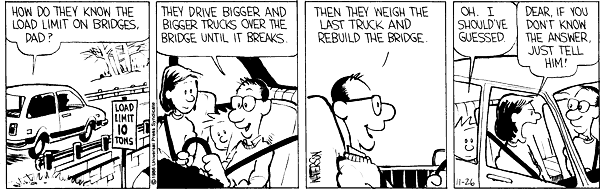
Have you ever wondered how a structural engineer knows how strong a bridge will be? Well Calvin of Calvin and Hobbes sure did. Take a minute to read this cartoon.
Calvin's dad is not correct (he's joking!), but he is not totally wrong either. In fact, structural engineers rely on testing to know how strong individual components of bridges are. In structural engineering research labs, engineers test different materials and configurations until they fail to find out all about how they behave under varying loads. Then, structural engineers can use that information to design safe bridges and other structures.
In this activity, you will play the role of a structural researcher who is interested in evaluating the strength of a standard design, called a truss, under two different load conditions: shear force (a force that acts perpendicular to a structural member) and compression force (a force that pushes inward on a structural member; the opposite of tension). You will build and test two trusses, and then, as a class, we will look at all the results to see what was strongest and what was weakest, and try to determine why.
Background
Review the procedure in full, including the test process.
Before the Activity
- Gather materials.
- Make one copy of the Truss Configurations Sign-Up Sheet (PDF) and post it in the classroom.
- Make copies of the Truss Destruction Worksheet (PDF), one per student.
- On test day, find a place outdoors to conduct the testing.
With the Students
- Gauge students' understanding of the forces that will be exhibited during the activity by asking them: What is the difference between compression forces and shear forces? (See the answer in the Assessment section.)
- Present the Introduction/Motivation section.
- Have the class form into groups of three or four students each. Groups of three are best; use groups of four only if class size or budget dictates.
- Hand out the worksheets for students to complete during the activity.
- Tell the students: It is important that you carefully follow these instructions: In your groups of 3-4 students, each group should select one of the eight typical truss configurations on a sign-up sheet that I have posted in the room (truss designs also shown in Figure 1). We want every design to be chosen by a least one team, but no more than three groups.
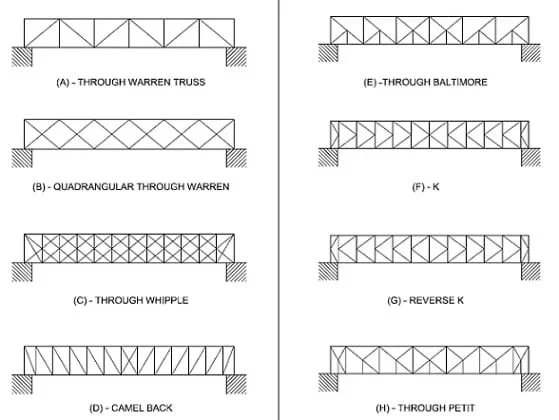 Figure 1: Typical railroad bridge truss configurations.Copyright 2013 Darcie Chinnis, College of Engineering, University of Colorado Boulder
 - Give groups a chance to each select a typical truss configuration using the sign-up sheet. Verify that all configurations have been selected and that no more than three groups have chosen the same configuration.
- Have each student determine how they will connect their Popsicle sticks for the sides. Tell the students: Now that your group has determined which of the typical configurations you would like to investigate, we need you to discuss how you will build it. The configuration that you have selected will form the sides of your truss. So next, you need to determine how each member of your group will construct the sides. There are different ways to join the Popsicle sticks (three methods are shown in Figure 2, which is also on the sign-up sheet). Each member of each team chooses a unique way that they will join the truss members while building the same truss as the rest of the group.
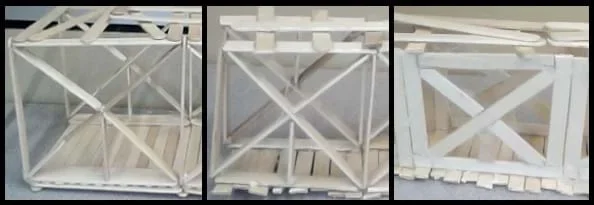 Figure 2: Three different joint style configurations, from left to right: butt joints, notched joints and overlapping joints.Copyright 2013 Skyline High School, Longmont CO. Used with permission.
 - Inform groups about building together the tops and bottoms of the truss (see Figure 3). Tell the students: As a group, determine how you will connect the two sides of your truss. In other words, decide how you will build the top and bottom of your truss that connects your two vertical pieces together. Every member of the group should build the top and bottom in the same manner.
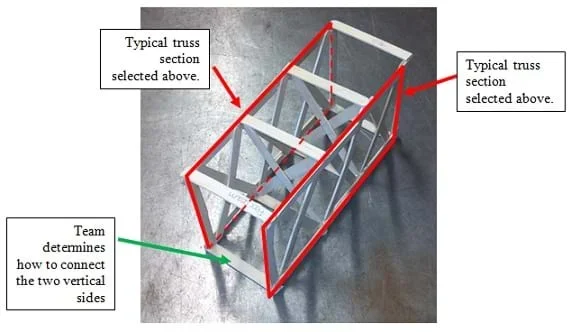 Figure 3: An example of how one student group decided to connect their two vertical sections using straight floor and ceiling beams, and diagonal cross-bracing between.Copyright 2013 Darcie Chinnis, College of Engineering, University of Colorado Boulder.
 - Tell the students: Once you have completed your planning, each member of each team needs to construct two identical versions of that same truss, since they will be tested to failure in two different tests.
- Tell the students: To summarize, each group selects a truss style. Each team member decides on a way to build that same truss using different joint styles, and then constructs two identical versions, one for compression testing and one for shear testing. Thus, a group of three students will end up with six total trusses, two identical copies of each of the three joint construction styles.
- Tell the students: Prior to testing, each completed truss section will be weighed. The weight will be used to normalize the results, which makes the results less dependent on the amount of glue and Popsicle sticks used. Testing will involve loading the trusses until they fail, and the amount of weight it took to make them fail will be recorded.
- As with all engineering projects, you have constraints to work within:
- Each team must select a typical truss and all members of that team must build that same truss configuration.
- Each team must agree on the design to connect the two truss pieces together (that is, the top and bottom of the truss).
- Each member of the team must determine a different manner of attaching the Popsicle sticks to each other on the vertical truss sections.
- Each member of the team must construct two identical versions of his/her truss. That means that a team of three will have six testable trusses completed at the end of the building phase.
- Your overall truss must be 8-12 inches (20-30 cm) long, 3-5 inches (7.5-12.5 cm) tall and 3-5 inches (7.5-12.5 cm) wide.
- You may use up to 35 Popsicle sticks per truss, no more. You are permitted to use fewer.
- You will use hot glue to connect the Popsicle sticks, and are permitted to use as much glue as you want. But keep in mind that glue is heavy and it is the weakest part of your truss, so you want to be very judicious when using the glue.
- When we test, everyone should be there to watch. We want to you to carefully observe how your truss fails. Do the Popsicle sticks break? Do the joints fail? Does the truss rack? Racking is when a regular polygon collapses without the length of the sides changing (draw Figure 4 on the classroom board). An example of racking is a square that when put under a compressive force, its right angles collapse. It is no longer a square, but a general rhombus shape, which is a type of parallelogram.
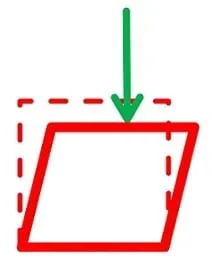 Figure 4: Regular polygons, if not reinforced with triangles, can collapse, which is called racking.Copyright 2013 Darcie Chinnis, College of Engineering, University of Colorado Boulder
 - After testing is complete, each group will normalize their test results (write the following information on the classroom board). Once you have your normalized test results, report those back to the teacher to compile the results of the class.
Wtruss = weight of truss (in pounds)
Wshear = weight of sand (and bucket) that caused the truss to fail in shear
Wcomp = weight of sand (and bucket) that caused the truss to fail in compression
Sshear = Wshear / Wtruss (normalized shear strength)
Scomp = Wcomp / Wtruss (normalized compressive strength)
- To wrap up the activity, each group prepares a 2-4 minute presentation summarizing their design process and findings and that includes the following information:
- The typical truss configuration they selected and why (even if that "why" is "because it looked cool")
- How they constructed the top and bottom of the truss and why.
- For each group member, how s/he constructed the joints and why.
- For each truss under each test, how the truss performed, its non-normalized and normalized strengths, and a description of how it failed.
- Their predictions of the performances of other groups and comparison to the actual performances.
- Two rankings per group, one for shear and one for compression, comparing their construction methods.
- An explanation of the fundamental difference between shear and compression testing, and why engineers perform structural failure testing such as this.
- Lots of pictures!
- Have students build their trusses, allowing at least two 90-minute class periods to build. Emphasize that it is important to be careful when building because good craftsmanship is important to the performance of the truss.
- After all groups have finished building, go around the room and have students, in two sentences, describe their truss configuration and details of their construction. Have them also record this information on the worksheet. Have each student record performance predictions, giving their classmates each a score from 1 to 5 for both compression and shear testing, where 1 indicates very weak and 5 indicates very strong.
- Have students predict relative performance (via ranking) of their trusses and others for both testing methods, recording this on their worksheets.
- Conduct the testing, following the Test Procedure described below.
- Have students record on their worksheets the data for their team trusses (truss weight, weight that caused shear failure, and weight that caused compressive failure), as well as descriptions of how they failed.
- Have students calculate their normalized strengths and give those results to the instructor to be compiled.
- Have students prepare and deliver their presentations, meeting the presentation requirements mentioned earlier.
- Conclude with the post-activity exercises, as described in the Assessment section.
Test Procedure
- Test set-up:
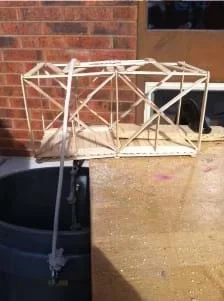 Figure 5: Shear testing configuration.Copyright 2013 Skyline High School, Longmont, CO. Used with permission.
- Tie a length of rope to the bucket to allow it to be hung over the trusses for testing.
- Gather the remaining testing supplies.
- Shear Testing (see Figure 5)
- Weigh the truss on the scale and record its weight.
- Place the truss at the edge of a table with half of the truss hanging over the table edge.
- Use a clamp to secure the other end of the truss to the table. It may be useful to have small pieces of wood to create good clamping spots.
- Hang the empty bucket over the cantilevered section of the truss, midway between the edge of the table and the end of the truss.
- Direct students to observe the truss as it is loaded to failure.
- Slowly pour sand into the bucket until the truss snaps. When the truss breaks, weigh the bucket with sand and record the weight.
- Discuss quickly with the student how the truss failed. Did the joints break apart? Did it rack until it collapsed? Did the Popsicle sticks break?
- Compression Testing (see Figure 6)
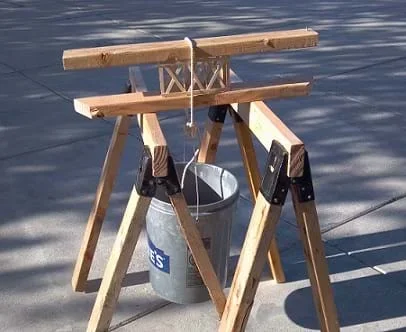 Figure 6: Compression testing configuration.Copyright 2013 Skyline High School, Longmont, CO. Used with permission.
- Weigh the truss and record its weight.
- Sandwich the truss between two 2x4s, and place together across two tables or two saw horses.
- Hang the empty bucket below the middle of the truss sandwich.
- Direct students to observe as the truss is loaded to failure.
- Slowly pour sand into the bucket until the truss snaps. Multiple buckets of sand may be required for all trusses to fail. If only one bucket is available and the truss does not break under full compression (full bucket), have either the instructor or student push down on the top 2x4 to add additional weight. When the truss breaks, weigh the bucket with the sand and record the weight. If the truss failed to break under the pressure of the sand alone and required force, make a note of that. If the truss failed to break even with sand and force, note that.
- Discuss quickly with the student how the truss failed. Did the joints break apart? Did it rack until it collapsed? Did the Popsicle sticks break? What would you do next time to improve your design?
- compression
- A force that pushes inward on a structural member. The opposite of tension.
- normalized
- Removing the influence of a single variable to isolate the impact of another variable.
- shear
- A force that acts perpendicular to a structural member.
- tension
- A force that pulls outward on a structural member. The opposite of compression.
- truss
- A structural configuration in which individual structural members are joined to provide increased strength over a single member (or beam).
Pre-Activity Assessment
Class Discussion: Ask students to describe the difference between compression forces and shear forces. (Answer: Compression forces act along the axis of a structural member, such as pushing straight down on a concrete column, and cause the structural member to buckle or bend when the forces get too high. Shear forces act across a structural member, such as pushing down on a cantilevered beam, and cause the structural member to bend or snap off when the forces get too high.)
Activity Embedded Assessment
Prediction: Have students predict relative performance (via ranking) of their trusses and others for both testing methods.
Class Discussion: Actively engage students in discussion during the testing of how each model truss failed.
Team Presentations: To wrap up the activity, have each group prepare a 2-4 minute presentation to summarize their design process and findings, meeting specified presentation requirements (as listed in the Procedure section).
Post-Activity Assessment
Analyze Your Truss: Have students evaluate the predicted performances against actual performances. Which configurations and construction methods proved to be the strongest under each of the two load conditions?
Communicate! Have students analyze and report on their own process by answering the same questions described in the Procedure section regarding how the truss failed during the shear and compression testing and presenting their answers to the class. These questions include:
- Discuss how the truss failed.
- Did the joints break apart?
- Did it rack until it collapsed?
- Did the Popsicle sticks break?
As an extra step, have students develop sales pitches for their truss configuration to sell the designs to a construction company.
- Loading to failure causes the Popsicle sticks trusses to explode. Be sure that all students and any other nearby observers wear safety glasses at all times.
- Take appropriate precautions as students use hot glue guns and cut Popsicle sticks.
- Be cautious during testing to avoid feet underneath the bucket, which crashes to the ground when a truss collapses.
- It is highly recommended that testing take place outside since large amounts of particulate dust are released into the air when sand is poured into the buckets and as the buckets crash to the ground.
Expand the structural design component into a larger project. Based on the reported relative strength of the different truss sections, have students, working in the same groups, construct a single bridge. They can use the typical truss sections original presented, or create their own based on what they witnessed and learned. Test the bridges using the compression evaluation only, eliminating the need to build multiple trusses.
- For lower grades, test only in shear.
- For upper grades, such as AP-level physics students, consider introducing a simple nodal analysis of one or two truss configurations.
- Triangles & Trusses
- Truss Destruction
Contributors
Darcie Chinnis; Amanda Guiliani; Scott Duckworth; Malinda Schaefer Zarske
Supporting Program
Integrated Teaching and Learning Program, College of Engineering, University of Colorado Boulder
Acknowledgements
The contents of these digital library curricula were developed by the Integrated Teaching and Learning Program under National Science Foundation GK-12 grant no. 0338326. However, these contents do not necessarily represent the policies of the National Science Foundation, and you should not assume endorsement by the federal government.
Copyright
2013 by Regents of the University of Colorado