
Bombs Away! Egg Drop Experiment
Students design and build devices to protect and accurately deliver dropped eggs. The devices and their contents represent care packages that must be safely delivered to people in a disaster area with no road access. Similar to engineering design teams, students design their devices using a number of requirements and constraints such as limited supplies and time. The activity emphasizes the change from potential energy to kinetic energy of the devices and their contents and the energy transfer that occurs on impact. Students enjoy this competitive challenge as they attain a deeper understanding of mechanical energy concepts.
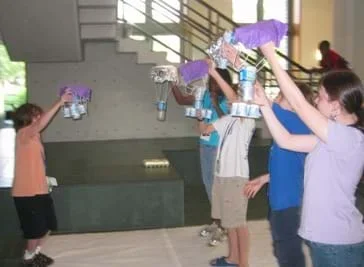 A number of disaster relief packages ready to drop from a low height.Copyright 2005 Paul Klenk, Pratt School of Engineering, Duke University
Natural disasters happen all over the world and can cause extreme damage and loss of life. The safe and accurate delivery of life-sustaining supplies to disaster relief efforts or military supply locations is an unpredictable real-world design challenge. Using the engineering design process, limited supplies and an egg to represent perishable supplies, students design, create and test their devices in an effort to investigate problems associated with supply delivery in remote regions. They mimic the process engineers use when designing devices for airdrop supplies.
After completion of this activity, students should be able to:
- Explain what natural disasters are.
- Explain that engineers design and build devices to help people.
- Explain why supplies might need to be dropped from a plane rather than delivered by a car or truck.
- Identify materials that cushion impact.
- Explain the difference between kinetic and potential energy.
- Understand the engineering design process.
- CCSS.Math.Content.5.G.A.2 Represent real world and mathematical problems by graphing points in the first quadrant of the coordinate plane, and interpret coordinate values of points in the context of the situation.
Grade 5
Do you agree with this alignment? - CCSS.Math.Content.5.MD.B Represent and interpret data.
Grade 5
Do you agree with this alignment? - CCSS.Math.Content.6.SP.B.4 Display numerical data in plots on a number line, including dot plots, histograms, and box plots.
Grade 6
Do you agree with this alignment?
- There is no perfect design.
Grades 6-8
Do you agree with this alignment? - Requirements for design are made up of criteria and constraints.
Grades 6-8
Do you agree with this alignment? - Brainstorming is a group problem-solving design process in which each person in the group presents his or her ideas in an open forum.
Grades 6-8
Do you agree with this alignment? - Make two-dimensional and three-dimensional representations of the designed solution.
Grades 6-8
Do you agree with this alignment? - Energy is the capacity to do work.
Grades 6-8
Do you agree with this alignment? - Energy can be used to do work, using many processes.
Grades 6-8
Do you agree with this alignment? - STEL-3F Apply a product, system, or process developed for one setting to another setting.
Grades 6-8
Do you agree with this alignment? - STEL-7J Evaluate designs based on criteria, constraints, and standards.
Grades 3-5
Do you agree with this alignment? - STEL-7R Refine design solutions to address criteria and constraints.
Grades 6-8
Do you agree with this alignment? - STEL-7S Create solutions to problems by identifying and applying human factors in design.
Grades 6-8
Do you agree with this alignment?
- MS-ETS1-1 Define the criteria and constraints of a design problem with sufficient precision to ensure a successful solution, taking into account relevant scientific principles and potential impacts on people and the natural environment that may limit possible solutions.
Grades 6-8
This resource focuses on the following Three Dimensional Learning aspects of NGSS:
Science & Engineering Practices- Define a design problem that can be solved through the development of an object, tool, process or system and includes multiple criteria and constraints, including scientific knowledge that may limit possible solutions.Do you agree with this alignment?
Disciplinary Core Ideas- The more precisely a design task's criteria and constraints can be defined, the more likely it is that the designed solution will be successful. Specification of constraints includes consideration of scientific principles and other relevant knowledge that is likely to limit possible solutions.Do you agree with this alignment?
Crosscutting Concepts- The uses of technologies and any limitations on their use are driven by individual or societal needs, desires, and values; by the findings of scientific research; and by differences in such factors as climate, natural resources, and economic conditions.Do you agree with this alignment?
- All human activity draws on natural resources and has both short and long-term consequences, positive as well as negative, for the health of people and the natural environment.Do you agree with this alignment?
Do you agree with this alignment? - Define a design problem that can be solved through the development of an object, tool, process or system and includes multiple criteria and constraints, including scientific knowledge that may limit possible solutions.
- MS-ETS1-2 Evaluate competing design solutions using a systematic process to determine how well they meet the criteria and constraints of the problem.
Grades 6-8
This resource focuses on the following Three Dimensional Learning aspects of NGSS:
Science & Engineering Practices- Evaluate competing design solutions based on jointly developed and agreed-upon design criteria.Do you agree with this alignment?
Disciplinary Core Ideas- There are systematic processes for evaluating solutions with respect to how well they meet the criteria and constraints of a problem.Do you agree with this alignment?
Do you agree with this alignment? - Evaluate competing design solutions based on jointly developed and agreed-upon design criteria.
- CCSS.Math.Content.5.MD.B Represent and interpret data.
Grade 5
Do you agree with this alignment? - CCSS.Math.Content.6.SP.B.4 Display numerical data in plots on a number line, including dot plots, histograms, and box plots.
Grade 6
Do you agree with this alignment?
- 6.P.3 Understand characteristics of energy transfer and interactions of matter and energy.
Grade 6
Do you agree with this alignment? - 7.P.2 Understand forms of energy, energy transfer and transformation and conservation in mechanical systems.
Grade 7
Do you agree with this alignment? - 7.P.2.1 Explain how kinetic and potential energy contribute to the mechanical energy of an object.
Grade 7
Do you agree with this alignment? - 7.P.2.2 Explain how energy can be transformed from one form to another (specifically potential energy and kinetic energy) using a model or diagram of a moving object (roller coaster, pendulum, or cars on ramps as examples).
Grade 7
Do you agree with this alignment?
Give each student team the same amount of materials to build their devices. Suggested supplies are listed below, but feel free to be creative in what materials you make available. Scissors are the only tool they need.
- 1 raw egg (buy extras as inevitably some get broken before testing)
- tape, 2 feet; more tape makes the activity easier and less tape makes it more difficult so scale as you like
- white glue, such as Elmer's Glue
- a drop target, such as a dot painted on a grassy field, chalk on a sidewalk, etc.; it is important to be able to measure the distance from the target to the actual impact spots
- 1 measuring device, such as a ruler, yardstick or tape measure
- 10 sheets of paper, such as 8.5" x 11 copy paper, but any kind will do
- 1 large black plastic trash bag
- 10 pipecleaners
- 15 cottonballs
- 3 wide rubberbands
- 10 Popsicle sticks
- yarn, 6 feet
Feel free to be creative and include additional supplies or remove supplies from the above list. Alternate or additional supply ideas: foil, grocery bags, plastic straws, toothpicks or shaving cream. Consider including small rocks that may provide weight to keep device parts in place. When choosing materials, remember that some materials, like cardboard and foamcore board, make this task too easy, especially for older students. On the other hand, additional materials provide opportunities for student creativity.
An understanding of the concepts of energy transfer, conservation of energy, potential energy and kinetic energy, as presented in the Move It! associated lesson.
(In addition to the information below, the associated lesson, Move It!, provides an introduction to this activity. The activity motivation is also discussed in the Assessment and Lesson Extension sections.)
Do you know what natural disasters are? Have you ever experienced one? (Listen to student responses). Natural disasters are natural events like floods, earthquakes, and hurricanes that cause significant damage and sometimes even loss of life. These natural disasters can make basic human needs like food, water, and shelter inaccessible due to compromised infrastructure.
Have you ever heard of disaster relief supply package drops? (Listen to student responses.) Disaster relief groups and the armed forces must deliver life-sustaining and sometimes delicate supplies of food and equipment to people in areas very difficult to reach, often where no nearby roads, trains or airports are located.
These supplies must reach designated landing areas accurately and intact. When things do not go as planned, bags of food can burst from the impact, and sometimes supplies completely miss the target landing areas. (Read aloud to students a 1994 news article about emergency food airdrops that landed off target in Zaire.)
Your engineering challenge today is to apply what you know about the engineering design process and energy (potential, kinetic, conservation of energy) to attempt to solve this real-life problem by testing techniques for dropping precious supplies (hold up an egg), as represented by a fragile raw egg, accurately and safely from a designated height. Let's get started!
A number of disaster relief packages ready to drop from a low height.Copyright 2005 Paul Klenk, Pratt School of Engineering, Duke University
Before the Activity
- Find a good spot from which to make the test airdrops. Ideally, drop the devices from three or four different heights such as 3, 6 (if the teacher holds it above their head), 15 feet (a second story window) and higher, if possible.
- Mark a target directly beneath the drop point (such as second story window). If the landing area is soft, place a piece of plywood or concrete blocks under the target to make the drop surface harder. For safety and uniformity reasons, have the teacher make (or at least closely monitor) all the airdrops.
- Gather materials and prepare equal supplies for each group. Refer to the Activity Scaling section for ideas on limiting supplies and creating more constraints that mimic real-world conditions.
- Decide on a time limit for students to design and create their projects, based on your classroom time constraints. This also mimics real-world conditions and usually helps students get focused to work quickly. Allow at least 25-30 minutes. Generally, the more time provided, the better the projects.
With the Students
- Divide the class into groups of two students each. Randomly divided groups better mimic how engineering problems require teamwork among people who may not know each other well nor get along. On the other hand, randomly divided groups may be more disruptive.
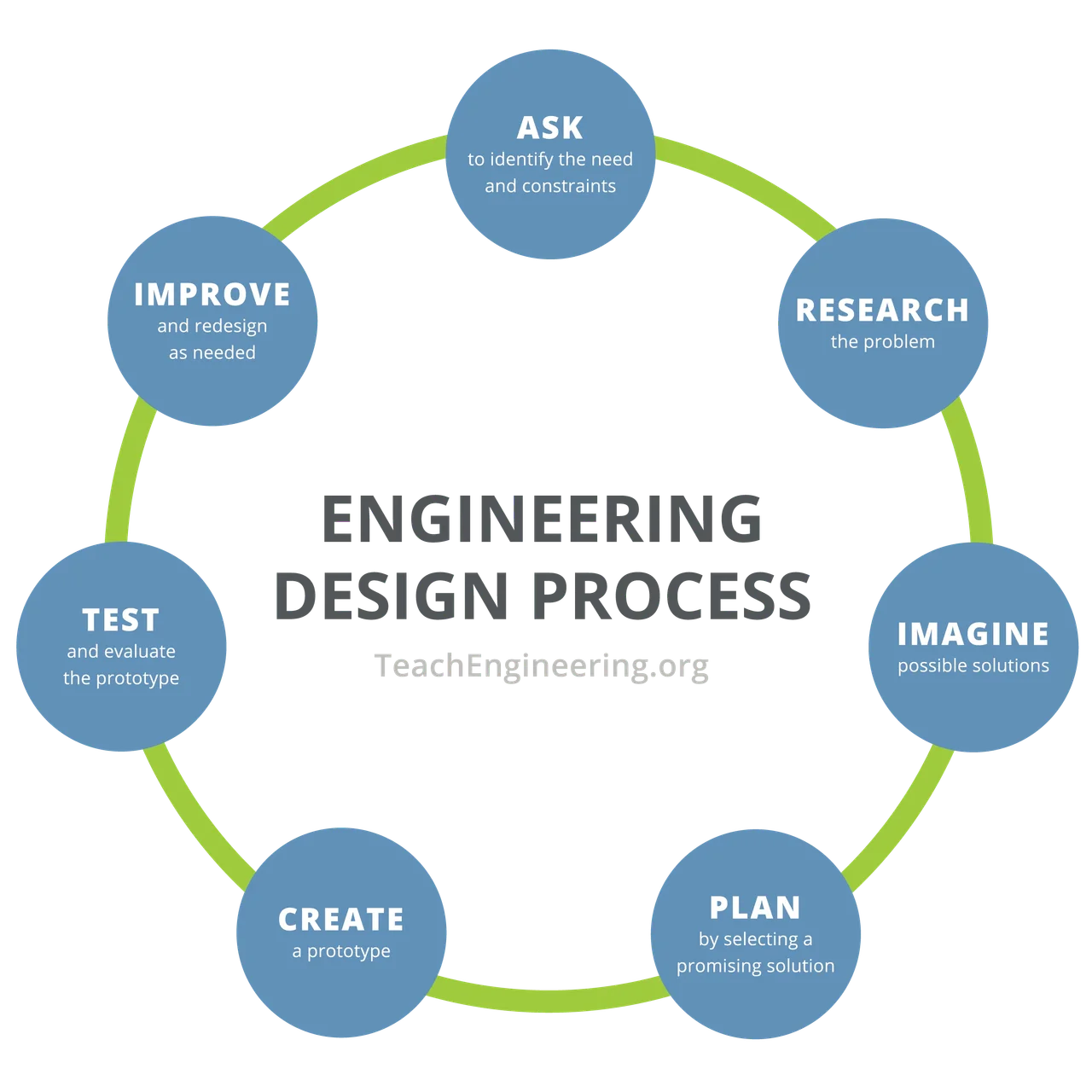
- Introduce the engineering design process by showing the students the image below, or write out the seven steps in a circle on the board. Explain that engineers use the engineering design process to solve problems and that the process is iterative and helps then learn from failure.
- Present the Introduction/Motivation content.
- EDP Step 1: Ask to Identify the Needs and Constraints. Inform students that engineers solve problems by first identifying the design requirements and constraints. For this design challenge, the requirements and constraints are:
- Design "something" that will protect your egg, which represents fragile relief supplies, so it survives the air drops.
- Not only must the dropped egg remain intact, but it must land close to the target area.
- Your building supplies are limited to what you are provided by the teacher.
- Your egg protection system will be tested from more than one height. (Tell students the heights.)
- You must leave some way for the teacher to check after each test drop to determine whether the egg is intact or has cracked. One simple method is to leave an opening or some access where the teacher can poke the egg with a finger. Feeling something wet or a flexing shell indicates that the egg has broken.
- You have __ minutes.
- EDP Step 3: Imagine Possible Solutions. Direct students to brainstorm in their teams and then design their devices by making drawings along with short paragraphs that describe what they want to do and why. This is what engineers do. Doing this also encourages students to communicate their ideas to others, which is important when they work in groups, and helps them to analyze their ideas for merit.
- EDP Step 4: Plan by Selecting a Promising Solution. Ask students to revisit the needs, constraints and research from the earlier steps, compare their best ideas, select one solution and make a plan to move forward with it.
- Hand out the supplies, including the eggs. Warn students to be careful with the fragile cargo. Inform them that if they accidentally break an egg, they face a penalty (such as a loss of a few minutes of working time or loss of materials, in addition to cleaning up the mess).
- EDP Step 5: Create a Prototype. Have students work together to create the design they decided on with the materials they have available.
- EDP Step 6: Test and Evaluate the Prototype. When the prototyping/building time is up, ask teams to bring their designs to the drop location. Perform the egg drop from the 3-foot height. Be sure the entire apparatus is above the required height. Test for broken eggs and ask students to measure and record the distances from the target.
- Egg packages that survive the first height move on to the second height. If the teacher drops the egg, be sure to have the students indicate the desired way to drop it, as it may require a certain orientation to be most effective. Drop the eggs and test for broken shells. Ask students to help measure and record the distances from the designated target. Repeat until either all the eggs are broken or you run out of heights or rounds.
- Have each group discuss what they did and how their designs were intended to protect the eggs and ensure they landed close to the target. Make sure they describe what did and did not work about their designs, as well as what they might do to make them better. Ask them to relate their explanations to kinetic and potential energy and discuss how their designs dissipated energy without cracking the eggs. The most successful group is the one that survived the longest and achieved the least total distance from the target.
- Have each group discuss how they could alter and improve their prototype to work in the aftermath of a natural disaster.
- force
- Anything that tends to change the state of rest or motion of an object. Force is represented by two quantities; its magnitude and direction in space. The magnitude of a force is represented by quantities such as pounds, tons or Newtons. Direction in space refers literally to the direction a force is applied. This means that force is a vector and requires two pieces of information to define it completely. When a number of forces act simultaneously on an object, the object moves as if acted on by a single force with a magnitude and direction that are the sum of the applied forces.
- vector
- A quantity that has both magnitude and direction. Example vector quantities include velocity, weight and force. Alternatively, speed and mass are NOT vector quantities and can be represented by their magnitudes.
- mass
- A measure of how much matter an object contains, or the total number of particles in an object. Mass is not weight. Weight is the force caused on a mass by gravity. Thus, a person's mass would not change on different planets, but their weight would. For instance, you would weigh about 1/6th of your body weight now if you were on the moon.
- velocity
- A vector quantity whose magnitude is an object's speed and whose direction is in the object's direction of motion. Velocity is different from speed because velocity describes a direction as well.
- energy
- The capacity to do work. Several different types of energy include: mechanical, heat, electrical, magnetic, chemical, nuclear, sound or radiant. For purposes of this activity and its associated lesson, we are focused primarily on mechanical energy since it is the energy of motion.
- potential energy
- The energy of a particle or system of particles resulting from position, or condition. Gravitational potential energy is based on how high off of the ground an object is while other forms of potential energy include springs, batteries or fuel.
- kinetic energy
- The energy possessed by an object because of its motion.
- impact
- The striking of one object against another; collision.
- acceleration
- The rate of change of velocity with respect to time. The measure of how fast the velocity of an object increases or decreases.
- natural disaster
- a natural event such as a flood, earthquake, or hurricane that causes great damage or loss of life.
- As a class, plot the distances away from the target that each egg lands, with the height on the x-axis and the distance away from the target on the y-axis. Use different colors to plot the different groups, and discuss reasons why some designs may have been more accurate than others. How does the accuracy change as the height is increased?
- Design Explanations: Review team designs to be sure students understand the concept of mechanical energy. One method to measure comprehension is to have students draw their designs and write short paragraphs explaining in their own words why they think their designs ensure safe, accurate drops.
- Design Evaluations: Listen to student descriptions of their devices and results. How well did students design their devices for different drops? Do they understand what worked and what didn't? Perhaps most importantly, do they understand why particular designs did not work?
- Energy Questions: Ask students to explain how energy is transferred when the egg is released until it impacts the ground. The importance of this question is to connect the material from this engineering design activity to the associated lesson on types of mechanical energy. Cover the material in the lesson either before or after the activity.
- Scissors and supplies are the primary sources of danger. Be sure students use proper caution.
- If dropping from a height such as a second story window, be sure to maintain proper supervision of students near the window. For greatest safety on higher drops, have only the teacher drop the eggs.
- Be sure the drop location remains clear for quite a surrounding distance, especially on a windy day. Falling eggs could harm someone, and raw eggs are messy and unsanitary.
Students may accidently break their eggs when building their devices. Implement a small penalty for the first infraction, perhaps a loss of time or materials, as well as the task to clean up the mess.
Beware that broken eggs left outside of a refrigerated environment smell really bad when broken.
If this seems like too much to accomplish in one day, divide the activity into three sections: design, creation and testing.
- For more advanced students, reduce the amount of supplies.
- Make the challenge harder by providing many supplies, but limiting the total package weight to not much more than the weight of the egg. This requires an accurate scale, but the additional constraint more accurately represents the real-world problem. Since aircraft have a limited cargo weight capacity, dropped packages usually have a maximum allowable weight. This may require some testing on the part of the teacher to determine what the maximum allowable weight should be.
- Make the challenge more demanding by adding an economic aspect to the activity. Assign prices to the supplies and give each group a limited budget with which to purchase supplies.This takes more time, but improves the overall understanding of real-world engineering problems by adding a financial constraint. One method for doing this in a similar activity is described in the Egg-cellent Landing activity.
- For more advanced students, either limit the types of materials that make good parachutes (no plastic or large sheets of paper, challenging students to devise creative ways to make parachutes) or eliminate parachutes entirely.
Integrated Regional Information Networks. United Nations. http://www.irinnews.org/
Olojede, Dele. Posted July 25, 1994. U.S. Food Drop Misses Mark for Rwanda Refuges: Pallets Land Off Target, Spill,While Sanitation Crisis Waits. Newsday. Seattle Times Company. Accessed June 17, 2014. http://community.seattletimes.nwsource.com/archive/?date=19940725&slug=1922123
- Move It! Conservation of Energy & Energy Transfer in Crashes
- Bombs Away! Egg Drop Experiment
Contributors
Randall Evans; Dan Choi
Supporting Program
Engineering K-PhD Program, Pratt School of Engineering, Duke University
Acknowledgements
This content was developed by the MUSIC (Math Understanding through Science Integrated with Curriculum) Program in the Pratt School of Engineering at Duke University under National Science Foundation GK-12 grant no. DGE 0338262. However, these contents do not necessarily represent the policies of the NSF, and you should not assume endorsement by the federal government.
Copyright
2013 by Regents of the University of Colorado; original © 2005 Duke University