
Strum Along with Shoebox Stringed Instruments: Sound or Music?
Music and sound are two different concepts that share much in common. Determining the difference between the two can sometimes be difficult due to the subjective nature of deciding what is or is not music. The goal of this activity is to take something constructed by students, that would be normally classified as just sound and have the class work together to make what can be perceived to be music. Students construct basic stringed instruments made of shoeboxes and rubber bands. This activity aims to increase student understanding of what distinguishes music from sound.
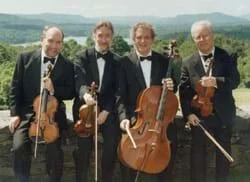 The Julliard String Quartet.Copyright Julliard College
Engineers must understand the relationship between pitch and the natural frequency of various materials to design instruments that produce beautiful music.
After this activity, students should be able to:
- Manipulate a homemade instrument to change the pitches produced and work together as part of a class to make a song.
- Create an instrumental song to demonstrate an understanding of the relationships between changing physical components and frequency.
- CCSS.Math.Content.5.G.A Graph points on the coordinate plane to solve real-world and mathematical problems.
Grade 5
Do you agree with this alignment? - CCSS.Math.Content.5.G.A.2 Represent real world and mathematical problems by graphing points in the first quadrant of the coordinate plane, and interpret coordinate values of points in the context of the situation.
Grade 5
Do you agree with this alignment? - CCSS.Math.Content.6.EE.C.9 Use variables to represent two quantities in a real-world problem that change in relationship to one another; write an equation to express one quantity, thought of as the dependent variable, in terms of the other quantity, thought of as the independent variable. Analyze the relationship between the dependent and independent variables using graphs and tables, and relate these to the equation.
Grade 6
Do you agree with this alignment? - CCSS.Math.Content.7.RP.A.2c Represent proportional relationships by equations.
Grade 7
Do you agree with this alignment? - CCSS.Math.Practice.MP4 Model with mathematics.
Grades K-12
Do you agree with this alignment?
- Some technological problems are best solved through experimentation.
Grades 6-8
Do you agree with this alignment? - STEL-1J Develop innovative products and systems that solve problems and extend capabilities based on individual or collective needs and wants.
Grades 6-8
Do you agree with this alignment?
- MS-PS4-1 Use mathematical representations to describe a simple model for waves that includes how the amplitude of a wave is related to the energy in a wave.
Grades 6-8
This resource focuses on the following Three Dimensional Learning aspects of NGSS:
Science & Engineering Practices- Use mathematical representations to describe and/or support scientific conclusions and design solutions.Do you agree with this alignment?
- Science knowledge is based upon logical and conceptual connections between evidence and explanations.Do you agree with this alignment?
Disciplinary Core Ideas- A simple wave has a repeating pattern with a specific wavelength, frequency, and amplitude.Do you agree with this alignment?
Crosscutting Concepts- Graphs and charts can be used to identify patterns in data.Do you agree with this alignment?
Do you agree with this alignment? - Use mathematical representations to describe and/or support scientific conclusions and design solutions.
- CCSS.Math.Content.5.G.A Graph points on the coordinate plane to solve real-world and mathematical problems.
Grade 5
Do you agree with this alignment? - CCSS.Math.Content.5.G.A.2 Represent real world and mathematical problems by graphing points in the first quadrant of the coordinate plane, and interpret coordinate values of points in the context of the situation.
Grade 5
Do you agree with this alignment? - CCSS.Math.Content.6.EE.C.9 Use variables to represent two quantities in a real-world problem that change in relationship to one another; write an equation to express one quantity, thought of as the dependent variable, in terms of the other quantity, thought of as the independent variable. Analyze the relationship between the dependent and independent variables using graphs and tables, and relate these to the equation.
Grade 6
Do you agree with this alignment? - CCSS.Math.Content.7.RP.A.2c Represent proportional relationships by equations.
Grade 7
Do you agree with this alignment? - CCSS.Math.Practice.MP4 Model with mathematics.
Grades K-12
Do you agree with this alignment?
- 6.P.3 Understand characteristics of energy transfer and interactions of matter and energy.
Grade 6
Do you agree with this alignment?
Each student needs:
- 1 empty shoebox, the kind with separate lids (ask students to bring some from home)
- 5-6 rubber bands, thick and thin
- scissors
- stapler
- Strum Along Worksheet (PDF)
Basic concepts of sound, as presented in the Sounds Like Music associated lesson.
(Play some music to spark students' interest, perhaps by playing a song on a guitar, asking the music teacher to play some guitar music, or play some other pre-recorded music that features guitars and/or stringed instruments. For example, a track of a recording by the L.A. Guitar Quartet is available for $0.99 from Apple iTunes at http://www.itunes.com.)
Listen to this. (Play the guitar music.) Today, you will individually - and as a group - create something similar to this. Let's get started!
Before the Activity
- Gather materials and make copies of the Strum Along Worksheet (PDF), one per student.
- Snip each rubber bank in one place so it becomes just a strip of rubber.
- At each student's desk, leave a shoebox, about 6 snipped rubber bands, stapler and scissors.
With the Students
- Have students remove the tops off their shoeboxes; they will not be used for this activity.
- Staple one end of one rubber band to a side of the box using three staples. Do this for two more rubber bands, all lined up next to each other.
- Then hold the other end of a rubber band against the opposite end of the open shoebox and pluck the rubber band. What do you hear? Experiment with pulling the band tighter and looser to see how that changes the sound.
- After experimenting, find three pitches that you are happy with and staple the ends of the three rubber bands to the other side of the open box using three staples per end.
- Now students have created their own stringed instruments! Direct students to work in groups of two or three to create a recognizable song using the instruments they just constructed.
- Re-stapling may be required to make the pitches of the boxes more "compatible."
- Have each instrumental group present its "song" to the class.
- Have the rest of the class guess what song was being attempted.
- Hand out and have students complete the Strum Along Worksheet (PDF).
- sound
- Vibrations transmitted through a medium, with frequencies in the range audible to humans.
- music
- Organized sounds.
- vibration
- A rapid motion of a particle or solid about a central position.
- frequency
- The number of complete cycles of a periodic process occurs per unit time.
- wavelength
- The distance between two consecutive "peaks" or between two consecutive "valleys" in a series of waves.
Pre-Activity Predictions
- What does the length of the rubber band have to do with the sound that the rubber band makes? Have them make a prediction. (Answer: Pitch)
- What will change if you pull the rubber band harder? Have them make a prediction. Answer: Volume)
- What is the difference is between sound and music? Explain. (Answer: Music is organized sound.)
Activity Embedded Questions
- What does the length of the rubber band have to do with the sound that the rubber band makes? How accurate was your prediction?
- What changes when you pluck the rubber band strongly vs. softly?
- Have students complete the Strum Along Worksheet (PDF), which involves a graphing exercise to emphasize the concepts above.
Post-Activity Assessment
- Did students make a cohesive and understandable song? If yes, then they have a good understanding of how the length of the rubber band affects the pitch produced.
- Can students explain the difference between music and sound?
- Did their worksheets indicate that they understand the relationship between the force applied to the rubber band and the volume? Could they relate the concept to energy and amplitude and express it mathematically?
- Rubber bands may snap, but using three staples to secure each end helps to prevent this.
- The teacher may want to perform the stapling.
Turn the shoeboxes upside down to turn the plucked instruments into percussive instruments. Conduct a similar experiment to examine the relationship between beats and rhythm by challenging students to create songs using only rhythms. Ask them what they think the difference is between a single beat caused by hitting the shoebox and a longer rhythm (teacher can beat a simple rhythm). In general, music is made of organized sound, while rhythm is made of organized beats.
- For older students (7th graders), have them examine the length of the rubber bands further. Have them precisely measure and cut different lengths of rubber bands, then document these lengths and explore whether length is the only factor in influencing the note the rubber band produces. Tension and thickness of the rubber band both influence the note the rubber band produces.
- For younger students (5th graders), exaggerate the different notes in order for students to notice them. To do this, make sure students choose rubber band lengths that are at least 2-inches different from each other. Another way to exaggerate the difference between rubber bands is by pulling one tightly while leaving the other alone.
- Sounds Like Music
- Strum Along with Shoebox Stringed Instruments: Sound or Music?
Contributors
Daniel Choi
Supporting Program
Engineering K-PhD Program, Pratt School of Engineering, Duke University
Acknowledgements
This content was developed by the MUSIC (Math Understanding through Science Integrated with Curriculum) Program in the Pratt School of Engineering at Duke University under National Science Foundation GK-12 grant no. DGE 0338262. However, these contents do not necessarily represent the policies of the NSF, and you should not assume endorsement by the federal government.
Copyright
2013 by Regents of the University of Colorado; original © 2005 Duke University