
Power for Developing Countries
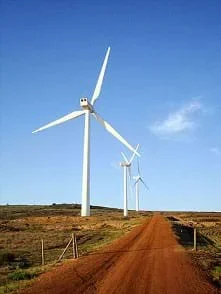 Wind turbines are one way to generate energy locally in some places in Africa.Copyright 2008 Warren Rohner, Wikimedia Commons https://commons.wikimedia.org/wiki/File:Darling_Wind_Farm.jpg
Working in groups, students look at three different villages in various parts of Africa and design economically viable engineering solutions to answer the energy needs of the off-the-grid small towns, given limited budgets. Each village has different nearby resources, both renewable and nonrenewable. Student teams conduct research, make calculations, consider the options and create plans, which they present to the class. Through their investigations and planning of custom solutions for each locale, they experience the real-world engineering research and analysis steps of the engineering design process.
While engineers face many technical challenges, often the hardest task is figuring out the appropriate approach to a problem. This is especially true for projects in developing countries. Simply "throwing" technology at a situation without researching and understanding the local landscape often causes more harm than good. Background research is an essential part of the engineering design process. While it may seem that this activity does not focus heavily on technical engineering and scientific principles, the most important parts of an engineering project often involve the effort to understand the local context and then appropriately strategize a design approach, as well as communicating and defending a design plan to others. Emphasizing with students that these aspects are integral parts to being an engineer helps them to avoid pitfalls and break stereotypes later in life.
After this activity, students should be able to:
- Explain the complications of real engineering projects while developing an awareness of the cultural, social, economic and political context surrounding such projects.
- Teach themselves about unfamiliar topics via background research, including sifting out sources that are too technical and/or irrelevant for the scope of understanding.
- Describe how electricity is extracted from different sources of energy, such as sun, wind, water, biomass, natural gas, etc.
- Analyze different technology options, and specifically for energy technologies, recognize the limitations of materials, the role of conversion efficiency, and environmental availability and impact.
- Design a tailored strategy to a challenging situation while defending and communicating the approach to others.
- CCSS.Math.Content.6.NS.B.3 Fluently add, subtract, multiply, and divide multi-digit decimals using the standard algorithm for each operation.
Grade 6
Do you agree with this alignment?
- Students will develop an understanding of the cultural, social, economic, and political effects of technology.
Grades K-12
Do you agree with this alignment? - Students will develop an understanding of the effects of technology on the environment.
Grades K-12
Do you agree with this alignment? - Students will develop an understanding of the attributes of design.
Grades K-12
Do you agree with this alignment? - Students will develop an understanding of engineering design.
Grades K-12
Do you agree with this alignment? - STEL-3E Analyze how different technological systems often interact with economic, environmental, and social systems.
Grades 6-8
Do you agree with this alignment? - STEL-4K Examine the ways that technology can have both positive and negative effects at the same time.
Grades 6-8
Do you agree with this alignment? - STEL-7S Create solutions to problems by identifying and applying human factors in design.
Grades 6-8
Do you agree with this alignment?
- MS-ESS3-4 Construct an argument supported by evidence for how increases in human population and per-capita consumption of natural resources impact Earth's systems.
Grades 6-8
This resource focuses on the following Three Dimensional Learning aspects of NGSS:
Science & Engineering Practices- Construct an oral and written argument supported by empirical evidence and scientific reasoning to support or refute an explanation or a model for a phenomenon or a solution to a problem.Do you agree with this alignment?
Disciplinary Core Ideas- Typically as human populations and per-capita consumption of natural resources increase, so do the negative impacts on Earth unless the activities and technologies involved are engineered otherwise.Do you agree with this alignment?
Crosscutting Concepts- Cause and effect relationships may be used to predict phenomena in natural or designed systems.Do you agree with this alignment?
- Scientific knowledge can describe the consequences of actions but does not necessarily prescribe the decisions that society takes.Do you agree with this alignment?
- All human activity draws on natural resources and has both short and long-term consequences, positive as well as negative, for the health of people and the natural environment.Do you agree with this alignment?
Do you agree with this alignment? - Construct an oral and written argument supported by empirical evidence and scientific reasoning to support or refute an explanation or a model for a phenomenon or a solution to a problem.
- MS-ETS1-1 Define the criteria and constraints of a design problem with sufficient precision to ensure a successful solution, taking into account relevant scientific principles and potential impacts on people and the natural environment that may limit possible solutions.
Grades 6-8
This resource focuses on the following Three Dimensional Learning aspects of NGSS:
Science & Engineering Practices- Define a design problem that can be solved through the development of an object, tool, process or system and includes multiple criteria and constraints, including scientific knowledge that may limit possible solutions.Do you agree with this alignment?
Disciplinary Core Ideas- The more precisely a design task's criteria and constraints can be defined, the more likely it is that the designed solution will be successful. Specification of constraints includes consideration of scientific principles and other relevant knowledge that is likely to limit possible solutions.Do you agree with this alignment?
Crosscutting Concepts- The uses of technologies and any limitations on their use are driven by individual or societal needs, desires, and values; by the findings of scientific research; and by differences in such factors as climate, natural resources, and economic conditions.Do you agree with this alignment?
- All human activity draws on natural resources and has both short and long-term consequences, positive as well as negative, for the health of people and the natural environment.Do you agree with this alignment?
Do you agree with this alignment? - Define a design problem that can be solved through the development of an object, tool, process or system and includes multiple criteria and constraints, including scientific knowledge that may limit possible solutions.
- MS-ETS1-2 Evaluate competing design solutions using a systematic process to determine how well they meet the criteria and constraints of the problem.
Grades 6-8
This resource focuses on the following Three Dimensional Learning aspects of NGSS:
Science & Engineering Practices- Evaluate competing design solutions based on jointly developed and agreed-upon design criteria.Do you agree with this alignment?
Disciplinary Core Ideas- There are systematic processes for evaluating solutions with respect to how well they meet the criteria and constraints of a problem.Do you agree with this alignment?
Do you agree with this alignment? - Evaluate competing design solutions based on jointly developed and agreed-upon design criteria.
- CCSS.Math.Content.6.NS.B.3 Fluently add, subtract, multiply, and divide multi-digit decimals using the standard algorithm for each operation.
Grade 6
Do you agree with this alignment?
- 6.P.3.3 Explain the suitability of materials for use in technological design based on a response to heat (to include conduction, expansion, and contraction) and electrical energy (conductors and insulators).
Grade 6
Do you agree with this alignment? - 8.P.2.1 Explain the environmental consequences of the various methods of obtaining, transforming and distributing energy.
Grade 8
Do you agree with this alignment? - 8.P.2.2 Explain the implications of the depletion of renewable and nonrenewable energy resources and the importance of conservation.
Grade 8
Do you agree with this alignment?
Each group needs:
- computer with Internet access and presentation software (such as Microsoft PowerPoint® or Prezi), to conduct research and create presentations; if presentation software is not available or familiar to students, have them just talk and/or use other student-made visual aids
- Pre-Activity Reading List (PDF), one per student
- Guiding Questions and Suggested Resources (PDF)
- Presentation Scoring Rubric (PDF)
- projector, to show the presentations to the class (shared by all groups)
Have you imagined what life would be like without electricity or running water? Many people in developing countries live this way. Especially in remote village, often no reliable electrical grid exists to which they can connect their houses. However, an abundance of natural resources are often available, such as sun, wind and geothermal potential, thus each region has a different energy solution suited for it. In addition, most non-governmental organizations (NGOs) and companies seeking to assist these regions are on limited budgets. In today's activity, you will gain an appreciation for the engineering complications in real development projects by designing energy solutions for different African villages.
Background
People use electricity for a variety of essential and non-essential needs. We need it for lighting, cooking, transportation and the use of most modern technology. Since energy can neither be created nor destroyed, energy from a variety of natural sources is extracted and transformed into the necessary electrical energy. Electrical energy is extracted from other sources at large power plants and transmitted to people through the electrical grid. Until now, the majority of energy that people used in industrialized countries originated from fossil fuels—buried deposits of long-decayed plants and animals that have been converted to coal, oil or natural gas. When these compounds are burned, electrical energy is extracted from the resulting heat. While fossil fuels are relatively inexpensive, provide an incredible amount of energy and are easy to transport, they can significantly damage our environment in the short and long term. Acid rain, airborne pollutants and greenhouse gas emissions that lead to climate change and global warming are all caused by the combustion of fossil fuels.
To find alternative options, people are turning to renewable energy sources. Coal, oil and natural gas are used up when they are burned to produce electricity and the Earth's supply of them will eventually run out. Renewable energy sources like the sun, wind, water currents, and heat generated and stored in the Earth, however, will not run out as we convert their energy to electricity. These sources have the added benefit of being "clean;" they do not have the same negative environmental consequences as fossil fuels. Currently, extracting energy from these sources is usually not as easy or efficient as burning coal, oil and natural gas, so further technological development and innovative financing mechanisms are necessary to get people to use them.
People in developing countries in regions such as Sub-Saharan Africa or Southeast Asia often do not have access to enough electricity for necessities such as lighting and cooking. Centralized power plants and grid infrastructure usually do not exist in these countries or are incomplete and unreliable. While it is tragic that many people in these countries do not have access to adequate energy, a silver lining exists.
Since fossil fuel power plant infrastructure does not exist in the same capacity as in places like the U.S., people in developing countries do not need to be convinced to switch from fossil fuels to renewable energy! They can go straight to using renewable resources. And as it turns out, these emerging markets often have a lot of solar, wind, hydro and/or geothermal energy potential.
These resources also lend themselves to providing power in smaller doses in a more spread out fashion than typical centralized power plants that burn fossil fuels. Thus, this distributed generation model works well for developing countries that lack reliable electricity grids that transfer power through large regions. Even though distributed generation using renewable energy sources is very well suited for the unique energy situation in developing countries, it does not resolve all electricity-related problems in these regions; to have the best effect, it must be combined with some centralized power generation, storage and transmission infrastructure.
Before the Activity
Make copies of the Pre-Activity Reading List (PDF), Guiding Questions and Suggested Resources (PDF) and Presentation Scoring Rubric (PDF). The reading list is provided three times on the sheet; cut each sheet apart to give to three students.
Make available computers with Internet access and PowerPoint® or Prezi software.
Assign students the following required pre-activity background reading. Hand out a reading list to each student and direct them to read the articles in the order provided.
- Renewable Energy (Union of Concerned Scientists) http://www.ucsusa.org/our-work/energy/our-energy-choices/our-energy-choices-renewable-energy#.VcP1V_lVhBd. Teacher note: This website provides great context on various renewable technologies and explains how they work at a generally accessible level.
- Distributed Generation in Developing Countries http://citeseerx.ist.psu.edu/viewdoc/download?doi=10.1.1.197.8487&rep=rep1&type=pdf. Teacher note: Students may not absorb all the information in this report. However, skimming it gives them a good basic grasp of the energy field in developing countries and cultivates an appreciation of the complexity of the space.
- Renewable Energies in Africa (JRC) https://publications.jrc.ec.europa.eu/repository/handle/JRC67752. Teacher note: It is acceptable for students to just skim this report to get a general idea of renewable potential throughout Africa. During the activity, they can find more recent and detailed information using the provided website links.
With the Students
- After conducting the pre-activity assessment (see the Assessment section) and presenting the Introduction/Motivation content, divide the class into three groups. Assign one group to Mariental, Nambia, another group to Hayq, Ethiopia, and the last group to Goundam, Mali.
Teacher note: Mariental is in Southern Africa and has access to solar energy. Hayq is in the East African Rift and has large geothermal potential. Goundam is on the West African coast, a region high in wind power. Do not share this information with students before the activity; expect them to find this information through their research.
- Inform students that their task is to design solutions to the energy shortages in each of these locations and present their solutions to the class. After all three presentations, the class will vote and pick two projects to "fund" based on which achieve the greatest impact at low cost. Pass out the guiding questions handout to each team.
Suggest that students refer to the provided guiding questions to spur them in the right direction:
- Where is your town? How many people live in it?
- What are the monthly energy needs of the town? If you cannot find specific information for the town, what about a similar town in a nearby region? If no numbers can be found, calculate a rough estimate based on the number of people in the town and how much energy each person might use.
- What are the available sources of energy to the people? How do they produce electricity and/or heat?
- What are the pros and cons of each type of energy resource in the context of your town? Some topics to consider include materials limitations, environmental impact and the efficiency of converting energy from the resource to electricity/heat.
- How much does it cost to install and maintain each of these energy solutions (solar, wind, geothermal, etc.)?
- What can the people in your town afford to pay for energy?
Suggested resources to get students started:
http://www.geni.org/globalenergy/library/renewable-energy-resources/world/africa/index.shtml
http://www.irena.org/potential_studies/
https://en.wikipedia.org/wiki/Energy_in_Africa#Current_Energy_Usage_in_Africa
http://www.globalconstructionreview.com/markets/electrification83737367363636363636363636-africa/
http://data.worldbank.org/indicator/EG.USE.ELEC.KH.PC
http://data.worldbank.org/indicator/NY.GNP.PCAP.CD
Additional resources for students:
Types of Renewable Energy (REW) http://www.renewableenergyworld.com/index/tech.html
Technology Basics (NRDC) http://www.nrdc.org/energy/renewables/technologies.asp
Fueling Sustainable Development: The Energy Productivity Solution (McKinsey Global Institute; PDF file) http://www.mckinsey.com/~/media/McKinsey/dotcom/Insights%20and%20pubs/MGI/Research/Resource%20Markets/Fueling%20sustainable%20development%20-%20energy%20productivity%20solution/MGI_Fueling_sustainable_energy_productivity_solution_perspective.ashx
- Direct the groups begin their research, aiming to each put together a plan for satisfying the energy needs of its town using a combination of available resources. Students need not go into geographic detail on where they plan to put all the various energy sources, but expect them to know the number and size/production capacity of the solar panels, wind turbines, etc. they plan to use. Likewise, it is unnecessary for students to come up with a detailed maintenance strategy, but some consideration of maintenance costs and general availability of facilities is preferred. Make sure students calculate the amount of energy demand they are meeting with the plan and the overall cost of the designs.
Teacher note: As necessary, provide students with the following guidance: To estimate energy needs per person in a town, one approach is to use the energy consumption per capita of countries in Africa that are fairly electrified (Libya and South Africa; see links 5 and 6 on the handout). After calculating the total energy demand for the town (multiplying total population by energy consumption per capita) and figuring out the total cost of satisfying this demand through their renewable choices, divide the total cost by the town population to determine the average cost for energy per person. Then estimate the general income per person in the town (by researching figures from other cities or rural areas, or find the gross national income per capita of the country the town is in; see link 7 on the handout) and determine if the town's populace can afford to be "fully" provided energy. If not, estimate what percentage of their full energy needs the residents can afford to be provided.
- Have groups each prepare a class presentation. Give them a presentation time limit. Direct them to use the questions on the handout as a guideline for what to include in their presentations when defending their design strategies. Optionally, give each group a scoring rubric, so they know the grading expectations.
- Have the three groups present their solutions to the class. Encourage other students in the class to ask questions of the presenting group, which must explain and defend its plan. Use the scoring rubric to critique and rate student presentations.
- After all three presentations, have all students vote on which projects they think are most effective and should be funded. Give each student two votes. Tally the votes and present the results to the class.
- distributed power generation
- The generation of energy from many small energy sources, as opposed to large, centralized facilities.
- grid
- An interconnected system for the distribution of electricity or electromagnetic signals across a wide region, especially a network of high-tension cables and power stations.
- renewable energy
- A form of unlimited energy derived from a natural source, such as the sun, wind, tides or waves.
Pre-Activity Assessment
Warm-Up Discussion: Ask the entire class:
- What is climate change and global warming? (Global warming is the average global surface temperature rise from human emissions of various greenhouse gases. Climate change represents the long-term change in the climate of the Earth.)
- What do engineers do? (Engineers apply math, science and technology to economically solve real-world problems. They construct bridges and airports, design software systems, create novel materials, invent pharmaceutical drugs, improve agriculture and help care for the environment. In this activity, we will focus on the "economic" and "real-world" parts of engineers' jobs—often referred to as engineering research and analysis.)
Then, after students have offered some answers, tell them that through today's activity they will experience and learn about many of the important aspects of engineering other than creating technology. They will also have the opportunity to design economically viable engineering solutions to answer the energy needs of the off-the-grid small towns and that help alleviate global warming.
Activity-Embedded Assessment
Energy Sources: As students are researching, visit each group and ask them which potential energy sources they have come across (solar, wind, geothermal, hydro, natural gas, etc.). Then, pick one or two of those sources and ask the group to explain how electricity is derived from it/them. Note: Students' responses need not delve into extreme detail. As an example, an acceptable student response might be: "Wind turbines work due to wind turning the blades, which in turn rotate a shaft. The shaft is connected to an electrical generator that converts the mechanical energy to electrical energy." Expect advanced students to additionally mention or describe the role of electromagnetic induction in the generator in converting mechanical energy to electrical energy.
Post-Activity Assessment
Presentations and/or Write-Ups: Have each team present its final design solution to the class, answering any audience questions. Use the Presentation Scoring Rubric (PDF) to rate student presentations against ideal expectations for organization, content and presentation. Optionally, have students turn in individual summary reports as described in the Activity Scaling section, which provides an alternative or additional means for assessment.
Ask students to research and then incorporate the social and political landscapes of each region into their design decisions. Have them address the issue of adoptability—will locals adopt the new technology/solutions? If not, what steps can be taken?
- For lower grades, instead of class presentations as the final deliverable, have students individually write answers to the guiding questions on the handout.
- For upper grades, in addition to the presentation have students prepare a formal research report built around their answers to the guiding questions on the handout. Require an introduction, detailed analysis and references, and specify the preferred report length. Ask students to defend their energy technology recommendations and describe in their own words how each technology works to the extent of their ability and understanding.
Farlex Inc. The Free Dictionary. Accessed October 15, 2013. http://www.thefreedictionary.com
Increasing Energy Access in Developing Countries: The Role of Distributed Generation. May 2004. Business Council for Sustainable Energy, U.S. Agency for International Development. Accessed October 2013. http://www.bcse.org/files/Increasing_Energy_Access.pdf
Sample Scoring Rubrics for Presentations. University of Wisconsin-Madison Engineering Education Resources. Accessed August 2015. http://hplengr.engr.wisc.edu/Rubric_Presentation.doc
Contributors
Kushal Seetharam
Supporting Program
Boeing Grand Challenge K-12 Outreach Fellows Program, Pratt School of Engineering, Duke University
Acknowledgements
This curricular content was developed through the Boeing Grand Challenges K-12 Outreach Fellows Program, a partnership between Pratt School of Engineering at Duke University and Boeing.
Copyright
2015 by Regents of the University of Colorado; original © 2013 Duke University