
Presentation Skills to Win that Bid! Selling Your Power Solution
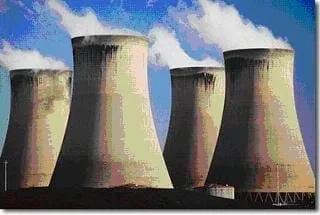 These are cooling towers, not smokestacks, and it is worthwhile to learn the difference.
A large part of engineering involves presenting products, concepts, and proposals to others in order to gain approval, funding, contracts, etc. Through this activity, students' presentation skills are fine tuned while they independently investigate one type of power production to meet the needs of their region of choice. Students also learn problem solving skills while examining the advantages and disadvantages of particular methods of power generation.
Understanding energy issues is an important part of engineering. Engineers must fully understand the pertinent science concepts and be able to professionally explain technological concepts in simple terms or in a depth of complexity suitable for the audience.
After this lesson, students should be able to:
- Name different sources of power generation and describe how they work.
- List the pros and cons of each method and give real-world examples.
- Describe the long-term financial costs/benefits of each power source presented.
- New products and systems can be developed to solve problems or to help do things that could not be done without the help of technology.
Grades 6-8
Do you agree with this alignment? - Energy can be used to do work, using many processes.
Grades 6-8
Do you agree with this alignment? - STEL-2S Defend decisions related to a design problem.
Grades 6-8
Do you agree with this alignment?
- 4-ESS3-1 Obtain and combine information to describe that energy and fuels are derived from natural resources and their uses affect the environment.
Grade 4
This resource focuses on the following Three Dimensional Learning aspects of NGSS:
Science & Engineering Practices- Obtain and combine information from books and other reliable media to explain phenomena.Do you agree with this alignment?
Disciplinary Core Ideas- Energy and fuels that humans use are derived from natural sources, and their use affects the environment in multiple ways. Some resources are renewable over time, and others are not.Do you agree with this alignment?
Crosscutting Concepts- Cause and effect relationships are routinely identified and used to explain change.Do you agree with this alignment?
- Knowledge of relevant scientific concepts and research findings is important in engineering.Do you agree with this alignment?
- Over time, people's needs and wants change, as do their demands for new and improved technologies.Do you agree with this alignment?
Do you agree with this alignment? - Obtain and combine information from books and other reliable media to explain phenomena.
- MS-ETS1-1 Define the criteria and constraints of a design problem with sufficient precision to ensure a successful solution, taking into account relevant scientific principles and potential impacts on people and the natural environment that may limit possible solutions.
Grades 6-8
This resource focuses on the following Three Dimensional Learning aspects of NGSS:
Science & Engineering Practices- Define a design problem that can be solved through the development of an object, tool, process or system and includes multiple criteria and constraints, including scientific knowledge that may limit possible solutions.Do you agree with this alignment?
Disciplinary Core Ideas- The more precisely a design task's criteria and constraints can be defined, the more likely it is that the designed solution will be successful. Specification of constraints includes consideration of scientific principles and other relevant knowledge that is likely to limit possible solutions.Do you agree with this alignment?
Crosscutting Concepts- The uses of technologies and any limitations on their use are driven by individual or societal needs, desires, and values; by the findings of scientific research; and by differences in such factors as climate, natural resources, and economic conditions.Do you agree with this alignment?
- All human activity draws on natural resources and has both short and long-term consequences, positive as well as negative, for the health of people and the natural environment.Do you agree with this alignment?
Do you agree with this alignment? - Define a design problem that can be solved through the development of an object, tool, process or system and includes multiple criteria and constraints, including scientific knowledge that may limit possible solutions.
- 8.P.2 Explain the environmental implications associated with the various methods of obtaining, managing, and using energy resources.
Grade 8
Do you agree with this alignment? - 8.P.2.2 Explain the implications of the depletion of renewable and nonrenewable energy resources and the importance of conservation.
Grade 8
Do you agree with this alignment? - EEn.2.8 Evaluate human behaviors in terms of how likely they are to ensure the ability to live sustainably on Earth.
Grades 9-12
Do you agree with this alignment? - EEn.2.8.1 Evaluate alternative energy technologies for use in North Carolina.
Grades 9-12
Do you agree with this alignment?
- poster board
- markers and other supplies for poster design
Prior knowledge of power generation techniques, such as presented in the associated lesson.
Provide a real-world historical example of a successful business venture leading to the development of a power company. Using a company or region known to students is a good idea. One example, which is close to home for students in North Carolina, is the story of Duke Power's beginnings. Duke Power's historical information is available in the North Carolina Historical Encyclopedia at http://northcarolinahistory.org/encyclopedia/279/entry. These modest beginnings led to the development of a huge power company for the region.
- Each group represents the interests of an engineering firm specializing in one type of power plant construction.
- As a class, have students come up with a list of criteria to consider when choosing a power generation method. Require the list to consist of initial and long term costs, environmental impact, safety, and production capacity to meet the region's soon-to-be-growing needs.
- Keep in mind that if for some reason people do not move to the region, the power company will lose money, so public opinion matters.
- Explain that the region is a previously undiscovered natural resource gem in that it has everything available that could possibly be needed for implementing any of the technologies. A beautiful river flows in the valley by the town with hot springs in the nearby mountains and abundant sunlight since it is located near the equator with adequate wind. In addition, coal deposits pocket the nearby hills.
- Have students brainstorm different energy sources available in the region and identify those sources as renewable or non-renewable resources.
- Give the groups 30 minutes to research all aspects of their power plant type.
- As students conduct research on the computers, make sure they stay on track by going around and engaging them by group.
- Have teams apply what they have learned by organizing the information onto posters to serve as a basis for their presentations. Indicate how much time each group has for its presentation.
- Direct students to pay special attention to which natural resource provides the energy, as well as pros and cons associated with tapping the energy from that resource.
- Have students make their presentations.
- Moderates a class discussion of each proposal, concluding with a class vote on which method to use for the community.
- energy
- Measurement of the ability of a system to do work.
- power
- Measure of amount of energy being used or generated per unit of time (energy/time).
- renewable resource
- Resources that are inexhaustible or replaceable by continuously replenished supply.
- non-renewable resource:
- Resources that cannot be regenerated as quickly as we use them. In other words, resources that are disappearing and cannot be replenished.
- turbine
- A device that produces electricity through the action of fast moving liquid, steam or gas.
- fuel cell
- A device that directly transforms chemical energy, usually hydrogen and oxygen, into electricity without combustion.
- photovoltaic cell
- A device that directly transforms light radiation into electricity.
Presentations/Posters: Student teams prepare posters and make presentations to summarize their specific research and summarize it briefly so the audience (of their peers) understands it. Assess their presentations and posters for accuracy of content, logic and clarity.
- Generators: Three Mile Island vs. Hoover Dam
- Presentation Skills to Win that Bid! Selling Your Power Solution
- Antimatter Matters
- Presentation Skills to Win that Bid! Selling Your Power Solution
Contributors
Brandon Jones
Supporting Program
Techtronics Program, Pratt School of Engineering, Duke University
Acknowledgements
This content was developed by the MUSIC (Math Understanding through Science Integrated with Curriculum) Program in the Pratt School of Engineering at Duke University under National Science Foundation GK-12 grant no. DGE 0338262. However, these contents do not necessarily represent the policies of the NSF, and you should not assume endorsement by the federal government.
Copyright
2013 by Regents of the University of Colorado; original © 2004 Duke University