
Cooking with the Sun - Creating a Solar Oven
Student groups are given a set of materials: cardboard, insulating materials, aluminum foil and Plexiglas, and challenged to build solar ovens. The ovens must collect and store as much of the sun's energy as possible. Students experiment with heat transfer through conduction by how well the oven is insulated and radiation by how well it absorbs solar radiation. They test the effectiveness of their designs qualitatively by baking some food and quantitatively by taking periodic temperature measurements and plotting temperature vs. time graphs. To conclude, students think like engineers and analyze the solar oven's strengths and weaknesses compared to conventional ovens.
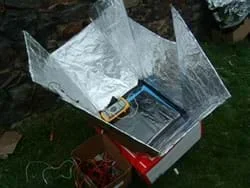 A solar oven built by middle school students.Copyright 2004 Paul Klenk, Duke University
The design, construction and testing of solar ovens is an engineering project that combines materials science with mechanical engineering through harnessing heat transfer mechanisms. Solar ovens are in use worldwide, providing fuel-free and smoke-free cooking, baking and water decontamination especially helpful in remote and poor regions.
After this activity, students should be able to:
- Explain the concept of radiation and give examples of ways that the sun's energy can be collected and stored for useful purposes.
- Explain that certain materials do not conduct heat well and are therefore good for insulation.
- Give examples of different materials that can be used for collecting and storing heat energy from the sun.
- Plot and analyze temperature vs. time data.
- CCSS.Math.Content.5.G.A.2 Represent real world and mathematical problems by graphing points in the first quadrant of the coordinate plane, and interpret coordinate values of points in the context of the situation.
Grade 5
Do you agree with this alignment? - CCSS.Math.Content.6.SP.B.4 Display numerical data in plots on a number line, including dot plots, histograms, and box plots.
Grade 6
Do you agree with this alignment? - CCSS.Math.Content.8.SP.A Investigate patterns of association in bivariate data.
Grade 8
Do you agree with this alignment? - CCSS.Math.Content.8.SP.A.1 Construct and interpret scatter plots for bivariate measurement data to investigate patterns of association between two quantities. Describe patterns such as clustering, outliers, positive or negative association, linear association, and nonlinear association.
Grade 8
Do you agree with this alignment?
- Requirements for design are made up of criteria and constraints.
Grades 6-8
Do you agree with this alignment? - Manufacturing systems use mechanical processes that change the form of materials through the processes of separating, forming, combining, and conditioning them.
Grades 6-8
Do you agree with this alignment? - STEL-1J Develop innovative products and systems that solve problems and extend capabilities based on individual or collective needs and wants.
Grades 6-8
Do you agree with this alignment? - STEL-3G Explain how knowledge gained from other content areas affects the development of technological products and systems.
Grades 6-8
Do you agree with this alignment? - STEL-4L Analyze how the creation and use of technologies consumes renewable and non-renewable resources and creates waste.
Grades 6-8
Do you agree with this alignment? - STEL-7J Evaluate designs based on criteria, constraints, and standards.
Grades 3-5
Do you agree with this alignment? - STEL-7Q Apply the technology and engineering design process.
Grades 6-8
Do you agree with this alignment? - STEL-7R Refine design solutions to address criteria and constraints.
Grades 6-8
Do you agree with this alignment? - STEL-7S Create solutions to problems by identifying and applying human factors in design.
Grades 6-8
Do you agree with this alignment?
- MS-ETS1-2 Evaluate competing design solutions using a systematic process to determine how well they meet the criteria and constraints of the problem.
Grades 6-8
This resource focuses on the following Three Dimensional Learning aspects of NGSS:
Science & Engineering Practices- Evaluate competing design solutions based on jointly developed and agreed-upon design criteria.Do you agree with this alignment?
Disciplinary Core Ideas- There are systematic processes for evaluating solutions with respect to how well they meet the criteria and constraints of a problem.Do you agree with this alignment?
Do you agree with this alignment? - Evaluate competing design solutions based on jointly developed and agreed-upon design criteria.
- MS-ETS1-3 Analyze data from tests to determine similarities and differences among several design solutions to identify the best characteristics of each that can be combined into a new solution to better meet the criteria for success.
Grades 6-8
This resource focuses on the following Three Dimensional Learning aspects of NGSS:
Science & Engineering Practices- Analyze and interpret data to determine similarities and differences in findings.Do you agree with this alignment?
Disciplinary Core Ideas- There are systematic processes for evaluating solutions with respect to how well they meet the criteria and constraints of a problem.Do you agree with this alignment?
- Sometimes parts of different solutions can be combined to create a solution that is better than any of its predecessors.Do you agree with this alignment?
- Although one design may not perform the best across all tests, identifying the characteristics of the design that performed the best in each test can provide useful information for the redesign process—that is, some of the characteristics may be incorporated into the new design.Do you agree with this alignment?
Do you agree with this alignment? - Analyze and interpret data to determine similarities and differences in findings.
- MS-PS3-3 Apply scientific principles to design, construct, and test a device that either minimizes or maximizes thermal energy transfer.
Grades 6-8
This resource focuses on the following Three Dimensional Learning aspects of NGSS:
Science & Engineering Practices- Apply scientific ideas or principles to design, construct, and test a design of an object, tool, process or system.Do you agree with this alignment?
Disciplinary Core Ideas- The more precisely a design task's criteria and constraints can be defined, the more likely it is that the designed solution will be successful. Specification of constraints includes consideration of scientific principles and other relevant knowledge that is likely to limit possible solutions.Do you agree with this alignment?
- A solution needs to be tested, and then modified on the basis of the test results in order to improve it. There are systematic processes for evaluating solutions with respect to how well they meet criteria and constraints of a problem.Do you agree with this alignment?
- Temperature is a measure of the average kinetic energy of particles of matter. The relationship between the temperature and the total energy of a system depends on the types, states, and amounts of matter present.Do you agree with this alignment?
- Energy is spontaneously transferred out of hotter regions or objects and into colder ones.Do you agree with this alignment?
Crosscutting Concepts- The transfer of energy can be tracked as energy flows through a designed or natural system.Do you agree with this alignment?
Do you agree with this alignment? - Apply scientific ideas or principles to design, construct, and test a design of an object, tool, process or system.
- MS-PS3-4 Plan an investigation to determine the relationships among the energy transferred, the type of matter, the mass, and the change in the average kinetic energy of the particles as measured by the temperature of the sample.
Grades 6-8
This resource focuses on the following Three Dimensional Learning aspects of NGSS:
Science & Engineering Practices- Plan an investigation individually and collaboratively, and in the design: identify independent and dependent variables and controls, what tools are needed to do the gathering, how measurements will be recorded, and how many data are needed to support a claim.Do you agree with this alignment?
- Science knowledge is based upon logical and conceptual connections between evidence and explanations.Do you agree with this alignment?
Disciplinary Core Ideas- Temperature is a measure of the average kinetic energy of particles of matter. The relationship between the temperature and the total energy of a system depends on the types, states, and amounts of matter present.Do you agree with this alignment?
- The amount of energy transfer needed to change the temperature of a matter sample by a given amount depends on the nature of the matter, the size of the sample, and the environment.Do you agree with this alignment?
Crosscutting Concepts- Proportional relationships (e.g. speed as the ratio of distance traveled to time taken) among different types of quantities provide information about the magnitude of properties and processes.Do you agree with this alignment?
Do you agree with this alignment? - Plan an investigation individually and collaboratively, and in the design: identify independent and dependent variables and controls, what tools are needed to do the gathering, how measurements will be recorded, and how many data are needed to support a claim.
- CCSS.Math.Content.5.G.A.2 Represent real world and mathematical problems by graphing points in the first quadrant of the coordinate plane, and interpret coordinate values of points in the context of the situation.
Grade 5
Do you agree with this alignment? - CCSS.Math.Content.6.SP.B.4 Display numerical data in plots on a number line, including dot plots, histograms, and box plots.
Grade 6
Do you agree with this alignment? - CCSS.Math.Content.8.SP.A Investigate patterns of association in bivariate data.
Grade 8
Do you agree with this alignment? - CCSS.Math.Content.8.SP.A.1 Construct and interpret scatter plots for bivariate measurement data to investigate patterns of association between two quantities. Describe patterns such as clustering, outliers, positive or negative association, linear association, and nonlinear association.
Grade 8
Do you agree with this alignment?
- 5.P.3 Explain how the properties of some materials change as a result of heating and cooling.
Grade 5
Do you agree with this alignment? - 6.P.3 Understand characteristics of energy transfer and interactions of matter and energy.
Grade 6
Do you agree with this alignment? - 6.P.3.1 Illustrate the transfer of heat energy from warmer objects to cooler ones using examples of conduction, radiation and convection and the effects that may result.
Grade 6
Do you agree with this alignment? - 6.P.3.3 Explain the suitability of materials for use in technological design based on a response to heat (to include conduction, expansion, and contraction) and electrical energy (conductors and insulators).
Grade 6
Do you agree with this alignment?
Each group needs:
- 1 piece of Plexiglas (1/4-3/8 inch thickness) that will need to be cut to fit specific dimensions of each oven; alternatively, a plastic oven bag may also be used for this top layer and is easier to work with, although it does not provide as much insulation against heat loss by conduction through the clear layer
- scotch tape
- black duct tape
- 1 Granite Ware pan or regular black metallic cooking pan sized to fit each specific box. Teachers can simply standardize the box size for the entire class to avoid having to buy multiple size pans.
- foam insulation, which can be acquired at any home improvement store; supply each group with enough foam to insulate its box; alternatively, foam peanuts and newspaper are less-expensive insulation materials
- cardboard boxes of various sizes (at least 2)
- 3-4 feet of aluminum foil
- scissors; must be strong enough to cut corrugated cardbaord if utility knives are not used
- (optional) glue
- 3-4 pieces of black construction paper
- ruler
- (optional) utility knife
- food item to be cooked on metallic pan with box, such as Break and Bake Cookies (pre-made cookie dough), Bagel Bites, etc...; best if the items are pre-cooked and only require warming
- thermometer
- oven mitts (can share among groups)
- graph paper
Students should have completed the Using Heat from the Sun associated lesson if the teacher wishes them to have a fundamental understanding of how a solar oven works.
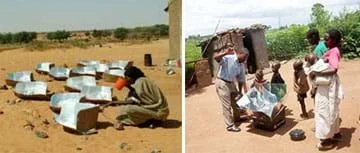 Examples of solar ovens being used to boil water and cook dinner in Africa.Copyright NASA http://climatekids.nasa.gov/smores/
Suggested motivation ideas:
- Show students pictures of solar cookers used around the world, such as the two-minute Infinity Bakery solar oven YouTube video listed in the Additional Multimedia Support section. Additionally, inform students about statistics illustrating the use of solar ovens and solar energy throughout the world, specifically in developing nations. See examples at http://www.solarcooking.org.
- Discuss how heat transfer concepts are used to make the oven work. The device needs to concentrate solar radiation on the center of the oven. The pot or pan must absorb as much solar radiation as possible. Then, the rest of the oven must be designed to resist heat transfer through conduction by insulating the device.
- How does the oven heat up and stay hot? How does it retain heat? What materials are used?
Using the suggested materials, give students the freedom to choose their own designs. Clearly explain the following considerations prior to building the solar ovens.
Design Considerations
- Design should ideally be independent of position of sun. For this purpose, instruct students to make use of reflectors and consider designs that would not require them to continually reposition the solar oven.
- Heat loss, heat gain and heat storage: The best insulation is a natural substance such as newspaper or Styrofoam. Another option is to use an inner cardboard box and leave a small empty space between the two boxes. It is also important to consider the color of the inside box. Lining the sides with reflective material such as aluminum foil will reflect solar radiation towards the food to be cooked. If the inside is painted, it is important that the paint be non-toxic. (Note: Do not use materials in the oven that are likely to melt at 200 to 250 °F. For example, a black garbage bag used to line the inside of the box will melt at high temperatures.)
- The solar oven collects heat through the heat transfer mechanism of radiation. Reflect as much sunlight as possible towards the food that is being cooked. Make the pot or cooking container a dark color so that it absorbs as much solar radiation as possible. Make sure that the box is large enough to hold a dark, lightweight, shallow metallic cooking container. Granite Ware, which can be found in any chef supply store, is a good material to use.
- The solar oven combats heat transfer via conduction through the use of insulation to maintain its temperature. Heat is lost through conduction through the oven sides. Insulation slows this heat loss mechanism.
- Convection is generally only a significant heat loss mechanism for a solar oven if it is in a particularly windy environment. Hence, heat loss through convection can be reduced by shielding a solar oven from the wind.
A detailed explanation of how to construct an example solar oven can be found at http://www.backwoodshome.com/articles/radabaugh30.html
- Upon completion, students test the effectiveness of their ovens on a sunny day by attaching and using a thermometer to measure the temperature every 10 minutes for 1 hour, then every 1 hour for the duration of the school day (at least 3-4 hours total). Alternatively, the teacher could take readings on the ovens during the school day if students are in other classes. They also bake cookies in the ovens to qualitatively determine oven effectiveness.
- Students use their data to plot temperature vs. time on graph paper.
- Students eat their baked goods.
- conduction
- Heat flow due to the contact of two objects or within a solid object.
- convection
- Heat flow due to fluid movement such as water.
- radiation
- Energy transferred through the movement of electromagnetic waves; heat transfer not requiring a medium.
- thermal conductivity
- The property of a material that determines how well it conducts/transmits heat. (Examples: Metal generally has a high thermal conductivity, plastic generally has a low thermal conductivity.)
- insulator/insulation
- A material that does not conduct heat very well and has a low thermal conductivity. (Examples: A good jacket, fiberglass insulation, a sleeping bag, anything with air trapped in it.)
- emissivity
- A property of the surface of an object that determines how much electromagnetic energy is reflected and how much is absorbed by an object in the form of heat. Emissivity is very dependent on color. (Examples: Aluminum foil has a low emissivity because it reflects a majority of heat and a black surface has a high emissivity because it absorbs a lot of heat; a black shirt gets hotter than a white one in the sun.)
- insolation/solar radiation
- The amount of power received on the Earth's surface per unit area. (watts per square meter in the SI unit system)
- renewable resource
- A resource that is inexhaustible or replaceable by new growth; limitless supply. (Example: Solar energy.)
- nonrenewable resource
- A resource that is not replaceable after it has been used. (Examples: Fossil fuels such as oil or natural gas, iron ore.)
- temperature
- A measure of the average kinetic energy of particles of matter.
Class Discussion and Presentations:
- Hold a class discussion to assess students' ability to accurately talk about the covered material. Ensure that the students can adequately describe the three basic forms of heat transfer—conduction, convection and radiation.
- Have groups make class presentations about their solar ovens. Require each student to participate. Require groups to describe how their ovens work and why they made certain material/design choices, such as reflector types and insulation used.
Determine whether or not students grasped the key concepts from the solar oven activity by asking the following questions:
- How does the oven work and why did you choose those materials?
- What parts of the solar cooker have high thermal conductivity? Low thermal conductivity?
- How is radiation used?
- Do reflector panels have high or low emissivity? Why?
- How is convective cooling prevented?
- Where are your insulators? What kind of insulation did you choose and why?
Have students compare their temperature vs. time plots.
- What oven got the hottest?
- How are the designs different?
- How did differences in design affect performance?
- Provide close supervision of students using scissors or utility knives to cut cardboard boxes. Consider not using the very dangerous utility knives; they are not required for this project.
- Do not permit students to cut the Plexiglas. Either have the teacher cut it or the home improvement store when the material is purchased.
- Remember to use oven mitts to remove cookies from the ovens.
- Warn students to be careful when opening their ovens after they have been sitting in the sun as they will be hot and may release steam, which can burn skin.
- If the ovens are not reaching the desired temperatures, make sure that all seals are tightly closed and air is not leaking out. Make sure any box cracks are glued or taped and well insulated and that the lid forms a tight seal with the box and where the glass meets the box. Adding foam around the rim where the lid meets the box can help improve this seal.
- If all seals have been insulated and the box is still not reaching 185 °F, make sure that the box is facing toward the sun for at least 20 minutes every hour. This project should only be done during the spring or summer months. If the box still will not heat adequately, add more insulation by placing the box inside an even larger container and adding insulation. Finally, the box may simply be too large. Consider making the area that needs to be heated smaller by placing another box within the original space or allow more time for heating.
- Construct the solar oven as desired and then fit the Plexiglass to the box.
- To make the reflectors, cover the flaps of the box with aluminum foil.
- Get plenty of black duct tape, as it tends to run out.
- Foam insulation tends to work better than newspaper.
- The reflectors are hard to attach and sometimes cause the ovens to tip over. Encourage students to stabilize their ovens in case of mild breezes.
Have students use their ovens to cook other food.
Visit a nearby solar house that uses solar hot water or passive solar heating.
Determine how well the oven performs in the winter. How important is the season? How important is the time of day? How important is the outside temperature?
What are the similarities between the greenhouse effect and the solar ovens?
Scaling of this activity depends on the amount of interaction between the students and the teacher during the design and building process.
- For advanced students, offer little to no advice and have students research different options so that they develop their own designs. Do not restrict their choice of materials or even offer examples of different devices. Have these students independently test their designs by designing their own experiments and ask them to justify their design choices either through a presentation or paper. Students could even modify their designs to determine the importance of individual aspects, such as the color of the box or how different insulators affect the temperature.
- For students who need more help, interact with them through every stage of the planning and building process. Suggest the materials to use or restrict them so they do not have to make as many choices. Offer a variety of examples or simply instruct all the students to construct their ovens based on a provided design and instructions.
To give students a wider context for how a project like this can help others, show them a two-minute YouTube video about the Infinity Bakery solar oven—a low-cost solution that enables bakery entrepreneurs and communities in the developing world to harness the power of the sun for baking and cooking more sustainably: smoke free and fuel free; see https://www.youtube.com/watch?v=6ZRqPYwlYt0
Radabaugh, Joe. "Making and Using a Solar Cooker." Published November/December 2004. Backwoods Home Magazine. Issue 30, 1998. Accessed June 2, 2004. http://www.backwoodshome.com/articles/radabaugh30.html Accessed 6/2/2004.
Solar Cooking International, "The Solar Cooking Archive." Solar Cooking International. Accessed June 2, 2004. (lots of good information on solar cooking and building solar ovens, including recipes, plans and information on where solar ovens are used) http://solarcooking.wikia.com/wiki/Solar_Cookers_International_Network_%28Home%29
- Exploring Solar Power
- Using Heat from the Sun
- Cooking with the Sun - Creating a Solar Oven
- From Sunlight to Electric Current
- Using Heat from the Sun
Contributors
Roni Prucz; Rahmin Sarabi; Lauren Powell
Supporting Program
Techtronics Program, Pratt School of Engineering, Duke University
Acknowledgements
This content was developed by the MUSIC (Math Understanding through Science Integrated with Curriculum) Program in the Pratt School of Engineering at Duke University under National Science Foundation GK-12 grant no. DGE 0338262. However, these contents do not necessarily represent the policies of the NSF, and you should not assume endorsement by the federal government.
Copyright
2013 by Regents of the University of Colorado; original © 2004 Duke University