
Sensors for Our Hearts
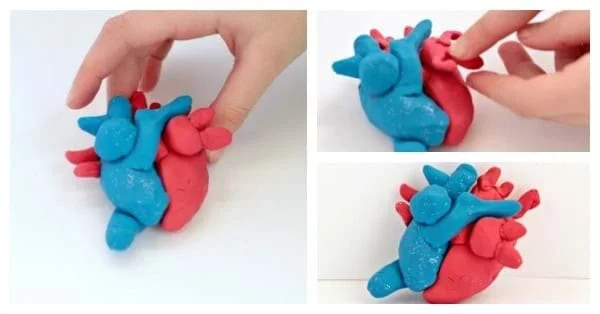 Human heart modelCopyright 2020 Priddy, Brenda. STEAMsational, Copyright Heirloom Media, www.steamsational.com/diy-heart-model.
How can we design and employ simple sensors to give us accurate information about the human body? In this activity, students make sense of how the human heart works and heart health by using the engineering design process to create a model of a human heart and then use sensors to determine their success. Students will know their heart model is successful if the Arduino Nano Gesture, Proximity, Light & RGB sensor can classify if the student's model has a right atrium (blue) and a left atrium (red).
When students are expected to share their knowledge on healthcare, they typically respond with any background knowledge they bring from their experiences with doctors, nurses, or EMTs. Yet what helps and supports those doctors, nurses, and EMTs to be successful are devices created by biomedical engineers. A physical sensor can measure blood pressure, body temperature, blood flux, blood viscosity, etc. Within this lesson, students will explore how biomedical sensors are used to gain information on the body through biomedical engineering.
After this activity, students should be able to:
- Identify parts of the human heart.
- Describe the functions of the heart.
- Identify the parts of an Arduino.
- Explain how a sensor works.
- Compare the function(s) of a sensor to our five senses.
- SC.5.L.14.1 Identify the organs in the human body and describe their functions, including the skin, brain, heart, lungs, stomach, liver, intestines, pancreas, muscles and skeleton, reproductive organs, kidneys, bladder, and sensory organs.
Grade 5
Do you agree with this alignment?
- STEL-7I Apply the technology and engineering design process.
Grades 3-5
Do you agree with this alignment? - STEL-7J Evaluate designs based on criteria, constraints, and standards.
Grades 3-5
Do you agree with this alignment?
- 3-5-ETS1-1 Define a simple design problem reflecting a need or a want that includes specified criteria for success and constraints on materials, time, or cost.
Grades 3-5
This resource focuses on the following Three Dimensional Learning aspects of NGSS:
Science & Engineering Practices- Define a simple design problem that can be solved through the development of an object, tool, process, or system and includes several criteria for success and constraints on materials, time, or cost.Do you agree with this alignment?
Disciplinary Core Ideas- Possible solutions to a problem are limited by available materials and resources (constraints). The success of a designed solution is determined by considering the desired features of a solution (criteria). Different proposals for solutions can be compared on the basis of how well each one meets the specified criteria for success or how well each takes the constraints into account.Do you agree with this alignment?
Crosscutting Concepts- People's needs and wants change over time, as do their demands for new and improved technologies.Do you agree with this alignment?
Do you agree with this alignment? - Define a simple design problem that can be solved through the development of an object, tool, process, or system and includes several criteria for success and constraints on materials, time, or cost.
Each student will need the following to create their heart model:
- yarn/string ~30.5 cm (or 1 foot)
- duct tape, ~30.5 (or 1 foot)
- 5 plastic straws
- 4 index cards
- 2 paper cups
- scissors
- glue stick
- 20 craft sticks
- 3 empty toilet paper rolls
- paper plate
- 2 red crayons
- 2 blue crayons
- container of red Playdoh
- container of blue Playdoh
- science notebook
- computer/laptop with a web browser
For the entire class to share/teacher models with:
- Engineering Design Process Worksheet (docx)
- Engineering Design Process Worksheet (pdf)
- Making Connections Worksheet (docx)
- Making Connections Worksheet (pdf)
- Your Heart & Circulatory System Worksheet (docx)
- Your Heart & Circulatory System Worksheet (pdf)
- Making Connections Worksheet Answer Key (docx)
- Making Connections Worksheet Answer Key (pdf)
- Your Heart & Circulatory System Worksheet Answer Key (docx)
- Your Heart & Circulatory System Worksheet Answer Key (pdf)
Students should be familiar with the engineering design process.
What kind of wearable sensors can be used monitor our hearts? What is a sensor? What role do sensors play in our daily lives? [Answers may vary: for example, Fitbits, Apple Watch, pulse oximeter; a device that detects or measures a physical property; sensors are everywhere such as in our smartphones and cars to in wearable technologies.]
Let’s watch a video about sensors. [Show the following video, What is a Sensor? Different Types of Sensors, Applications by RealPars.] How do humans see, feel, hear, smell, and taste? Can you remember a time where you were able to do something with the help of a sensor?
In this next video, we are going to look at some examples of how sensors are used. [Show Sensors in Daily Life by the Malaysia Automotive Robotics and IoT Institute.] What are some more sensors you can think of that we use every day? What sensors do you think are used by doctors, nurses, or in health care?
Now, let’s watch another video about biosensors. [Show the following video, What is a Biosensor? by SensUsCompetition.]
Let’s do a KWL chart. What do we already know about the human heart?
How do we keep our hearts healthy? Specifically let’s think about the heart's functions and how humans can keep their hearts healthy. What do we want to learn about the keeping our hearts healthy? What do we want to learn about the heart functions, and how to keep their hearts healthy?
Background
Cardiovascular diseases cause significant mortality globally. Devices that utilize sensors to measure cardiac biomarkers have traditionally been focused on large instruments in a central laboratory. Still, the development of affordable, portable devices that measure multiple cardiac biomarkers at the point of care is needed to improve clinical outcomes for patients, especially in underserved populations. Educating students about the devices and the engineering behind the devices will only help future generations.
What is a sensor? A sensor is a device that detects or measures a physical property and then records, indicates or otherwise responds to it. A sensor is very similar to our five senses. We use our sense of touch, sight, and hearing to detect color, sound, pressure, temperature, or humidity. That information is then sent to our brain, similar to the controller within an Arduino Nanosensor.
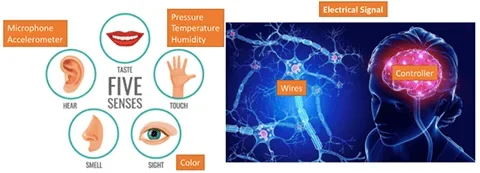 How Arduino sensors relate to human senses and the nervous system.Copyright 2022 Kaitlin Cunningham, Florida International University RET
Follow the tutorial provided by Arduino (https://blog.arduino.cc/2019/11/07/fruit-identification-using-arduino-and-tensorflow) using the Arduino and TensorFlow to ensure the device can use the sensor to capture, train and classify objects based on their color.
Day 1
Before the Activity
- Set up an account with AnatomyAR+ for Merge Cube to display a three-dimensional heart: https://appadvice.com/app/anatomyar-for-merge-cube/1263511289
- Set up an account with Arduino Web Editor. Follow the getting started instructions (https://create.arduino.cc/getting-started/plugin?page=1) which offers a guide through the following:
- Downloading and installing the plugin
- Signing in or signing up for a free account
- Program the Arduino Nano 33 BLE Sense with Headers (so students can scan the objects).
- Use Arduino Create to program the Arduino board with the application “object_color_capture.ino” that samples color data from objects you place near it. The board sends the color data as a CSV log to a desktop machine over the USB cable.
- To load the object_color_capture.ino application onto Arduino board:
- Connect board to laptop or PC with a USB cable. (Note: The Arduino board takes a male micro-USB.)
- Open object_color_capture.ino in Arduino Create as shown in Figure 1.
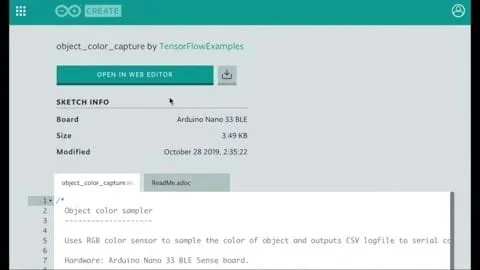 Figure 1. How to code the Arduino for this activity.Copyright 2022 Kaitlin Cunningham, Florida International University RET
- Browser will open the Arduino Create web application (see GIF above).
- Click “open in web editor”
- For existing users this button will be labeled “add to my sketchbook”
- Press Upload & Save
- You will see the yellow light on the board flash as it is programmed.
- Open the serial Monitor panel on the left side of the web application.
- Color data in CSV format should be seen here when objects are near the top of the board.
- Have the three different colored objects accessible for students to scan—for example, a banana, orange, and apple.
- Make sure student computers/laptops/tablets are charged and easily accessible.
- Have the Your Heart & Circulatory System Worksheet (PDF) printed and readily available.
With the Students
- Go through Introduction / Motivation section.
- Have students gather their science notebook and computer/laptop/tablet.
- Split class into pairs and have everyone read "Your Heart & Circulatory System" (https://www.wonderopolis.org/wonder/is-your-heart-shaped-like-a-heart) on their device.
- Document findings, wonderings, or answers to questions in the Your Heart & Circulatory System Worksheet (PDF).
- Bring the students back to discuss their findings.
- Using the student's new knowledge of the heart, have students view the heart using the AnatomyAR+ for Merge Cube: https://appadvice.com/app/anatomyar-for-merge-cube/1263511289
Day 2
Before the Activity
- Make sure student devices are charged and easily accessible.
- Have the Making Connections Worksheet (PDF) printed and readily available.
With the Students
- Have students gather their science notebook and computer/laptop/tablet.
- Inform the students that they will be using the Arduino Nano 33 to determine different objects based on their color.
- Explain the parts of the Arduino by projecting Figure 2 on the board.
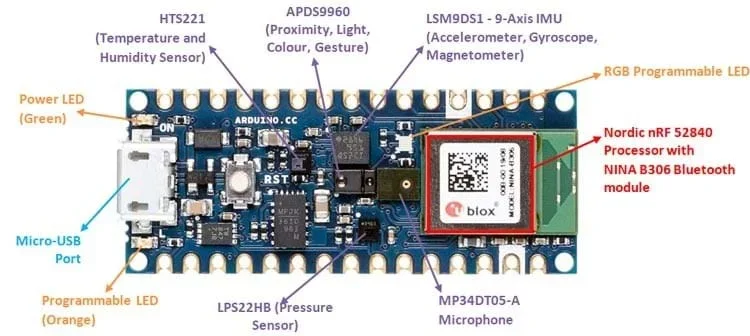 Figure 2. An annotated graphic that describes the component sensors of an Arduino.Copyright 2022 Kaitlin Cunningham, Florida International University RET
- Explain the different parts and have students complete the Making Connections Worksheet (PDF), which will provide them the opportunity to determine which sensor on the Arduino Nano 33 BLE acts as the sight, hearing, and touch.
- Explain how the proximity sensor detects different objects based on their color, like how sensors are used in wearable devices that help one better understand their overall health.
- Show students the Arduino Web Editor and begin modeling how to scan the objects.
- Reset the board using the small white button on top.
- Keep fingers away from the sensor (unless you want to sample it!).
- The Monitor in Arduino Create will say ‘Serial Port Unavailable’ for a minute.
- You should then see Red, Green, and Blue appear at the top of the serial monitor.
- Put the front of the board to the apple.
- The board will only sample when it detects an object is close to the sensor and is sufficiently illuminated (turn the lights on or be near a window).
- Move the board around the surface of the object to capture color variations.
- You will see the RGB color values appear in the serial monitor as comma separated data.
- Capture at a few seconds of samples from the object.
- Copy and paste this log data from the Monitor to a text editor.
- Tip: untick AUTOSCROLL check box at the bottom to stop the text moving.
- Save your file as apple.csv.
- Reset the board using the small white button on top.
- Give each student the opportunity to come up to the front of the room and scan an object.
Day 3
Before the Activity
- Have the Arduino programmed so that students can scan their heart models to determine their success, which has a right atrium (blue) and a left atrium (red).
- Have copies of the Engineering Design Process Worksheet (PDF).
With the Students
- Explain how students will be putting their knowledge to work by creating an accurate model of the heart. Tell students the class will determine success by using the Arduino Nano 33 BLE Proximity, Light, Color, and Gesture sensor.
- Display the challenge on the board: Using any of the materials, create an accurate model of the human heart. The model must accurately reflect the human heart anatomy. It must have a right and left atrium.
- Put students into groups of two to complete the challenge.
- Hand out the Engineering Design Process Worksheet (PDF) to guide their thinking.
- Give students 10 minutes to complete the Engineering Design Process Worksheet (PDF).
- Once they have completed the worksheet, students pick up their materials. Students are only allowed to take materials that they have identified in their plans.
- Give students 20 minutes to create their models. Consider displaying a digital clock on the screen.
- When each group has completed their model, have each group scan, using the sensor on the Arduino, their model and determine if they were successful or not.
- Have students answer the following questions in their science notebook:
- Was your design successful? How do you know?
- What parts of this project went well or poorly?
- What could you improve upon next time?
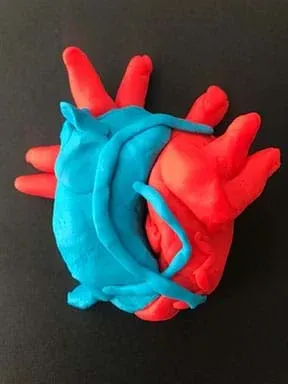 An example of student model of the heart.Copyright 2022 Kaitlin Cunningham, Florida International University RET
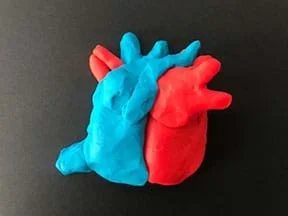 An example of student model of heart.Copyright 2022 Kaitlin Cunningham, Florida International University RET
- aorta
- The main artery that carries blood from the heart to branch arteries by which it is carried throughout the body.
- arduino
- A small, complete, and breadboard-friendly motherboard.
- data analysis
- The process of inspecting, cleansing, transforming, and modeling data with the goal of discovering useful information, informing conclusions, and supporting decision-making.
- heart
- The hollow muscular organ of vertebrates that expands and contracts to move blood through the arteries, veins, and capillaries.
- left atrium
- The chamber of the heart receiving blood from the veins and forcing it into a ventricle that in lung-breathing vertebrates (as frogs and human beings) is one of two chambers of which the left receives oxygen-rich blood from the lungs but in gill-breathing vertebrates (as fishes) is only a single chamber.
- machine learning
- The study of computer algorithms that improve automatically through experience and using data.
- right atrium
- The chamber of the heart receiving blood from the veins and forcing it into a ventricle that in lung-breathing vertebrates (as frogs and human beings) is one of two chambers of which the right receives blood full of carbon dioxide from the body.
- sensor
- The device that detects or measures a physical property and records indicates or otherwise responds to it.
Pre-Activity Assessment
KWL: Students complete the KWL chart. What they know already will act as the pre-activity assessment.
Activity Embedded (Formative) Assessment
Worksheet: The formative assessment within the first lesson is completion of the Your Heart & Circulatory System Worksheet (PDF) that assesses the student's knowledge of the heart's functions and what they read in the article. The formative assessment for the cumulative activity is the model and the Padlet responses.
Post-Activity (Summative) Assessment
Reflect: The post-activity will be to go back to the KWL and respond with what they have learned from the three lessons.
"How-to Get Started with Machine Learning on Arduino." Tensor Flow, 2019, blog.tensorflow.org/2019/11/how-to-get-started-with-machine.html.
"Is Your Heart-Shaped Like a Heart?" Wonderopolis, 3 Dec. 2019, www.wonderopolis.org/wonder/is-your-heart-shaped-like-a-heart.
"A Review of Biosensor Technologies for Blood Biomarkers toward Monitoring Cardiovascular Diseases at the Point-of-Care." ScienceDirect, 1 Jan. 2021, www.sciencedirect.com/science/article/abs/pii/S0956566320306114
Team, Arduino. "Fruit Identification Using Arduino and TensorFlow." Arduino Blog, 11 Nov. 2019, blog.Arduino.cc/2019/11/07/fruit-identification-using-Arduino-and-TensorFlow.
"Wearable Health Devices—Vital Sign Monitoring, Systems and Technologies." PubMed Central (PMC), 1 Aug. 2018, www.ncbi.nlm.nih.gov/pmc/articles/PMC6111409.
"What Do We Know about Cardiovascular Disease Spending and Outcomes in the United States?" Peterson-KFF Health System Tracker, 25 Mar. 2019, www.healthsystemtracker.org/chart-collection/know-cardiovascular-disease-spending-outcomes-united-states/#item-mortality-rates-within-30-days-hospital-admission-heart-attack-stroke-decreased-version-2.
"Which Are and How to Use the NANO 33 BLE SENSE Built-in Sensors." Arduino Help Center, 26 May 2021, support.Arduino.cc/hc/en-us/articles/360014654820-Which-are-and-how-to-use-the-NANO-33-BLE-SENSE-built-in-sensors.
Contributors
Kaitlin Cunningham; Lin Tong; Dr. Joshua Hutcheson
Supporting Program
PATHS-UP Research Experience for Teachers, Florida International University
Acknowledgements
This activity was developed as part of the Research Experience for Teachers through the Florida International University Department of Mechanical and Materials Engineering—PATHS-UP under grant number IIS 1730574. Any opinions, findings and conclusions or recommendations expressed in this material are those of the authors and do not necessarily reflect the views of the National Science Foundation or Florida International University.
Thank you to the NSF PATHS-UP center for providing the RET opportunity.
Copyright
2022 by Regents of the University of Colorado; original © 2021 Florida International University