
Chasing the Sun
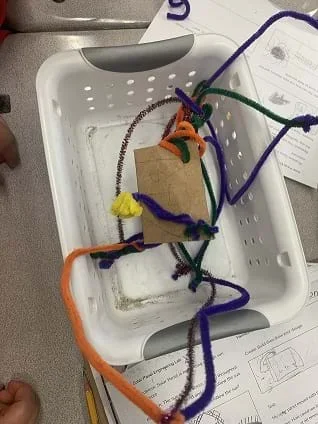 The first iteration of a prototype.Copyright 2022 Aubriel Sweeney
Solar energy has almost limitless potential to power our needs, and best of all it is exceptionally clean! However, the challenge lays in how to harness that energy in an effective manner—and that’s where engineers come in. In this activity, students learn how the sun can help us make electricity with a device called a solar panel. They are then presented with the challenge of the stationary solar panel versus the moving sun. Using the behavior of a sunflower following the sun throughout the day, students build upon and apply their knowledge of solar patterns, solar energy and plant needs as they engineer model solar panels that move to follow the path of the sun.
Engineers design technologies that maximize the efficiency of clean energy. Environmental engineers, mechanical engineers and materials engineers all contribute to the process of developing the potential of solar panels. Examining nature and the natural processes can help engineers develop solutions to real-world problems. Students step into the role of these professions as they go through the engineering design process of applying their scientific knowledge on the sun and plants to making their own mobile solar panel units. Students are engaging in solving this real-world problem of maximizing the efficiency of clean energy.
After this activity, students should be able to:
- Explain how and why a sunflower follows the sun.
- Describe the sequence the sun travels through the sky throughout the day.
- Discuss ways to maximize sun exposure for a solar panel.
- Engineer a stand that allows their “solar panel” to follow the path of the sun.
- SC.1.E.5.4 Identify the beneficial and harmful properties of the Sun.
Grade 1
Do you agree with this alignment? - SC.3.L.14.2 Investigate and describe how plants respond to stimuli (heat, light, gravity), such as the way plant stems grow toward light and their roots grow downward in response to gravity.
Grade 3
Do you agree with this alignment?
- K-2-ETS1-1 Ask questions, make observations, and gather information about a situation people want to change to define a simple problem that can be solved through the development of a new or improved object or tool.
Grades K-2
This resource focuses on the following Three Dimensional Learning aspects of NGSS:
Science & Engineering Practices- Ask questions based on observations to find more information about the natural and/or designed world(s).Do you agree with this alignment?
- Define a simple problem that can be solved through the development of a new or improved object or tool.Do you agree with this alignment?
Disciplinary Core Ideas- Asking questions, making observations, and gathering information are helpful in thinking about problems.Do you agree with this alignment?
- A situation that people want to change or create can be approached as a problem to be solved through engineering.Do you agree with this alignment?
- Before beginning to design a solution, it is important to clearly understand the problem.Do you agree with this alignment?
Do you agree with this alignment? - Ask questions based on observations to find more information about the natural and/or designed world(s).
- K-2-ETS1-2 Develop a simple sketch, drawing, or physical model to illustrate how the shape of an object helps it function as needed to solve a given problem.
Grades K-2
This resource focuses on the following Three Dimensional Learning aspects of NGSS:
Science & Engineering Practices- Develop a simple model based on evidence to represent a proposed object or tool.Do you agree with this alignment?
Disciplinary Core Ideas- Designs can be conveyed through sketches, drawings, or physical models. These representations are useful in communicating ideas for a problem's solutions to other people.Do you agree with this alignment?
Crosscutting Concepts- The shape and stability of structures of natural and designed objects are related to their function(s).Do you agree with this alignment?
Do you agree with this alignment? - Develop a simple model based on evidence to represent a proposed object or tool.
- K-2-ETS1-3 Analyze data from tests of two objects designed to solve the same problem to compare the strengths and weaknesses of how each performs.
Grades K-2
This resource focuses on the following Three Dimensional Learning aspects of NGSS:
Science & Engineering Practices- Analyze data from tests of an object or tool to determine if it works as intended.Do you agree with this alignment?
Disciplinary Core Ideas- Because there is always more than one possible solution to a problem, it is useful to compare and test designs.Do you agree with this alignment?
Do you agree with this alignment? - Analyze data from tests of an object or tool to determine if it works as intended.
Each group needs:
- 10 pipe cleaners
- 2 x 3” piece of cardboard (solar panel model)
- foil, to cover the cardboard and to represent the panel modules (optional)
- pair of scissors
- anything at their desk (textbooks, folders, etc.)
For each student:
- writing or drawing utensils
For the entire class to share:
- a flashlight (representing the sun)
- The Sun’s Path Sequence Writing Worksheet (docx)
- The Sun’s Path Sequence Writing Worksheet (pdf)
- The Sun’s Path Sequence Writing Worksheet Answer Key (docx)
- The Sun’s Path Sequence Writing Worksheet Answer Key (pdf)
- The Sun’s Path Sequence Drawing Worksheet (docx)
- The Sun’s Path Sequence Drawing Worksheet (pdf)
- Teacher Assessment Checklist (docx)
- Teacher Assessment Checklist (pdf)
- Presentation Rubric (docx)
- Presentation Rubric (pdf)
- Solar Stand Procedures Worksheet (docx)
- Solar Stand Procedures Worksheet (pdf)
- Presentation Script Worksheet (docx)
- Presentation Script Worksheet (pdf)
- Solar Panel Design Worksheet (docx)
- Solar Panel Design Worksheet (pdf)
- Solar Engineering Presentation (pptx)
- Solar Engineering Presentation (pdf)
- Solar Patterns Presentation (pptx)
- Solar Patterns Presentation (pdf)
- Solar Energy Effects Presentation (pptx)
- Solar Energy Effects Presentation (pdf)
- Familiarity with the engineering design process and its steps.
- Familiarity with solar patterns such as how the sun travels through the sky during the day.
- Knowledge on how the sun’s energy has different benefits like helping plants grow.
- Knowledge of cardinal direction
[Show an image of a solar panel.] What do you think this is? (Let students offer answers.) What do you think this has to do with the sun? (Let students offer answers.) Solar panels convert the sun’s photons into electricity as they excite the electrons found in the solar panels.
(Show this video, How Solar Power Works: https://www.youtube.com/watch?v=hw2_hEMgE4o)
What do you notice about these solar panels? (Students should discuss what they think the issue might be based on what they know about solar patterns and solar panels. Point out the solar panel’s position in relation to the sun and ask the students why this might be a problem. Lead students toward the fact that the solar panels are static/stationary but the sun moves across the sky. Have students draw the conclusion that the solar panels are not facing the sun during all times of the day.) One of the main problems with solar energy is that it can be difficult to maximize its efficiency as a green alternative because of its need for direct sunlight. How do you think we can improve these solar panels? (Students should conclude that this is a problem because this means the solar panels only get a limited amount of sun exposure and thus less potential solar energy to turn into electricity.)
What else besides solar panels needs lots of sunlight? (Lead students to plants also needing lots of sunlight to grow.) Do you know that sometimes engineers turn to nature for inspiration? There is one plant that engineers can look to that might be the solution to the problem of the sun moving throughout the day. Let’s check out this video. (Show this video: Why sunflowers follow the sun: https://www.youtube.com/watch?v=1gaWrMCiZR8)
What did you see the flower doing in the video? Why do you think it is doing that? How do you think we can apply the sunflower solution to the problem they have with the solar panels.? (Since the goal is to have the solar panel follow the sun to optimize its sunlight exposure, let’s think about how we can design a set of panels to help solve this problem.
Background:
Solar panels convert the sun’s photons into electricity as they excite the electrons found in the solar panels. One of the main problems with solar energy is that it can be difficult to maximize its efficiency as a green alternative because of its need for direct sunlight. After research on how sunflowers bend and turn to maximize sun exposure to help them grow, students should be able to independently discover what benefits a moving solar panel would have.
The problem the students are solving is the sun moves across the sky, but solar panels remain stationary. The goal is to design a prototype solar panel that “follows” the sun to optimize its sunlight exposure. Theoretically students will apply what they learned about the sun flowers to help solve this problem. Use the Solar Patterns Presentation (PPTX) and the Solar Energy Effects Presentation (PPTX) to help guide planning and discussions.
Before the Activity
- Gather materials for each group in bins: 2 x 3” cardboard (for the solar panel) 10 pipe cleaners, 1 pair scissors, foil (optional) for the panel modules.
- Make student copies of the Solar Stand Procedures Worksheet (PDF) and the Solar Panel Design Worksheet (PDF).
- Make desired teacher copies of the Teacher Assessment Checklist (PDF), Presentation Rubric (PDF).
- Before passing out materials, explain to students what materials they will be using and how to use them safely as an engineer would.
- Demonstrate how to cut a pipe cleaner safely.
- Show the Solar Stand Procedures Worksheet (PDF) and the Solar Panel Design Worksheet (PDF) and explain how they will use it to record their engineering iterations and observations.
- Set partner work expectations for students and remind them how engineers effectively communicate and collaborate.
- Practice collaboration expectations if needed for 1- 2 minutes.
With the Students
- Go through the Introduction/Motivation section.
- Pass out the Solar Stand Procedures Worksheet (PDF) and the Solar Panel Design Worksheet (PDF) and have students put their names on it.
- Have students group up with their partners.
- Pass out material bins: 2 x 3” cardboard (solar panel), 10 pipe cleaners, pair scissors, foil (optional).
- Remind students their goal is to work together to create a solar panel stand that maximizes sun exposure.
- Set a timer for 10 minutes on the board and let students explore the materials and try to construct their panels.
- Possible methods for construction:
- Wrapping the pipe cleaners around each other to create a bendable stand for the solar panel.
- Creating a panel of solar modules that use pipe cleaners to move back and forth.
- Circulate the room and prompt students to try different materials or work together using their collaboration expectations as needed.
- When the timer goes off, prompt students to stop where they are at for a collaborative check-in.
- Walk around the room with a flashlight and mimic the sun's path throughout the day to test each design. Have students walk around the room and observe each group's design test.
- Prompt students to discuss why their designs worked or why not and what they could change.
- Give students an additional 10 minutes to reiterate their designs.
- When the timer goes off, prompt students to organize their work station/put away materials.
- Put a 2 minute timer on the board for this transition.
- Go over the Presentation Rubric (PDF) with students.
- Go over the Presentation Script Worksheet (PDF) with students. Read it out to the class and prompt each group to fill in along the way.
- Put a 2 minute timer on board to practice for the presentation.
- Have groups present their inventions and evaluate.
- Hold a post presentation discussion.
- Prompt students to share strengths and weaknesses of their designs. Prompt students to discuss similarities and differences.
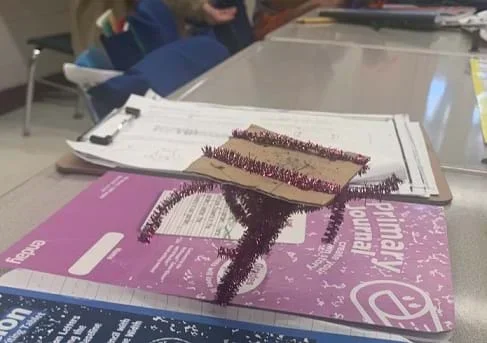 A student-designed prototype after reiteration.Copyright 2022 Aubriel Sweeney
- atom
- A tiny particle (that you cannot see) that makes up matter.
- axis
- An invisible line around which the earth rotates.
- electricity
- When electrons move.
- electron
- A tiny particle with a negative charge that is part of an atom.
- matter
- Anything that takes up space.
- rotate
- To spin around itself.
- solar energy
- Light and heat energy from the sun.
- solar panel
- A tool used to convert sunlight into electricity.
Pre-Activity Assessment
To assess student background knowledge on solar patterns:
Students answer The Sequence of the Sun Writing (PDF) worksheet to describe the path the sun takes throughout the day. Students describe the position of the sun at the beginning, middle and end of the day using the sentence starters. (Younger students can use The Sequence of the Sun Drawing (PDF) worksheet instead.)
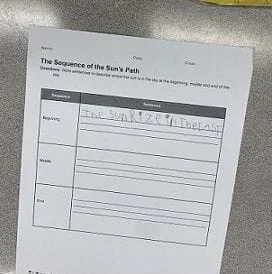 Example of student pre-assessment work.Copyright 2022 Aubriel Sweeney
Activity Embedded (Formative) Assessment
To assess students understanding of solar patterns and solar panels during the activity:
Observe students' creation of solar panel stands. While doing this they can use the Teacher Assessment Checklist (PDF) check off for student understanding. Students demonstrate understanding when they can accurately describe if their prototype is maximizing sun consumption and how they know. (For example, they might say “Yes, because the stand can move to follow the sun” or “No, because the solar panel can only face this way without falling”. This provides the ability to see if students understand what motion their stand will have to make to mimic the sun's path after the research portion of the process and gives room for them to correct misconceptions and prompt students to reiterate their design as needed.)
(Optional) To assess students understanding of engineering design process:
Use the Teacher Assessment Checklist (PDF) to check off for student understanding. Students demonstrate understanding of the engineer design process by being able to tell what part of the process they are currently in throughout the lesson.
To assess ability to design reiterations:
Use the Teacher Assessment Checklist (PDF) to mark off students who iterate their designs. Prompt to share during presentation what they tried and changed or what they would change to improve their design. For example, you could ask students when they are sharing their design which parts of their design contributed to maximizing solar consumption. You can then prompt them to share what they think they could do to improve their design based on this.
Collaborative work/ Feedback: Use the Teacher Assessment Checklist (PDF) to mark off students observed using collaborative techniques and participating in providing critical feedback using the compliment sandwich model provided throughout the activity.
Post-Activity (Summative) Assessment
Presentation Rubric: After concluding the activity, each group finalizes their notes and present their findings to the class. Use the Presentation Rubric (PDF) for the students' presentation of their findings. Each student's presentation should include a summary of their engineering design process (including possible iterations), how they know their tool was maximized sun exposure and a demonstration of how their solar stand works.
(Optional) Presentation Script: Once students have concluded the activity, present the sequencing Presentation Script (PDF). This “First, Next, Then, Finally” script helps students meet the presentation rubric requirements by having them write out what they did first when building, if their design worked and what they did next to reiterate. Prompt each student group to fill in the blanks of the sequence writing script as they go through it as a class.
- Students may use scissors to cut pipe cleaners. This should be demonstrated during review of how to use materials safely and supervise.
- Students will be using pipe cleaners which can have sharp tips. Demonstrate how to maneuver a pipe cleaner during review of how to use materials safely and supervise.
- Some students may want to poke holes in their cardboard with pencils or scissors. Demonstrate how to do this safely if need arises.
After the first build, have students circulate to observe the test of all designs so you can facilitate a discussion on what worked and what did not. The biggest problem that was observed the first time is that the stands did not stand up by themselves. Including a discussion on how students think they could solve this problem before the next build could assist in the issue. Remind students they can also use any of the supplies at their desks to help anchor their designs.
Published Procedure Paper
Once all students have engineered a successful prototype the teacher can have students write up their procedures just like engineers would in real life to publish for others to learn from. The teacher will prompt students to describe the sequence in which they built their design. If desired the teacher could have groups swap procedures to see if students can replicate designs based on the procedures written and discuss how papers are often peer reviewed. After the initial swap groups can provide each other feedback and rewrite for clarity.
To support lower grades and younger students in carrying out this activity the teacher can have them complete the drawing templates rather than the writing ones to allow them to focus on the engineering. You can also have them verbally complete the optional presentation script rather than write it.
To support upper grades, older students and more advanced students the teacher can extend the content knowledge used and even introduce more materials or complex designs into their prototypes. For example, they can discuss that the reason the sunflower follows the sun has to do with photosynthesis. They could also have students further apply their knowledge on how sun exposure changes with the seasons to challenge them to further adapt their solar panel to combat such changes. Finally, they could also further challenge their writing and comprehension skills by having them create the published procedures paper and swapping these papers to see if other groups can replicate their prototype from the methods provided. This will challenge students to have to be clear and concise just like real engineers do in the methods/ procedures sections of their papers.
Before activity:
- Earth’s Rotation: https://www.youtube.com/watch?v=l64YwNl1wr0
- The Sun: https://jr.brainpop.com/science/space/sun/
- How do solar panels work?: https://www.youtube.com/watch?v=hw2_hEMgE4o
- Sunflowers solution: https://www.youtube.com/watch?v=1gaWrMCiZR8
Contributors
Aubriel Sweeney (University of Florida)
Supporting Program
Aubriel Sweeney, elementary education teacher, Florida (with original support from the University of Florida MRET)
Copyright
2023 by Regents of the University of Colorado; original © 2022 Aubriel Sweeney