
Arduino Air Quality Monitor
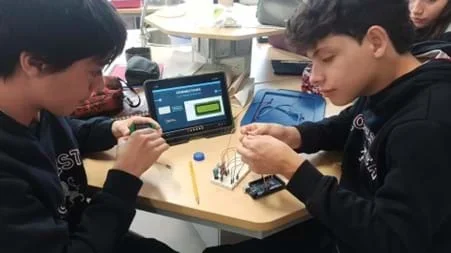 Students construct Arduino air quality monitors.Copyright Matthew Reis, 2024
Students use the engineering design process to engage in a hands-on investigation of how atmospheric conditions impact learning while connecting their findings to real-world sustainability goals. By constructing and using an Arduino air quality monitor, students collect and analyze data on factors such as temperature, humidity, carbon dioxide levels, and air particulates. Through this process, they explore how these environmental properties influence cognitive function, concentration, and overall well-being. Students then interpret their data, draw evidence-based conclusions, and relate their findings to the United Nations Sustainable Development Goals (SDGs), particularly those related to health, education, and sustainable cities. Finally, they apply their knowledge by proposing actionable improvements to optimize classroom air quality, fostering healthier, more effective learning environments.
Environmental engineers play a vital role in designing spaces that optimize environmental and atmospheric conditions to support health, comfort, and productivity. By carefully managing factors such as temperature, humidity, ventilation, and carbon dioxide levels, engineers create environments that enhance well-being and efficiency. Poor air quality, inadequate lighting, or extreme temperatures can negatively impact occupants, making it essential to integrate smart systems that monitor and regulate these conditions. Engineers develop advanced sensors and control systems to ensure that spaces remain within safe and optimal parameters, preventing potential health risks. Through innovative design and technology, engineers continuously improve indoor environments, making workplaces, schools, and public spaces safer, more comfortable, and more effective for their intended use.
After this activity, students should be able to:
- Explain the effect of atmospheric properties on human well-being.
- Propose mechanisms and improvement plan to ensure healthy atmospheric conditions in classrooms to optimize teaching and learning.
- Connect proposed improvement plan to fulfillment of United Nations Sustainable Development Goals.
- CCSS.Math.Content.HSN-Q.A.3 Choose a level of accuracy appropriate to limitations on measurement when reporting quantities.
Grades 9-12
Do you agree with this alignment?
- HS-ETS1-2 Design a solution to a complex real-world problem by breaking it down into smaller, more manageable problems that can be solved through engineering.
Grades 9-12
This resource focuses on the following Three Dimensional Learning aspects of NGSS:
Science & Engineering Practices- Design a solution to a complex real-world problem, based on scientific knowledge, student-generated sources of evidence, prioritized criteria, and tradeoff considerations.Do you agree with this alignment?
Disciplinary Core Ideas- Criteria may need to be broken down into simpler ones that can be approached systematically, and decisions about the priority of certain criteria over others (trade-offs) may be needed.Do you agree with this alignment?
Do you agree with this alignment? - Design a solution to a complex real-world problem, based on scientific knowledge, student-generated sources of evidence, prioritized criteria, and tradeoff considerations.
Each student needs:
- 1 Student Activity Guide (PDF)
- pencil or pen
Each group needs:
- 1 laptop or computer with:
- Access to the internet
- Arduino IDE software downloaded (https://www.arduino.cc/en/software)
- Access to Microsoft Excel, Google Sheets, or some other graphing application
- 1 DHT11 sensor Arduino
- 1 MQ135 sensor Arduino
- 1 Uno or Mega Arduino board
- 1 LCD screen Arduino (similar to this: https://www.amazon.com/MEYOTAO-Characters-Yellow-Green-Backlight-Compatible/dp/B0DK6TF97V)
- 1 breadboard
- jumpers
- 8 male/male
- 4 male/female
- 1 physical or digital copy of the Arduino Sensor Code (PDF)
- 1 physical or digital copy of the Arduino Presentation (PPTX)
For the entire class:
- laptop or computer with projector to display the Arduino Presentation (PPTX)
Students should:
- Have basic arithmetic knowledge.
- Be able to create a line graph, although this skill can be developed during the activity.
- Be able to describe and analyze trends in graphs, although this skill can be developed during the activity.
- Be familiar with the common greenhouse gasses.
- Have a basic understanding of physiology, particularly that the byproducts of human respiration are CO2 and water vapor.
You're ready for the big final exam in your favorite class. You've studied diligently, gotten plenty of rest, and fueled your body with healthy food—nothing can stand between you and a perfect score.
You arrive early, feeling confident as the teacher gives instructions and hands out the test. You jot down your name and dive in. Everything is going smoothly until the room starts to feel stuffy and warm. Your eyes sting, your thoughts grow hazy, and sweat beads on your forehead.
You glance around—the room is packed, the air feels heavy, and a wave of claustrophobia sets in. Desperate for a moment to clear your head, you ask to step outside, but the teacher denies your request.
What are some environmental and atmospheric conditions of the room that could affect your performance on the exam? (Let students offer answers. Potential answers: poor ventilation, temperature too hot or too cold, air pollution, stuffy air, poor lighting.)
Environmental engineers play a vital role in designing spaces that optimize environmental and atmospheric conditions to support health, comfort, and productivity. By carefully managing factors such as temperature, humidity, ventilation, and carbon dioxide levels, engineers create environments that enhance well-being and efficiency. Poor air quality, inadequate lighting, or extreme temperatures can negatively impact occupants, making it essential to integrate smart systems that monitor and regulate these conditions. Engineers develop advanced sensors and control systems to ensure spaces remain within safe and optimal parameters, preventing potential health risks. Through innovative design and technology, engineers continuously improve indoor environments, making workplaces, schools, and public spaces safer, more comfortable, and more effective for their intended use.
Today you will become environmental engineers and investigate environmental and atmospheric conditions that may have negative effects on students’ and teachers’ well-being!
Background
Air quality plays a crucial role in teaching and learning, as it directly affects cognitive function, concentration, and overall well-being. Poor air quality—characterized by high carbon dioxide (CO₂) levels, inadequate ventilation, excessive humidity, and airborne pollutants—can cause drowsiness, headaches, eye irritation, and respiratory issues, making it harder for students to focus and absorb information. Studies have shown that classrooms with poor ventilation often have elevated CO₂ levels, which can impair decision-making and slow reaction times, reducing both student performance and teacher effectiveness.
For teachers, poor air quality can lead to voice strain, fatigue, and increased exposure to airborne illnesses, affecting their ability to deliver engaging lessons. By contrast, well-ventilated classrooms with balanced humidity, low pollutant levels, and proper temperature control create a comfortable learning environment where both students and teachers can perform at their best. Monitoring and improving indoor air quality can lead to higher student engagement, better test scores, and reduced absenteeism, ultimately enhancing the overall educational experience.
An Arduino can measure air quality by using a combination of environmental sensors that detect key atmospheric properties such as temperature, humidity, CO₂ levels, volatile organic compounds (VOCs), and particulate matter (PM). These sensors collect real-time data, which the Arduino microcontroller processes and records for analysis. By integrating multiple sensors, an Arduino-based air quality monitor provides a comprehensive picture of indoor environmental conditions.
The Arduino processes the data, displays the results on an LCD screen, and sends them to a computer or stores them for long-term analysis. If air quality reaches unhealthy levels, the system triggers alerts to prompt actions such as improving ventilation. This hands-on approach enables students to collect and analyze real-world data, fostering problem-solving and critical thinking skills. By using an Arduino air quality monitor, students gain experience in programming and data analysis while developing a deeper understanding of how air quality impacts their learning environment.
Several United Nations SDGs relate to air quality in the classroom, emphasizing health, education, and sustainable environments:
- SDG 3: Good Health and Well-Being – Poor air quality can lead to respiratory issues, fatigue, and decreased cognitive function, all of which affect students' ability to learn and teachers' ability to teach. Monitoring and improving classroom air quality promotes better health, reducing absenteeism and enhancing overall well-being.
- SDG 4: Quality Education – A healthy learning environment is essential for student success. Proper air quality improves concentration, memory retention, and engagement, leading to better academic outcomes. By ensuring clean air in classrooms, schools can create an optimal setting for learning and development.
- SDG 11: Sustainable Cities and Communities – Schools are a vital part of sustainable urban development. Implementing air quality monitoring systems in classrooms encourages the adoption of eco-friendly ventilation and filtration solutions, contributing to healthier, more resilient communities.
- SDG 13: Climate Action – Indoor air quality is directly affected by outdoor pollution and climate-related factors such as temperature and humidity. Educating students about air quality and sustainability fosters awareness and encourages actions that reduce environmental impact, such as energy-efficient building designs and air purification strategies.
This activity occurs over three sessions. On Day 1, students learn about the problem. On Day 2, students construct the Arduino air quality monitors in small groups. Depending on the autonomy of the students, on Day 3 they monitor the conditions within the classroom or monitor the conditions of another classroom in the school. After students collect data for ~30 minutes, they transform their data into a visual line graph. They then summarize their results and the activity in an air quality report.
Before the Activity
Day 1
- Make copies of the Student Activity Guide (PDF) (1 per student), or make it available digitally.
Day 2
- Ensure that all laptops or computers have appropriate access to the internet, the graphing application, and the Arduino IDE software.
- Organize all of the Arduino components into trays for each group.
- Make copies of the Arduino Presentation (PPTX) (1 per group), or make it available digitally.
- Make copies of the Arduino Sensor Code (PDF) (1 per group), or make it available digitally.
- Optional, but recommended: Pre-assemble an Arduino for students to reference.
Day 3
- Ensure that all groups’ Arduinos are ready to collect data.
- If using other classrooms, gain permission ahead of time to take measurements there.
During the Activity
Day 1: Introduction to atmospheric properties and how they influence human behavior
- Divide the class into small groups.
- Give students 10 minutes to engage in open discussion about the following questions. Remind students that no idea or suggestion is "silly"; all ideas should be respectfully heard. Take an uncritical position, encourage wild ideas, and discourage criticism of ideas.
- How does air quality affect school performance?
(Potential answers: Poor ventilation can lead to high carbon dioxide levels, making you feel sluggish and impairing cognitive function. Excessive heat and humidity can cause discomfort, increase stress levels, and lead to dehydration, further affecting concentration and memory. Stuffy air with high particulate or VOC levels may irritate your eyes, throat, and lungs, making it harder to stay focused. When the environment is physically uncomfortable, your brain must work harder to compensate, reducing your ability to process information and recall what you’ve studied.)
- What harmful substances in the atmosphere can we detect with our senses?
(Potential answers: CO₂, smoke, PM, VOCs, dust, and ozone. Although CO₂ is odorless and invisible, its effects—such as drowsiness or lightheadedness—alert us to poor air quality. Smoke and PM are visible and can irritate the eyes and throat, while VOCs are often detectable by their distinct smells, typically from products such as paints or cleaning agents. Dust can be seen and felt, causing respiratory irritation, and ozone, in high concentrations, has a sharp smell and can irritate the lungs.)
- What atmospheric properties require technology to measure?
(Potential answers: CO₂ levels, which are odorless and colorless, need specialized sensors to ensure air quality is safe. PM, such as dust and smoke, is too small to be seen with the naked eye but can be tracked with air quality monitoring devices. VOCs, emitted from products such as paints and cleaning agents, are harmful in high concentrations and require sensors for detection. Although we can feel changes in humidity and temperature, precise measurements necessitate technological tools.)
- Bring the class back together and discuss the groups’ answers.
- Record their ideas on the board.
- Distribute the Student Activity Guide (PDF) to students.
- Review the engineering design process.
- Ask: Introduce students to the essential question, role, problem, and final product.
- ROLE: You are a team that works for the Environmental Protection Agency (EPA). Your team has been commissioned by the school district to assess the air quality in school classrooms.
- PROBLEM: The school district is concerned about the well-being of its students in the school district. In addition, the superintendent wants to develop global citizenship by fulfilling United Nations sustainability goals. To ensure that students have optimal conditions for learning, your team is tasked with providing a report of the atmospheric conditions inside the classrooms.
- PRODUCT: Your team needs to create a report outlining the atmospheric conditions of various classrooms and suggestions for improvement.
- Research: Have students quietly read the Reading Check section of the Student Activity Guide (PDF).
- When they finish, have students answer the review questions.
- Monitor students to ensure they are carefully reading the material.
- Brainstorm: Have students compare answers with a peer or another group. Alternatively, have a class discussion about the review questions. Make sure students discuss which atmospheric properties would be of interest to analyze.
- Check that all students understand the answers and clarify any misunderstandings.
Day 2: Learn about and construct the Arduinos
- Present the Arduino Presentation (PPTX) to the class, going over each part so students are familiar with the components and functions of the Arduino.
- Have each group gather their tray of sensor materials.
- Have students follow the steps in the Arduino Presentation (PPTX)to assemble their Arduino.
- Once students have their Arduino sensors set up, go over the activity components in the Student Activity Guide (PDF).
- Plan: Have each group identify and plan where (i.e., their location) and what (i.e., specific atmospheric variables) they will measure.
These students are finishing the construction of their Arduino air quality monitor.Copyright Matthew Reis, 2024
Day 3: Program the Arduino and collect data
- Create: Give students time to program their Arduino sensors for their planned variables.
- Test: Have students set up and collect data in their planned classroom.
- Students should collect data for at least 30 minutes at three-minute intervals.
- Once the data is collected, lead a class discussion:
- What is the relationship between greenhouse gasses and temperature? (Answer: It depends on the greenhouse gas, but they should be able to observe that CO2 and temperature have a direct relationship. As CO2 increases over time, so does the temperature.)
- What would happen to student well-being if the CO2 continued to increase? (Answer: We would get drowsy, maybe get a headache.)
- How could you manipulate the conditions of the room to ensure the best air quality? (Answer: Leave the door open, take active pauses, propose shorter class, install fans, etc.)
- If there is time, have students create a line graph of their data using the graphing application available on their laptop or computer. (Optional homework)
- If there is time, give students time to draw conclusions based on their graph. (Optional homework)
- (Homework) Analyze and Improve: Have students write an air quality report that includes the following sections:
- Background research (Use answers from reading check)
- Essential question
- Methods
- Graph
- Discussion of results that includes improvements and further research ideas.
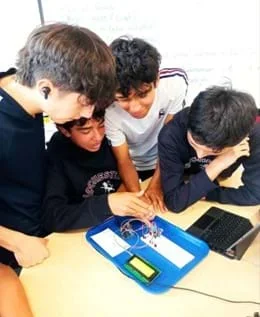 Students explain to each other how the Arduino works and how to troubleshoot misconnections.Copyright Matthew Reis, 2024
- greenhouse gas
- Gasses in the earth's atmosphere that trap heat.
- carbon dioxide
- A colorless, odorless gas produced by burning carbon and organic compounds and by respiration. It is naturally present in air (about 0.03%) and is absorbed by plants in photosynthesis.
- temperature
- The degree or intensity of heat present in a substance or object, especially as expressed according to a comparative scale and shown by a thermometer or perceived by touch.
- relative humidity
- The amount of water vapor actually present in the air compared to the greatest amount possible at the same temperature.
- asthma
- A chronic (long-term) condition that affects the airways in the lungs.
- mental performance
- The ability to think, reason, and remember information, as well as how one functions mentally and emotionally on a day-to-day basis.
- arduino
- An open-source electronics platform that allows users to build digital devices.
Pre-Activity Assessment
Brainstorming: In small groups, have students engage in open discussion about how air quality affects school performance. Remind them that no idea or suggestion is "silly"; all ideas should be respectfully heard. Take an uncritical position, encourage wild ideas, and discourage criticism of ideas. As a class, record their ideas on the board.
Activity Embedded Assessment
Student Activity Guide: Have students work individually or in pairs on the Reading Check review questions in the Student Activity Guide (PDF). After they finish, have them compare answers with a peer or another pair, giving all students time to finish the worksheet.
Post-Activity Assessment
Problem Solving: After showing the Arduino Presentation (PPTX)and the steps to create the Arduino, let students construct their Arduino and collect data. Once the data is collected, lead a class discussion:
- What is the relationship between greenhouse gasses and temperature? (Answer: It depends on the greenhouse gas, but they should be able to observe that CO2 and temperature have a direct relationship. As CO2 increases over time, so does the temperature.)
- What would happen to student well-being if the CO2 continued to increase? (Answer: We would get drowsy, maybe get a headache.)
- How could you manipulate the conditions of the room to ensure the best air quality? (Answer: Leave the door open, take active pauses, propose shorter class, install fans, etc.)
Air Quality Report: Tell students that engineers must justify their proposals and recommendations with evidence. Using data from their graphs, have student write up an air quality report that includes improvements and further research ideas.
To ensure a smooth experience with Arduino projects:
- Check Jumper Connections: The most common issue is incorrect jumper connections. To avoid this, have an assembled Arduino as a model or assign a teaching assistant. The assistant can either assemble the Arduino before class or do it quickly during class, and then help support other students with their setups.
- Program Arduinos Outside of Class: To avoid potential problems, program the Arduinos outside of class time. Programming during class can lead to delays and technical issues. Pre-programming ensures everything runs smoothly and allows more class time for hands-on work.
For younger students who may struggle with the data analysis, offer simpler graphing tools or a template where they only need to plug in the numbers from their data.
For students unfamiliar with Arduino, go step-by-step through the assembly process, with lots of visual support. You could also pre-assemble some components.
For advanced students,
- Have students choose two United Nations sustainability goals and justify how this activity fulfilled them (https://sdgs.un.org/goals). Note: They must select a specific criterion within the UNSG.
- Have students design a poster that could be shared on campus that teaches the community about the importance of classroom protocols such as keeping doors closed, not blocking ventilation, and regularly checking sensors for proper functioning.
https://getuhoo.com/blog/education/air-quality-affects-childrens-school-performance
Contributors
Matthew Douglas Reis (Natural Science Coordinator and Sustainability and Energy Coordinator, Rochester School); William Zorro Camacho (Industrial Designer, CAD Teacher, Rochester School, Cundinamarca, Colombia); Julieth Tatiana Lara Perez (Environmental Engineer, Nueva Granada Military University, Cundinamarca, Colombia)
Acknowledgements
This curriculum was designed and implemented at Rochester School in Chia, Colombia. We would like to give special thanks to Juan Pablo Aljure and the Aljure family. Rochester School is an innovative school focused on sustainability and mental health. It is committed to teaching students to take control of their lives with the world in mind.
Copyright
2025 by Regents of the University of Colorado