
Designing an Arduino Geiger Counter
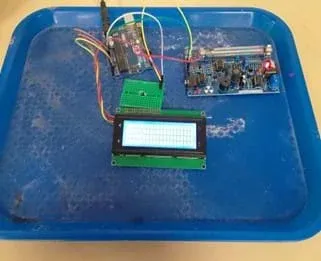 Students create a functioning Geiger counter.Copyright Matthew Reis
Students use the engineering design process to investigate radiation and its effects on human health. Students design and build simple Geiger counters, learn about different types of radiation and typical background levels, and gather data from various locations. They then analyze their findings, compare them to accepted safety standards, and refine their devices for improved performance. The activity culminates in a final report where students explain their results, justify conclusions with evidence, and reflect on the strengths and limitations of their investigation and design.
Nuclear engineers design and maintain systems that keep nuclear reactors safe. They create sensors to monitor conditions such as temperature and radiation, helping detect problems before they become dangerous. Events like the Chernobyl disaster show the importance of keeping reactors within safe limits. Nuclear engineers use these lessons to improve safety systems and protect people from harmful radiation through shielding, monitoring, and strict safety protocols.
After this activity, students should be able to:
- Define the types of nuclear radiation.
- Explain the effect of nuclear radiation on human well-being.
- Propose mechanisms and improvement plans to ensure healthy environmental conditions in classrooms.
- CCSS.Math.Practice.MP4 Model with mathematics.
Grades K-12
Do you agree with this alignment? - CCSS.Math.Practice.MP5 Use appropriate tools strategically.
Grades K-12
Do you agree with this alignment? - CCSS.Math.Practice.MP6 Attend to precision.
Grades K-12
Do you agree with this alignment?
- HS-ETS1-2 Design a solution to a complex real-world problem by breaking it down into smaller, more manageable problems that can be solved through engineering.
Grades 9-12
This resource focuses on the following Three Dimensional Learning aspects of NGSS:
Science & Engineering Practices- Design a solution to a complex real-world problem, based on scientific knowledge, student-generated sources of evidence, prioritized criteria, and tradeoff considerations.Do you agree with this alignment?
Disciplinary Core Ideas- Criteria may need to be broken down into simpler ones that can be approached systematically, and decisions about the priority of certain criteria over others (trade-offs) may be needed.Do you agree with this alignment?
Do you agree with this alignment? - Design a solution to a complex real-world problem, based on scientific knowledge, student-generated sources of evidence, prioritized criteria, and tradeoff considerations.
- HS-ETS1-3 Evaluate a solution to a complex real-world problem based on prioritized criteria and trade-offs that account for a range of constraints, including cost, safety, reliability, and aesthetics, as well as possible social, cultural, and environmental impacts.
Grades 9-12
This resource focuses on the following Three Dimensional Learning aspects of NGSS:
Science & Engineering Practices- Evaluate a solution to a complex real-world problem, based on scientific knowledge, student-generated sources of evidence, prioritized criteria, and tradeoff considerations.Do you agree with this alignment?
Disciplinary Core Ideas- When evaluating solutions it is important to take into account a range of constraints including cost, safety, reliability and aesthetics and to consider social, cultural and environmental impacts.Do you agree with this alignment?
Crosscutting Concepts- New technologies can have deep impacts on society and the environment, including some that were not anticipated. Analysis of costs and benefits is a critical aspect of decisions about technology.Do you agree with this alignment?
Do you agree with this alignment? - Evaluate a solution to a complex real-world problem, based on scientific knowledge, student-generated sources of evidence, prioritized criteria, and tradeoff considerations.
- HS-PS1-8 Develop models to illustrate the changes in the composition of the nucleus of the atom and the energy released during the processes of fission, fusion, and radioactive decay.
Grades 9-12
This resource focuses on the following Three Dimensional Learning aspects of NGSS:
Science & Engineering Practices- Develop a model based on evidence to illustrate the relationships between systems or between components of a system.Do you agree with this alignment?
Disciplinary Core Ideas- Nuclear processes, including fusion, fission, and radioactive decays of unstable nuclei, involve release or absorption of energy. The total number of neutrons plus protons does not change in any nuclear process.Do you agree with this alignment?
Crosscutting Concepts- In nuclear processes, atoms are not conserved, but the total number of protons plus neutrons is conserved.Do you agree with this alignment?
Do you agree with this alignment? - Develop a model based on evidence to illustrate the relationships between systems or between components of a system.
- HS-PS4-5 Communicate technical information about how some technological devices use the principles of wave behavior and wave interactions with matter to transmit and capture information and energy.
Grades 9-12
This resource focuses on the following Three Dimensional Learning aspects of NGSS:
Science & Engineering Practices- Communicate technical information or ideas (e.g. about phenomena and/or the process of development and the design and performance of a proposed process or system) in multiple formats (including orally, graphically, textually, and mathematically).Do you agree with this alignment?
Disciplinary Core Ideas- Solar cells are human-made devices that likewise capture the sun's energy and produce electrical energy.Do you agree with this alignment?
- Information can be digitized (e.g., a picture stored as the values of an array of pixels); in this form, it can be stored reliably in computer memory and sent over long distances as a series of wave pulses.Do you agree with this alignment?
- Photoelectric materials emit electrons when they absorb light of a high-enough frequency.Do you agree with this alignment?
- Multiple technologies based on the understanding of waves and their interactions with matter are part of everyday experiences in the modern world (e.g., medical imaging, communications, scanners) and in scientific research. They are essential tools for producing, transmitting, and capturing signals and for storing and interpreting the information contained in them.Do you agree with this alignment?
Crosscutting Concepts- Systems can be designed to cause a desired effect.Do you agree with this alignment?
- Modern civilization depends on major technological systems.Do you agree with this alignment?
- Science and engineering complement each other in the cycle known as research and development (R&D).Do you agree with this alignment?
Do you agree with this alignment? - Communicate technical information or ideas (e.g. about phenomena and/or the process of development and the design and performance of a proposed process or system) in multiple formats (including orally, graphically, textually, and mathematically).
Each group needs:
- 1 assembled radiation detector system, DIY Miller tube nuclear radiation detector Geiger counter kit module experimental module
- 1 Uno or Mega Arduino board
- 1 LCD screen Arduino
- 1 breadboard
- 12 jumpers
- 8 male/male
- 4 male/female
- Engineering Design Process Worksheet (PDF)(1 per student)
- poster board or trifold poster
For the entire class:
- 1 laptop or computer and projector with Internet access to show YouTube videos
- Arduino IDE software downloaded on computer
- Geiger Counter Arduino Sensors Code (PDF)
- Student Rubric (PDF)
- Access to the Geiger Counter Instructions Presentation (PPTX)
- Geiger Counter Instructions Presentation (pptx)
- Geiger Counter Instructions Presentation (pdf)
- Geiger Counter Arduino Sensors Code (docx)
- Geiger Counter Arduino Sensors Code (pdf)
- Engineering Design Process Worksheet (docx)
- Engineering Design Process Worksheet (pdf)
- Student Rubric (docx)
- Student Rubric (pdf)
Students should be able to:
- Create a line graph (this skill can be developed throughout the activity).
- Describe and analyze trends in graphs (this skill can also be developed throughout the activity).
- Add and subtract.
- Know the types of nuclear radiation.
- Have a basic understanding of physiology, especially how the human body repairs damage.
- Have knowledge of atomic structure.
- Have basic knowledge of the physical properties of materials.
You have been hired by the largest private environmental protection company in the world. The company wants to build a large apartment complex next to a nuclear reactor. There will be many families living in the complex, and the company wants to ensure they are safe from nuclear radiation. Your job is to ensure that there is a healthy level of background radiation. Your goal is to construct a Geiger counter, measure the background radiation, and create a report of your findings.
Let’s start with this question: How does nuclear radiation affect human health? (Let students offer answers; write student answers on board for all to see.) Radiation can damage living tissue. At low levels, the human body can usually repair the damage. But high levels of radiation exposure—especially over time—can lead to serious health problems such as cancer or organ failure. That’s why monitoring radiation is so important, especially in places where people will live and work. Now, not all radiation is dangerous. There’s something called background radiation—this is the natural radiation we’re all exposed to every day from things like the sun, soil, rocks, and even bananas!
Here’s the next question: What are normal and healthy levels of background nuclear radiation? (Let students offer answers; write student answers on board for all to see.) Typically, background radiation levels are low, measured in a unit called microsieverts per hour (µSv/h). For example, most places on Earth have background radiation levels of about 0.1 to 0.2 µSv/h. Anything significantly higher might require a closer look. Your job will be to take these kinds of measurements and compare them to what’s considered safe.
Which brings us to the final piece of the puzzle: How do we measure nuclear radiation? Radiation isn’t something we can see, smell, or touch. That’s why we use a device called a Geiger counter, a tool that detects particles emitted by radioactive materials. You’ll build your own Geiger counter, test it, and then use it to measure background radiation around our “reactor site.” You’ll analyze your data, write a report, and make a recommendation: Is it safe to build the apartment complex, or not?
This is real-world science. And real-world engineering. With real-world consequences. Your findings could influence the safety of hundreds of people. Are you ready to take on the challenge?
Background
Radiation is energy emitted from unstable atomic nuclei, and it comes in three main types. Alpha particles are heavy, slow, and easily blocked by paper or skin. Beta particles are lighter, travel faster, and can pass through skin but are stopped by materials such as aluminum. Gamma rays are high-energy electromagnetic waves that are extremely penetrating and can pass through the human body.
Radiation can damage cells, especially those that divide quickly, such as in the skin, bone marrow, and stomach. At low doses, the body can often repair this damage, but high doses or prolonged exposure can cause burns, radiation sickness, cancer, or organ failure. Not all radiation is harmful, though—radiation is used in medicine to detect and treat disease, sterilize equipment, and preserve food. These applications are safe when strict safety measures are followed.
Background radiation is the natural radiation we are exposed to every day from the sun, rocks, soil, and even food. Typical background radiation levels are low, around 0.1 to 0.2 microsieverts per hour (µSv/h). Knowing these levels helps put radiation risk into context. Because radiation cannot be seen, smelled, or touched, it must be measured with specialized instruments such as Geiger counters. These tools detect ionizing radiation particles and allow scientists and engineers to monitor exposure levels to ensure they remain within safe limits.
A Geiger counter is a handheld device used to detect and measure ionizing radiation, the kind of radiation that can remove electrons from atoms and potentially harm living tissue. It works by using a Geiger–Müller tube, which is filled with gas that becomes ionized when radiation passes through. Each time a radioactive particle or ray interacts with the gas, it produces an electrical pulse. The Geiger counter records these pulses, often as audible clicks and as a numerical reading on a display.
The more radiation present, the more clicks you hear and the higher the reading. Because radiation can’t be seen, smelled, or felt, Geiger counters are critical tools for monitoring radiation levels in environments such as hospitals, research labs, nuclear power plants, and even natural settings where radioactive materials are present.
Before the Activity
- Gather the materials needed by each group.
- Organize all the materials into trays or boxes (1 per group).
- Make copies of the Engineering Design Process Worksheet (PDF) (1 per student) or upload it to your LMS.
- Upload the Geiger Counter Instructions Presentation (PPTX) to your LMS or print a physical copy (1 per group).
DAY 1
Ask (20 min)
- Introduce students to the activity by reading the Introduction/Motivation section.
- Put students into groups of 3-4.
- Hand out one Engineering Design Process Worksheet (PDF)to each student.
- Review the objective: You will use the engineering design process to design and build a Geiger counter prototype.
- Optional: Review the steps of the engineering design process.
- Review the constraints of the problem/challenge:
- Must use Arduino parts.
- Must measure radiation count per minute.
- Pre-Activity Assessment Brainstorming: In their groups, have students engage in an open discussion, answering the question: How could radiation affect human health? Remind students that:
- No idea or suggestion is "silly."
- All ideas should be respectfully heard.
- They should take an uncritical position, encourage wild ideas, and discourage criticism of ideas. Ask students how radiation could affect human health.
- As a class, have them record their ideas on the board.
- Quick Poll: Ask the class and tally their responses on the board: How can we measure background radiation to ensure healthy levels?
Research (25 min)
- Show students this video: https://www.youtube.com/watch?v=s9APLXM9Ei8 (2:38 minutes).
- Have students follow the directions in the Research section of their Engineering Design Process Worksheet (PDF).
- Students write down a phrase, statement, or portion of dialogue that stands out to them.
- Each student shares their chosen a phrase, statement, or portion of dialogue with their group.
- Students write down what the quote “Every atom of uranium is like a bullet...” means to them.
- Students quietly read the guided reading and answer the review questions.
- After students finish their reading and answer the guided reading questions, have a class discussion about the guided reading questions and clarify any misunderstandings.
- What are the three types of nuclear radiation?
- Alpha particles: Heavy and slow; blocked by paper or skin.
- Beta particles: Smaller and faster; can pass through skin but are stopped by materials such as aluminum.
- Gamma rays: Energy waves; very penetrating and can pass through the human body.
- How does radiation affect human cells?
Radiation can damage cells, especially fast-dividing ones like those in the skin, bone marrow, and stomach. The effects depend on the dose, duration of exposure, and which part of the body is exposed. Low doses may cause little harm, but high exposure can result in burns, radiation sickness, or cancer.
- In what ways is radiation helpful to society?
Radiation is used to detect and treat diseases such as cancer, sterilize medical equipment, and preserve food. Scientists and doctors use it for many positive purposes while following strict safety measures.
Imagine (15 min)
- Show the following two videos:
- What tools measure radiation? https://www.youtube.com/watch?v=cwOPGfLkB7w (1:44 minutes).
- Why do Geiger counters click? https://www.youtube.com/watch?v=qtvz8lH5zhk (3:07 minutes).
- Have students complete the Imagine section of their Engineering Design Process Worksheet (PDF), where they brainstorm ideas with their group and then sketch their ideas and designs in their worksheet.
- If any class time remains, have students begin to review the Geiger Counter Instructions Presentation (PPTX).
DAY 2
Plan (15 min)
- Give each group a Geiger Counter Instructions Presentation (PPTX) or make it available digitally.
- As a class, go over each part so the students are familiar with the components and functions of the Arduino Geiger counter.
- Have students work with their groups on the Plan section of their Engineering Design Process Worksheet (PDF).
- Groups review the Geiger Counter Instructions Presentation (PPTX).
- Each group makes a drawing of their final Geiger counter design.
- Each group lists the materials that they will need for their design.
Create (30 min)
- Using the Geiger Counter Instructions Presentation (PPTX), have each group build their planned Arduino Geiger counter.
- As students complete their Geiger counter, have students bring their design to your computer and download the Geiger Counter Arduino Sensors Code (PDF)onto their Arduino through the Arduino IDE application.
This is the final product: a functioning Geiger counter.Copyright Matthew Reis
Preparing to Test (15 min)
- Have students discuss which locations in the school will have the highest background radiation
- Allow students to search online resources to investigate normal background radiation.
- Have students make their hypothesis and write it in their Engineering Design Process Worksheet (PDF).
DAY 3
Test (60 min)
- Allow students to take their Arduino to different locations in the school and collect data for 10-15 minutes.
- Have students enter their results in Data Table #1 in their Engineering Design Process Worksheet (PDF).
- Have students answer the questions in the Test section.
- Homework: Have students transform their Data Table #1 results for the different locations to make line graphs and draw conclusions.
DAY 4
Improve and Retest (60 min)
- Have students make changes to their Geiger counter prototype based on what worked and what did not work during testing.
- Have students retest their Geiger counter prototype in the same locations around the school for the same times.
- Have students record their results in Data Table #2.
- Have students answer the questions in the Improve section of their Engineering Design Process Worksheet (PDF).
- Homework: Have students transform their Data Table #2 results for the different locations to make line graphs and draw conclusions and then answer the Reflection Questions in the Engineering Design Process Worksheet (PDF).
DAY 5
Summary (30 min)
- Have students draft a Radiation Report that includes the following:
- Background research (use answers from reading check)
- Challenge question/objective
- Hypothesis
- Methods
- Graph
- Analysis in CER paragraph format that states whether their hypothesis was supported or rejected with justification using numerical evidence
- A discussion that includes improvements and further research ideas
Conclusion (30 min)
- Have students design a poster that could be shared on campus that teaches the community about the background radiation at different locations at school and the health effects of nuclear radiation. Include the strengths and limitations of the Geiger counter.
- If time, have students present their final reports and posters based on the Student Rubric (PDF).
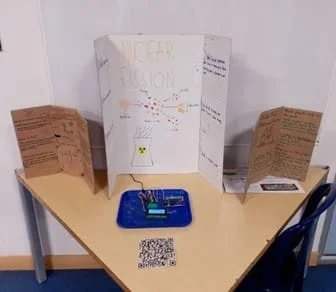 A final stand with functioning Geiger counter and trifold posters.Copyright Matthew Reis
- alpha particles
- A type of ionizing radiation made up of two protons and two neutrons—the same as a helium nucleus. They are emitted during the radioactive decay of certain heavy elements, such as uranium or radium.
- beta particles
- High-energy, fast-moving electrons or positrons emitted by certain types of radioactive nuclei during beta decay.
- gamma rays
- A form of electromagnetic radiation (such as X-rays or light) emitted from the nucleus of an atom during radioactive decay.
- geiger counter
- A scientific instrument used to detect and measure radiation, particularly ionizing radiation such as alpha particles, beta particles, and gamma rays.
- background radiation
- The natural radiation that is always present in the environment. It comes from a variety of natural and artificial sources and is not caused by any specific human activity.
- cancer
- The uncontrollable growth of cells, which can occur when nuclear radiation damages the DNA inside cells and mutations develop.
- arduino
- An open-source electronics platform that allows users to build digital devices.
Pre-Activity Assessment
Brainstorming: In small groups, have students engage in open discussion. Remind them that no idea or suggestion is "silly." All ideas should be respectfully heard. Take an uncritical position, encourage wild ideas, and discourage criticism of ideas. Ask students how radiation could affect human health. As a class, record their ideas on the board.
Quick Poll: Before the activity begins, ask the class a question and tally their responses on the board. Ask: “How can we measure background radiation to ensure healthy levels?”
Activity Embedded Assessment
Worksheet/Pairs Check: Have students work individually or in pairs on the Reading Check. After they finish, have them compare answers with a peer or another pair, giving all students time to finish the Engineering Design Process Worksheet (PDF).
Hypothesize: Have students hypothesize and record their hypotheses for the following questions:
- What will be the background radiation at the school?
- What areas will have the most background radiation, and why?
Post-Activity Assessment
Problem-Solving and Reflection: Once their data is collected, have students answer the Reflection Questions in the Engineering Design Process Worksheet (PDF):
- What is the relationship between location and background radiation?
- What would happen to a person who lived next to and was exposed to nuclear radiation?
- How could you construct an infrastructure to contain nuclear radiation?
Radiation Report: Students use the data from their graphs to construct a Radiation Report explaining the relationship between location in the school and background radiation.
The most common problem is that the students connect the jumpers incorrectly. It’s best to have an Arduino already assembled as a model or assign a teaching assistant. The teaching assistant could be a student that comes before class and assembles the Arduino or assembles the Arduino quickly in class and can then support other students.
The other tip is to program the Arduinos outside of class. If you program them during class you can have problems.
For more advanced students, have them choose TWO UN sustainability goals and justify how this activity fulfilled them (https://sdgs.un.org/goals). Note: You must select a specific criterion within the UNSG.
Murchison, Joseph. Arduino DIY Geiger counter. 24 June 2011, www.instructables.com/member/Josehf+Murchison. Accessed 5 May 2025.
Contributors
Matthew Douglas Reis (Natural Science Coordinator and Sustainability and Energy Coordinator, Rochester School, Chia, Colombia); Pablo Contreras (Math Teacher, Rochester School, Chia, Colombia); Laura Perilla (Lab Technician, Rochester School, Chia, Colombia)
Acknowledgements
This curriculum was designed and implemented at Rochester School in Chia, Colombia. We would like to give a special thanks to Juan Pablo Aljure and the Aljure family. Rochester School is an innovative school that is focused on sustainability and mental health. They are committed to teaching students to take control of their lives with the world in mind.
Copyright
2025 by Regents of the University of Colorado; original © 2024 Matthew Douglas Reis