
Build Your Own Insect Trap
Students design and construct devices to trap insects that are present in the area around the school. The objective is to ask the right design questions and conduct the right tests to determine if the traps work .
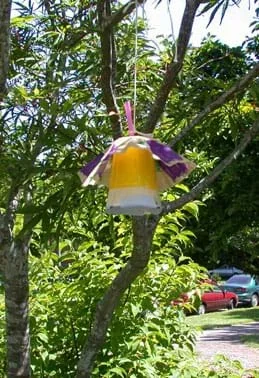 An example of a student made insect trapCopyright Sujaya Rao, K-12 Rural Science Education Program, Department of Crop and Soil Sciences, Oregon State University
Engineers are well known for designing and building large structures such as bridges, tunnels and skyscrapers. But they also must be skilled at designing things at a much smaller scale. These smaller designs are just as difficult to figure out. They require a choice of materials, a physical layout, a good grasp of the underlying scientific principles, building prototypes, and trial and error testing. Designing and building something such as an insect trap is a test of an engineer's knowledge and skills.
After this activity, students should be able to:
- Design and build structures based on provided criteria and materials.
- Follow the steps of the engineering design process to create a prototype insect trap.
- Discuss the environmental issues surrounding the creation of an insect trap.
- Discuss how engineers would be involved in the design of an insect trap.
Note: While the insect is fictitious, determine in advance some of the characteristics of the imaginary insect. The insect has to fly during the day and be attracted to one or more specific colors and food items that you can purchase inexpensively. Modify the provided Materials List accordingly. For example: if you indicate that the insect is attracted to yellow, provide items such as yellow cups and yellow paper. If you indicate that the insect is attracted to the odor of coffee, provide coffee or coffee grounds.
- Students will develop an understanding of the attributes of design.
Grades K-12
Do you agree with this alignment? - Students will develop an understanding of engineering design.
Grades K-12
Do you agree with this alignment? - STEL-7I Apply the technology and engineering design process.
Grades 3-5
Do you agree with this alignment? - STEL-7J Evaluate designs based on criteria, constraints, and standards.
Grades 3-5
Do you agree with this alignment?
- Abilities Necessary to Do Scientific Inquiry
Grades K-12
Do you agree with this alignment? - Abilities of Technological Design
Grades K-12
Do you agree with this alignment?
- 3-5-ETS1-1 Define a simple design problem reflecting a need or a want that includes specified criteria for success and constraints on materials, time, or cost.
Grades 3-5
This resource focuses on the following Three Dimensional Learning aspects of NGSS:
Science & Engineering Practices- Define a simple design problem that can be solved through the development of an object, tool, process, or system and includes several criteria for success and constraints on materials, time, or cost.Do you agree with this alignment?
Disciplinary Core Ideas- Possible solutions to a problem are limited by available materials and resources (constraints). The success of a designed solution is determined by considering the desired features of a solution (criteria). Different proposals for solutions can be compared on the basis of how well each one meets the specified criteria for success or how well each takes the constraints into account.Do you agree with this alignment?
Crosscutting Concepts- People's needs and wants change over time, as do their demands for new and improved technologies.Do you agree with this alignment?
Do you agree with this alignment? - Define a simple design problem that can be solved through the development of an object, tool, process, or system and includes several criteria for success and constraints on materials, time, or cost.
To share with the entire class:
- paper, regular weight or construction (include several colors, including the color that the target insect is attracted to), 2-3 times the number of teams in the class
- markers, any kind and any color, 4-packs (for students who wish to add designs on their traps)
- plastic cups, any kind, 1-2 per team (include several colors, including the color that the insect is attracted to)
- 1 ball of string
- plastic plates, large and small, any kind, 2-3 times the number of teams in the class (include several colors, such as yellow, white and red, making sure to include the color that the insect is attracted to)
- 1 large box Popsicle sticks
- masking tape, 2 rolls
- 75 drinking straws
- scissors, inexpensive but sharp
- 1 box Q-tips
- 1 bag cotton balls
- food items to act as lures, whatever is specified as the material(s) that attracts the insect, for example: vanilla, coffee, soda
- assorted building materials, such as wire, screen, cardboard, twist ties, foil, tape, glue (items that might help students create imaginative insect traps)
Note: This list suggests materials suitable for attraction of an example flying insect that are inexpensive and easily available at grocery stores. However, since it is up to the teacher to specify the species of insect to trap, feel free to alter the necessary supplies and ingredients and answer students' questions accordingly. For example, if you need sugar instead of lentils as bait, then if a student asks what is the insect attracted to, you would answer, "sugar."
Students should have a basic knowledge of insects, for example, that insects fly, that they are present during certain times of the year, that they are attracted to certain foods, that some of them are beneficial to humans whereas others are harmful, and that that they can be trapped.
A new insect has been sighted in your neighborhood. It has two pairs of wings and is capable of flying great distances. Whether or not it consumes plants is unknown. This fact alone has homeowners and farmers concerned that it might be damaging their plants. Because very little is known about the biology of this insect, entomologists would like to catch as many as possible so that they can be studied.
Entomologists trap insects for many reasons; for instance, to study them and to learn more about them. They know that insects can easily be studied once they are captured in the traps. How do entomologists find the right trap to use for an insect about which they do not yet know a whole lot? Well, they learn as much as they can about the insect and then ask engineers to design an insect trap according to what they have discovered. Once entomologists trap insects and study them more, they learn how to improve the trap.
Engineers must consider several things when designing insect traps.The first step in the design process is to identify your audience or user community. Who is the audience for the insect trap? It might be an entomologist, or perhaps homeowners, farmers and ranchers who are worried about the insects damaging their plants, crops and trees, or biting their animals. This shows that designing an insect trap can have different goals and objectives. For example, scientists typically use traps so that they can study insects, while homeowners use traps to remove insects from their homes.
Next, you have to identify the problem. The problem has two parts, the problem statement and the design requirements. The problem statement for designing the insect trap might be, "How to catch the specific insects to be studied." What kind of design requirements do we have for the trap? Do we have any constraints? As a trap engineer, you probably have some limitations as far as materials and time. You would also think about how these constraints might affect the design of the trap.
Now we are ready to gather information about the insect species and brainstorm some different design ideas. We will choose our best idea and design a model, or prototype, of the trap to present to our audience. What do we already know about the insect? We have already been told that the insect has two pair of wings and is capable of flying great distances.
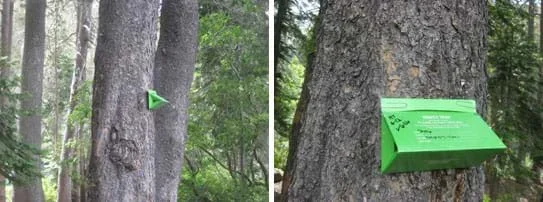 This insect trap is collecting insect data in Castle Crags State Park in northern California.Copyright 2012 Denise W. Carlson. Used with permission.
Many different types of insect traps are available on the market. Some use pheromone baits, which are scents that lure the insects to a trap. Other traps lure the insect with a food source. There are even traps that are simply attractive to insects because of their color.
The design of insect traps has the potential for wide variety since insects are so diverse that their responses vary. Researchers have found that for bee traps, the size matters, but only up to a point. For other insects, traps must be very large—a minimum size is needed for the traps to be even detected (show students the images of the very large Tabanidae trap in the Netherlands). To attract insects using odor stimuli, often the amount must be just right—if too much, they get confused and don't make it to the stimulus source at all.
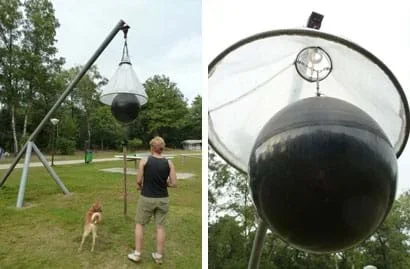 An example of a Tabanidae (horse fly) trap in the Netherlands.Copyright 2012 ITL Program, College of Engineering, University of Colorado Boulder
Let's assume that your engineering team has been hired to design a trap to capture this new insect species that has moved into the area. Your job is to design a trap that will effectively capture this insect species alive so that it can be studied. To design a trap that will be effective in capturing the insect, you need some background information about the insect and where the trap must be located.
Now ask me some questions to learn more information that can help you design an insect trap that works. (See the Procedure and Assessment sections insect characteristics.)
Before the Activity
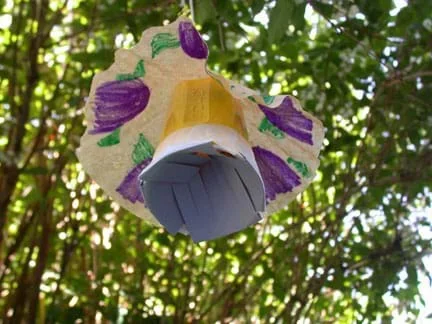 A student-designed insect trap design.Copyright Sujaya Rao, K-12 Rural Science Education Program, Department of Crop and Soil Sciences, Oregon State University
Encourage students to ask you questions about the insect so they learn more information to help them build a trap that works. Provide answers based on the materials provided. This inquiry aspect is important. Example student questions:
- Does the insect fly?
- Is the insect attracted to color?
- Is the insect active during the day or at night?
- What does the insect eat?
- Does the insect sting or bite?
With the Students
- Remind students that they are working for an engineering firm that will design a trap to capture these insects in the region.
- Mention some overall design requirements: The traps must be strong enough to withstand natural elements such as rain and wind, but still relatively simple to move and set up. They must be able to be opened up to permit frequent removal of trapped insects.
- Show students the supplies available for building the trap (hold them up as you review the items). Let students know that this is an open-ended design challenge and they can use some or all of the different items available to them: cups, paper, tape, string, plates, food items (to act as lures), markers, scissors, cotton balls, Q-tips, Popsicle sticks, straws, etc.
- Direct students to follow the steps of the engineering design process while they create their prototype traps. Write the steps on the classroom board:
A. Brainstorm ideas
- With a partner, create a list of many ideas for your new insect trap.
- Compile your ideas into your best design to develop into a prototype.
B. Plan/Design your trap.
- Create a drawing of your trap on paper. Indicate dimensions and materials.
- Remember that you are capturing a small insect, not a big animal. Make the dimensions of the trap no larger than 12 in x 12 in.
- Show the design to your teacher for approval.
C. Build the trap.
- Using engineering skills, build a prototype insect trap to help homeowners, farmers and entomologists capture live insects.
D. Communicate the trap design to the class.
- Your engineering team presents your trap design to the class and explains how it works. Point out the features you incorporated to lure and trap the insects.
- Ask the audience for questions and comments about your trap design.
- Think about improvements that you would make to your trap if you could redesign it.
- entomologist
- A scientist who studies insects.
- insect trap
- An object used to catch insects.
- odor cue
- A smell or scent that attracts organisms.
- pheromone
- A chemical passed through scent that triggers a(n innate) behavioral response in another member of the same species.
- prototype
- An original, full-scale and functioning model of a device or product that is used for testing to help designers learn what works (and what doesn't work) and make improvements towards achieving a final best design.
- visual cue
- A color or shape object that attracts organisms.
Pre-Activity Assessment
Gathering Information: Engage students in a discussion about the known characteristics of the insect they are trying to trap.
- What would you like to know about the insect before you design your trap? Answer student questions with known information. If students ask questions for which the information is not provided, let them know that it is unknown, and that this is a good research question.
- Questions likely to be asked by students (write the answers on the board):
Does the insect walk or fly? (Possible answer: It flies.)
Does the insect fly during the day or night? (Possible answer: It flies during the day.)
Is it attracted to any color? (Possible answer: It is attracted to yellow / red / white, or whatever materials color you have provided.)
Is it attracted to any scent? (Possible answer: It is attracted to the scent [odor] of beans / lentils [proteins] and Pepsi / soda. Or, whatever food cues the teacher has specified.)
How big is the insect? (Possible answer: It is similar in size to a yellow jacket wasp, about one-half inch long.)
Activity Embedded Assessment
Design Process: Have students follow the steps of the engineering design process: brainstorming ideas, creating designs, building prototypes, communicating, and testing and improving the insect traps. Also assess students on their ability to work in groups.
Trap Presentations: Have students present their traps to the class and draw attention to features that aid in insect attraction and retention. Use the following guide for evaluation of the trap.
Teacher Guide for Evaluation of Insect Trap Prototypes: While the insect for which the trap is being created is chosen by the teacher, the trap itself must be designed such that it meets certain specifications. Emphasize that the traps will be scored based on features that make it effective in accomplishing the objective, which is trapping of the insect, of which little is known. Give students the opportunity to be creative and figure out at least some of the critical Trap Specifications that are listed below. Others will come up during discussion as students present their traps. At the end of the class session, outline on the board with input from the students, the list of specifications that should match the list below.
Trap Specifications
- Presence of color and odor for attraction of the target insect from a distance.
- Entrance into the trap such that once the insect has entered it cannot escape. Hint: Use a funnel shape at the entrance.
- Mechanism for removal of insects from the trap so that some can be removed alive and released. Hint: Insects are cold-blooded, so they are inactive at low temperatures. If the trap is emptied when it is cool or is placed into a cool environment such as shade, a refrigerator or an ice box, the insects can be removed more easily.
- Adjust the trap size and the planned frequency of monitoring and removal of insects to each other. Given that the abundance of the insect and the ability of the trap in capturing it are unknown, if students plan to check the trap weekly, the trap needs to be fairly large. Students may choose to build a smaller version, but then it might need more frequent monitoring.
- Trap placement. For flying insects, the trap must be suspended.
- Ability to hold up to weather conditions. The materials provided are inexpensive and unlikely to withstand heavy wind, intense heat and light or rain. At activity end, have students discuss what (improved) materials would be best for the final design so that the trap can withstand wind and heat from the sun, as well as any (improved) design modifications so that it can handle the rain and ongiong monitoring.
Post-Activity Assessment
Re-Engineering: Ask students how they could improve their insect traps and have them sketch or test their new ideas based on what they have learned.
Informal Discussion: Solicit, integrate and summarize student responses.
- Ask students how their designs and insect trap prototypes relate to engineering. Why might engineers be involved in the creation of insect traps?
- Ask students what the environmental and ethical issues might exist surrounding the trapping of insects.
- Always be careful when using scissors.
Advise students to design the trap by making a drawing first. Then, they should get started on making the trap.
Make certain that the final dimensions are no larger than 12 in by 12 in. Engineers are often given space constraints when only so much room is available in which to implement a design.
The insect described in this activity is chosen by the teacher. Thus, if desired, the teacher can modify the description to match a more specific insect.
Place the traps outdoors and test to see how they hold up against the natural elements and whether they are successful in trapping any insects.
Have students plan out the entire process of inspecting the traps for insects, how to collect the data, what time of day would be best to check for any trapped insects, etc. Have them also draw up their ideas on the best ways to present the data (charts, graphs, photos, etc.).
Have students do a research project on a local insect to determine what it would be attracted to and design a possible trap that could be used to catch the insect.
As a research project, assign students to each investigate one example real-world insect trap, describing its design objectives and the features that make it successful.
Contributors
Sujaya Rao
Supporting Program
K-12 Rural Science Education Program, Department of Crop and Soil Sciences, Oregon State University
Acknowledgements
This digital content was developed by the Rural Science Education Program under National Science Foundation GK-12 grant no. DGE 0139372. However, these contents do not necessarily represent the policies of the National Science Foundation, and you should not assume endorsement by the federal government.
Copyright
2013 by Regents of the University of Colorado; original © 2007 Oregon State University