
Speedy & Compact: The Perfect Vehicle for Your Future
As if they are engineers, students are tasked to design solar-powered model vehicles that are speedy and compact in order to make recommendations to a local car sales company. Teams familiarize themselves with the materials by building solar-panel model car prototypes, following kit instructions, which they test for speed. After making design improvements, they test again. Then they take measurements and calculate the volume of each team’s vehicle. They rank all teams’ vehicles by speed and by size. After data analyses, reflection and team discussion, students write recommendations to the car company about the vehicle they think is best for consumers. Youngsters experience key portions of the engineering design process and learn the importance of testing and collaborating in order to make better products. Pre/post-quizzes and numerous worksheets and handouts are provided.
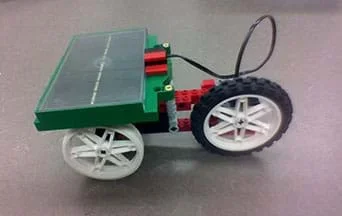 Engineers build prototypes (like this one) from which they design improvements.Copyright 2017 Lisa VanOrder, RET Program, College of Engineering, Michigan State University
Many engineers are involved in creating fuel-efficient vehicles that travel at high speeds. This involves experimenting with aerodynamics and weight, and in the case of solar-powered vehicles, solar cell placement for the most efficient light capture. Some transportation experts envision an automated highway system in which driverless electric vehicles are wirelessly charged by solar power. In this scenario, the benefits include reducing the number of accidents, dramatically improving the flow of traffic, and lowering greenhouse gas emissions.
Engineers typically invent and design products that meet the requirements and constraints imposed by clients. Engineers often create small-sized models of new products and projects in order to improve the end design through a series of evolving prototypes. Engineers also write summaries of their research and testing results that they share with clients.
After this activity, students should be able to:
- Design and build a small-sized speedy and compact solar-powered model vehicle.
- Design and rebuild a generic prototype vehicle with modifications and improvements in order to meet given design criteria.
- Take time measurements as the model vehicles travel a known distance.
- Analyze collected time data to determine car velocity and then order/rank all the cars’ performance.
- Order decimals that are recorded to the nearest tenth of a centimeter and the nearest tenth of a second.
- Make measurements from which to calculate volume (length x width x height).
- Record, organize and analyze data to find which vehicle is most suitable for the consumer.
- Write a recommendation letter explaining their reasoning for choosing the “best” car.
- Use scientific vocabulary in a written recommendation.
- CCSS.Math.Content.5.MD.C.5b Apply the formulas V = l × w × h and V = b × h for rectangular prisms to find volumes of right rectangular prisms with whole-number edge lengths in the context of solving real world and mathematical problems.
Grade 5
Do you agree with this alignment? - CCSS.Math.Content.5.NBT.A.3b Compare two decimals to thousandths based on meanings of the digits in each place, using >, =, and < symbols to record the results of comparisons.
Grade 5
Do you agree with this alignment? - CCSS.Math.Content.5.NBT.B Perform operations with multi-digit whole numbers and with decimals to hundredths.
Grade 5
Do you agree with this alignment? - CCSS.Math.Practice.MP2 Reason abstractly and quantitatively.
Grades K-12
Do you agree with this alignment?
- Students will develop an understanding of the attributes of design.
Grades K-12
Do you agree with this alignment? - Students will develop an understanding of engineering design.
Grades K-12
Do you agree with this alignment? - Students will develop an understanding of the role of troubleshooting, research and development, invention and innovation, and experimentation in problem solving.
Grades K-12
Do you agree with this alignment? - Students will develop an understanding of the characteristics and scope of technology.
Grades K-12
Do you agree with this alignment?
- CCSS.Math.Content.5.MD.C.5b Apply the formulas V = l × w × h and V = b × h for rectangular prisms to find volumes of right rectangular prisms with whole-number edge lengths in the context of solving real world and mathematical problems.
Grade 5
Do you agree with this alignment? - CCSS.Math.Content.5.NBT.A.3b Compare two decimals to thousandths based on meanings of the digits in each place, using >, =, and < symbols to record the results of comparisons.
Grade 5
Do you agree with this alignment? - CCSS.Math.Content.5.NBT.B Perform operations with multi-digit whole numbers and with decimals to hundredths.
Grade 5
Do you agree with this alignment? - CCSS.Math.Practice.MP2 Reason abstractly and quantitatively.
Grades K-12
Do you agree with this alignment?
- 3-5-ETS1-1 Define a simple design problem reflecting a need or a want that includes specified criteria for success and constraints on materials, time, or cost.
Grades 3-5
Do you agree with this alignment? - 3-5-ETS1-3 Plan and carry out fair tests in which variables are controlled and failure points are considered to identify aspects of a model or prototype that can be improved.
Grades 3-5
Do you agree with this alignment? - 4-PS3-4 Apply scientific ideas to design, test, and refine a device that converts energy from one form to another.
Grade 4
Do you agree with this alignment?
- 3-5-ETS1-1 Define a simple design problem reflecting a need or a want that includes specified criteria for success and constraints on materials, time, or cost.
Grades 3-5
This resource focuses on the following Three Dimensional Learning aspects of NGSS:
Science & Engineering Practices- Define a simple design problem that can be solved through the development of an object, tool, process, or system and includes several criteria for success and constraints on materials, time, or cost.Do you agree with this alignment?
Disciplinary Core Ideas- Possible solutions to a problem are limited by available materials and resources (constraints). The success of a designed solution is determined by considering the desired features of a solution (criteria). Different proposals for solutions can be compared on the basis of how well each one meets the specified criteria for success or how well each takes the constraints into account.Do you agree with this alignment?
Crosscutting Concepts- People's needs and wants change over time, as do their demands for new and improved technologies.Do you agree with this alignment?
Do you agree with this alignment? - Define a simple design problem that can be solved through the development of an object, tool, process, or system and includes several criteria for success and constraints on materials, time, or cost.
- 3-5-ETS1-3 Plan and carry out fair tests in which variables are controlled and failure points are considered to identify aspects of a model or prototype that can be improved.
Grades 3-5
This resource focuses on the following Three Dimensional Learning aspects of NGSS:
Science & Engineering Practices- Plan and conduct an investigation collaboratively to produce data to serve as the basis for evidence, using fair tests in which variables are controlled and the number of trials considered.Do you agree with this alignment?
Disciplinary Core Ideas- Tests are often designed to identify failure points or difficulties, which suggest the elements of the design that need to be improved.Do you agree with this alignment?
- Different solutions need to be tested in order to determine which of them best solves the problem, given the criteria and the constraints.Do you agree with this alignment?
Do you agree with this alignment? - Plan and conduct an investigation collaboratively to produce data to serve as the basis for evidence, using fair tests in which variables are controlled and the number of trials considered.
- 4-PS3-4 Apply scientific ideas to design, test, and refine a device that converts energy from one form to another.
Grade 4
This resource focuses on the following Three Dimensional Learning aspects of NGSS:
Science & Engineering Practices- Apply scientific ideas to solve design problems.Do you agree with this alignment?
Disciplinary Core Ideas- Possible solutions to a problem are limited by available materials and resources (constraints). The success of a designed solution is determined by considering the desired features of a solution (criteria). Different proposals for solutions can be compared on the basis of how well each one meets the specified criteria for success or how well each takes the constraints into account.Do you agree with this alignment?
- Energy can also be transferred from place to place by electric currents, which can then be used locally to produce motion, sound, heat, or light. The currents may have been produced to begin with by transforming the energy of motion into electrical energy.Do you agree with this alignment?
- The expression "produce energy" typically refers to the conversion of stored energy into a desired form for practical use.Do you agree with this alignment?
Crosscutting Concepts- Science affects everyday life.Do you agree with this alignment?
- Energy can be transferred in various ways and between objects.Do you agree with this alignment?
- Engineers improve existing technologies or develop new ones.Do you agree with this alignment?
- Most scientists and engineers work in teams.Do you agree with this alignment?
Do you agree with this alignment? - Apply scientific ideas to solve design problems.
For the teacher to present a mini math lesson and demo about finding volume:
- graduated cylinder, 100 ml-size works well
- small rock that easily fits inside the graduated cylinder
- marker
- tap water
- meter sticks
- small rectangular objects, such as white board erasers, calculators, books, etc.
Each group needs:
- solar-panel model kit, such as Engino STEM Solar Power Building Model Kit from Amazon, or eLAB LEGO® 9684 Renewable Energy Set from Bricklink, or similar kit
- copies of the 10 quizzes, worksheets and handouts in the Attachments section, one each per student
- 3 x 5-inch (7.6 x 12.7-cm) index card
- pencils
- calculator
To share with the entire class:
- timer
- masking tape
- (optional) cell phone or camera, to take photographs of prototype vehicles
- Vocabulary Pre-Quiz (docx)
- Vocabulary Pre-Quiz (pdf)
- Vocabulary Pre-Quiz Answer Key (docx)
- Vocabulary Pre-Quiz Answer Key (pdf)
- Data Collection Sheet (docx)
- Data Collection Sheet (pdf)
- Designing My Vehicle Worksheet (docx)
- Designing My Vehicle Worksheet (pdf)
- Data Analysis Worksheet (docx)
- Data Analysis Worksheet (pdf)
- Rationale Writing Worksheet (docx)
- Rationale Writing Worksheet (pdf)
- Recommendation to Car Company Sheet (docx)
- Recommendation to Car Company Sheet (pdf)
- Jump Start Recommendation to Car Company Sheet (docx)
- Jump Start Recommendation to Car Company Sheet (pdf)
- Vocabulary Post-Quiz (docx)
- Vocabulary Post-Quiz (pdf)
- Vocabulary Post-Quiz Answer Key (docx)
- Vocabulary Post-Quiz Answer Key (pdf)
- Solar cells convert light energy into electrical energy by way of photovoltaic cells.
- An understanding of the difference between qualitative and quantitative data.
(Introduce to the class the hypothetical scenario that provides the context for the activity.) A local car sales company wants your team of engineers to design the best vehicle to meet the demands of the people in your community. In order to do this, you need to know how to calculate speed and volume, two variables that are important to determining the “best” car. You have several models to choose from in order to practice this skill before you design and test your own small-sized prototype car models. The company wants a solar-powered compact car that can get drivers from point A to point B quickly.
Today we want to decide which model, from the basic models that already come with the kits we are using, would be the best option to meet the car company’s criteria of maximizing speed and minimizing volume. As engineers, you will alter and improve the initial model design in order to make it the fastest, smallest car. Let’s get started!
Background
Solar panels enable us to convert solar energy to electrical energy. Within the solar panels are photovoltaic (PV) cells made of silicon sheets. The silicon is a semiconductor; it can conduct electricity. In PV cells, negatively charged N-type silicon with a lot of electrons, and positively charged P-type silicon lacking electrons are sandwiched together; the location where they meet is called the P-N junction. Electrons from the N-type silicon pair up with “holes” (places with no electrons) in the P-type silicon.
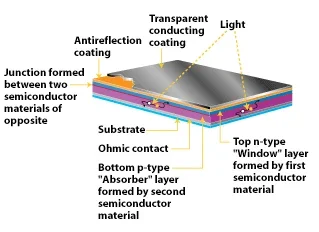 A diagram of a PV cell.Copyright U.S. Department of Energy (public domain), Wikimedia Commons https://commons.wikimedia.org/wiki/File%3AIllust_poly_thinfilm.gif
As photons from sunlight beat down upon solar cells, they provide energy that breaks the electron-hole pairs and knocks electrons off the silicon. The negatively charged free electrons are attracted to the N-side of the silicon cell, and the holes are attracted to the P-side. This creates an electric voltage that can be collected by thin metal sheets on either side of the silicon and used as power for vehicles or other purposes.
Before the Activity
- Make copies of all the worksheets.
- Locate a large, smooth outdoor area, such as a sidewalk or parking lot, to use as a test track. Use masking tape to mark start and stop lines that are five meters apart.
With the Students
- Day 1: Administer the Vocabulary Pre-Quiz (PDF).
- Present the Introduction/Motivation content to introduce the hypothetical situation and design challenge.
- Divide the class into groups of three students each and hand out the kits.
- Direct the teams to each construct a model by following the instructions that come with the kit. This gives you a set of 7 to 10 prototypes for the class, depending on class size.
- As groups are building, introduce and discuss the word prototype, explaining how the models they are building will be the teams’ initial prototypes. Continue to use the activity vocabulary words throughout the activity.
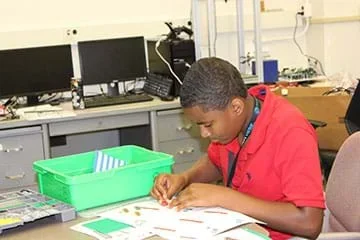 Assembling a solar-powered model car prototype from a kit.Copyright 2017 Lisa VanOrder, RET Program, College of Engineering, Michigan State University
- Hand out the Data Collection Sheet (PDF) and tell groups to get organized to test their prototypes. Direct students to decide, within each team, who will set up the vehicle, be the timer and record data.
- Have one group test at a time while the other teams gather around the test track to watch. For the trials, the setup person brings the vehicle and puts it on the start line. The recorder brings the Data Collection Sheet and pencil with him/her to record the time. The timer stands at the finish line.
- Ask groups to come up with a “go” signal like a thumbs up. At the “go” signal, the timer piece is turned on. The timer watches the car travel to the finish line and hits stop. Each team runs three trials, recording the data for each in the “Vehicle 1 (prototype)” column. Remind students to write the times in decimal form to the nearest tenth of a second.
- Day 2: Explain that the goal is to improve the prototype to make it faster. Teams must change at least one item on the vehicle in order to make it faster. Hand out the Designing My Vehicle Worksheet (PDF). Direct students to collaborate together in their groups to discuss the variables and decide which is the best to change. To enhance the team discussion, suggest that teams reflect on how their prototype vehicles worked and refer to the “things to consider” items at the top of the worksheet. Then, have each student sketch on the worksheet the team’s new design, which is different from the prototype, identifying the variable(s) they are changing. Note: If doing the second activity extension, at this point have each student use the worksheet to design and draw his/her own model as an improvement of the team prototype vehicle.
- Day 3: Today, teams build their new vehicles. Direct students to find the parts they need from the kit and work as a team to assemble the vehicle. They may leave the prototype intact unless they need some of its parts. If they take apart the prototype, have them take a photograph of it first in case they want to refer to it later.
- Day 4: Today, groups finish building their new vehicles. Remind them to get ready for the second round of testing by deciding within their teams who sets up the vehicle, is the timer and is the data recorder.
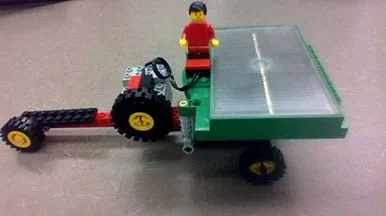 Have student teams use Engino Kits or eLAB LEGO sets (pictured) to build small-size solar-powered vehicles.Copyright 2017 Lisa VanOrder, RET Program, College of Engineering, Michigan State University
- Day 5: Before the activity: Check that the test track is still operational. If necessary, replace the masking tape start and finish lines.
- Have one group test at a time while the other teams gather around the track to watch—like the earlier prototype testing. This time, have students write the data from three trials in the “Vehicle 2” column.
- Have students compare the three trial times and write the fastest time on an index card.
- After all students have collected data, hand out the Data Analysis Worksheet (PDF).
- Put an identifying number (Team 1, Team 2, etc.) on each team index card and place them around the room with their vehicles.
- Have students calculate and then record the speed of each vehicle on the Data Analysis Worksheet. Remind students that car speed can be calculated by speed = distance/time.
- Then, have students list the vehicles in order by speed in the second worksheet chart.
- Day 6: Present a demo and mini-lesson to students on how to measure the vehicle volume. Explain that the way to measure the volume of irregular objects is to use the formula, Vx=V2-V1. Demonstrate with a small rock and water in a graduated cylinder.
- Fill the graduated cylinder half-way up with water.
- Have a student read the volume of water in the cylinder. Record the volume, V1.
- Have a student place the rock into the cylinder and record the new volume, V2.
- Ask students: What is the volume of the rock? Answer: Vx=V2-V1.
- Tell students that even though the vehicle shapes are irregular, we can get an approximate measurement using the rectangular formula, V=L x W x H, which means length times width times height. Have students practice calculating the volumes of some rectangular classroom objects such as white board erasers, markers and books. Round to the nearest tenth of a centimeter.
- Next, rotate the students from vehicle to vehicle to make measurements and calculate all the vehicle volumes, recording them on the worksheet. Then, have students list the vehicles in order by volume in the second worksheet chart.
- Day 7: Today students write their vehicle recommendations to the car company. Remind students of the car company’s criteria of maximizing speed while minimizing volume. Advise students to consider the speed and volume ranking information on the Data Analysis Worksheet. Once students see which cars fit the fastest and most compact criteria, they are ready to develop their rationale for choosing that vehicle.
- Next, students consider and discuss the points listed on the Rationale Writing Worksheet (PDF), and then decide how to “sell” this vehicle with its features. This prepares them to each write to the car company using the Recommendation to Car Company Sheet (PDF).
- Conclude the activity by administering the Vocabulary Post-Quiz (PDF).
- data analysis
- Inspecting data to find useful information.
- engineer
- To invent, design, build and/or test something in order to meet given requirements and any imposed limitations.
- model
- A representation of something you build or create.
- prototype
- A first model of something, to test but not to sell.
- volume
- The amount of space an object occupies.
Pre-Activity Assessment
Pre-Quiz: Have students take the Vocabulary Pre-Quiz (PDF), which asks them to match five definitions to five vocabulary terms. The same words are tested on the post-quiz. Two open-ended questions ask students to describe what they know about solar power and explain what features and benefits they would want in a car.
Activity-Embedded Assessment
Data Collection and Analysis: Have students individually use the Data Collection Sheet (PDF) and the Data Analysis Worksheet (PDF) to record data, make calculations, and rank the results.
Post-Activity Assessment
Written Recommendations: After working through the ideas prompted in the Rationale Writing Worksheet (PDF), have students write their recommendation paragraphs on the Recommendation to Car Company Sheet (PDF) (or Jump Start Recommendation to Car Company Sheet (PDF) for younger students). Review their paragraphs for their incorporation of the vocabulary words and to gauge their comprehension of the project objectives and concepts.
Post-Quiz: Have students take the Vocabulary Post-Quiz (PDF), which asks them to match definitions to words for five vocabulary terms—the same as on the pre-quiz. Two open-ended questions ask students to describe how they modified the standard vehicle design and explain what they learned from the project about engineering design and solar power.
Speed tests must be done on a sunny day with sufficient light for the solar panels.
If the vehicles are not moving, check the wheels for the cause of unnecessary friction.
Position the test track start line so that the vehicles get the optimal sunshine on the solar panels.
It helps if students design the vehicles so the solar power source faces the sun while on the test track. This is good information to observe in the prototype trials to apply as a new model improvement.
Extend this activity to fabricating several models (numerous iterations) to refine the speed and compact size.
If enough supplies exist for each student to build a model, start the activity with students working in teams of three, but on Day 2, have each student design and build his/her own model as an improvement of the team prototype vehicle. Have students compete to create the fastest and most compact vehicle in class. Have each student write a sales pitch for his/her own vehicle.
For lower grades, use the accommodated sheet, Jump Start Recommendation to Car Company Sheet (PDF) instead of the Recommendation to Car Company Sheet (PDF), which gives younger kids a head start to writing a persuasive sales paragraph by providing them with a fill-in-the-blank paragraph.
How Solar Cells Work by Jessika Toothman and Scott Aldous at How Stuff Works.com: https://science.howstuffworks.com/environmental/energy/solar-cell.htm
How Do Solar Panels Work? (4:58-minute video) by Richard Komp at TED-Ed: Lessons Worth Sharing (January 2016). https://www.youtube.com/watch?v=xKxrkht7CpY
Instructions for eLAB LEGO 9684 Renewable Energy Set, 2003 version, at http://lego.brickinstructions.com/lego_instructions/set/9684/renewable_energy_set
Contributors
Lisa VanOrder; Jack Sparrow; Ameer Hicks
Supporting Program
Smart Sensors and Sensing Systems RET, College of Engineering, Michigan State University
Acknowledgements
This curriculum was developed through the Smart Sensors and Sensing Systems research experience for teachers under National Science Foundation RET grant no. CNS 1609339. However, these contents do not necessarily represent the policies of the NSF, and you should not assume endorsement by the federal government.
Copyright
2018 by Regents of the University of Colorado; original © 2017 Michigan State University