
Keep Your Boat Afloat
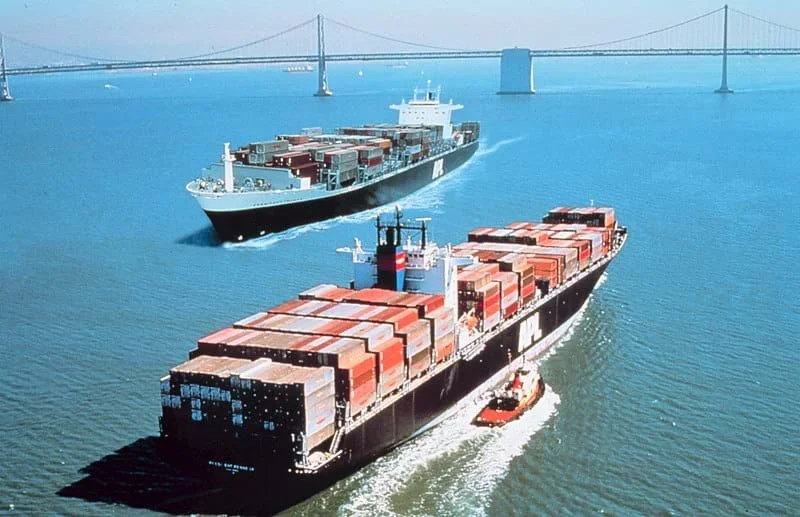 Two contain ships pass by each other in the San Francisco Bay. How do seafaring ships prevent corrosion over a long period of time?Copyright 2006 NOAA, Public Domain, Wikimedia Commons, https://commons.wikimedia.org/wiki/File:Container_ships_President_Truman_(IMO_8616283)_and_President_Kennedy_(IMO_8616295)_at_San_Francisco.jpg
Students engineer a ship that not only holds cargo but also resists corrosion. After activity constraints are introduced, the students discuss success criteria and how they will determine whether their final designs are deemed successful. Once the success criteria are defined, student groups are given a budget to design and engineer a ship that will meet the all of the challenge criteria. Students choose the design and shape of ship, the metal used to make the ship, and the type of coating that will prevent corrosion from occurring. After the initial design and build, students set their ships to sea and then monitor their ship daily, collecting observations about their ship (e.g., floating vs. sinking, corrosion, water intake, etc.). At the end of the testing period, students reflect on their design and engineering choices as well as what they would change if they repeated the activity again.
Corrosion has an adverse effect on many industries by lowering the shelf life of various metal products. With further research and intentional planning, engineers can design solutions to prevent corrosion to prolong the life of different metals and their applications. Often in their testing, engineers use models to test and improve new designs and materials. This is especially true when wanting to create (and duplicate) products on a larger scale. Companies that rely on cargo ships to transport goods and materials do not want to spend a lot of money on a full-size ship without knowing how much is will hold and how well it will hold up to environmental elements. With treatment and intentional planning, companies can prolong the life of a vessel, making it more cost effective (and producing less waste) for the company.
After this activity, students should be able to:
- Explain the effects of changing the temperature or concentration of the reacting particles on the rate at which a reaction occurs.
- Analyze a major global challenge to specify qualitative and quantitative criteria and constraints for solutions that account for societal needs and wants.
- Design a solution to a complex real-world problem by breaking it down into smaller, more manageable problems that can be solved through engineering.
- Evaluate a solution to a complex real-world problem based on prioritized criteria and trade-offs that account for a range of constraints, including cost, safety, reliability, and aesthetics, as well as possible social, cultural, and environmental impacts.
- Students will develop an understanding of the attributes of design.
Grades K-12
Do you agree with this alignment? - Students will develop an understanding of engineering design.
Grades K-12
Do you agree with this alignment? - Students will develop abilities to apply the design process.
Grades K-12
Do you agree with this alignment? - Students will develop an understanding of the characteristics and scope of technology.
Grades K-12
Do you agree with this alignment?
- HS-ETS1-1 Analyze a major global challenge to specify qualitative and quantitative criteria and constraints for solutions that account for societal needs and wants.
Grades 9-12
Do you agree with this alignment? - HS-ETS1-2 Design a solution to a complex real-world problem by breaking it down into smaller, more manageable problems that can be solved through engineering.
Grades 9-12
Do you agree with this alignment? - HS-ETS1-3 Evaluate a solution to a complex real-world problem based on prioritized criteria and trade-offs that account for a range of constraints, including cost, safety, reliability, and aesthetics, as well as possible social, cultural, and environmental impacts.
Grades 9-12
Do you agree with this alignment? - HS-PS1-5 Apply scientific principles and evidence to provide an explanation about the effects of changing the temperature or concentration of the reacting particles on the rate at which a reaction occurs.
Grades 9-12
Do you agree with this alignment?
- HS-ETS1-1 Analyze a major global challenge to specify qualitative and quantitative criteria and constraints for solutions that account for societal needs and wants.
Grades 9-12
This resource focuses on the following Three Dimensional Learning aspects of NGSS:
Science & Engineering Practices- Analyze complex real-world problems by specifying criteria and constraints for successful solutions.Do you agree with this alignment?
Disciplinary Core Ideas- Criteria and constraints also include satisfying any requirements set by society, such as taking issues of risk mitigation into account, and they should be quantified to the extent possible and stated in such a way that one can tell if a given design meets them.Do you agree with this alignment?
- Humanity faces major global challenges today, such as the need for supplies of clean water and food or for energy sources that minimize pollution, which can be addressed through engineering. These global challenges also may have manifestations in local communities.Do you agree with this alignment?
Crosscutting Concepts- New technologies can have deep impacts on society and the environment, including some that were not anticipated. Analysis of costs and benefits is a critical aspect of decisions about technology.Do you agree with this alignment?
Do you agree with this alignment? - Analyze complex real-world problems by specifying criteria and constraints for successful solutions.
- HS-ETS1-2 Design a solution to a complex real-world problem by breaking it down into smaller, more manageable problems that can be solved through engineering.
Grades 9-12
This resource focuses on the following Three Dimensional Learning aspects of NGSS:
Science & Engineering Practices- Design a solution to a complex real-world problem, based on scientific knowledge, student-generated sources of evidence, prioritized criteria, and tradeoff considerations.Do you agree with this alignment?
Disciplinary Core Ideas- Criteria may need to be broken down into simpler ones that can be approached systematically, and decisions about the priority of certain criteria over others (trade-offs) may be needed.Do you agree with this alignment?
Do you agree with this alignment? - Design a solution to a complex real-world problem, based on scientific knowledge, student-generated sources of evidence, prioritized criteria, and tradeoff considerations.
- HS-ETS1-3 Evaluate a solution to a complex real-world problem based on prioritized criteria and trade-offs that account for a range of constraints, including cost, safety, reliability, and aesthetics, as well as possible social, cultural, and environmental impacts.
Grades 9-12
This resource focuses on the following Three Dimensional Learning aspects of NGSS:
Science & Engineering Practices- Evaluate a solution to a complex real-world problem, based on scientific knowledge, student-generated sources of evidence, prioritized criteria, and tradeoff considerations.Do you agree with this alignment?
Disciplinary Core Ideas- When evaluating solutions it is important to take into account a range of constraints including cost, safety, reliability and aesthetics and to consider social, cultural and environmental impacts.Do you agree with this alignment?
Crosscutting Concepts- New technologies can have deep impacts on society and the environment, including some that were not anticipated. Analysis of costs and benefits is a critical aspect of decisions about technology.Do you agree with this alignment?
Do you agree with this alignment? - Evaluate a solution to a complex real-world problem, based on scientific knowledge, student-generated sources of evidence, prioritized criteria, and tradeoff considerations.
- HS-PS1-5 Apply scientific principles and evidence to provide an explanation about the effects of changing the temperature or concentration of the reacting particles on the rate at which a reaction occurs.
Grades 9-12
This resource focuses on the following Three Dimensional Learning aspects of NGSS:
Science & Engineering Practices- Apply scientific principles and evidence to provide an explanation of phenomena and solve design problems, taking into account possible unanticipated effects.Do you agree with this alignment?
Disciplinary Core Ideas- Chemical processes, their rates, and whether or not energy is stored or released can be understood in terms of the collisions of molecules and the rearrangements of atoms into new molecules, with consequent changes in the sum of all bond energies in the set of molecules that are matched by changes in kinetic energy.Do you agree with this alignment?
Crosscutting Concepts- Different patterns may be observed at each of the scales at which a system is studied and can provide evidence for causality in explanations of phenomena.Do you agree with this alignment?
Do you agree with this alignment? - Apply scientific principles and evidence to provide an explanation of phenomena and solve design problems, taking into account possible unanticipated effects.
Each group needs:
- aluminum foil (for prototyping)
- white board or poster paper to record process and data
To share with the entire class:
- metal sheets (some options listed)
- copper
- steel
- aluminum foil
- coatings (some options listed)
- wax paper
- petroleum jelly
- plastic wrap
- car wax
- primer
- dishpans, larger totes, or kiddie pool (for trial experiments and/or control)
- scissors
- leather or cut-resistant gloves (recommended)
- pliers (recommended)
- pennies (or other “cargo”)
Teacher materials:
- air tight storage container for metals
- small condiment cups (for measured coatings)
- salt (to add to water)
Students should know:
- The definition of corrosion and how it can be prevented
- How buoyancy works
- Definition of ratio
Metals react differently to oxidation, based on their chemical properties. Corrosion of metals can be prevented in numerous ways, some of which involve coating the material, which will be tested during this activity.
Cargo ships carry goods and materials from one part of the world to another. Because of their time spent on water, ships can start to corrode and rust. This is a problem for both cost and safety that needs to be taken into consideration for long term use of these ships. Today we will be engineering a design for a ship that not only holds cargo but also resists corrosion. Let’s dive in!
Before the Activity
- Select materials that will be used during this activity as well as how long ships will be tested.
- A budget for each group should be decided ($100 is recommended), as well as a price list for the available materials that are going to be offered to students (i.e., $10 per piece of metal, $5 per tbsp of coating, etc.).
- Aluminum foil should be cut to the desired size prior to activity (one per group). One sample of the other metal sheets (steel and copper) should also be cut before the first day so that students can look at and feel the metal before making a final decision on their design.
- During day 1, students can make a decision on their design (based on materials available and their budget). Teacher should cut the metal needed and put measured amounts of coatings in small containers for each group before the start of day 2.
- Build a sample boat of the metals being tested (same design, without coating). These will be the controls and should help students observe oxidation of metals during the trials.
- Using large tote or kiddie pool, teacher creates salt-water mixture and puts it in the desired container (before day 1).
With the Students
Day 1:
- Launch the activity/challenge with real-world problem. (See Introduction/Motivation)
- As a class, have students help build the rubric that will be used for final evaluation of their ship’s design.
- Ask students, “What are important factors that need to be considered when determining the success of each boat?”
- Ask students, “How will you determine whether a boat is successful or not?”
- Evaluation criteria that should be discussed:
- material choices
- design
- Factors to evaluate:
- Stability of boats (number of days floating, ability to hold cargo)
- Amount of corrosion (visual observation)
- Amount of material and cost (look at ratio: cost/number of pennies held)
- Allow students to choose their groups and discuss designs, documenting their thoughts and notes on their whiteboard. Each group should look at the options for both metals and coatings. By the end of the day, students need to have their final material choices written down and given to teacher.
- Each group will be given one sheet of aluminum foil. Groups should test their boat design (in water) to see how well it floats and holds pennies. Students may use this time to purchase additional prototype material or change their design before they are given their final sheet of metal during day 2. Note: Students will only use aluminum foil during initial testing on day 1.
Day 2:
- Students collect materials from the day before (whiteboard, prototype, etc.) as well as the materials (from the teacher) that they decided on the previous day.
- Students may make changes to their boat design and continue work on their prototype, but may not change their material choices at this time.
- Students may not receive more than one sheet of their final metal (steel or copper), but may continue to purchase more prototype material (aluminum foil) if their budget allows.
- By the end of day 2, students need to have their final ship built, tested, and coated. Ships can dry overnight before being placed in the water to allow the coating material to dry completely.
- Observations and notes should be made during this time, specifically looking at how many pennies the ship can hold (before sinking) and the cost of materials used.
Day 3:
- Boats are launched and additional notes or observations are made.
- Optional: list of team ships and the number of pennies they hold (as well as how many days each boat stays afloat). This could be updated as the trial continues.
Days 4-6:
- Decide on how long the ships will be observed before the activity starts (3-5 days is recommended.) Each team should be given about 5 minutes each day to observe changes in their ship (floating vs. sinking, corrosion, water intake, etc.).
- If a ship sinks, it should be left in the water to determine how well the coating holds up against corrosion. Teams can still make observations about their ship, whether it’s floating or sinking.
Final day:
- Each group collects final data and observations. Based on their notes, they write a final evaluation and reflection about their ship design and its success.
- Lead a class discussion on: corrosion observations, success of ship designs, etc.
- buoyancy
- The ability or tendency to float in water.
- corrosion
- Chemical change of a metal surface when it’s exposed to oxygen in the environment.
- metal
- A type of matter that is a good conductor of heat and electricity. Properties: typically hard, lustrous, ductile, malleable, and fusible.
- rate of reaction
- How fast a chemical reaction takes place; in other words, how fast a product is formed or a reactant is used up.
- rust
- Corrosion of iron and its alloys. A reddish- or yellowish-brown flaking coating of iron oxide.
- surface area
- The amount of reactant that is exposed to other reactants in a chemical reaction. The greater the surface area of a solid reactant, the faster its rate of reaction.
Pre-Activity Assessment:
Discussion Questions: Ask students the following questions to gauge their understanding:
- What is a metal?
- What types of properties do they have?
- What is corrosion of a metal and why does it occur?
- Is corrosion the same as rust?
- How can corrosion be prevented?
Activity-Embedded Assessment:
Recording: Each team will record data, observations, and notes throughout the activity.
Post-Activity Assessment:
Reflection: Each team will write a final reflection and evaluate their team’s ship design.
Rubric: The Keep Your Boat Afloat Rubric (PDF) can be used to assess how well each team followed the engineering design process and the success criteria that was decided on by the group.
- If using a metal that is sharp or more difficult to work with (such as steel and copper), gloves and pliers should be available for students.
- Keep an eye on the water, especially if it sits for a long period of time. It may need to be switched out for clean water periodically.
- Students could create more than one ship design or test multiple coatings.
- How Can We Prevent the Corrosion Crisis?
- Keep Your Boat Afloat
Contributors
Jennifer Roth
Supporting Program
RET Program, College of Engineering, Michigan State University
Acknowledgements
This material is based upon work supported by the National Science Foundation under grant no. 1609339—a Research Experience for Teachers program at Michigan State University. Any opinions, findings, and conclusions or recommendations expressed in this material are those of the author and do not necessarily reflect the views of the National Science Foundation.
Copyright
2020 by Regents of the University of Colorado; original © 2018 Michigan State University