
Smelling the Difference Between Healthy & Cancerous Cells
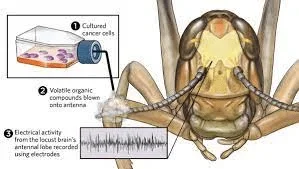 Detecting and recording brain neuron signals of locust when exposed to different odor molecules.Copyright 2022 Laurie Okeefe, The Scientist https://www.the-scientist.com/modus-operandi/scents-and-sense-abilities-using-bug-brainpower-to-smell-cancer-70823
This activity utilizes simulated cancerous and noncancerous cell cultures, probes, and Arduinos to teach students about current research that involves mapping nerve signaling patterns in insect (locust) brains in response to odor molecules produced by healthy versus cancerous cell lines. A connection is made to cellular respiration and metabolism because these are the processes that cause the cell cultures to produce different odorous metabolites. The simulated cultures will contain fluids of varying pH values instead of using solutions with volatile compounds. Students use pH probes in the solutions to observe a number and lighting pattern that is programmed into the code of the Arduino. Students use observations to make conclusions about which patterns represent cancerous cell odors versus healthy cell odors with “known” cell cultures. After recording data, students select “unknown” cultures and determine whether the unknown samples are cancerous or not based on the earlier established patterns. Students graph, analyze, and summarize the data to write a claim, evidence, reasoning (CER) paragraph.
This activity centers on building, testing, and evaluating an artificial brain that can detect cell odors. Acting as biomedical engineers, students first view schematics of the setup of an artificial locust brain and build it (following the schematics). Then, students test the device for accuracy and move on to testing cell solutions. Lastly, they determine whether the device can actually differentiate between solutions and then test unknown solutions.
After this activity, students should be able to:
- Explain how cellular respiration, metabolism, and cell division rate are related.
- Discuss the differences between healthy and cancerous cells.
- Identify and analyze patterns in data.
- Write claims using the patterns as evidence to support their claims.
- Create graphical representations of the observed results in an experiment.
- Edit computer code to improve the testing and design of a measuring tool.
- CCSS.Math.Content.HSS-ID.B.5 Summarize categorical data for two categories in two-way frequency tables. Interpret relative frequencies in the context of the data (including joint, marginal, and conditional relative frequencies). Recognize possible associations and trends in the data.
Grades 9-12
Do you agree with this alignment?
- HS-LS1-2 Develop and use a model to illustrate the hierarchical organization of interacting systems that provide specific functions within multicellular organisms.
Grades 9-12
This resource focuses on the following Three Dimensional Learning aspects of NGSS:
Science & Engineering Practices- Develop and use a model based on evidence to illustrate the relationships between systems or between components of a system.Do you agree with this alignment?
Disciplinary Core Ideas- Multicellular organisms have a hierarchical structural organization, in which any one system is made up of numerous parts and is itself a component of the next level.Do you agree with this alignment?
Crosscutting Concepts- Models (e.g., physical, mathematical, computer models) can be used to simulate systems and interactions—including energy, matter, and information flows—within and between systems at different scales.Do you agree with this alignment?
Do you agree with this alignment? - Develop and use a model based on evidence to illustrate the relationships between systems or between components of a system.
- HS-LS1-4 Use a model to illustrate the role of cellular division (mitosis) and differentiation in producing and maintaining complex organisms.
Grades 9-12
This resource focuses on the following Three Dimensional Learning aspects of NGSS:
Science & Engineering Practices- Use a model based on evidence to illustrate the relationships between systems or between components of a system.Do you agree with this alignment?
Disciplinary Core Ideas- In multicellular organisms individual cells grow and then divide via a process called mitosis, thereby allowing the organism to grow. The organism begins as a single cell (fertilized egg) that divides successively to produce many cells, with each parent cell passing identical genetic material (two variants of each chromosome pair) to both daughter cells. Cellular division and differentiation produce and maintain a complex organism, composed of systems of tissues and organs that work together to meet the needs of the whole organism.Do you agree with this alignment?
Crosscutting Concepts- Models (e.g., physical, mathematical, computer models) can be used to simulate systems and interactions—including energy, matter, and information flows—within and between systems at different scales.Do you agree with this alignment?
Do you agree with this alignment? - Use a model based on evidence to illustrate the relationships between systems or between components of a system.
- HS-LS1-7 Use a model to illustrate that cellular respiration is a chemical process whereby the bonds of food molecules and oxygen molecules are broken and the bonds in new compounds are formed resulting in a net transfer of energy.
Grades 9-12
This resource focuses on the following Three Dimensional Learning aspects of NGSS:
Science & Engineering Practices- Use a model based on evidence to illustrate the relationships between systems or between components of a system.Do you agree with this alignment?
Disciplinary Core Ideas- As matter and energy flow through different organizational levels of living systems, chemical elements are recombined in different ways to form different products.Do you agree with this alignment?
- As a result of these chemical reactions, energy is transferred from one system of interacting molecules to another. Cellular respiration is a chemical process in which the bonds of food molecules and oxygen molecules are broken and new compounds are formed that can transport energy to muscles. Cellular respiration also releases the energy needed to maintain body temperature despite ongoing energy transfer to the surrounding environment.Do you agree with this alignment?
Crosscutting Concepts- Energy cannot be created or destroyed—it only moves between one place and another place, between objects and/or fields, or between systems.Do you agree with this alignment?
Do you agree with this alignment? - Use a model based on evidence to illustrate the relationships between systems or between components of a system.
Each group needs:
- Arduino
- a power source for the Arduino (e.g., computer or battery pack)
- pH sensor
- a breadboard
- 3 resistors (1000 Ohm)
- 7 jumper wires (female to male and male to male)
- a 3 color RGB SMD LED module (or 3 separate RGB LED lights)
- 2 different solutions to represent cancerous cell cultures with a pH of less than 6.5
- 2 different solutions to represent healthy cell cultures with a pH of 7 or higher
- a control solution of water with a pH of 7
- Smelling Cancer Cells Worksheet (PDF)
- access to a digital version of the Smelling Cancer Arduino & Sensor Code Sheet (PDF) (e.g., on Google Classroom)
- distilled water
- a ruler with mm markings
The entire class needs to share:
- 10 solutions to represent unknown cell cultures
- Note: Each group will select 2 solutions from the class set.
- colored pencils for graphing
- something that has an odor (e.g., perfume, food, candle)
To create solutions to represent cell cultures:
- water
- baking soda
- citrus juice or vinegar
- small cups or beakers
- Smelling Cancer Activity Worksheet (docx)
- Smelling Cancer Activity Worksheet (pdf)
- Smelling Cancer Activity Worksheet Answer Key (docx)
- Smelling Cancer Activity Worksheet Answer Key (pdf)
- Smelling Cancer Arduino Code Zip File; IDE ready
- Smelling Cancer Arduino Code (docx)
- Smelling Cancer Arduino Code (pdf)
- A basic understanding of cellular respiration and metabolism.
- A familiarity with cell division and its importance to life.
- A basic understanding of the purpose of neurons/the nervous system.
- A basic understanding of graphing data.
- Knowledge of lab safety measures.
- A familiarity with Arduino coding.
With this activity, we’re going to focus on cell division and its relation to cancer. Currently, diagnosis of cancer involves a biopsy, blood analysis, or other time-consuming test. Given what we know about the process of cellular respiration and how it relates to energy expenditure, we’re going to look at the connection between cancerous cells, energy expenditure, and cellular respiration metabolites. Is it possible that some organisms may be able to smell these metabolites? If so, how could humans use this information to help with diagnosis?
(In this activity, students learn about exciting research being done with insect brains. Insects have a much more complex and distinct olfactory system than humans. It has been shown that insect antennae respond to volatile cellular respiration metabolites with specific neuron pathway signaling. Patterns in signaling between cancerous and noncancerous cells display a statistical difference, as do different types of cancerous cells. It is hoped that someday these patterns can be repeated in a device that could be used to easily diagnose cancer in patients without the invasiveness or time consumption of current diagnostic tools. During the activity, students simulate the process of discovering the insect brain response to various cell odors and then apply that knowledge to unknown cell cultures.
- Ask students if they feel they have a good sense of smell.
- Open something that has an odor (e.g., perfume, food, candle) and ask how many students in the class can smell it. Ask the students:
- What factors do you think affect the ability to smell things?
- What do you know about how the sense of smell works?
- What organisms besides humans can smell?
- If you think cells smell, do different cells smell differently? Why or why not? If they do, could we use this to help with any health conditions? Which ones?
- Watch one or both of these videos that could be used as “hooks.”
- https://www.youtube.com/watch?v=e0UK6kkS0_M – “Dogs Can Smell Cancer” (4 minutes): This is an incredible video about a dog that acted weird around his owner and ended up helping her find out she had breast cancer.
- https://www.youtube.com/watch?v=Ccz-SBrpcOM – “These tiny worms can smell cancer in your pee” (1:16 minutes): Roundworms can detect cancer cells.
- Ask students, “Can we use odor to detect cancerous cells? If so, how could we use this information to help people?”)
Background
Cell division and cellular respiration are closely linked. Cell division requires more energy than interphase due to the building and use of materials, as well as the physical movement of cell structures as cells multiply. Research has shown that cancer cells’ metabolism, due to their rapid and abnormal cell division, is different from that of healthy cells, resulting in different molecules being released.
Odor, or smell, is due to molecules in the air that olfactory systems sense. Many types of organisms have a sense of smell, including humans, dogs, fish, and insects, but the structures and level of distinction vary. Insects have a highly evolved sense of smell. Their antennae house olfactory receptors that respond to odors in specific patterns and with much more precision than humans. In this activity, students explore the questions: Can insect antennae, specifically locust antennae, be used to detect cancerous cells versus healthy cells? If so, could we design an artificial locust antenna that would allow us to detect cancer with just someone’s breath?
Researchers sought to answer these questions with a set up similar to the one in Figure 4 below.
Figure 4. Detecting and recording brain neuron signals of locust when exposed to different odor molecules.Copyright 2022 Laurie Okeefe, The Scientist https://www.the-scientist.com/modus-operandi/scents-and-sense-abilities-using-bug-brainpower-to-smell-cancer-70823
They found that locust brains produced different electrical patterns when the locusts smelled cancerous throat cells compared to healthy throat cells. The locusts could distinguish cancer from healthy cells.
In this activity, students use Arduino to mimic a locust brain (e.g., create an artificial locust antenna). Although a locust’s brain is more complicated than a simple circuit, the Arduino model allows students to explore an emerging area of research in biomedical engineering. Figures 1 and 2 show the Arduino sensor setup.
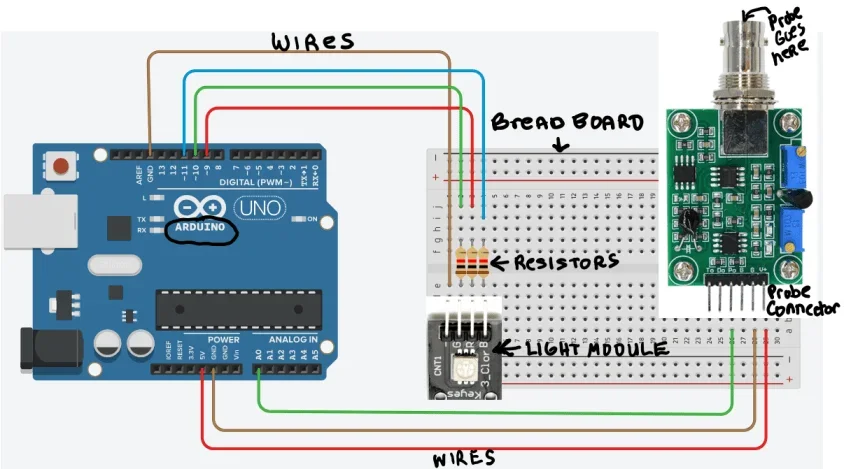 Figure 1. Schematic of Arduino pH Sensor Setup.Copyright 2023 Matthew Jourdin and Denise Facione
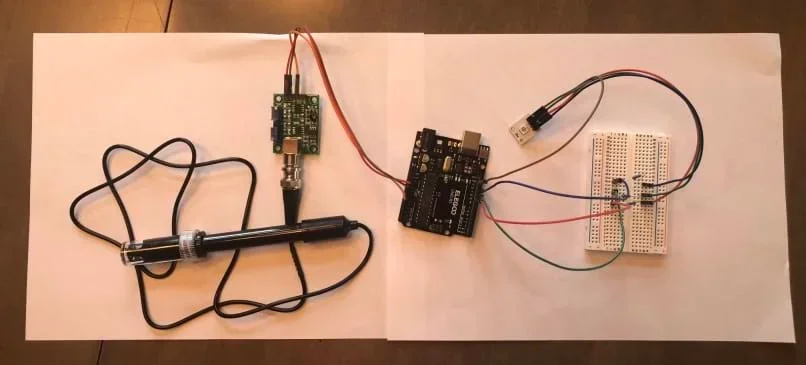 Figure 2. Photograph of an Arduino connected with wires to a pH sensor and LED module light.Copyright 2023 Denise Facione
Before the Activity
- Upload the Smelling Cancer Arduino & Sensor Code Sheet (PDF) to Google Classroom (or similar shared digital location) for students to access during the activity.
- Gather materials and make copies of the Smelling Cancer Cells Worksheet (PDF).
- Place a copy of the Smelling Cancer Arduino & Sensor Code Sheet (PDF) into Google Classroom or other accessible electronic place for students to copy onto their computers.
- Make the following cell culture solutions for each group, and label them:
#1: no cells–control/neutral solution (50 ml water)
#2: healthy lung cells (2 g baking soda with 50 ml water)
#3: healthy throat cells (higher concentration of baking soda (5-10 g) and 50 ml water)
#4: cancerous lung cells (5 ml citrus juice or vinegar and 50 ml water)
#5: cancerous throat cells (higher concentration of citrus juice or vinegar (10-20 ml) and 50 ml water)
- Make two sets of 5 containers of “unknown” solutions for students to choose to test (10 containers total).
- These can be basic (baking soda/healthy cells) or acidic (citrus juice or vinegar/cancerous cells).
- Label each set of containers with “unknown #6-#10.”
- Set up a “class table” where the unknown solutions will be located.
- Lay out materials at each table, following the lab setup in Figure 3.
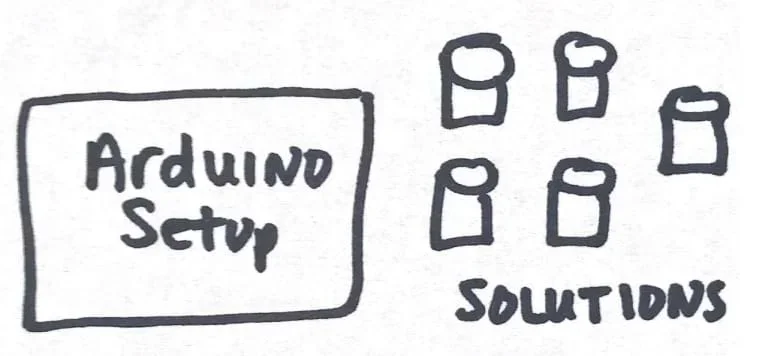 Figure 3. Contents at each lab table.Copyright 2023 Denise Facione
With the Students
Step 1: Pre-Lab
- Have students sit at their desks, preferably in pods or pairs.
- Distribute copies of the Smelling Cancer Cells Worksheet (PDF) and guide students through the pre-lab.
- Read through the background information with the students.
- Read through the pre-lab questions and ask students to answer them with their desk partner/pod. Discuss as a whole class.
- Briefly, describe the purpose of the activity or ask a student to do this based on the pre-lab information and questions.
- Assign (or let students choose) groups of 2-4 to work at lab tables.
- Discuss the remaining parts of the activity before the students move to tables.
- Show each piece of lab equipment and review lab safety.
- Point out the schematic of the lab setup on the screen.
- Provide basic information about the Arduino, just enough for students to see the analogy to a neural circuit.
- Ask students why there is a sample to test with a known, neutral result.
- Display code on the screen and model calibrating the probe.
Step 2: Activity
- Students will use the Smelling Cancer Cells Worksheet (PDF) to do the activity.
- For the Lab Procedure Step 2, assist students as they go to https://support.arduino.cc/hc/en-us/articles/360019833020-Download-and-install-Arduino-IDE
- to download the Arduino website software.
- For the Lab Procedure Step 3, help students as needed to copy the code from the Smelling Cancer Arduino & Sensor Code Sheet (PDF) in Google Classroom into the IDE (open area) and save it there. When the Arduino is connected to the computer, the code will automatically upload to it.
- While students are doing the activity, walk around the classroom and stop in with each group to check for questions about the Arduino setup. Help them if needed! Ask at least one question at each table to make sure they understand the procedure and where the materials are.
Step 3: Post-Activity
- Students complete the wrap-up questions in the Smelling Cancer Cells Worksheet (PDF) as a post-activity assessment.
- action potential/nerve signal
- The burst of electrical activity a nerve cell experiences when it responds to a stimulus.
- cancer
- A disease caused by cells that divide too frequently and abnormally.
- cell culture
- A solution that contains living cells and nutrients.
- cell cycle
- The life stages of a cell.
- cell division
- A cell splitting to become two new cells.
- cellular respiration
- The reactions that happen in cells that provide energy for all other cell reactions and processes.
- interphase
- The stage of the cell cycle in which cells are not activity dividing.
- metabolism
- The reactions that happen in cells to build, use, and break down materials.
- metabolite
- A product of a metabolism reaction.
- neuron
- A nervous system cell that can receive and send messages to other neurons or parts of an organism.
- olfactory system
- The parts of the nervous system that allow an organism to detect odors.
- products
- The substances that are formed in a chemical reaction.
- reactants
- The substances that enter into a chemical reaction.
- volatile compound
- Molecules/substances that spread about the air easily and are odorous.
Pre-Activity Assessment
Pre-Lab Questions: Walk around the room as students are completing the pre-lab questions. If needed, help students who are having difficulties. Ask students to share their answers and show possibilities under a document camera or on the board or screen.
Activity Embedded (Formative) Assessment
Check-ins: While students are doing the activity, walk around the classroom and ask groups questions about the Arduino setup and their data analysis. Ask students if their unknown samples are healthy or cancerous; have students use their data and graphs to explain their answers.
Post-Activity (Summative) Assessment
Post-Lab Questions: Use the graphing, CER summary, and post-lab questions as the post-activity assessment. These are located in the Smelling Cancer Cells Worksheet (PDF).
Electrical Safety: Arduino Max Voltage Output 5V
Solutions/Chemicals: Do not smell, touch, or taste any chemicals/solutions.
Provide PPE as needed (e.g., lab goggles).
For help with understanding and using the Arduino, use the following website:
https://www.arduino.cc/en/Tutorial/HomePage
Wiring: Pay close attention to circuit schematic with signal, voltage, and ground wires in relation to the Arduino ports and breadboard.
Probe: Make sure that all groups calibrate and fix the code correctly before testing the cell solutions. This may mean stopping the whole class and pointing to the code area (after groups try to figure it out themselves) so each group can double check that they did it correctly.
Have students research the hierarchy among individual nerves, neurons, nerve tissue, and nerve organs. Students can focus on locusts (or another creature of their choice) to research the relationship between the nervous system and behaviors/movements that help with finding mates and food, and avoiding danger.
For lower grades and younger students, do the Arduino setup for them. Discuss cancer versus healthy cells in simpler terms, such as more cell division = higher energy requirement = different materials needed and released= some organisms can smell these differences. Give graph directions. Simplify vocabulary and background information.
For upper grades and/or older students: Have students research the actual metabolites created by cancer cells and describe the chemical pathway from reactants to products. Instruct students to write another piece of code for the Arduino using the existing code to create a response to another substance that they pick.
For more advanced students: Instruct students to create/find code for Arduino, figure out Arduino/probe/wire setup, gather numerical data from probes and calculate standard error of mean with each measurement; have them analyze whether the difference in pH between cancerous and healthy cells is statistically significant.
For more advanced students: Have the students design and build a housing for the probe using the Engineering Design Process. Give students the following design constraints:
The housing must provide access to:
- Arduino: power
- Probe connection
- Probe end
- Wire management
- LED lamp location
** if Arduinos are not able to be purchased, have students research how to create a circuit with aluminum foil, energy source, and lights. Odor molecules could be created with aluminum foil shapes. Each shape could cause the circuit to light up differently. **
United States Environmental Protection Agency, Ph of Common Substances, August 6, 2015
Kulbatski, Iris. “Scents and Sense-Abilities: Using Bug Brainpower to Smell Cancer.” The Scientist. December 12, 2022. https://www.the-scientist.com/modus-operandi/scents-and-sense-abilities-using-bug-brainpower-to-smell-cancer-70823
Contributors
Denise Facione; Andrew Kim; Wen Li; Xiang Liu; Matt Jourden; Leyf Sterling
Supporting Program
Smart Sensors and Sensing Systems RET, College of Engineering, Michigan State University
Acknowledgements
This curriculum was developed through the Smart Sensors and Sensing Systems research experience for teachers under National Science Foundation RET grant no. CNS 1609339. However, these contents do not necessarily represent the policies of the NSF, and you should not assume endorsement by the federal government.
Copyright
2024 by Regents of the University of Colorado; original © 2023 Michigan State University