
Design and Test Soft Materials for Tactile Sensing
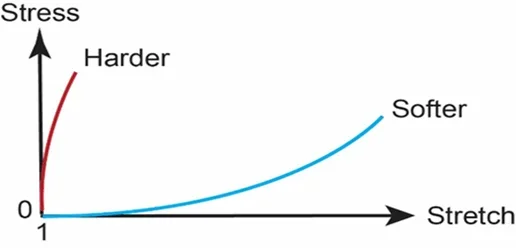 A stress vs. stretch graph illustrating that harder materials show greater resistance to stretching, while softer materials stretch more before encountering stress.Copyright Thamira Hindo 2023
Students conduct stress tests on soft materials to measure their elasticity and tensile strength by calculating stress and stretch ratio and plotting stress-stretch curves. This process mirrors real-life applications in biomedical engineering, particularly in the development and testing of hydrogels. Hydrogels, with their high water content and unique ability to stretch and return to their original shape, are used in biomedical devices, tissue engineering, and drug delivery systems. By understanding stress testing, students gain insight into how biomedical engineers evaluate the durability and performance of hydrogels under real-world conditions.
Biomedical engineers conduct tests on soft materials such as hydrogels, which are essential in medical devices, wound healing, and tissue scaffolds, to evaluate their stretch and tensile properties. These tests are vital because hydrogels must stretch and revert to their original shape without damage, closely mimicking the behavior of human tissue. Designed for flexibility and support, hydrogels find applications in artificial skin, cartilage repair, and drug delivery systems. Engineers assess their ability to withstand repeated stretching and compression, reflecting the daily stresses that human tissues endure. Such evaluations are crucial for developing reliable materials that function effectively within the body, ultimately enhancing patient outcomes in regenerative medicine, prosthetics, and advanced medical technologies.
After this activity, students should be able to:
- Describe the relationship between the stress and stretch of a soft material.
- Explain the importance of stress testing in understanding how materials respond to applied forces.
- Define and calculate stress, weight, stretch ratio, cross-sectional area, and stress-stretch curves.
- Plot the results using graphing methods in Microsoft Excel.
- CCSS.Math.Content.8.SP.A.1 Construct and interpret scatter plots for bivariate measurement data to investigate patterns of association between two quantities. Describe patterns such as clustering, outliers, positive or negative association, linear association, and nonlinear association.
Grade 8
Do you agree with this alignment? - CCSS.Math.Practice.MP4 Model with mathematics.
Grades K-12
Do you agree with this alignment?
- MS-ETS1-1 Define the criteria and constraints of a design problem with sufficient precision to ensure a successful solution, taking into account relevant scientific principles and potential impacts on people and the natural environment that may limit possible solutions.
Grades 6-8
This resource focuses on the following Three Dimensional Learning aspects of NGSS:
Science & Engineering Practices- Define a design problem that can be solved through the development of an object, tool, process or system and includes multiple criteria and constraints, including scientific knowledge that may limit possible solutions.Do you agree with this alignment?
Disciplinary Core Ideas- The more precisely a design task's criteria and constraints can be defined, the more likely it is that the designed solution will be successful. Specification of constraints includes consideration of scientific principles and other relevant knowledge that is likely to limit possible solutions.Do you agree with this alignment?
Crosscutting Concepts- The uses of technologies and any limitations on their use are driven by individual or societal needs, desires, and values; by the findings of scientific research; and by differences in such factors as climate, natural resources, and economic conditions.Do you agree with this alignment?
- All human activity draws on natural resources and has both short and long-term consequences, positive as well as negative, for the health of people and the natural environment.Do you agree with this alignment?
Do you agree with this alignment? - Define a design problem that can be solved through the development of an object, tool, process or system and includes multiple criteria and constraints, including scientific knowledge that may limit possible solutions.
- MS-ETS1-2 Evaluate competing design solutions using a systematic process to determine how well they meet the criteria and constraints of the problem.
Grades 6-8
This resource focuses on the following Three Dimensional Learning aspects of NGSS:
Science & Engineering Practices- Evaluate competing design solutions based on jointly developed and agreed-upon design criteria.Do you agree with this alignment?
Disciplinary Core Ideas- There are systematic processes for evaluating solutions with respect to how well they meet the criteria and constraints of a problem.Do you agree with this alignment?
Do you agree with this alignment? - Evaluate competing design solutions based on jointly developed and agreed-upon design criteria.
- MS-PS1-3 Gather and make sense of information to describe that synthetic materials come from natural resources and impact society.
Grades 6-8
This resource focuses on the following Three Dimensional Learning aspects of NGSS:
Science & Engineering Practices- Gather, read, and synthesize information from multiple appropriate sources and assess the credibility, accuracy, and possible bias of each publication and methods used, and describe how they are supported or not supported by evidence.Do you agree with this alignment?
Disciplinary Core Ideas- Each pure substance has characteristic physical and chemical properties (for any bulk quantity under given conditions) that can be used to identify it.Do you agree with this alignment?
- Substances react chemically in characteristic ways. In a chemical process, the atoms that make up the original substances are regrouped into different molecules, and these new substances have different properties from those of the reactants.Do you agree with this alignment?
Crosscutting Concepts- Structures can be designed to serve particular functions by taking into account properties of different materials, and how materials can be shaped and used.Do you agree with this alignment?
- Engineering advances have led to important discoveries in virtually every field of science, and scientific discoveries have led to the development of entire industries and engineered systems.Do you agree with this alignment?
- The uses of technologies and any limitations on their use are driven by individual or societal needs, desires, and values; by the findings of scientific research; and by differences in such factors as climate, natural resources, and economic conditions. Thus technology use varies from region to region and over time.Do you agree with this alignment?
Do you agree with this alignment? - Gather, read, and synthesize information from multiple appropriate sources and assess the credibility, accuracy, and possible bias of each publication and methods used, and describe how they are supported or not supported by evidence.
- SEP.12.6-8.1 Use mathematical representations to describe and/or support scientific conclusions and design solutions.
Grades 6-8
Do you agree with this alignment?
Each group needs:
- 1 rectangular strip of polyurethane (10 cm x 1 cm x 2 mm)
- 1 rectangular strip of clear elastic rubber (10 cm x 1 cm x 0.5 mm)
- 1 set of weights
- 1 ruler or measuring tape
- 1 lab stand
- 1 clamp (to securely attach the material strip to the lab stand)
- 1 S hook or carabiner (to hang the weights from)
- 1 laptop with access to Excel (or Google Sheets)
- 1 utility knife
- Introduction Worksheet (PDF)(one per student)
- Stress Test Worksheet (PDF) (one per student)
Students should:
- Be comfortable with basic calculations, including division and multiplication.
- Have experience in plotting graphs.
- Have basic Excel skills to input data into a table and create graphs.
- Be familiar with generating linear graphs and interpreting slopes as part of data analysis.
Hey, everyone! Today we’re going to step into the exciting world of biomedical engineering, where we’ll be conducting stress tests on soft materials. But first, what exactly is a soft material?
Imagine materials that can change shape easily, like when you pull on a rubber band or squish a sponge. Soft materials are those that can easily deform—which means they can stretch, compress, or bend without breaking. They’re super flexible and can often bounce back to their original shape once the force is gone.
Let’s brainstorm! Can you think of some examples of soft materials? (Answers could include things like rubber, gels, foams, biological tissues, hydrogels, or even elastomers.) These materials are used everywhere, from healthcare to electronics, in clothing, and even in everyday products. Their flexibility makes them incredibly useful in adapting to different situations and environments.
Now, one of the coolest types of soft materials is hydrogels! These amazing materials are not just flexible; they’re also super absorbent! Hydrogels can hold a lot of water, making them perfect for medical uses such as drug delivery systems and wound dressings. They interact safely with our bodies, helping to keep wounds moist for better healing. Plus, their soft nature makes implants and prosthetics more comfortable for people who need them.
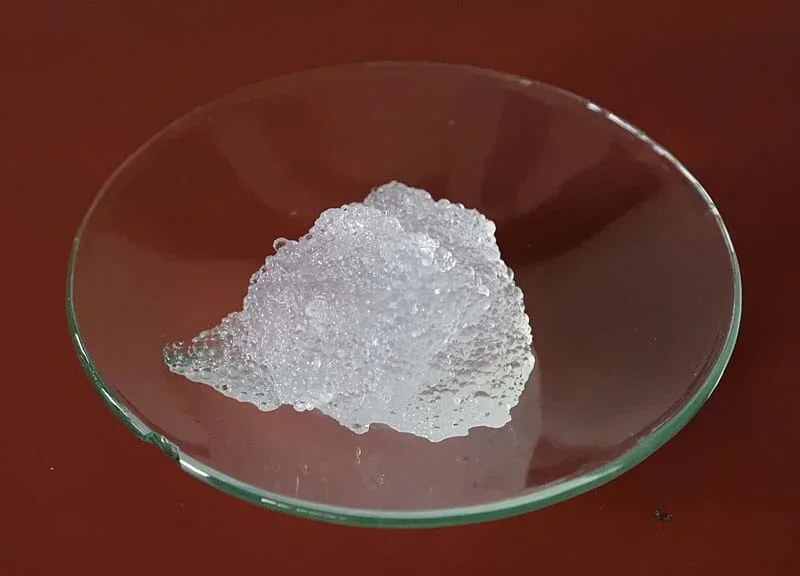 A sample of super hydrogel, displaying its porous, foam-like structure, on a transparent glass petri dish. This material is known for its high water absorption capacity and flexible texture.Copyright https://commons.wikimedia.org/wiki/File:Superabsorber_Hydrogel_KSG_2917_pK.jpg; Petra Klawikowski 2016But here’s the catch: When these soft materials are pulled, squished, or bent repeatedly, we need to make sure they can handle it. That’s where a stress test comes in! A stress test is like a workout for materials, helping us see how they respond to different forces. We apply more and more stress and watch how they change. We’ll be looking for things like how much they stretch, whether they break, and how they bend.
Today, we’re going to learn how to calculate stress and stress ratios, and then create plots to show stress versus stretch. After that, we’ll dive into our hands-on experiments to see which of our two soft materials performs the best under stress. Are you ready to explore the world of soft materials and become biomedical engineers? Let’s get started!
Background
Hydrogels are three-dimensional networks of hydrophilic polymers that can absorb and retain significant amounts of water while maintaining their structure. They are soft and flexible, and they can exhibit unique properties such as biocompatibility, elasticity, and responsiveness to environmental stimuli. Hydrogels are important in various fields due to their versatility and functionality.
In biomedical applications, they are used for drug delivery systems, wound dressings, and tissue engineering, providing a moist environment that promotes healing and mimics natural tissues. In agriculture, hydrogels help retain soil moisture, enhancing water availability for plants. They are also used in consumer products like contact lenses and diapers, and in electronics for flexible sensors and actuators. The ability of hydrogels to swell and respond to changes in temperature, pH, or other factors makes them valuable for developing smart materials and innovative solutions across diverse industries.
Stress tests are systematic evaluations used to determine how materials or structures respond to applied forces and conditions. During these tests, various forms of stress—such as tension, compression, and bending—are applied to assess the material's strength, durability, and elasticity. The results help identify the maximum load a material can handle before deforming or failing.
Stress tests are crucial for several reasons:
- Safety: They ensure that materials and structures can withstand expected loads and conditions, preventing failures that could lead to accidents or disasters.
- Quality Control: Stress testing helps manufacturers maintain consistent quality in their products by verifying that they meet specified performance standards.
- Material Selection: Engineers use stress tests to compare different materials, allowing for informed decisions in design and construction based on performance characteristics.
- Innovation: These tests provide valuable data for developing new materials and technologies, driving advancements in various fields such as construction, aerospace, and biomedical engineering.
Stress tests are utilized by various types of engineers across multiple fields, including:
- Structural Engineers: They assess the strength and stability of buildings, bridges, and other structures to ensure they can withstand loads and environmental forces.
- Mechanical Engineers: They evaluate components such as gears, shafts, and machinery parts to ensure they can handle operational stresses and strains during use.
- Civil Engineers: They use stress testing for infrastructure projects, such as roads and dams, to ensure materials and structures are safe and durable under load conditions.
- Materials Engineers: They analyze the properties of materials to determine their behavior under different stress conditions, helping in the development of new materials with specific characteristics.
- Aerospace Engineers: They conduct stress tests on aircraft and spacecraft components to ensure they can withstand the forces experienced during flight and re-entry.
- Biomedical Engineers: They test medical devices and implants, such as prosthetics and stents, to ensure they can handle physiological stresses without failure.
- Automotive Engineers: They evaluate vehicle components, such as frames and suspension systems, to ensure they can endure the stresses of driving and impact forces.
- Geotechnical Engineers: They assess soil and rock stability under load conditions to ensure the safety of foundations and earth structures.
Overall, stress tests are a critical tool for engineers in any discipline that involves the design, analysis, and application of materials and structures.
Before the Activity
- Gather materials.
- Cut rectangular strips of polyurethane (10 cm x 1 cm x 2 mm). (one per group)
- Cut rectangular strips of clear elastic rubber (10 cm x 1 cm x 0.5 mm). (one per group)
 The teacher cuts the testing materials to 10 cm in length before the activity.Copyright Thamira Hindo 2023
 - Make copies of the Introduction Worksheet. (PDF) (one per student)
- Make copies of the Stress Test Worksheet (PDF). (one per student)
During the Activity
Day 1 (50 minutes)
- Split the class into pairs.
- Give each student an Introduction Worksheet (PDF). A stress vs. stretch graph illustrating that harder materials show greater resistance to stretching, while softer materials stretch more before encountering stress.Copyright Thamira Hindo 2023
- As a class, read through the theory, definitions, and calculations for a stress test on Page 1 of the Introduction Worksheet (PDF).
- Theory: Stress testing of soft materials is conducted to understand how they respond to applied forces. This is essential for various applications, including medical devices, elastomers, and construction materials. The tests assess the material's elasticity, strength, and overall behavior under loads, providing valuable insights into its durability and performance in real-world conditions.
- Definitions:
- Stress (σ): The force applied per unit area, measured in Pascals (Pa) or Newtons per square meter (N/m²).
- Weight (W): The force exerted by gravity on an object, calculated as mass (in kilograms) multiplied by the acceleration due to gravity (9.8 m/s²), measured in Newtons (N).
- Stretch Ratio (λ): The ratio of the change in length to the original length of a material.
- Cross-Sectional Area (A): The area of a shape observed when cutting through an object perpendicular to its length, like slicing a loaf of bread.
- Stress-Stretch Curves: Graphs that illustrate the elastic properties of a material by showing its stress response (force per area) as it stretches (deformation) under an applied force.
- Calculations for a stress test: The following steps are used to find the stress corresponding to the applied force, the cross-sectional area, and the change in length of a soft material.
- Calculate stress.
- Stress (σ) is defined as the force (F) divided by the cross-sectional area (A).
- Formula: σ = F / A
- Calculate the stretch ratio.
- The stretch ratio (λ) is the ratio of the change in length (ΔL) to the original length (L).
- Formula: λ = (L + ΔL) / L where λ is the stretch ratio, L is the original length of the material, and ΔL is the change in length.
- Give students 5 minutes to solve the practice problem on Page 1 of the Introduction Worksheet (PDF).
- As a class, walk through how to solve the practice problem.
- Given:
- Original Length (L) = 15 centimeters (cm)
- Cross-Sectional Area (A) = 1.5 square centimeters (cm²)
- Force (F) = 20 Newtons (N)
- Step 1: Calculate Stress
- Stress (σ) is calculated using the formula: σ=F/A
- Substituting the given values:
σ = 20 N / 1.5 cm2 ≈13.33 N/cm2 or converting to Pascals: (σ≈13,330 Pa)
- Step 2: Calculate Stretch Ratio
- To calculate the stretch ratio (λ), we need information about the change in length (ΔL) or the final length. If we assume a hypothetical change in length, for example, ΔL = 2 cm:
- Using the formula: λ=(L+ΔL)/L, substituting:
λ= (15 cm+2 cm)/15 cm = 17 cm/15 cm ≈ 1.133
- Conclusion
- Stress: The material experiences a stress of approximately 13.33 N/cm² (or 13,330 Pascals).
- Stretch Ratio: If ΔL = 2 cm, the stretch ratio is approximately 1.133.
- Give students 40 minutes to complete Page 2 of the Introduction Worksheet (PDF). Any unfinished work may be assigned as homework.
Day 2 (50 minutes)
- Briefly summarize the previous assignment on the Introduction Worksheet (PDF). Emphasize: Stress is directly proportional to stretch. The graph shows linear relation with high positive correlation.
- Split the class into pairs. These can be the same pairs as the previous class.
- Give each student a Stress Test Worksheet (PDF).
Ask
- Give students the scenario: “You are an engineer tasked with selecting a material that can best withstand tension (stretching forces) without breaking. You will be given two different materials, and your goal is to determine how much force each material can handle while staying within its elastic limit. To complete this challenge, you will follow the engineering design process!”
- Define the problem for students: How much force can a material endure before it deforms permanently or breaks?
Research
- Give students 10 minutes to research material properties such as elasticity, tensile strength, and how engineers use stress and strain tests to evaluate materials.
- Have students record their notes in their Stress Test Worksheet (PDF).
Test
- Provide students with the materials available to test.
- Have students follow the Stress Test Procedure in the Stress Test Worksheet (PDF).
- Students collect their group’s materials.
- Students set up their testing apparatus by doing the following:
- Secure one end of the polyurethane or clear elastic rubber strip to the lab stand using a clamp or secure knot.
- Cut a small hole/slit 9 cm from the stop of the strip.
 A student cuts a small hole/slit 9 cm from the top of the strip.Copyright Thamira Hindo 2023
 - Add the hook or carabiner to the bottom of the material strip through the small hole.
- Students need to make sure the testing apparatus is stable using the smallest weight. Students should do the following:
- Add the smallest weight to the hook or carabiner.
- Ensure the material does not swing or move excessively.
- Ensure the weights hang vertically from the rubber strip.
 Students apply weights to their testing material.Copyright Thamira Hindo 2023
- Students then test their materials by doing the following:
- With no weights attached, measure the exact length of the first material strip. (Note: It should be 10 cm.) Record this in the data table.
 With the lightest weight attached, students measure the exact length of the material strip. (Note: It should be 10 cm.)Copyright Thamira Hindo 2023
 - Start with the smallest weight (e.g., 50 g) and add it to the hook or carabiner.
- After attaching the first weight, allow the material to stabilize, and then measure the length of the material. Record this in the data table.
- Add the next weight, allow the material to stabilize, and then measure the length of the materials.
- Continue until the material breaks or deforms.
- Repeat the above steps for the second material.
 Students continue adding weights and measuring the length of the material until the material breaks or deforms.Copyright Thamira Hindo 2023
- With no weights attached, measure the exact length of the first material strip. (Note: It should be 10 cm.) Record this in the data table.
- After completing the stress tests, have students use Excel to complete their data tables.
- Have students use Excel to plot stress vs. stretch.
- Have students fit a best fit line to the data and find the slope.
- Have students analyze their data to identify which materials performed best under stress.
- Have students answer the “Analysis” questions in their Stress Test Worksheet (PDF).
- Facilitate a brief discussion where students can share their results and reflect on why some materials performed better than others.
- Give students 5 minutes to answer the questions in the “Improve” section of the Stress Test Worksheet (PDF).
- Summarize learning: Ask students to summarize what they learned from the experiment, including key findings about material properties and their applications in engineering.
- Encourage students to reflect on the experimental process, discussing what worked well and what they would change for future experiments.
- hydrogels
- Polymer networks that can absorb and retain significant amounts of water.
- soft materials
- A type of material that can easily deform or change shape when subjected to forces such as tension, compression, or bending. These materials typically have low stiffness and high flexibility, meaning they can stretch, compress, or bend without breaking and often return to their original shape after the force is removed.
- stress
- Internal force per unit area that develops within a material when an external force is applied. It measures how much force is acting on a particular area of the material and is typically expressed in units of Pascals (Pa) or Newtons per square meter (N/m²).
- strain
- A measure of the deformation of a material in response to an applied stress.
- stretch
- The act of a material lengthening or expanding when a force, such as tension, is applied. It is the physical deformation that occurs when the material is pulled or elongated beyond its original shape or size.
- deformation
- A process by which a material's shape or size is altered due to the application of external forces such as tension, compression, shear, or torsion.
- tension
- A force that is transmitted through a material when it is pulled or stretched. It acts along the length of the material and tends to elongate it.
- compression
- A type of mechanical stress that occurs when a material is subjected to forces that push or squeeze it together, resulting in a decrease in volume or length. This force acts along the material's axis, causing it to become shorter and denser.
- bending
- A type of mechanical deformation that occurs when a material is subjected to an external load that causes it to curve or flex.
Pre-Activity Assessment
Intro Worksheet: Students are introduced to the theory, definitions, and calculations for a stress test before calculating and plotting data in the Introduction Worksheet (PDF).
Research: Students research soft material properties such as elasticity, tensile strength, and how engineers use stress and strain tests to evaluate soft materials and add their notes to the Stress Test Worksheet (PDF).
Activity Embedded (Formative) Assessment
Real-World Stress Test: Students conduct two stress tests on two different soft materials. They then use Excel to make the appropriate calculations and plot stress vs. stretch plots.
Post-Activity (Summative) Assessment
Reflection questions: Students reflect and answer questions about their stress tests, including what worked and what did not. They also determine what improvements they would make for future tests.
Contributors
Dr. Thamira Hindo; Dr. Shaoting Lin; Jiabin Liu
Supporting Program
Research Experience for Teachers (RET), College of Engineering, Michigan State University
Acknowledgements
This curriculum was developed through the Michigan State University College of Engineering NSF RET program under grant number 1609339. However, these contents do not necessarily represent the policies of the NSF, and you should not assume endorsement by the federal government.
Special thanks to the director, curriculum experts, and staff for answering our questions.
Copyright
2024 by Regents of the University of Colorado; original © 2023 Michigan State University