
Under Pressure: Using Young’s Modulus to Explore Material Properties
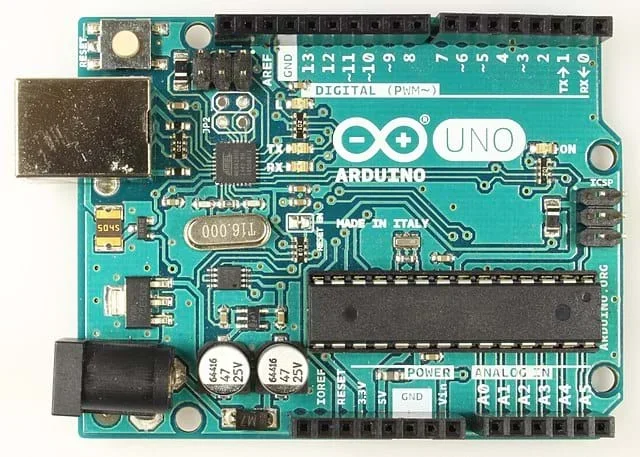 A top view of an Arduino Uno.Copyright 2018 , CC BY-SA 4.0, Wikipedia, source link.
Students explore Young’s Modulus by investigating how materials respond to stress and strain, measuring their stiffness and flexibility using Arduino technology. Through hands-on experimentation, students learn how variations in force application can affect the accuracy of their measurements. Building on this knowledge, they apply the engineering design process to create a device that ensures a consistent pressure and angle during testing, improving the reliability of their results.
Materials engineers use Young’s Modulus to evaluate a material's stiffness or elasticity, which determines how it deforms under stress. This property helps engineers select appropriate materials for specific applications, ensuring they meet the required strength, flexibility, or rigidity. For example, materials with a high Young's Modulus, such as steel, are used in structures needing stiffness, while those with a low Young’s Modulus, such as rubber, are ideal for flexible applications. By analyzing stress-strain relationships, engineers can design safe and efficient products, optimize material usage, and predict how materials will perform under various forces.
After this activity, students should be able to:
- Determine the average rate of change on various sections of a curve.
- Demonstrate understanding of Young’s Modulus, including its significance in measuring material stiffness or flexibility and its role in material selection.
- Explore and categorize materials, learning to recognize their characteristics and discuss their potential applications in engineering contexts.
- CCSS.Math.Content.HSA-CED.A.2 Create equations in two or more variables to represent relationships between quantities; graph equations on coordinate axes with labels and scales.
Grades 9-12
Do you agree with this alignment? - CCSS.Math.Content.HSA-SSE.A.1 Interpret expressions that represent a quantity in terms of its context
Grades 9-12
Do you agree with this alignment? - CCSS.Math.Content.HSF-IF.B.4 For a function that models a relationship between two quantities, interpret key features of graphs and tables in terms of the quantities, and sketch graphs showing key features given a verbal description of the relationship.
Grades 9-12
Do you agree with this alignment? - CCSS.Math.Content.HSF-IF.B.6 Calculate and interpret the average rate of change of a function (presented symbolically or as a table) over a specified interval. Estimate the rate of change from a graph.
Grades 9-12
Do you agree with this alignment?
- HS-PS2-6 Communicate scientific and technical information about why the molecular-level structure is important in the functioning of designed materials.
Grades 9-12
This resource focuses on the following Three Dimensional Learning aspects of NGSS:
Science & Engineering Practices- Communicate scientific and technical information (e.g. about the process of development and the design and performance of a proposed process or system) in multiple formats (including orally, graphically, textually, and mathematically).Do you agree with this alignment?
Disciplinary Core Ideas- Attraction and repulsion between electric charges at the atomic scale explain the structure, properties, and transformations of matter, as well as the contact forces between material objects.Do you agree with this alignment?
Crosscutting Concepts- Investigating or designing new systems or structures requires a detailed examination of the properties of different materials, the structures of different components, and connections of components to reveal its function and/or solve a problem.Do you agree with this alignment?
Do you agree with this alignment? - Communicate scientific and technical information (e.g. about the process of development and the design and performance of a proposed process or system) in multiple formats (including orally, graphically, textually, and mathematically).
Each group needs:
- 1 laptop computer
- 1 Arduino board and force-sensitive resistor (FSR)
- Arduino Uno Setup FAQ Sheet (PDF)(1 per student)
- link to Arduino Uno Setup FAQ Sheet (PDF) for students to copy code (can be emailed, posted on LMS, etc.)
- Measuring Force on Materials Worksheet (PDF) (1 per student)
For the entire class to share
- testing materials:
- paper
- rubber eraser
- silicon
- aluminum foil
- sheet plastic
- cardboard
Familiarity with graphing in the Cartesian coordinate system and calculating the slope between two points.
Take a minute to look around the classroom right now. Can you name five different materials that you see? What about 10? (Allow students to offer answers.) Now think about this: Which of those materials we just listed could hold the weight of a person? Why? (Let student offer their guesses!)
Every single day, we interact with countless materials—wood, cotton, stainless steel, plastic, and so many more—all carefully chosen for their specific properties. Imagine starting your day: You wake up on a bed made of wood and springs, pour water from a stainless-steel faucet into a ceramic sink, and brush your teeth with a plastic and silicone toothbrush. Each material is engineered for a purpose, with unique qualities that make it the best fit for the job.
Engineers are the creators behind the structures and objects that shape our world, from towering skyscrapers to everyday items such as toothbrushes. Every man-made object, regardless of size, goes through the engineering design process to ensure it fulfills its purpose effectively. At the core of these designs is the critical relationship between an object’s intended use and the properties of the materials used to create it.
For instance, some objects require flexibility, such as rubber bands or suspension bridges, while others must endure extreme loads, such as steel beams or concrete foundations. It is the job of engineers to analyze these needs, select the right materials, and ensure the object functions safely and efficiently.
One key property engineers use to evaluate materials is Young’s Modulus, a measurement of stiffness. In simple terms, it shows how much a material stretches (strain) when a force (stress) is applied. Some materials, such as rubber, are designed to bend and stretch, while others, such as steel, are meant to stay strong and rigid. (What examples of flexible vs. stiff materials can you think of?)
As engineers, understanding these material properties helps us design safe, efficient, and long-lasting structures and tools. Today, you’ll step into the role of an engineer and explore how forces act on different materials.
By the end of this activity, you’ll:
- Learn how different materials respond to forces such as pulling and stretching.
- Conduct hands-on experiments to test these principles.
- Discover how these ideas have shaped engineering, from ancient buildings to cutting-edge technology such as rockets.
Are you ready to see the forces at work and unlock the science behind the materials all around us? Let’s dive in!
Background
Engineers are the creators behind the structures and objects that shape our world, from towering skyscrapers to everyday items such as toothbrushes. Every man-made object, regardless of size, goes through the engineering design process to ensure it fulfills its purpose effectively. At the core of these designs is the critical relationship between an object’s intended use and the properties of the materials used to create it.
For instance, some objects require flexibility, such as rubber bands or suspension bridges, while others must endure extreme loads, such as steel beams or concrete foundations. It is the job of engineers to analyze these needs, select the right materials, and ensure the object functions safely and efficiently.
One key property engineers use to evaluate materials is Young’s Modulus, a measurement of stiffness. It is calculated as the ratio of stress (force applied) to strain (how much the material deforms).
- High Young’s Modulus: Indicates a stiff material resistant to bending, such as steel or ceramic.
- Low Young’s Modulus: Indicates a flexible material that deforms easily under force, such as rubber or certain plastics.
By understanding and applying concepts such as Young’s Modulus, engineers can design everything from lightweight yet strong airplanes to durable bridges. This activity introduces students to these principles through hands-on exploration, helping them connect theoretical knowledge to real-world engineering challenges.
The Arduino Uno is a beginner-friendly microcontroller board used for building and programming electronic projects. Powered by the ATmega328P chip, it features 14 digital pins for input/output and six analog pins for reading variable signals, and it can be connected to a computer via USB to upload code. Operating at 5V, it supports a wide range of sensors, motors, and devices, making it ideal for projects including robotics, home automation, and interactive installations. With its open-source design, ease of use through the Arduino IDE, and extensive community support, the Arduino Uno is a versatile tool for anyone looking to explore electronics and programming.
Force-sensitive resistors (FSRs) are sensors that allow you to detect physical pressure, squeezing, and weight. They are low cost and simple to use. The FSR is made of two layers separated by a spacer. The harder one presses, the more of the Active Element dots touch the semiconductor, which makes the resistance go down.
Summary of how Arduino works:
- Code Overview
The code will read the voltage output from the FSR and display or use the readings.
- Circuit Explanation
The FSR changes its resistance based on the amount of force applied to it. To measure this change, the FSR is combined with a 10K resistor in a voltage divider circuit.
- FSR: One side is connected to power (5V), and the other is connected to Analog 0 on the Arduino.
- 10K Resistor: One end is connected to Analog 0, and the other end is connected to ground.
This forms a voltage divider:
- When no force is applied, the resistance of the FSR is very high, so most of the voltage drops across it, and Analog 0 reads a low voltage.
- As more force is applied, the FSR's resistance decreases, causing the voltage at Analog 0 to increase.
- Reading the Analog Value
The Arduino reads the analog signal from Analog 0, which is a voltage between 0V (no force) and 5V (maximum force). This voltage is converted into a numerical value (0–1023 for a 10-bit ADC on most Arduinos).
- Applications
This setup can measure the force applied to the FSR. For example:
- Light touch → low reading
- Heavy press → high reading
Before the Activity
- Gather materials for each group.
- Make copies of the Measuring Force on Materials Worksheet (PDF). (1 per student)
- Make copies of the Arduino Uno Setup/FAQ Sheet (PDF). (1 per group)
- Note: It is recommended to have a small supply of materials available for students who may not be able to bring in any household materials.
During the Activity
Part 1 (50 minutes)
Introduction
- Divide the class into groups of three or four students.
- In their groups, have students engage in open discussion about materials in general. Have students come up with as many materials they see in the classroom as they can. You can start with a minute, but extend the time if you notice groups are still coming up with ideas.
- Have each group share their ideas with the class. Encourage students to categorize materials (e.g., metals, plastics, natural materials) to deepen their analysis.
- List the materials on the board.
- Ask the class the following question and tally their responses on the board: Which of these materials do you think would be the best to make a new student desk with?
Young’s Modulus
- Give each student a copy of the Measuring Force on Materials Worksheet (PDF).
- Define Young’s Modulus for students: Young’s Modulus is a measure of how stiff or flexible a material is. It tells us how much a material will stretch or bend when a force is applied to it. Think of it as a way to measure how "tough" a material is:
- High Young’s Modulus value: Material is very stiff and doesn’t stretch or bend easily (like steel or glass).
- Low Young’s Modulus value: Material is flexible and stretches or bends more easily (like rubber or silicone).
- Young’s Modulus: The ratio of Stress (force applied) ÷ Strain (how much the material changes in shape)
- Give students time to research and complete Part 1 of the worksheet, in which they research the Young’s Modulus for the materials paper, rubber eraser, silicon, aluminum foil, sheet plastic, and cardboard.
- Have students fill in the table in Part 1 of the Measuring Force on Materials Worksheet (PDF) for each material.
- Have students answer the question in Part 1.
- If time allows, let students start Part 2 by reading the Arduino Uno Setup/FAQ Sheet (PDF) and becoming familiar with the hardware and software.
Introduction to Arduino
- Give each group the Arduino Uno Setup/FAQ Sheet (PDF).
- Have each group gather their materials: laptop or computer, Arduino board, and FSR.
- Give students time to read the Arduino Uno Setup/FAQ Sheet (PDF) and become familiar with the hardware and software.
A top view of an Arduino Uno.Copyright 2018 , CC BY-SA 4.0, Wikipedia, source link.
Part 2 (50 minutes)
Material Testing
- Have students follow the instructions in the Arduino Uno Setup/FAQ Sheet (PDF) to set up and test their Arduino.
- Once students have tested their Arduino, they can start testing materials. Have students work through Part 2 of the Measuring Force on Materials Worksheet (PDF).
- Have students start with their first material, where they apply constant pressure on the probe while simultaneously changing the angle at which they are applying it.
- Have them do this for 15 seconds.
- Looking at the serial plotter, students should see data points that can be used to find the average rate of change of force over given time periods.
- Have students record these values in the table in Part 2 of the Measuring Force on Materials Worksheet (PDF).
- Have students repeat the process for each material.
- Have students answer the two Part 2 follow-up questions on the worksheet.
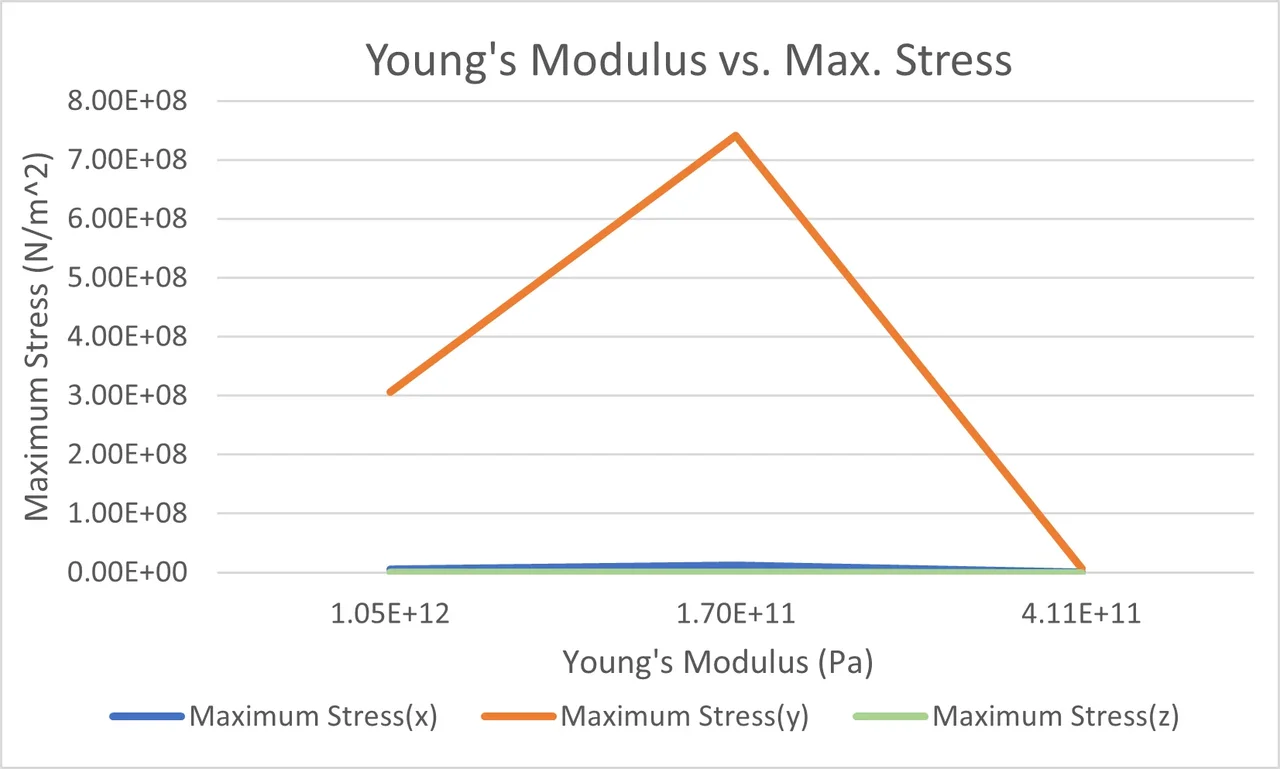 Different materials have different Young’s Modulus values. You can see how different Young’s Modulus values have varying amounts of stress they can withstand.Copyright Olivia Becker
Engineering Design Challenge
- Introduce the engineering design challenge to the students, telling them that they are going to use the engineering design process to prototype a device that will allow them to apply pressure at the same angle every time for each material.
- Emphasize that the challenge requires balancing competing needs such as strength, flexibility, and cost-effectiveness.
- Review the engineering design process.
- Have students complete the first four steps of the engineering design process, Ask, Research, Imagine and Plan, in the worksheet.
- Before dismissing the class, make sure student groups have a plans for which household materials they will bring in for the next class period.
Part 3 (50 minutes)
Engineering Design Challenge (continued)
- Have students get in their groups, gather their materials, and get their Arduino setup like they did during the previous day.
- After setup, have students use their household materials to build their device.
- After building their prototype, have students test their device by repeating their measurements on each materials, as done in Part 2.
- Have students apply pressure to each material for 15 seconds to measure the force. (Note: What should change is that the angle should be more steady.)
- Have students complete the table in Part 3 of the worksheet, calculating the average rate of change on different time intervals.
- Repeat this with each material (this should go faster since they have already done it).
- Have students answer Improve and Reflection questions.
- Once students finish, revisit the original challenge and reflect on how the engineering design process helped solve the problem.
- If some students finish before others, have them sketch out improvements they would make to their design.
- Before the end of class, regroup as a whole class and have students share their design and findings (this could happen the next day if needed).
- young’s modulus
- A measure of elasticity, equal to the ratio of the stress acting on a substance to the strain produced.
- average rate of change
- The ratio at which one quantity is changing with respect to another quantity’s change; i.e., change of the dependent variable over change in the independent variable.
- arduino
- An open-source electronics platform that includes hardware and software for building devices that interact with the real world.
Pre-Activity Assessment
Brainstorming: In small groups, have students engage in open discussion. Have students come up with as many materials they see in the classroom as they can. You can start with a minute, but extend the time if you notice groups are still coming up with ideas. Then, share the ideas as a whole class and write the materials on the board.
Quick Poll: Ask the class a question and tally their responses on the board. Ask: Which material do you think would be the best to make a new student desk with?
(You can tailor this question to the interests of your students.)
Activity Embedded (Formative) Assessment
Part 1: Students research and document the Young’s Modulus for various materials, demonstrating their understanding of stiffness and flexibility. As students are researching the Young’s Modulus, ask them what types of patterns they’re seeing.
Part 2: Have each group show you their worksheet and how they are finding the average rate of change. Ask probing questions such as:
- Do your answers make sense in the context of the situation?
- How would you explain it to someone who wasn’t doing this activity?
Each group should show you their prototype design before the end of class. Based on their structure and explanation, you will know if they got the premise of creating a constant angle of force or not. If not, still have them reason through their design. They may find a bump in the road later on, where maybe their Part 3 results weren’t as constant.
Part 3: Look at students' worksheets as they go and see whether they have more constant average rate of changes for materials, and whether it makes sense with the structure they have created. Ask probing questions such as, “Why do you think this is different than before?”
Post-Activity (Summative) Assessment
Students will reflect on how their structures worked, and what they could change in the future, and why. Then, they will apply these findings back to the pre-assessment discussion of redesigning the student desks. These discussions will start in groups, and then everyone will come together as a class.
Troubleshoot with the Arduino Setup FAQ Sheet (PDF).
For lower grades or less advanced students, you can reduce the number of materials tested, simplify the Arduino and sensor setup, and shorten the time for data collection.
For upper grades or more advanced students, you can increase the complexity of the materials studied, introduce more advanced data analysis, and encourage deeper research.
Contributors
Olivia Becker; Dr. Wen Li; Zebin Jiang; Matt Jourden
Supporting Program
Research Experience for Teachers (RET), Engineering Department, Michigan State University
Acknowledgements
This curriculum was developed through the Michigan State University College of Engineering NSF RET program under grant number CNS-1854985 under National Science Foundation. However, these contents do not necessarily represent the policies of the NSF, and you should not assume endorsement by the federal government.
Copyright
2025 by Regents of the University of Colorado; original © 2024 Michigan State University