
Detecting Flaws With Sound: Exploring Non-Destructive Evaluation (NRE) Techniques
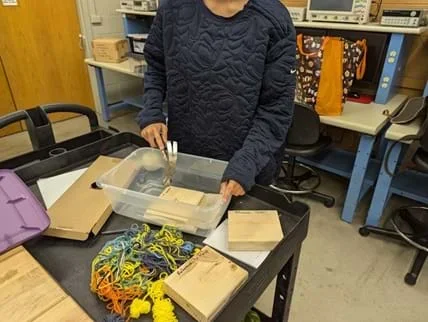 A student testing the vibration dampening capability of a plastic bin, with other possible materials at the workstation.Copyright Photograph by Orion Smith, taken 07/15/2024. No rights reserved; Orion Smith releases this image to the public domain.
Students engage in a hands-on exploration of non-destructive evaluation (NDE) through tap testing and sound analysis, using hammers to tap wooden blocks with and without hidden flaws while listening to the sounds produced. Initially, they rely on their hearing to identify differences, and then they progress to digitally recording the tap sounds and applying Fourier transforms to analyze the frequency distribution. To enhance the quality of their recordings, they design and test noise-dampening solutions. The activity is guided by the engineering design process, emphasizing iterative design, experimentation, and critical thinking to help students deepen their understanding of NDE in practical applications.
The scientific principles of sound wave propagation and frequency analysis are closely linked to real-world engineering applications in non-destructive evaluation (NDE). Engineers use similar techniques to detect hidden flaws in materials, ensuring the safety and reliability of structures and components. In practical applications, ultrasonic methods are commonly employed, utilizing high-frequency sound waves to inspect the interior of materials and reveal internal defects that may not be visible on the surface. Engineers apply these techniques to maintain the integrity of critical infrastructure such as bridges, aircraft, and pipelines, preventing failures and ensuring public safety through continuous monitoring and assessment.
After this activity, students should be able to:
- Describe how sound waves can be used to detect hidden flaws in materials.
- Utilize the engineering design process to improve sound recording quality.
- Analyze sound recordings using a Fourier transform to identify frequency distributions indicative of material flaws.
- CCSS.Math.Content.HSN-Q.A.3 Choose a level of accuracy appropriate to limitations on measurement when reporting quantities.
Grades 9-12
Do you agree with this alignment?
- HS-ETS1-4 Use a computer simulation to model the impact of proposed solutions to a complex real-world problem with numerous criteria and constraints on interactions within and between systems relevant to the problem.
Grades 9-12
This resource focuses on the following Three Dimensional Learning aspects of NGSS:
Science & Engineering Practices- Use mathematical models and/or computer simulations to predict the effects of a design solution on systems and/or the interactions between systems.Do you agree with this alignment?
Disciplinary Core Ideas- Both physical models and computers can be used in various ways to aid in the engineering design process. Computers are useful for a variety of purposes, such as running simulations to test different ways of solving a problem or to see which one is most efficient or economical; and in making a persuasive presentation to a client about how a given design will meet his or her needs.Do you agree with this alignment?
Crosscutting Concepts- Models (e.g., physical, mathematical, computer models) can be used to simulate systems and interactions—including energy, matter, and information flows—within and between systems at different scales.Do you agree with this alignment?
Do you agree with this alignment? - Use mathematical models and/or computer simulations to predict the effects of a design solution on systems and/or the interactions between systems.
- HS-PS4-1 Use mathematical representations to support a claim regarding relationships among the frequency, wavelength, and speed of waves traveling in various media.
Grades 9-12
This resource focuses on the following Three Dimensional Learning aspects of NGSS:
Science & Engineering Practices- Use mathematical representations of phenomena or design solutions to describe and/or support claims and/or explanations.Do you agree with this alignment?
Disciplinary Core Ideas- The wavelength and frequency of a wave are related to one another by the speed of travel of the wave, which depends on the type of wave and the medium through which it is passing.Do you agree with this alignment?
Crosscutting Concepts- Empirical evidence is required to differentiate between cause and correlation and make claims about specific causes and effects.Do you agree with this alignment?
Do you agree with this alignment? - Use mathematical representations of phenomena or design solutions to describe and/or support claims and/or explanations.
Each student needs:
- 2 copies of the Pre/Post Assessment (PDF)
Each group needs:
- Day 1 Worksheet (PDF) (1 worksheet per student group, or if desired, 1 per student).
- Day 2 Worksheet (PDF)(1 worksheet per student group, or if desired, 1 per student).
- Day 3 Worksheet (PDF)(1 worksheet per student group, or if desired, 1 per student).
- 1 wooden block without flaws
- 1 wooden block with a cylindrical center hole on the underside
- 1 wooden block with 4 cylindrical holes in “corner” locations on the underside
- several experimental wooden blocks with unknown flaws and/or flaw “locations” on the undersides
- 1 small hammer or mallet: teachers can easily purchase large sets of 20-30 claw hammers online at low cost
- 1 laptop or other digital device with a microphone
- noise-dampening materials (e.g., blankets, paper, foil, foam, cardboard)
- cardboard and twine for vibration-isolating devices
- scrap cardboard or dark paper to cover the bottom surfaces of the blocks
- tape or staples
- Python program for sound analysis (provided by the teacher)
For the entire class to share:
- reference blocks without flaws, and with known flaws in various locations
- reference recordings of blocks with and without known flaws
- 1 large-diameter Forstner bit
The lists below are suggestions of what students could use to build their designs. None of these engineering challenge materials is individually required, so you are encouraged to find whichever materials you have easy and free access to instead of purchasing design materials just for this activity.
Soft Materials for Cushioning
- cotton balls
- foam sheets or pieces
- felt sheets
- sponges
- bubble wrap
- packing peanuts
Flexible Materials for Wrapping and Binding
- rubber bands
- unfilled balloons
- twine or string
- pipe cleaners
- transparent tape
- masking tape
- duct tape
- VELCRO strips
Structural Materials for Support and Stability
- cardboard sheets or pieces
- empty plastic bins or boxes
- plastic cups
- small wooden blocks or sticks
- plastic or metal brackets
Noise-Dampening Materials
- blankets or towels
- fabric scraps
- carpet squares or samples
- cork sheets or pieces
- egg cartons
Miscellaneous Materials
- paper or plastic plates
- aluminum foil
- clothespins
- Popsicle sticks
- paper clips
- binder clips
- small foam or rubber balls
Additional Tools and Supplies
- scissors
- hot glue gun and glue sticks
- tape
- stapler and staples
- hole punch
- measuring tape or ruler
Students should have a basic understanding of sound waves, frequency, and amplitude. Familiarity with the engineering design process and basic data analysis is also helpful.
Imagine you're an engineer tasked with ensuring the safety of a bridge. As you walk across this structure, you trust that it will hold, that it won't collapse under the weight of traffic or the stress of time. But what if there were hidden flaws within the bridge's materials—flaws that aren't visible to the naked eye? These hidden defects could lead to catastrophic failures if left undetected. This is where non-destructive evaluation, or NDE, comes into play.
NDE techniques allow engineers to inspect and assess materials and structures without causing any damage. Today, we're going to explore one such method—tap testing. We'll use simple tools to detect flaws in wooden blocks by analyzing the sounds they produce when tapped. This hands-on activity will help us understand how engineers use sound waves to uncover hidden defects.
(Ask students: "Can anyone think of other situations where it might be important to detect hidden flaws in materials?") (Possible answers: airplane wings, car parts, pipelines, medical implants.) Exactly! Ensuring the integrity of these materials is crucial for safety and reliability.
Before we get started, let's talk about how sound travels through materials. When you tap an object, sound waves propagate through it. These waves can change depending on the material's properties and any flaws it might have. By listening carefully, we can detect differences in the sounds produced by materials with and without flaws. This is similar to how doctors use ultrasound to see inside the body without surgery.
(Ask students: "Have any of you seen or experienced ultrasound imaging, maybe during a doctor's visit?") (Possible answers: yes, for checking baby development, examining internal organs.) Ultrasound uses high-frequency sound waves to create images of the inside of the body. Engineers use similar techniques in NDE to inspect the internal structure of materials.
In today's activity, we'll start by tapping wooden blocks and listening to the sounds they make. Some of these blocks have hidden flaws—cylindrical holes drilled partway into them. We'll use our ears and some simple tools to try to detect these flaws. Then, we'll move on to a more advanced step: recording the sounds and analyzing them using a computer program.
This hands-on investigation will help us understand how engineers use sound waves to detect hidden defects. It's a bit like being a detective, uncovering clues that aren't immediately visible. As we work through this activity, think about how these skills and techniques are used in real-world engineering to keep us safe.
(Ask students: "Why do you think it's important for engineers to be able to detect hidden flaws without damaging the materials they're inspecting?") (Possible answers: to avoid weakening the structure, to save costs, to maintain safety.)
Let's get started with our tap testing. We'll begin by learning how to use the tools and materials, and then we'll dive into our investigation. By the end of this activity, you'll have a deeper understanding of how engineers ensure the safety and reliability of the structures we depend on every day.
Background
Non-destructive evaluation (NDE), also known as non-destructive testing (NDT), refers to a group of analysis techniques used to inspect and evaluate materials, components, or structures without causing any damage to them. The primary goal of NDE is to detect defects, inconsistencies, or imperfections in materials—such as cracks, corrosion, or other structural flaws—without affecting the usability or integrity of the object being tested.
NDE is commonly used in industries such as aerospace, manufacturing, construction, and civil engineering to ensure the safety and quality of products and infrastructure. It plays a vital role in quality control, maintenance, and safety inspections.
Common NDE Techniques
- Ultrasonic Testing (UT): Uses high-frequency sound waves to detect internal flaws or measure material thickness.
- Magnetic Particle Testing (MT): Detects surface and slightly subsurface discontinuities in ferromagnetic materials using magnetic fields and particles.
- Radiographic Testing (RT): Uses X-rays or gamma rays to view the internal structure of a component, similar to medical X-rays.
- Eddy Current Testing (ECT): Uses electromagnetic induction to detect surface or near-surface defects in conductive materials.
- Visual Inspection (VI): Involves direct visual examination, often enhanced with magnification or cameras.
- Liquid Penetrant Testing (LPT): Involves applying a liquid to the surface to reveal cracks or other surface defects after a developer is applied.
NDE helps reduce waste, prevent failures, and improve safety by allowing ongoing inspections throughout the life of a component or structure without having to dismantle or destroy it.
NDE techniques are crucial for ensuring the safety and reliability of materials and structures. One common NDE technique is tap testing, where sound waves are used to identify defects within an object. When an object is tapped, the sound waves that propagate through it can reveal information about its internal structure. Flaws, such as cracks or voids, alter the way sound waves travel, resulting in different sound patterns. This activity introduces students to the basics of NDE using tap testing and sound analysis, culminating in a digital recording and frequency analysis using a Fourier transform.
Before the Activity
- Make copies of the Pre/Post Assessment (PDF) (2 per student)
- Make copies of the Day 1 Worksheet (PDF) (1 worksheet per student group, or if desired, 1 per student).
- Make copies of the Day 2 Worksheet (PDF)(1 worksheet per student group, or if desired, 1 per student).
- Make copies of the Day 3 Worksheet (PDF) (1 worksheet per student group, or if desired, 1 per student).
- Gather all materials.
- Prepare the wooden blocks as follows:
- Cut lumber into uniform blocks (rectangular boxes due to actual beam dimensions)—2”x6” beams cut into 6” segments are recommended. Hardware stores will sometimes do this step for free, if you don’t have a power tool that allows you to do it yourself.
- Drill cylindrical holes into some of the blocks using a Forstner bit. Try to maintain a consistent hole depth; this activity focuses on the location of flaws more than on their size or depth in the material. There are many excellent ways to learn about how to use a Forstner bit; try searching YouTube for many instructional videos. You can either use a drill press, or a hand drill if you are careful.
- Drill holes either in the center or in one or more "corner" locations about halfway from the center to each corner (five total locations). See the image for an example with four corner holes drilled.
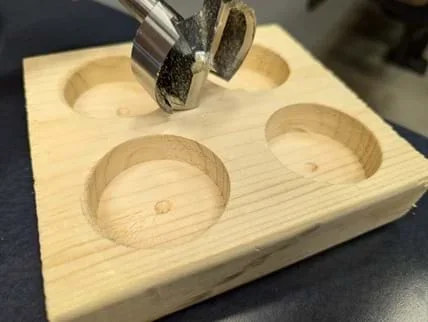 A Forstner bit resting on a 6”x2”x6” wooden block with four holes drilled in four quadrants of one surface.Copyright Photograph by Orion Smith, taken 07/20/2024. No rights reserved; Orion Smith releases this image to the public domain.
 - Ensure that no blocks have both center and corner holes, to prevent overlap.
- Mark the tops of the blocks with sample identifiers. It may be helpful to divide the blocks into sample sets of 3-6 blocks where, for example, sample set A has identifiers A1, A2, A3, and so on.
- Cover the bottom surfaces of the blocks with cardboard or dark paper and secure with tape or staples after recording where holes are for each sample identifier.
- Gather building materials for the Day 1 and Day 2 engineering challenges.
- Create and process reference sound files.
- Tap the reference blocks and record the sounds.
- Use the provided Python program to process these recordings and create labeled data files. You may choose to make these labeled files. Ensure that you know how you will access the sound analysis code, using Google Colab or another pathway. If using Google Colab, consider sharing a link to your version of the program with students on Day 3 so that they can make copies directly in the Google Colab environment.
During the Activity
Day 1: Analog Tap Testing and Vibration Dampening Design
Part 1: Introduction and Hook
- Hook Activity: Enhanced Material Lattice and Structural Weakness Demonstration
- Begin by having students form two parallel lines facing each other, about an arm's length apart. Explain that they will create a human "lattice" by making connections to up to three other students using their hands and feet. Each student should hold hands with two students from the opposite line and hook one foot around the foot of another student next to them. For students who may have physical difficulty making these connections, provide alternatives such as using soft ropes or bands to symbolize bonds. See Figure 1 for an example of how this lattice might be connected.
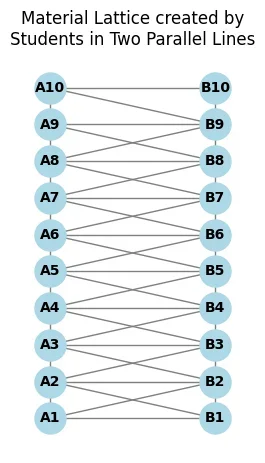 Figure 1. Material Lattice Created by Students in Two Parallel Lines.Copyright Created by Orion Smith using Python code in Google Colab. No rights reserved; Orion Smith releases this image to the public domain.
 - Once the lattice is formed, explain that this represents the interconnected structure of a material, where each connection symbolizes a bond between atoms or molecules. This complex network provides strength and stability to the material.
- Select a few students at random to "break" one of their connections, simulating flaws or defects within the material. Observe and discuss how the overall structure becomes less stable as more connections are broken. Emphasize that even a few flaws can significantly weaken the material's integrity. Relate this demonstration to the NDE techniques used by engineers to detect hidden flaws, setting the stage for the day's activity on tap testing and sound analysis.
- Begin by having students form two parallel lines facing each other, about an arm's length apart. Explain that they will create a human "lattice" by making connections to up to three other students using their hands and feet. Each student should hold hands with two students from the opposite line and hook one foot around the foot of another student next to them. For students who may have physical difficulty making these connections, provide alternatives such as using soft ropes or bands to symbolize bonds. See Figure 1 for an example of how this lattice might be connected.
Part 2: Tap Testing With Known and Experimental Blocks
- Pre-Assessment: Distribute the Pre/Post Assessment (PDF) to students and ask them to fill it out with no expectation that they know the answers yet.
- Ask and Research:
- Ask student groups to fill out the first two stages of the worksheet, corresponding to the “Ask” and “Research” phases of the engineering design process.
- Reference Blocks:
- Demonstrate tapping a “no flaws” reference block with a hammer, as well as the “four corners” reference block. Ask students to describe the differences they hear.
- Give each group a hammer and a set of reference blocks, or have them share the blocks with one other group.
- Set Up Vibration-Isolating Challenge:
- Show how tapping a block on a table produces a lot of sound related to the block's interface with the table.
- Demonstrate how sounds can vary, even when blocks are held in the hands, due to variations in hand-holding position and grip strength.
- Highlight the danger of hitting one's hand with a hammer.
- Design and Build Vibration-Isolating Devices:
- Explain the goal of designing a device to limit the sounds produced by the tap to the vibrations within the block itself.
- Provide access to materials (suggested options listed above); use a variety of materials to which you have easy access.
- Distribute the Day 1 Worksheet (PDF)(1 worksheet per student group, or if desired, 1 per student).
- Allow students to brainstorm and build their vibration-isolating devices, filling out the worksheet as they proceed.
- Optionally, students may create two dampening devices to aid in hearing the sounds of two blocks side by side when each is tapped.A student testing the vibration dampening capability of a plastic bin, with other possible materials at the workstation.Copyright Photograph by Orion Smith, taken 07/15/2024. No rights reserved; Orion Smith releases this image to the public domain.
- Tap Testing With Known Blocks:
- Have students first test their devices with known blocks. Ask them to have one listener try to hear sounds with their eyes closed, while another student taps the block with a hammer, and then guess the number/location of flaws based on the sound.
- Tap Testing With Experimental Blocks:
- Distribute experimental blocks labeled with names like "A1," "A2," "B1," "B2," etc.
- Have students use their vibration-isolating devices to tap these blocks and compare the sounds to the reference blocks.
- Have student groups fill out the last page of the Day 1 Worksheet (PDF), drawing where holes are (or are not) on the underside of experimental blocks.
- Encourage students to tap in the same place on both blocks to limit one source of variation. Alternatively, students can experiment with tapping multiple locations on a single block.
- Present Findings:
- Have students present their findings by sharing their vibration-dampening devices, data-collection and decision strategies, and what they found challenging about the activity.
- Facilitate a group discussion to compare different approaches and results.
- Conclusion of Day 1:
- Reveal ground-truth labels and ask students to compare their predictions with the results.
- Explain that on Day 2, students will make digital recordings and complete another engineering design challenge.
Day 2: Digital Recording and Noise-Isolating Environment Design
Part 1: Introduction to Digital Recording
- Recap Day 1:
- Begin by reviewing the findings from the previous day. Discuss the importance of NDE and how students used their ears and vibration-isolating devices to detect sound differences in the blocks.
- Gather quick feedback from students:
- Who was successful in detecting sound differences?
- What challenges did you face?
- What did you learn from designing, creating, and using your prototypes?
- Introduce Digital Recording:
- Explain that today, the students will use digital tools to record tap sounds.
- Tell students they will make a simple .wav file audio recording on their computers. This could be their voices or arbitrary sounds. Ask students to play their recordings back to verify they work, and to practice saving recording files with specific names and finding the saved files.
- Teacher Advice: Many operating systems have built-in audio recording tools. On Chromebooks, websites such as Online Voice Recorder can be used to record an audio clip and save it to the student's device.
- Ask all student groups to make a recording of the same event from various locations in the classroom. The event can be a loud sentence spoken by you, a short song, or even a well-known sound played over computer speakers. Ask students to compare their recordings of the same sound, to expose some example sources of variability in the different recordings.
- Distribute the Day 2 Worksheet (PDF), 1 worksheet per student group, or if desired, 1 per student.
- Inform students that their Day 2 challenge is the design and creation of a noise-isolating environment in which they will make a set of digital tap recordings of known and unknown blocks.
Part 2: Digital Recording and Frequency Analysis
- Recording Setup:
- Guide students to set up their recording environments using the noise-dampening materials provided (e.g., cotton balls, rubber bands, unfilled balloons, transparent tape, masking tape, large empty plastic bins or boxes).
- Ensure that each group has access to a laptop or digital device with a microphone that is capable of creating .wav audio files.
- Initial Recording:
- Have students make initial recordings of the tap sounds using their noise-isolating environments. Students may also use their noise-dampening devices from Day 1 if desired, though their opinions on their Day 1 devices may have changed and they may wish to alter their experimental setup further.
- Encourage students to listen to their recordings and identify any background noises. Discuss the importance of limiting background noise for clearer recordings.
- Noise-Dampening Design Challenge:
- Explain the impact of background noise on recordings and the need for effective noise-isolating setups.
- Allow students to refine their noise-isolating environments based on initial recordings.
- Encourage iteration and improvements to achieve clearer recordings.
- Discuss proper file-naming conventions.
- Experimental Block Recording:
- Have students move to recording tap sounds on the experimental blocks while utilizing their noise-isolating environments.
- If students are using lab computers, have them store their recordings in a way that preserves access for Day 3, such as cloud storage or a flash drive.
- Present and Compare Results:
- Have students present their designs, including the effectiveness of their noise-isolating environments.
- Reflection:
- Tell students that the ground truth for the digitally recorded samples will be revealed at the end of Day 3, when they have had a chance to analyze these recordings digitally.
Day 3: Digital Signal Processing and Analysis
- Introduction to Digital Signal Processing:
- Recap Day 2: Review the findings from Day 2, focusing on the noise-isolating environments and the quality of recordings.
- Introduction to FFT: Explain the Fast Fourier Transform (FFT) and its importance in converting time-domain signals to frequency-domain signals. Discuss how frequency analysis helps in identifying flaws in materials. If desired, connect students with resources about the workings of the Fourier transform and its applications.
- Introduction to Google Colaboratory (Google Colab): https://colab.research.google.com
- Google Colab is a free, cloud-based platform that allows students to write and execute Python code in a Jupyter notebook environment.
- Google Colab requires that users sign in with a Google account. Although personal Google accounts work seamlessly with Google Colab, school-based accounts may need to be authorized to access the Google Colab resource from within the district’s administrative control panel for Google services.
- For more information about Google Colab, see the Jupyter Notebook Teachers Guide in the activity Studying Brain Waves on the TeachEngineering.org website.
- The interactive Jupyter notebook for this activity was created in the free Google Colab environment. If your students can access Google Colab with student Google accounts, have them upload the Jupyter notebook file provided to them, or share a copy of it that you have hosted yourself on Google Colab and ask students to make their own copies on their own accounts. If your district does not authorize students to use Google Colab, find and ensure the setup of either a different Jupyter notebook environment, or a pure Python environment with the appropriate Pure Python (PY) attached file.
- Practice connecting to a compute runtime environment (does not have to be a GPU-enabled environment in Google Colab) and uploading .wav audio files to the environment’s root directory.
- Distribute the Day 3 Worksheet (PDF), 1 worksheet per student group, or if desired, 1 per student.
- Using the Python Program:
- Environment Preparation: Ensure that all required Python libraries are installed and ready for use in Google Colab or another environment.
- Loading and Running the Notebook: Have students load the Jupyter notebook and upload their .wav files. Have them run the provided code cells to process their recordings.
- Interactive Frequency Generation Tool: Allow students to experiment with the frequency generation tool. Have students adjust the sliders to blend up to three different frequencies and observe the resulting waveforms.
- Reflection: Have students use blank 5 ms time-amplitude graphs to replicate 1-frequency, 2-frequency, and 3-frequency plots generated by the code.
- FFT Analysis: Have students use the Python program to perform FFT on their recordings, and then analyze the frequency distributions and compare the results with their reference data.
- Present and Compare Results:
- Present Findings: Have students present their findings, including the effectiveness of their noise-isolating environments on their digital recordings, and the results of their frequency analysis.
- Compare Results: Reveal the ground truth of blocks tested on Day 2, so students can check the effectiveness of their digital analyses. Have students compare their digital analysis results with their human analysis results from Day 1. Have them discuss any discrepancies and what they learned from using digital tools.
- Summative Assessment:
- Distribute the Pre/Post Assessment (PDF) and ask students to fill it out to complete the activity.
Teacher's Role and Pitfalls:
- Facilitate the discussion and guide students through the activity.
- Ensure that all students participate and understand the objectives.
- Assist students in setting up their recording environments and using the Python program.
- Address challenges such as background noise and encourage iterative improvements to the recording setups.
- non-destructive evaluation (nde)
- A range of techniques used to examine materials or structures without causing damage, often used to detect flaws or defects.
- sound wave propagation
- The movement of sound waves through a medium such as air, water, or solid materials, which can be used to detect internal flaws by analyzing the way the waves are altered.
- amplitude
- The height of a sound wave, which determines the loudness of the sound; higher amplitude means a louder sound.
- frequency
- The number of sound wave cycles that pass a point in one second, measured in Hertz (Hz); higher frequency means a higher-pitched sound.
- wavelength
- The distance between consecutive points of a sound wave, such as from peak to peak or trough to trough; wavelength is inversely related to frequency.
- the fast fourier transform (fft)
- A mathematical algorithm that converts a time-domain signal into its frequency components, allowing for analysis of the different frequencies present in the signal.
Pre-Activity Assessment
Pre-Assessment: Administer the Pre/Post Assessment (PDF), which contains five questions representing broad understandings from this activity, with opportunities for students to demonstrate higher proficiency with the techniques of sound-based NDE.
- What is NDE?
- Why is it important to detect hidden flaws in materials without causing damage?
- What features of sound differentiate materials with and without structural flaws?
- What external factors can affect the accuracy of sound analysis?
- How can the use of digital tools, such as Python programs, enhance the analysis of tap sounds compared to human hearing?
Activity Embedded (Formative) Assessment
- Day 1: Circulate and gauge student efforts at the ideation and design phases of the engineering design process. Provide commentary and feedback to students as they construct their noise-dampening devices.
- Day 2: Use student discussion of sources of recording variability to assess which students can describe different sources of variability. Also circulate during the engineering design process and evaluate students’ progress vs. Day 1—the design challenge is similar but not identical.
- Day 3: Ask students to describe the variation between 1-frequency, 2-frequency and 3-frequency time-amplitude signals (sound waves).
Post-Activity (Summative) Assessment
Post-Assessment: Re-administer the Pre/Post Assessment (PDF)to gauge student growth on core questions related to the activity.
- Handling Hammers and Wooden Blocks:
- Issue: Risk of injury from using hammers and handling wooden blocks.
- Safety Precaution: Ensure that students use hammers carefully and avoid striking their hands or fingers. Demonstrate proper hammering techniques and monitor students to ensure safe practices. Encourage students to wear safety gloves if available.
- Use of Sharp Tools:
- Issue: Risk of injury from using sharp tools (e.g., for preparing materials).
- Safety Precaution: Only you or another authorized adult should handle sharp tools such as the Forstner bit and power drills or a drill press. If students need to use sharp tools, provide close supervision and ensure they use the tools safely.
- Noise Levels:
- Issue: Potential hearing damage from loud noises during the tapping activity.
- Safety Precaution: Encourage students to tap the blocks at a moderate volume. If necessary, provide ear protection for students who are sensitive to loud noises.
- Allergies and Sensitivities:
- Issue: Allergic reactions to materials used in noise-dampening setups (e.g., certain types of foam or fabric).
- Safety Precaution: Be aware of any student allergies and choose materials that are safe for all students. Provide alternatives if needed.
- Electrical Safety:
- Issue: Risk of electrical hazards from using laptops and recording equipment.
- Safety Precaution: Ensure that all electrical equipment is in good working condition and used according to manufacturer instructions. Avoid using equipment near water or in damp conditions. Ensure that cables are properly managed to prevent tripping hazards.
- General Classroom Safety:
- Issue: Risk of tripping or falling due to materials and equipment scattered around the classroom.
- Safety Precaution: Keep the workspace organized, and ensure that materials and equipment are stored safely when not in use. Encourage students to be mindful of their surroundings and report any hazards to you immediately.
- Digital Analysis Problems:
- Issue: Errors in running the Python code.
- Solution: Ensure that all necessary libraries are installed. Check for typos or syntax errors in the code. Encourage students to carefully follow instructions and consult with peers or with you if issues persist.
- Issue: Inconsistent or unexpected results from the FFT analysis.
- Solution: Verify that the correct audio files are being used. Ensure that the recordings are of good quality and are properly normalized before analysis.
- File Management:
- Issue: Misnamed or misplaced files.
- Solution: Emphasize the importance of proper file-naming conventions. Provide clear examples and instructions for naming files. Regularly check that students are saving files in the correct locations.
- Equipment Malfunctions:
- Issue: Recording devices not functioning properly.
- Solution: Check the device settings and ensure that it is fully charged or plugged in. Have backup devices available if possible. If using external microphones, ensure that they are properly connected.
- Student Understanding:
- Issue: Students struggling to understand concepts or follow procedures.
- Solution: Provide additional explanations and examples. Use peer support by pairing students who understand the material with those who are struggling. Offer one-on-one assistance as needed.
For lower grades: Complete Day 1 only. Skip the pre-assessment and instead use a hook question and exit ticket as the pre and post assessments.
For more advanced students: Ask students to investigate the Python programming involved in the Google Colaboratory notebook.
Center for Nondestructive Evaluation at Iowa State University. “Nondestructive Testing and Evaluation (NDT&E) Education.” 2021, www.nde-ed.org/
Contributors
Orion Smith (computer science and technology teacher at East Lansing High School); Subal Sharma (graduate student in materials science in PUMA Lab at Michigan State University College of Engineering); Dr. Sunil Kishore Chakrapani (professor of Mechanical Engineering and Electrical/Computer Engineering at Michigan State University)
Supporting Program
Research Experience for Teachers (RET), Michigan State University College of Engineering, and the National Science Foundation.
Acknowledgements
This curriculum was developed through the Michigan State University College of Engineering NSF RET program under grant number CNS-1854985 under National Science Foundation. However, these contents do not necessarily represent the policies of the NSF, and you should not assume endorsement by the federal government.
Copyright
2024 by Regents of the University of Colorado; original © 2024 Michigan State University